The Hydraulic Dump Trailer (Part I)
September 2, 2013
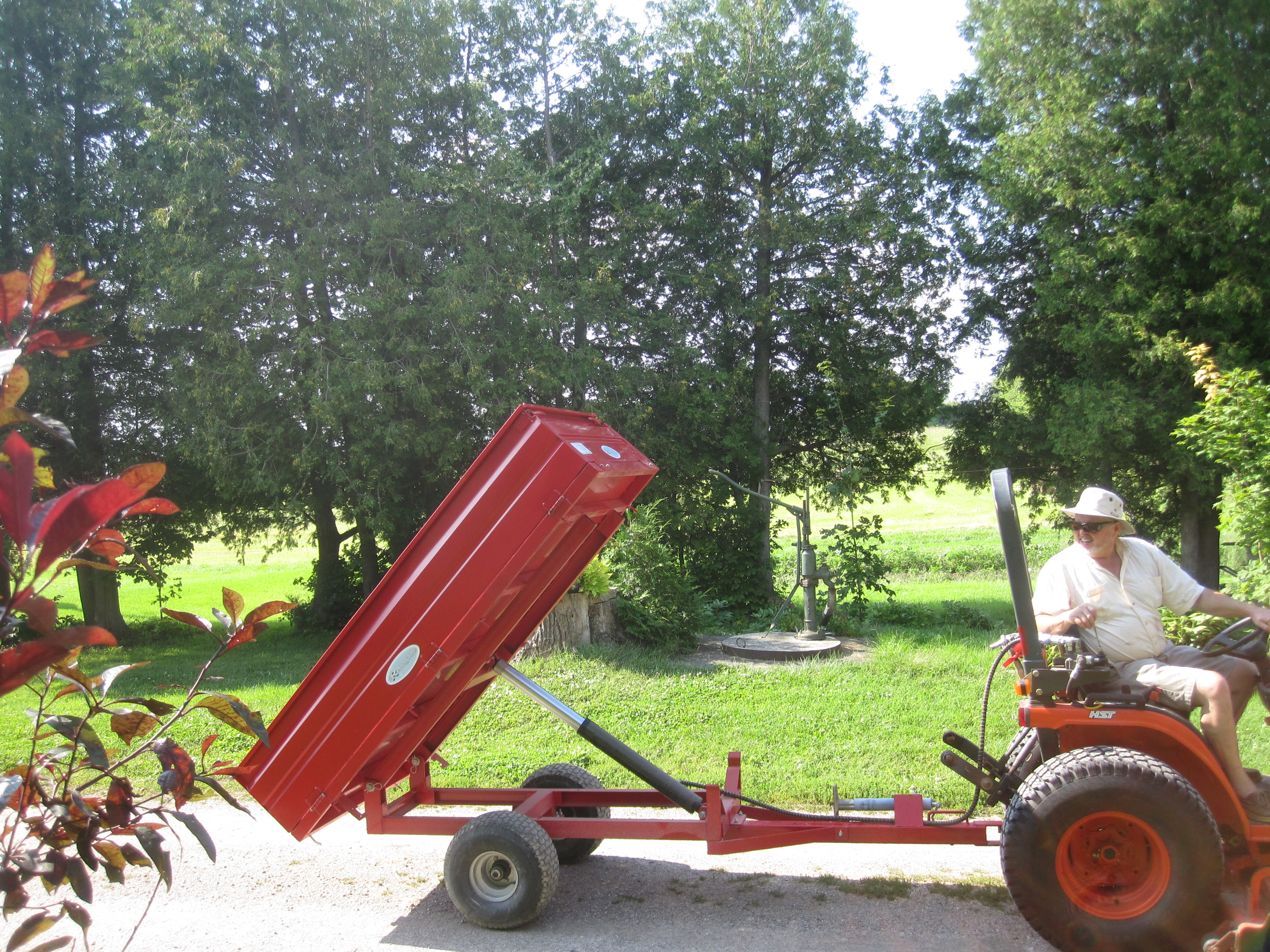
It looked too fragile to work, even in the Kijiji ad. I kept looking. But tipping trailers in North America are for the highway, to be towed by huge pickup trucks, cost a great deal of money, and take up too much space.
I needed a replacement for my trusty red 4X6 trailer which had served since 1995 as a mobile workshop, tool hauler, crushed stone and sand hauler, and so on. More times than I can count I took it through the scales at the quarry with upwards of 3400 pounds of payload. It was also narrow enough to back in the long alley at Martin’s house in Kingston, so it had the honour of emptying his backyard on several occasions after his year-long renovation.
Speaking of renovations, that’s why I wanted a trailer this time which could dump. Clotted shingles are a royal pain to unload from a trailer. There must be a better way (this side of hiring a contractor) than forking them out of a metal box.
It was a load of shingles which did Little Red in. The counter guy at Rideau Lumber turned out to be a fine salesman, and before I knew what had happened I had agreed to the purchase of 28 bundles of shingles, which the fork lift operator cheerfully plumped onto the trailer and slid the pallet neatly into position for the trip to Forfar. My tires were fine, but the axle broke on the first corner, plumb rusted through. Determined to prevent a traffic jam, I dragged the disabled trailer to a quiet spot, and then tried to get back to the Rideau Lumber yard with the right tire rubbing against the box to support the weight of the shingles. The tire and wheel gave up with a loud bang a block short of refuge. The Rideau Lumber boom truck responded to my call for help and loaded the shingles onto its commodious bed, and almost as an afterthought, my wounded trailer as well. Little Red made what turned out to be its first final trip home.
I couldn’t find a replacement for a heavy duty 4X6 trailer. They don’t seem to make them any more. So it sat there in the yard, scrap metal, until Princess Auto had a sale on axles, wheels and tires. $400 and a morning of work and Little Red was back from trailer heaven.
But all was not well. Red’s fenders were rusted through. The tail gate required a sledge hammer to open and close. A winter of neglect with a load of salted sand pretty well did the poor old trailer in. After a trip to the quarry last week I had to use a bar clamp to pull the sides together to enable the sledge hammer to do its work. Little Red was past its useful service life, suitable now only for lending to friends who didn’t check for running lights, or for storing scaffold.
So I revisited the dump-trailer ads. A beauty turned up on Kijiji for $3200., everything I could want in a dump trailer, and more. It was the “more” which gave me pause. My old Tacoma can only tow 3500 pounds, and this new trailer could easily haul twice that with its brakes. But a precious implement like this new one would need indoor storage, and that would mean seven feet of width in a 20′ wide building. I could put a boat or a sports car in that space. And the 4X6 is already too wide for some of the trails in the woodlot and the aisles among my 15,000 little trees. So the Hamilton hydraulic trailer would end up a highway vehicle, used about ten days per year.
Truth? I shuddered at the thought of two trips across Toronto in my stiffly-clutched truck. My last trip took an hour and 56 minutes in bumper-to-bumper traffic and I spent the last half terrified my clutch leg would give out before I could find a gravel shoulder. It’s possible to feel claustrophobia on an eight-lane freeway and I had no desire to repeat the experience.
Perhaps “Almost everything you always wanted in a trailer (in the Ottawa area)” would be a better approach. I called the flimsy trailer dealer again. He seemed confident in the product because he had sold a lot of them and his mechanic has one on his hobby farm. I asked him to explain why the hoist uses one hose only: where does the oil go on the return trip? His answer was basically, “It works. Come and look.” So I drove two hours north with the trailer we built for the Ranger attached.
The sides looked light and flimsy, but as the-mechanic-who-owns-one explained, “Look at the underside. It’s very strong.” He ran the hoist up to reveal the heavy metal underneath. Without trepidation I stepped onto the again-horizontal bed. “I haul 10′ logs out of the woods on it. I just take off the sides and the front and tie the logs on. It works fine behind my 60 hp tractor. I have also heaped it with sand and gravel. To dump gravel I disconnect the bottom of the tailgate so it works like a little dump truck and still supports the sides.”
Perhaps because I didn’t know how I would use the thing, I asked them to load it up, and home we went. Buyer’s remorse could come later.
 the Walnut Diary