Waxing the log ends
January 16, 2021
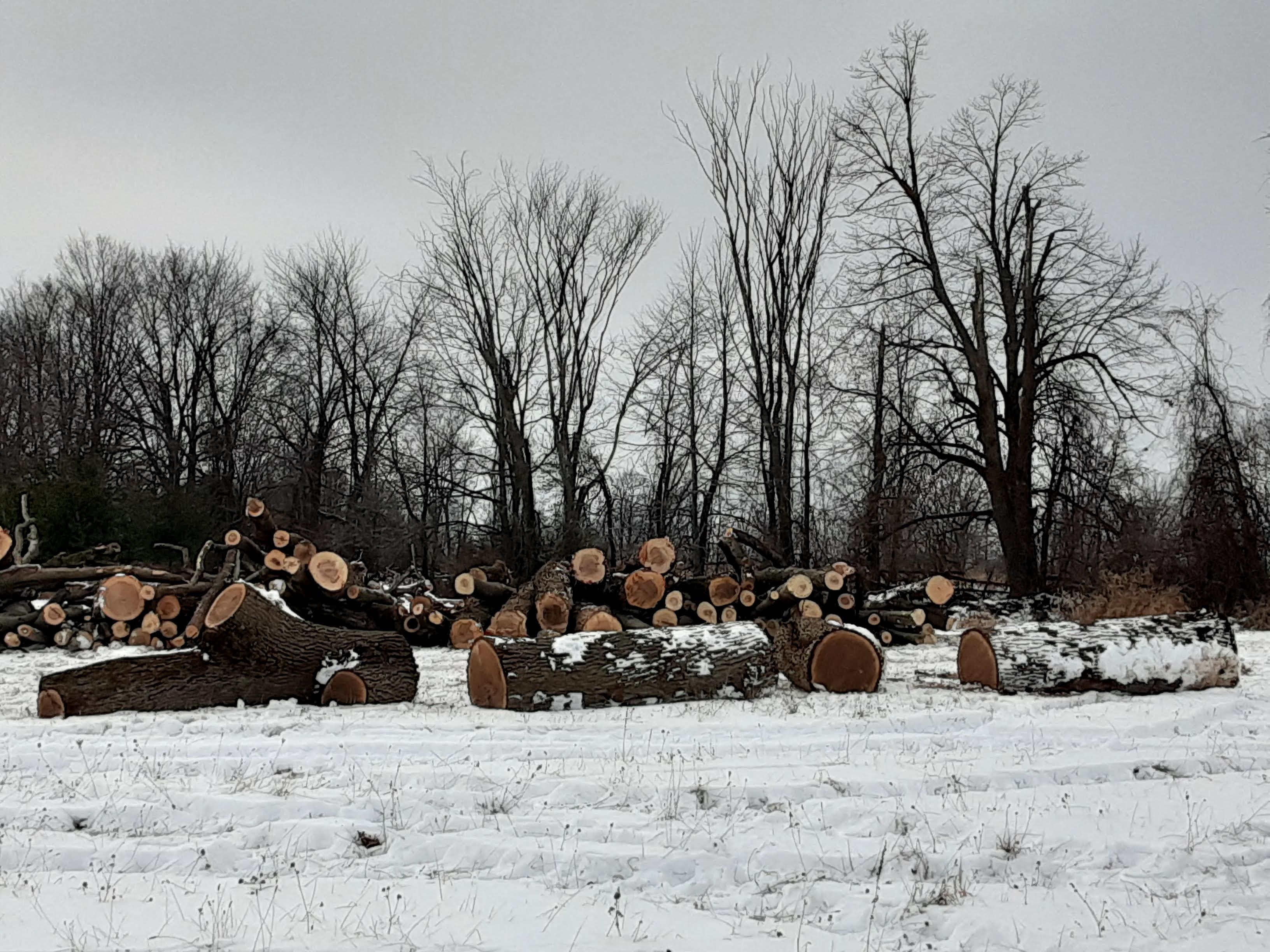
A logger from Kemptville, Greg Beech, has just finished cutting the American beech trees out of our woodlot on Young’s Hill. He skidded them out to the field facing the road, where Brian Raison, a firewood merchant from Athens, is in the process of cutting and splitting the logs into firewood for his customers.
Martin Streit, recently retired from the Ministry of Natural Resources, told me last year that the time to cut the beech was now, or else my woodlot would be overcome with dead stubs and scrubby beech crowding out the other growth. He marked a total of two beech trees which were not afflicted with the blight. Greg cut the rest, as well as the over-age maples which Martin also marked as part of a regular improvement cut of the managed forest.
While his skidder was on-site, I asked Greg to fell a substantial black walnut for me. As usual I ended up deciding that the thousand board feet of excellent furniture material from this tree would be better stacked in one of my garages than loaded onto a truck on its way off the property.
This meant that I had to seal the ends of the logs against sunlight and evaporation. A 24″ clear 8′ walnut log will lose 6″ on either end to checks unless the cut ends are sealed with wax. A mill owner at the west end of Lake Erie told me what product to order and how to apply it. He ships his best black walnut logs to Europe, and the limbs go along too, for use in flooring.
The shipment of the wax paint from Lee Valley tools was due yesterday, but it arrived after sunset, so I hoped for a window this morning where I could cover the ends of four large logs before heavy snow or a freeze-up put an end to paint application.
At daylight I had two diesel engines idling at the site: my little tractor turned the generator for the compressor which sat proudly in the box of the UTV amid a wide assortment of other tools and accessories. In fact I did use the compressor to blow snow off the log ends, but at that point I decided that a 3″ brush was the tool for the job. Bet had sent one along in case the paint sprayer didn’t work. In the uncertainty of a snow storm I figured a disposable brush was a better bet than an air-powered paint gun which might find the white goo too thick to spray, but would certainly need cleaning. The brush worked fine, dipped directly into the gallon of paint. I used a litre.
Now I can relax.
 the Walnut Diary