Fargo, Ontario 2017
December 17, 2017
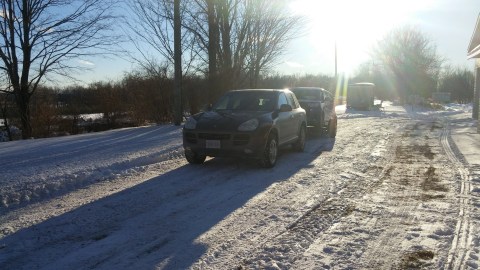
Remember the opening scene from the Coen Brothers’ movie? A beige 1987 Olds Cutlas appears through a whiteout with what appears to be another identical car reared up behind it. Turns out the clone rides on a U-Haul car dolly, and the camera reveals William H. Macy grimly fighting his way through a prairie storm to deliver it to a pair of hit men. It’s the stuff of legend for Coen buffs, if not for car lovers.
This morning I had scheduled myself to deliver Mom’s Scion to the Kingston Toyota dealership, so there I was on Hwy 15 amid the blowing salt dust as the sun came up, locked in a Hollywood fantasy. Couldn’t I have done better than William H. Macy? I squinted through Ruby’s frosted windshield and waited for my vision to clear.
Loading the Scion had proven quite easy. Though the dolly came without rental agreement or instructions, its operation seemed straightforward and my son Charlie was there to supervise. The only confusing part came when I tried to attach the safety chains which hold the car to the dolly. I couldn’t find any frame under a Scion onto which to hook anything.
A dozen or so U-Tube videos during the evening and early morning led me slowly to the realization that 1) the chains are essential; 2) they don’t have to be tight; and 3) just running each over its lower control arm and hooking back to itself will be fine. I finished tying them in place at 7:15, just before departure.
Some of those videos had flat-out scared me. Half of them portrayed accidents in waiting, so this one time I decided not to cut any corners.
Generally I am loathe to leave Ruby out of doors on a cold night lest her engine frost up and her lubrication fail. But the car and dolly were already attached, so the garage was out of the question, even during an Arctic clipper.
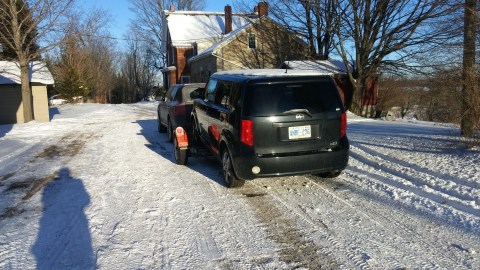
Ruby lit up at first touch, regardless of the extreme cold, but then took her sweet time at warming up. Nonetheless we descended the driveway, a trim towing package, and turned onto #15 to face the rising sun.
On the highway with a two-ton load the Cayenne’s V8 certainly does not lack power. Cruising at just under 2000 rpm in 6th gear, Ruby occasionally downshifted to 4th for steep hills, but the whole thing went smoothly. I was struck by how quiet and comfortable the towing experience was — nothing like the tooth-grinding battle the same load puts my Tacoma through. Yes, I soon had the cruise control engaged at 93 km.
After fifteen minutes I stopped for fuel, tightened the straps, and had largely recovered from the frostbite of that experience by the time we turned onto the 401. Ruby’s speed crept up to 110 km/hr without any sign of instability in the load or the tow vehicle.
We breezed through empty west-end intersections in record time. Chuckling at how clever I had been to make this run early on a Sunday morning to avoid the Christmas traffic, I found my entry blocked by security gates at every entrance to the Kingston Toyota lot.
OOOOPS! Hadn’t thought of that.
Surely the answering machine will have someone on call to open up. Ten minutes of phone tag during which I spoke to no human led me to realize that I had outwitted myself this time.
Across the street lay an almost-empty parking lot for a drugstore. We pulled in out of the growing traffic to unload. The chains came off the Scion’s control arms with a shake. Tire strap webbing was a little stiff in places, but the ratchet mechanisms worked as promised, with just a bit of brute force. By now the idling Scion was making progress on its windshield, so I lowered the ramps and prepared to back off the dolly.
Nothing happened but whining tires. Mom’s car was stuck on the dolly.
With visions of last night’s videos (jeep and mini-van belly-hung over twisted car dollies), we rocked ahead an inch, then reversed. More whirring of tires on steel. The Scion was without usable traction on small squares of slick metal between the thick angle irons fore and aft designed to hold the car in place. I left the idling car in neutral, set the parking brake (on the rear wheels), fired up Ruby and shot forward. On the third try, it worked. I looked back to see the bemused Scion sitting on all fours, with its right front wheel tentatively pressing down on a trailing tire strap, for security, I guess.
The drug store staff accommodated my request to park my charge overnight for the mechanics to collect, so I sealed up the envelope with a key and a hypochondriac’s list of ailments for diagnosis and repair as well as the air bag replacement, wrote the car’s number and location on the front, and marched it across to the service department. Every dealership has a hole in a door for car keys.
As I walked around the gate I didn’t notice. After I had dumped the key, on the return trip only, I realized that the gate which had barred my way was not locked. I had dropped the key through the dealer’s wall, but there was another Scion key in Ruby, so I fired up the patient, scurried through the gate, and parked it in slot 12, right in front of the key drop.
And away Ruby and I went, home by 11:00 with the entire business of the delivery completed. A first-gen Porsche Cayenne is built for this sort of errand. The hand warmers on the steering wheel and the butt-and-back heaters in the seats take on their full relevance after sessions on frozen ground stringing chains through another car’s undercarriage.
U-Haul Car Dolly rental: 1 day $59.68 CDN
Morning with my Cayenne doing something hard: difficult to say, but pretty good
Ruby’s air conditioning
October 25, 2017
Over the course of the summer it seemed that Ruby’s air conditioning system was becoming less vigorous. Then I rode in the passenger seat on a return from Kingston one warm afternoon. The passenger vent doesn’t work. I cooked. My wife is a lot more tolerant of the heat in a vehicle than I am.
For the rest of the summer we drove Bet’s Lexus to my many medical appointments. Its excellent climate control and electronically cooled front seats won out.
As I recovered from the heart operation I put my scattered thoughts to the problem. Leaving an elderly Porsche parked for weeks at a time wouldn’t do. I recalled that Ruby’s longtime mechanic had recharged the system in B.C. just before Charlie delivered it to the railroad yard in Vancouver back in July of 2016. I’d go to the local air conditioning shop and have it done again.
Google suggested Olgivie’s on Kilmarnok Island. I made an appointment and turned up to find a clean facility with a lot of expensive cars, high-end pickups, and heavy trucks around. The tech came out to listen to my request for a diagnosis, then returned with a printed statement that claimed one a.c. solenoid for the passenger side wasn’t working, but the cooling system works fine with less output on the right. I gave them the requested $100 and left, more impressed with the car wash than the diagnosis.
Air conditioning performance steadily decreased until I feared for the compressor if it ran out of lubricant.
The next closest shop is Pat’s Radiator in Kingston. After an initial talk with the counter guy I dropped Ruby off there for service between appointments at the hospital. They vacuumed the system and recharged it with oil and refrigerant. Because the tech could find no leak, he added a green dye and suggested I have a look after a week or two of driving. The counter guy told me small leaks often occur in this climate because of extremes of temperature and then can’t be located when it warms up. Out of the blue he commented: “You haven’t driven it very much, have you?” I think he was referring to Ruby’s mileage and condition in comparison to its year. Generally techs in Ontario don’t expect much of a car built in 2003, but Vancouver cars have it easy.
My $238 was well spent, as the a/c now seems to work quite well. No leaks are evident so far. I’d take Ruby back to “Pat’s” for other repairs.
UPDATE, 16 DECEMBER, 2017
I should mention that I did take Ruby back to Pat’s for a checkup of the coolant refill. A drop-in, I figured someone would take a quick look under the car and give me the nod and be done with it.
No. A tech put Ruby into the shop and I sat down for a half hour before he re-appeared. I approached the counter. He began to operate the bill machine. Out came the invoice, documenting the cooling system check, declaring that there were no leaks. Amount owing: $ 0.00.
Apparently it is important to document the inspections, and they figure the cost into the original invoice.
Ruby’s HVAC system continues to function well. Pat’s Radiators in Kingston, Ontario rates pretty high in my book.
UPDATE, Spring, 2018
Ruby’s air conditioning acted depleted as the days grew warmer, so I took it back to Pat’s for a top-up. This time a more senior tech made a determined search for the source of the leak. This involved the removal of the front bumper cover and an attempt to replace the condensor, only to find that there was no leak in this area. After a couple of visits to the shop, they charged me $360, topped up the system, and sent me on my way. By fall the only place I could find the green dye was at the filler nozzle. Maybe that’s where it leaks.
Driving Ruby on April Grease
March 24, 2017
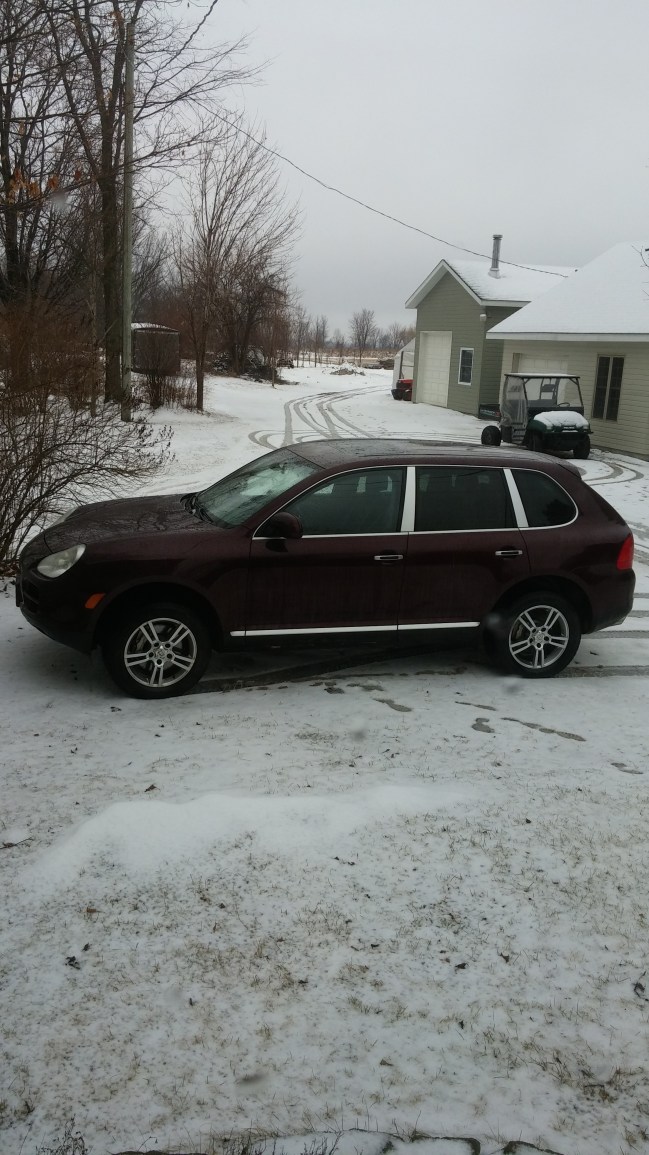
For years I have told anyone who would listen that the most hazardous driving conditions of the winter occur in April, when a quick fall of snow is saturated by rain at 32 degrees F. I even had a name for the phenomenon, April grease.
We drove into some on the way home from Merrickville today. I was mildly curious to see how Ruby would do on zero-traction slush, but primarily I was eager to get her home without damage.
The trip began bravely enough, with very little traffic on the back roads. The few winter- hardy drivers plowed along, their pickups in 4WD and loaded tanks of sap in the back.
As long as I was exactly in their wheel ruts, things were normal. But if the right wheels climbed a 1″ pile of slush, Ruby let me know with a stutter-step to the right, the same as any other car I’ve driven in this stuff.
On a side note: because of this slush I quit using a Volkswagen for winter commutes. A light FWD like our Jetta would lose control for as long as both front wheels were floating on slush — in passing situations, for example. I opted for a series of Volvo sedans, those of the skinny, tall Michelins. They were pretty good, though I managed the odd front-wheel skid with them, as well. When the new 4Runner came along I learned just to drive it in 4WD through thick and thin. It was very stable in the passing lane unless in 2WD, at which point it behaved like an annoyed pig on ice.
Back to Ruby and the unfamiliar April slush. As we passed Toledo things became greasier, though I noticed that most drivers were still holding a pace for dry pavement. Then one guy braked to turn. His SUV split-arsed a bit, but he recovered neatly and continued into a barn yard. Though well back, I tried my brakes on the tricky surface. To my surprise nothing happened for a bit. It wasn’t a skid — no machine gun rattle from various corners of the car — but rather it seemed that the brakes just weren’t working. Ice on the rotors, or all wheels with zero traction? Likely ice. I’ve noticed that before on Ruby. This never happens on a Lexus, but Toyota engineers didn’t have to worry about brake cooling on a sedan designed for geezers. Cayennes occasionally find themselves on a track, so the rotors are built to run very cold. 32 degree F slush, a whirling, shiny object and you have a perfect chance for ice to form.
So part of the routine for driving Ruby in near-freezing conditions is frequent touches of the brakes to defrost them.
Once they were dry, I over-applied the brakes as a test. The usual muted machine-guns went off, and the car slowed quickly, dead-straight. A basic safety line established, I experimented with the Goodyear winter tires and the grease. Frankly, I wasn’t all that impressed. The wheels are simply too wide for the weight of the vehicle on grease. The coarse off-road treads of my pickup would grip the asphalt better, I think. I slowed down to just a bit over 80 km/hr.
Why the critical attitude when I certainly should have been driving more slowly in bad conditions? In my wife’s Lexus, a pretty good slush car with a relatively high weight-to-tire width, I know how quickly I’m driving without a look at the speedometer. In Ruby, I really don’t know without instruments. Speed creeps up if I don’t use cruise control. Stealth speed is not what a driver needs in April grease.
Will I leave Ruby at home next time in bad conditions? Naw. I’ll just set the cruise at 80 km and go for it. It’s still by far the best, safest car we’ve ever driven. I just need to adjust the control nut behind the wheel.
And now that I think of it, on one memorable 5 a.m. drive to the Ottawa Airport on April 7th, I refused to drive my Volvo an inch further because I couldn’t keep it on the road. We went in our friend’s Dodge Mini-Van with AWD. It drove like a motorized living room, but it didn’t slide around on grease.
Ruby and the Chaffey’s Locks Road
January 11, 2017
Those who have driven the Chaffey’s Locks Road from Perth Road to Hwy 15 over the years don’t need any convincing that it is one of the best scenic drives in Eastern Ontario. Regular improvements have turned the rough cottage track into a fine hard surface through the original twists and climbs around Upper Rock and Opinicon Lakes in this section of the Canadian Shield. The wider eastern stretch from Chaffey’s Locks to Hwy 15 also received a superb paving job two summers ago.
Of course the county fathers clapped a 40 km speed limit on the whole thing lest there be a Miata wrapped around every tree. The many bicyclists in summer no doubt appreciate this.
After an errand in Kingston on a snowy morning last week I came home by Perth Road, but then turned toward Chaffey’s, partly to escape the deluge of salt and sand on the more heavily-travelled route to Westport.
Ruby discovered twenty miles of packed snow with a light dusting of sand down the middle. This could be interesting. At 5380 pounds empty, the Porsche Cayenne plants its winter tires quite firmly on the surface below, so I expected a smooth and controlled drive around the many dips and turns.
But I hadn’t taken the traction control into account. After a while I began to wonder why the car felt so rooted to the road, so I tried to induce a little bit of slippage on a sweeper around an open field.
No. Ruby just slowed down to a reasonable pace and continued on her way.
What?
I tried again when I found another good sightline. As soon as the computer detected any slippage, on came brakes in a couple of wheels and she resumed the correct line.
You mean I could drive this road without braking for turns? But that would be crazy! There are far too many blind spots for that.
So behave, you old coot!
And so I did. Ruby and her computer/nanny guided me on an amazingly smooth passage to Chaffey’s Locks. The ride was as serene as an illegal golf cart tour on a back road on a fine summer day. It offered about the same sensation of motion, but it wasn’t long until Ruby pulled up to the stop sign at Hwy 15.
We ducked across the sandy main road and followed a series of other snow-covered by-ways back to Young’s Hill. Only at the hairpin on an unused road around Forfar Station was I able to confuse Ruby. I guess German programmers didn’t anticipate a 25 mph hairpin turn on virgin snow over gravel. The left rear lost traction, all four brakes instantly burped that machine-gun rattle, and Ruby collected herself and proceeded at a resolute ten miles per hour regardless of my efforts on the throttle.
Two thoughts collided: I certainly wouldn’t want a teenager to learn to drive on this thing. If the computer ever failed with the bad habits it had engendered, he’d crash. But then I thought how great this car would be in the kind of slush on a crowded highway which turns light front-wheel drives into aquaplaning death traps.
There’s no doubt that a smart tank like Ruby is the right conveyance for my new grand-daughter.
Porsche Cayenne factory hitch a potential safety hazard
December 28, 2016
Today I ran into a case where Porsche over-engineering produced a potential safety hazard for the uninformed trailer user.
A Cayenne’s a logical choice to tow a 6X12 covered U-Haul trailer, but not until the rental’s safety chains receive an important modification. The hooks on the trailer I recently rented would not engage the rings on the factory trailer hitch because the steel is too thick to accommodate the triangular safety devices. Jamming the hooks into place wasn’t going to work, so I limped three miles to my shop from the rental depot by a back road. By then, one of the three chains had worked its way loose and was dragging.
I borrowed a pair of hooks from a robust trailer I built a few years ago. The photo shows them in place, pinned into links below the U-Haul hooks. I only had access to two hooks this time but from now on I’ll keep three which I can add on to safety chains to ensure that the robust hitch does not itself produce a hazard.
Update: 29 December, 2016
Grab the chain about 12″ from the hook, stick the CHAIN through the hole, loop the hook around the chain. This worked for me at UHaul.
Another RennList contributor used 3/8″ stainless steel quick-links to do the same job.
According to trailer veteran Tom Stutzman, Toyota has similarly robust hitch dimensions. Pennsylvania mandates simple S-hooks which fit easily. Ontario regulations require the problematic hooks.


Woodlot excursion
December 25, 2016
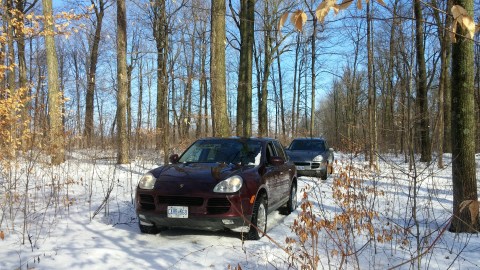
Over the years it has become a Christmas ritual to tour the woodlot by whatever means necessary. Ten years ago Charlie and Shiva began the tradition by bullying the golf cart into the trip through too much fluffy snow. When the Ranger replaced the golf cart, it hauled passengers and their snowshoes across the windy fields to the woodlot and froze them on the return trip.
This year Charlie started up both 2004 Cayennes to try out their low range and differential locks around the yard. Ruby was thus already cleaned off and warmed up when I grabbed my keys and tracked him down on the property. Then we toured the sugar bush.
We soon observed that it would take a good deal of snow to stop a Porsche Cayenne equipped with winter tires. I did manage to twist over an earth berm at such an angle that I needed to use the locker to maintain traction to the wheels, but Ruby felt right at home off-roading in snow.
The only problem is that puttering through the woods in a Porsche Cayenne isn’t much fun. It’s far too capable a vehicle. A golf cart or 2WD UTV, or even a snowmobile, provides much more of a challenge, and hence a higher fun quotient.
On the other hand Charlie is now a father and I’m not getting any younger, and we did break a good wide walking track through the bush.
Ruby visits Sweet’s Quarry.
December 15, 2016
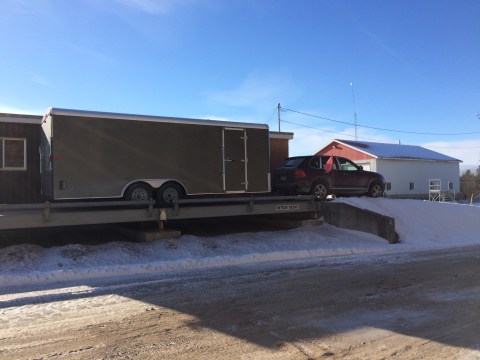
When Charlie tried to transfer his trailer’s registration from BC to Ontario, the clerk told him he was obliged to provide a weight for the vehicle. Email ensued.
Roads were good today so we unloaded the BMW track car, squiggled it over driveway ice and into the shop, cleared out the luggage in the trailer, and hit the road to the Sweet’s Corners quarry.
Ruby towed the 2950 lb trailer quite willingly, though in a headwind on the return trip the fuel consumption shot up to just over 17 litres per 100 km. (Interestingly, a few weeks later a 6X12 U-Haul tandem trailer exacted the same fuel penalty on a trip to Ottawa.)
An ongoing debate on Rennlist.com has dealt with whether a Cayenne is car, truck, or other. Up until this point my comments have favoured “car.” With this photo, though, I may be entering the “truck” tent.
The weigh-scales guy loved Ruby. This tag shows the gross weight of Ruby and the trailer at 3780 kg, or 3.78 metric tonnes, as the quarry guys prefer. That’s 8333.5 pounds to me.

Ulp. That means Ruby weighs 5383 pounds! And the fuel tank was nearly empty. The trailer weighed 2950 lb.
New CV boots for Ruby
December 2, 2016
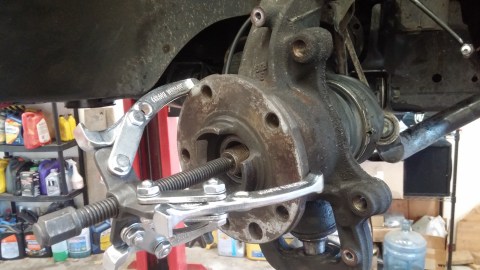
Background
When I switched to winter tires I was surprised to find a substantial deposit of grease inside the right front rim. The boot looked intact, but closer examination revealed a bit of cracking in one location, so axle disassembly seemed inevitable before I took the car on a sanded road.
The local auto parts supplier had access to the boots, but I had to resort to Amazon for a 32mm, 12 point impact socket for the axle bolt. Two days later the set of sockets appeared at the house, courtesy of Canada Post.
There are no videos explaining how to perform this unglamorous repair to a Cayenne. I found one cryptic explanation on RennTech.org by a man named Whippet who popped one in to fill a need. Perhaps I’ll post an addendum to fill in a few gaps where I was left bewildered.

Morning
I removed the right front half-shaft successfully in pursuit of the cracked boot. After a thorough bath in the parts washer, there wasn’t any apparent internal damage to the joints, but now I have to figure out how to pop off one end or the other prior to re-lubing both cv’s and adding boots. Major cleanup around the brakes is in order. Fun, but messy.
At the moment I’m stuck until I find instructions on how to disassemble the half-shaft. 
Early Afternoon
I had to search VW sites to gain insight into how the half-shafts come apart. Eventually I ran across a video where a guy separated one with a slide hammer, but he said that a flat board with a slot for the axle would work pretty well for removing the outer joint if you hit it sharply with a hammer, only his board broke. Mine didn’t until the part which goes through the brake rotor had come apart.
I’m beginning to believe that the trick to working on a Porsche is to use a heavy enough hammer. A light mallet had no effect on the axle, but a 20 ounce construction hammer’s effect was smooth and incremental. (Similarly, I have found an eight-pound sledge perfect for the disassembly of ball joints and wheel removal.)
The cleaning of the CV joints involved hosing down each in its turn in a stream of varsol over the parts washer. Not bad at all, though I’ll need to buy more solvent.
Then came the battle-of-the-day with after-market clamps which came for the boots. The two which fasten the narrow ends to the axle were perilously large for the job, but might work. The others were too small. After a long battle I managed to fit the outboard clamp (no other type of clamp will work in this position because of narrow clearances). The clamp next to the front differential was 1/4″ short, so after almost two hours of trying, I twisted on a 4″ plumbing clamp. There’s no shortage of clearance in there. I read somewhere that the pipe clamp’s a stronger alternative to the ubiquitous zip-tie on DIY boot-repair projects.
The Hint
A hint I read online eventually allowed the breakthrough on the outboard boot: a contributor recommended drilling a small hole 1/4″ ahead of the other holes on the boot clamp. He said this allows the use of needle-nose pliers to pull the clamp together enough for it to latch when other attempts are unsuccessful.
Surely enough, with the extra hole I was able to snug up the clamp enough that it would hold its place so that I could use the specialized crimping pliers purchased for the purpose. I guess it’s hard to visualize the benefit of drilling a hole in a pipe clamp, but smooth pieces of stainless steel offer very little to hang onto, especially when one attempts to install them over a neoprene enclosure bursting with grease.
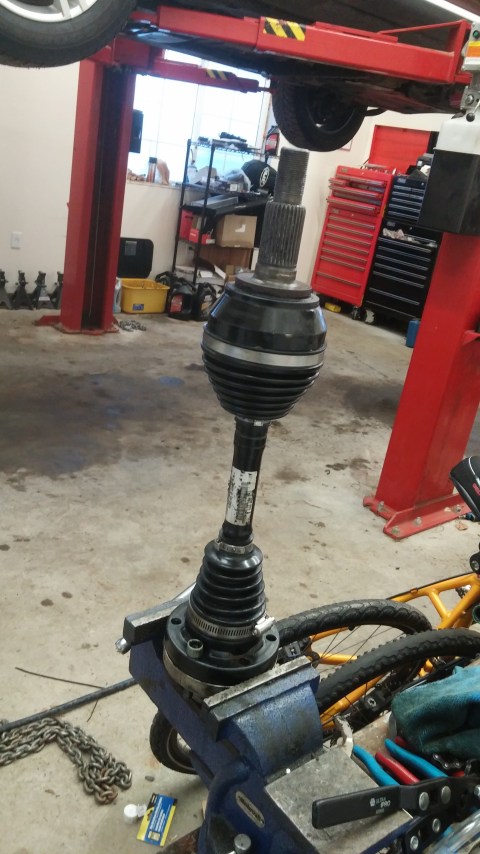
My day with the quarter-shaft was quite challenging. What vexes me more than anything is that I spent a day trying to salvage one of the only inexpensive parts on this car: rebuilt quarter shafts are very cheap on the gray market. On the other hand, my labour is free.
Monday, 5 December, 2016 5:54 a.m.
The axle went back into the car yesterday. Everything went surprisingly well until it came time to torque the six studs to the differential. I couldn’t keep the axle from turning, so I pressed Bet into service on the brake pedal. After I wore out both her legs pumping the dead pedal, we concluded that the brakes wouldn’t hold sufficiently for me to put 60 lbs of torque onto the studs, so brake bleeding moved up in the schedule.
Careful not to damage the brake line or electronic feed from the ABS, I had removed and stored the calliper early in the process. This left the line dripping brake fluid into a tray for two days. Now I can’t get the brakes to bleed, I assume because there’s an air lock in the system.
Charlie told me at various times he had dealt with dry brake lines on his 968 during an extensive rebuild, and it took a while to get the fluid to flow. His old bleeding pump applied pressure at Ruby’s fluid reservoir*, but to no effect. I’m nervous about online reports of broken pump lines spraying paint-destroying brake fluid all over everywhere, so I’ve been very tentative in my use of this unknown tool.
Ruby’s paint is still almost perfect.
Resetting of the two alignment-critical bolts and torquing of suspension and axle parts remains incomplete.
If anybody has any ideas on reviving brake fluid flow, please chip in.
*Number 1 rule: Make SURE you’re pouring the brake fluid into the correct reservoir. For the record, Pelican’s lavish shop tutorial photos are not always correct. In this case I beat myself up for six months about this blooper until my son found a Pelican diagram on Google which labeled the power steering reservoir “brake reservoir.”
3:30 p.m., Monday, 5 December
Brakes now work. Under a concealment panel I found the actual brake reservoir. No amount of positive air pressure on the power steering reservoir would bleed the brakes. So I siphoned nearly 1/2 litre of Motul DOT 4 brake fluid out of it. Then I refilled the reservoir with hydraulic oil (like it said on the reservoir, only for the Kubota). Shall drain and refill the power steering system asap. The unlabelled plastic tank was nearly empty when I opened it, expecting a brake reservoir, so I looked no further.
Bleeding the brakes was straightforward once I had located the right reservoir and put some brake fluid in it. To its credit, the car’s sensors quit complaining as soon as the brakes worked. Ruby didn’t hold my mistake against me.
When I told Bet she asked, “Are you going to tell Charlie?”
Now all I have to do is torque everything. The brake calipers are already at about 200 lb. The torque wrench clicked at 140. Then I added a 2’pipe to an old ratchet and tightened them up one lurch. The axle nut goes to 340, but I’ll use my tractor wrench with a 4′ cheater pipe and take it easy: for my rotary mower blades it calls for 540 foot pounds torque. Immediately after it’s tightened, the nut is too hot to touch.
I’ll have Bet hold the brake for the six axle screws which torque to 60 pounds. And so on. I’ll look up the suspension numbers. Then off for alignment again.
Ruby has visitors
November 13, 2016
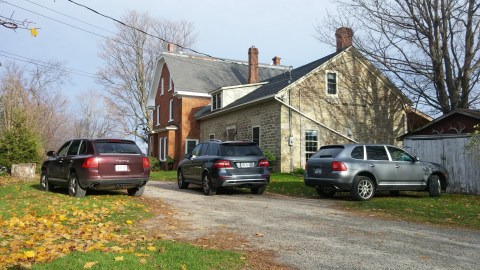
I posted this photo before my typing skills had returned, so I’ll tap a few notes three weeks later. Ruby’s visitors, a sister Cayenne S from Ottawa and a diesel Mercedes from Montreal (I dare not guess at the model number) were both purchased as tow vehicles for track expeditions.
Both track haulers fill the rest of their days transporting infant daughters, so their bullet-proof qualities rank high with the new fathers.
UPDATE: 16 DECEMBER, 2017
Whenever the three SUVs get together the drivers update repairs which have occurred over the last interval. A sensor for the Mercedes diesel system has needed attention twice since first writing, and the transmission needed extensive work to cure a leak. My son’s Cayenne needed a suspension part after an altercation with a curb hidden under snow, brake pads and front rotors, and a set of tires. Ruby had an A/C refrigerant top-up.
UPDATE: 2 FEBRUARY, 2019
The Mercedes was the first to go. The owner got fed up with expensive repairs to the diesel system and he traded it on a Range Rover for greater reliability. ?????? My son’s silver Cayenne S was replaced by a CPO 2015 BMW 528i with AWD and a turbo-4 for improved fuel efficiency in city traffic. It’s cleaned up and sitting in the yard, waiting for a spring private sale. Ruby’s fine.
Where does it hurt, Ruby?
October 5, 2016
Today I pulled out to pass a minivan and the car began to shake. I’d been expecting this. At 127,000 km Ruby’s overdue for Cardan shaft work, so I eased out of traffic and skulked home, avoiding accelerating on hills to lessen the strain on the drivetrain.
Up onto the hoist Ruby went. Off came the covering plate, and there was the carrier bearing, its rubber membrane cracked, but still in place.

Nonetheless, I set out with a knife to hack the thin rubber membrane away, then followed with an air-driven hone to polish the last of the rubber off the carrier bearing.
Unwilling to leave the bare metal to rust, I sprayed several coats of black shop paint in the general direction of the bearing case.
Then came the Jimi Fix. As claimed, it was a “twenty-minute” procedure to compress a series of cross sections of heater hose between the bearing and its frame and hold them in position with a latticework of zip ties. By the second hour of the twenty minutes Bet had warmed to the job and insisted that I lower Ruby on the hoist “another inch” so that she could finish the last three ties at the top of the bearing. (My left arm was out of commission at the time due to a couple of pinched nerves from several days under the steering wheel, fighting with A/C boxes in an impossible location.)
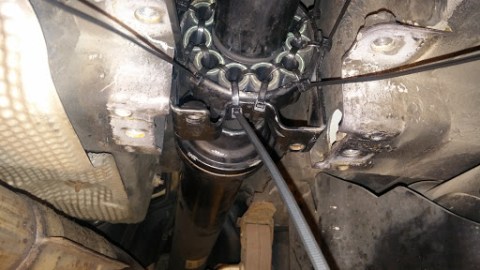
We cut off the ends and back on went the plate which hides everything, and Ruby seemed as good as new.
But when I started up, the “Check Engine” symbol popped. Ruby idled roughly as I backed out of the garage, then showed an ominous triangular warning, so back into her nest she went.
The meter showed Error Code P0307. Google told me that means a misfire on cylinder 7. Off came a panel covering the left hand coils, fuel injectors, and spark plugs. The various specialized screws and nuts weren’t about to stop me after the A/C actuator experience last week. Out came coil #7. Yep, a 2″ split right there on the side of the coil.
I ordered a set of eight from Amazon.ca, called it a night, and watched the Jays beat the Orioles with a three-run, walk-off home run in the bottom of the eleventh.
The rubber on the bearing support was brittle and cracked, though strictly speaking the Jimi Fix had been premature. Even though Ruby’s Cardan shaft had felt much sloppier than the new one on my son’s 04 Cayenne S, the bearing carrier had still been functional when I butchered it.
Update: 10 October, 2016
The coils arrived from Vancouver Island in four days. As soon as I slipped a new one into place, Ruby’s engine settled right down. Why the disproportionate reaction to a single mis-firing cylinder? Charlie explained that the unburned fuel alerts the O2 sensor, which then leans the whole bank of cylinders out to try to rectify the problem, so a single misfire affects four cylinders. That made sense.
BTW: Until that plastic cover removed to access the coils is properly screwed down, the engine seems alarmingly noisy. It’s likely fuel injector noise, but to my fevered imagination it just had to be the dreaded start-up death rattle of Cayenne V8’s. Once the cover was properly installed, Ruby purred once again.
Ruby has returned to normal duty. The drive shaft works fine, so I’d have to conclude that the Jimi fix seems a viable solution to a Cardan shaft problem, at least in the short term. Ruby now has 127,500 km on the odometer. I’ll report back on this periodically.
Update: 25 December, 2016
At 131,000 km Ruby’s Cardan shaft still performs perfectly. We tested it over the last couple of weeks with a 20′ enclosed car trailer in tow, and offroad in low range with the diff lock on. Not a whimper.
16 December, 2017: Still no problem with the drive shaft at some mileage north of 146,000 km.
31 December, 2016
On Rennlist.com the original contributor just posted the following update: Traded Cayenne S with Jimi fix away. Logged mileage with Jimi fix perfectly working was 44,632 miles. Yeah…
 the Walnut Diary