Woodlot excursion
December 25, 2016
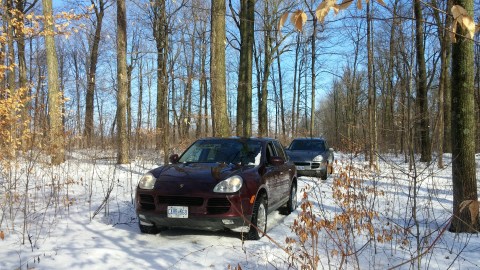
Over the years it has become a Christmas ritual to tour the woodlot by whatever means necessary. Ten years ago Charlie and Shiva began the tradition by bullying the golf cart into the trip through too much fluffy snow. When the Ranger replaced the golf cart, it hauled passengers and their snowshoes across the windy fields to the woodlot and froze them on the return trip.
This year Charlie started up both 2004 Cayennes to try out their low range and differential locks around the yard. Ruby was thus already cleaned off and warmed up when I grabbed my keys and tracked him down on the property. Then we toured the sugar bush.
We soon observed that it would take a good deal of snow to stop a Porsche Cayenne equipped with winter tires. I did manage to twist over an earth berm at such an angle that I needed to use the locker to maintain traction to the wheels, but Ruby felt right at home off-roading in snow.
The only problem is that puttering through the woods in a Porsche Cayenne isn’t much fun. It’s far too capable a vehicle. A golf cart or 2WD UTV, or even a snowmobile, provides much more of a challenge, and hence a higher fun quotient.
On the other hand Charlie is now a father and I’m not getting any younger, and we did break a good wide walking track through the bush.
A Subversive meme in Barney and Clyde
November 30, 2016
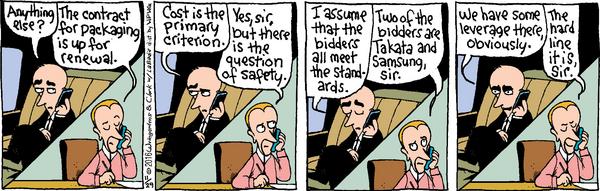
This Barney and Clyde strip appeared November 29, 2016. How it caused a few minutes’ anxiety for the service manager of a local Toyota dealership is a tale possibly worth recounting.
Barney and Clyde is one of my favourite Arcamax Publications online offerings. The strip often sends me to Google to track down obscure facts and theories I wouldn’t otherwise encounter.
In this strip I had a good idea that Samsung owns the notoriety associated with the exploding Galaxy 7 Smartphone, but I had to look up Takata.
The horror story of the 17 year-old girl bleeding to death from a shrapnel cut from a prematurely detonating air bag in a Honda Civic definitely caught my attention. Of course Google provided many references to track down the car models into which the potentially defective airbags had been installed.
On a US government site I ran through the family fleet. My models of Porsche, Lexus, and Toyota do not have Takata airbags. My mother’s 2008 Scion xB, a Florida purchase, was the only one which appeared on the list. I plugged in the VIN. Yep, it has the bad airbag.
Toyota/Lexus Canada is very good at maintaining contact with their owners, but this car came from a Florida auction to a local Honda dealer, and then was sold off his used car lot. I would need to register the car in Canada for the recall.
I called Kingston Toyota and spoke to the service manager. Impressive acceleration there. Over the course of a few halting sentences of dialogue while he no doubt searched his computer, he went from zero knowledge on the subject to enough information to at least sound competent and book the car for a recall a month later.
The only evidence that he was scrambling to get his feet under him was the question: “How did you hear about this?”
“It was in Barney and Clyde, a comic strip.”
Ten minutes later he called me back. Toyota has no plans yet for a recall, though that may change in the next few weeks. I responded that because I was essentially removing the family pool vehicle from service for a month, perhaps I should hold onto the appointment and confirm a day or two in advance of the date. He agreed that that would be a good strategy.
I asked how big a risk the exploding ignitor on the airbag presents to occupants of the car, and if it would be better simply to disable the device. He advised against that, but suggested that the car would be fine to drive in the interim as long as no one sits in the passenger seat. An empty seat disables the airbag.
So I left it.
Then I called my sister who has been using the car to ferry Mom around. She appeared uncharacteristically calm about my warning. She also knew considerably more about the Takata SNAFU than I did.
She owns a Honda Element. Her recall notification caught up with her last January at her winter residence in Florida. After many conversations with “a highly intelligent woman at the Honda hot-line over six months,” in early July her relieved Ottawa dealer gained access to an airbag and repaired her Honda Element. “The problem at that time was that half the airbags in the world needed to be replaced, all at the same time, and all from the same company. They were in short supply. Perhaps they have the shortage under control by now, a year later.” She further told me that she had simply shut off the airbag with the ignition key and gone about her business as usual. She saw no reason not to do the same with the Scion.
I guess you can get used to anything if you have a bit of time to adjust to it. That’s pretty much the central thesis of the Barney and Clyde comic strip, come to think of it.
UPDATE: 1 January, 2017
The December 29th recall appointment came and went. Toyota Canada still can’t provide the airbag. The service manager strongly suggested that I bring the Scion in for another recall on the master power window switch, though. I asked how the problem manifested itself. Apparently the master switch becomes sticky and some handymen spray it with penetrating oil, creating an alarming fire when the circuit is next closed in the presence of the volatile liquid. I suggested I’d keep the WD-40 away from window switches and would get both jobs done when they inform me that they have the air bag.
That’s when things got interesting. Seems I need to provide a recall letter from Scion USA, and they don’t have my address, so if I want things to proceed, I should call their 1-800 number and get on the list. Oh. I dialled, and on the third try spoke to a very helpful woman who carefully took down the VIN, my contact details, and again informed me that Toyota has no replacement air bags yet, but they’ll send me a letter when one becomes available. She further warned me about the window switch recall and we parted friends.
Bemused barks at the screen door
August 14, 2016
This morning our dog summoned her mistress with a series of bemused barks at the front screen door. Bet commented: “It wasn’t her intruding-car bark. She seemed to know it was you, but she didn’t understand what that yellow thing underneath you was.”
After considerable thought I had hopped onto one of the bikes in the garage and ridden it around the lawn, nearly falling off, twice. The forks of modern bikes don’t have as much caster as the old iron ones of the 1970’s. I’m sure of that. They steer harder too, I think. I soon learned that it would not steer itself, and that I would have to turn the handlebars, not just lean.
On the other hand a Bandit with disk brakes (I don’t know the language yet to describe the other features) has front shocks and many gears with toggles for shifting, rather like a Porsche. It’s light and taut and far too good a machine for my toe-dip into the maelstrom of physical fitness.
Gradually I became more confident with orbits of gravel and lawn, and glided down the long driveway with growing trepidation. Memories of wipeouts on fresh gravel flooded back to where I desperately wished I could shift my weight further aft, away from the front wheel. No chance on this bike. Then came the U-turn at the paved road: turn up the hill or down? I chose down, only to feel the front wheel start to slide on the sand washed onto the road by yesterday’s rain. I kept the bike upright, thereby losing the downhill apex of the turn and steering perilously close to the end of a culvert. The only way out was to track through a flower bed, but I stayed upright and the front shocks protected my arthritic wrists from vibration, so that was a win.
Then came the climb up the 500 feet to the house. With any other vehicle the slope is not significant, though it does help a 2WD tractor push a bucket of snow all the way down and across the road, regardless of traction. Backing up same hill in winter without tire chains on the tractor is out of the question. Still, it’s a gentle slope compared to that of Young’s Hill Road, which I’d have to master if I ever work up the nerve to leave the property on the bike.
Downshifts are effortless on the Bandit, even for the uninitiated. I tried to maintain a decent pace, because after all, it’s a very gentle slope. Legs quickly began to yelp, but I persevered, adding extra power with the balls of my feet. Feeling a bit gassed, I rode the bike back into the garage and dismounted without mishap.
Conscious of the precise location of every muscle the bike had used, I winced my way back to the recliner in the living room, the unfinished cup of coffee, and my computer.
By the end of the week I should be ready to tackle the hill.
UPDATE: 27 August, 2016
The following day I faced excruciating pain when I sat on the bike seat. Charlie had told me this would happen. It’s a high-tech woman’s seat, and the pressure points are all wrong for the male pelvis.
The new seat I bought at the bike store in Smiths Falls still felt very much like the head of an axe for a few days, but eventually the pain dulled, and by August 25th, I rode flat-out for 25 minutes in the rain and felt pretty good, actually.
I had given up on the hills. I own a truck. I found my bike rack hanging from the side of Tony’s shed in Newboro after I had loaned it to him about ten years ago. I bolted it to the hitch ball. So now my bike ride consists of flat runs on Hwy 42, the Cataraqui Trail, or the paved Forfar Road, with the Tacoma parked in my field at the corner.
Oiling the bike’s chain also increased the gears’ efficiency enough to let me cruise in eighth gear, top sprocket, on the flat. I still can’t look other cyclists in the eye because I have gone only a short distance while they have come from afar, but I can almost keep up to their pace, now, and the nurse yesterday said I have dropped 10 pounds.
Three days with a BIL-JAX 4527A #2 Articulating Lift
May 31, 2016
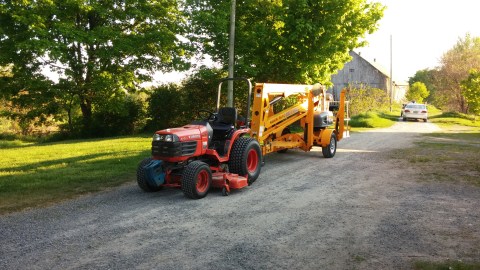
Without doubt the thing is the ultimate geezer gadget. With excellent surge brakes the two-ton hoist can be towed behind a small pickup (or positioned by a garden tractor, it turns out), it doesn’t have an hour meter, and recharges its batteries from a regular household extension cord.
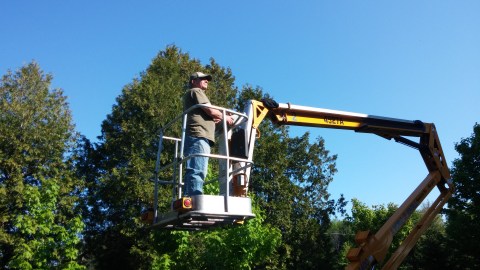
Les and I had our approved climbing harnesses on site, and we each tried them once in the basket, then chose not to use them.
It enabled Les and me to climb to unapproachable places on a Victorian house as easily as I did when I was 16, and it was no more terrifying than that wobbly extension ladder my boss assigned me that summer. The beauty of the thing was the 2.5X4′ cage which became our workplace for the Victoria Day weekend this year. It held paint tray, scrapers, nail gun, and whatever else we needed to repair and repaint the windows and soffits on this landmark building on Young’s Hill. Painting became truly a 3D proposition as long as I kept one hand free of paint to span pairs of buttons on the touch keyboard.
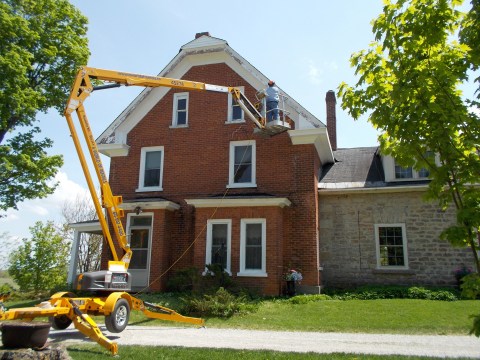
The 2013 model’s internal air hose obviously hadn’t seen any use for a while, so I just used a 100′ hose from my portable compressor on the ground. The electrical connection in the cage was fine. It also has an internal garden hose, if you need water far above the ground. It turned out that a compressed air nozzle was at least as effective as a hand scraper in freeing up the peeling paint on the fascia boards.
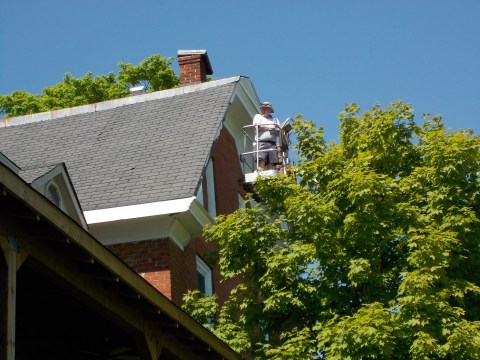
The photo above shows the hoist at almost its full extension: not enough to get onto the roof of this very high building on a side hill, but high enough to do the job. The unit had to be placed on a driveway well out from the wall and substantially below the level of the basement, about a 45′ lift, in total. It was best not to look down.

World of Rentals in Kingston apparently knows how to deal with customers like me as there were no additional insurance charges or other annoying surprises on the bill. The weekend special normally involves a one-day fee of $295 plus HST for the interval from Friday at 3:00 until Monday at 9:00. On the long weekend it became a 1 1/2 day charge. When I returned the unit at 8:00 Tuesday morning, I paid $500.03 CDN.
A car lift is a mixed blessing.
March 29, 2016
When our son Charlie planned a shop for his hobby, he insisted upon a 12′ ceiling to provide clearance for a car lift. He had worked on his Porsche for a couple of years on a gravel floor in a crowded plastic hut, freezing in winter and utterly baking in summer until I took pity on him and cut the end out of the edifice with an exacto knife.
We mutually agreed that he needed a separate shop for automotive pursuits. He insisted that no sawdust make its way into his clean area. My preference was for a space not filled with used brake rotors for my woodworking.
In any case, Charlie, Martin, and other volunteers popped the garage up in a surprisingly short period of time. Charlie learned drywall and taping, then he and Roz painted the interior to a high standard of quality.
The centrepiece of the shop was the asymmetric-arm, two-post auto lift. Charlie located a beauty weighing a bit over a ton. My trailer easily hauled it down the 401 and home, thereby saving $500 in shipping.
Les Parrott lent us a heavy drill, I bought a 3/4″ bit for it, and Charlie drilled the holes for the many 6″ lag bolts which anchor the massive posts. Then we attached the beam across the top, and Peter Myers came over to assemble the hydraulics.
If you don’t mind that the left post is almost an inch lower than the right, things went together very well. A narrow vehicle looks a little tilted to me when up at the top, but everyone has either had the decency not to mention it, or else hasn’t noticed the flaw. Everything else is admirably straight, plumb, and torqued.
There’s a manual to tell the operator where to place the arms and pads to lift each model of car and truck. Safety instructions call for one to make a vigorous attempt to shake the vehicle on the hoist before raising it above knee height.
It works well for cars, not badly for UTVs, and not at all for garden tractors, but that is covered in another story in this series entitled Why It’s a Bad Idea To Raise Your Kubota On a Car Lift.
To get on with the current tale, I need to recount that our 2005 Lexus has had an exemplary career mechanically, but this week it broke down. The power steering mechanism began to make a lot of noise. A check revealed that it was low on fluid. Up onto the hoist it went. Into the bowels of the beast I crawled with alacrity, armed only with a penlight battery on a long, flexible probe with an LED at the other end.
After a few minutes of searching I located the power steering pump. Its belt was snug and looked new, but the reservoir was almost empty. With a turkey baster I topped it up with ATF. On Internet discussion boards Dexxon Automatic Transmission Fluid is the unanimous choice for Toyota/Lexus power steering repairs. Then I went looking for leaks.
To make a tedious story shorter, I concluded that I needed a 42″ hose to carry high-pressure oil from the pump to the steering rack. RockAuto.com had it for $94. The Lexus dealer wanted $900 for the Lexus model, but suggested an after-market equivalent for $480.
I promise: the Lexus dealer comes out o.k. on this. Keep reading.
Grudgingly I agreed to the expensive hose and Brian Madeley ordered it for this morning. Derek prepared the car while Brian picked up the part from the nearby dealership. Derek didn’t think the wet spot I identified as the source of the leak was bad enough, so he kept looking, only to find a split metal tube on a low-pressure return line which he promptly repaired with a length of hose and a pair of clamps. Total bill: $250.
While it looks wonderful in the shop, the hoist is not the whole deal in auto repair. It takes experience to know when a blemish on a line is cosmetic and when it’s a broken part which needs to be replaced. Had I tried to do this job myself I would have ordered parts from RockAuto.com, an admittedly excellent parts source, but they would have had to make it across the border and couldn’t be returned if they turned out to be the wrong ones, or not needed. The car would have been out of service for at least a week.
For an evening I ranted freely at Lexus and Toyota for the outrageous price on their hose, but is it wrong to put a very high value on a part if it lasts the life of the vehicle and nobody ever needs to replace it?
What’s more, with the use of the hoist in this case I was able to make a prompt diagnosis of the problem and prevent further damage. My wife suggested having Brian do the repair regardless of the potential cost in order to get her car back into service quickly. In this case while its benefit proved far from clear-cut, the hoist offered more advantage than liability, a balance I’ll ponder while switching out the winter tires and admiring this tall, red icon of the do-it-yourself culture.
“They’re all garbage.”
January 25, 2016
Twelve years ago the deal my wife and I made was that we could leave the brick Edwardian on a corner lot in town and move to the stone cottage at the farm – if – Bet could have her dream kitchen.
So we renovated, putting in a couple of years of cheerful labour, designing the lower floor of the project so that the kitchen occupied the west half and the sink was in the centre of the room on a large slab of American beech with excellent views in all possible directions.
Over a winter I built red oak cabinets to cover every available wall. The appliances were the final touch. A fine stainless steel “commercial” range looked wonderful until the oven door fell off during delivery. It took two calls to Australia to locate a service man in Merrickville capable of working on the thing.
But it’s been great ever since.
The dealer wanted $2400. for a range hood to match the stove. I baulked and bought a matching high-capacity domestic model for $200. from a Kijiji ad. The hard part of the job was cutting a 7″ hole through 25″ of stone for the exhaust, but the ventilation system was well worth the effort.
The pride of the kitchen was the three-doored, stainless steel KitchenAid refrigerator. Getting the 36″, 360 pound monster through the low front door (since replaced) was a comedy of errors for the rather dim delivery guys, but once they had it set up we loved the thing, even when it started to rattle and the service tech from Brockville turned out to be a young woman who had me drag it out from the wall, tearing up the new varnish before she failed to find anything wrong with it.
Last night it died.
Today’s tech from Elgin surprised me by twisting a couple of bolts under the fridge and lo and behold, casters descended to roll it away from the wall. A few minutes later he told us the fridge is toast. The compressor is seized, and that part’s not really repairable as the fix involves a very tricky coolant transfer and nobody wants to do it outside a factory setting because of the high probability of failure.
“It’s only eight years old! How long do they last?”
“Seven to twelve years. The energy saving rating means they use little 1/8 hp motors in them now. Ten years ago these fridges cost $3 thousand, and prices haven’t gone up with inflation, so now they’re building them cheaper. The motor and the compressor are a single unit so you can’t just switch the motor if it quits.
“And all brands are the same, all garbage, but at least with our brand you can get someone to come and work on it. It doesn’t matter whether it’s a little cheap one or a great big fancy model, your fridge will last you seven to twelve years, and then it’s a throw-away.”
The replacement’s due on Friday. Anybody want a three-door, stainless steel bookshelf?
UPDATE: 4 February, 2016
The replacement, a Frigidaire Gallery, started up without a hitch and has delighted us with its shiny newness.
In talking with Willy Colford of Duncan’s Appliances, I learned interesting facts about the appliance business and the mechanics of moving heavy objects.
First I’ll deal with the banking. The Royal Bank charges him between 3 and 4% per credit card transaction, regardless of the size of the bill. That really ads up on a large item. The debit card charge, on the other hand, is 30 cents. Of course most debit cards have a daily maximum of $2K, but a cheque to cover the balance costs only 70cents. Cash for payment isn’t so great either, as his bank charges 1.7% to handle the stuff. In Willy’s opinion the enormous annual Royal Bank profits are extracted from small business owners through fees on credit card transactions.
The most interesting part of the deal, however, involved the delivery. Willy arrived with fellow Elgin businessman Steve Gordanier with the fridge in the back of an elderly GM pickup. He commented that his regular assistant had to be away and so Steve agreed to help out.
The truck had a well-used lift gate attached, so I suggested he back up the slope and set the gate on the small concrete step attached to the house. Willy used 4WD to place the edge of the gate exactly where I suggested on the first try. Having done this maneuver many times over the course of an eight-year renovation, I realized I was dealing with an experienced individual.
Willy measured the door openings (36 1/2″) and decided not to remove the doors on the fridge, just the handles. “For a 32″ door we have to take off the front doors of the fridge, which isn’t too hard, but the real work is in putting them back on.” Off came the styrofoam sheeting which covered the entire refrigerator. Onto the dolly it went, and then onto the tailgate for the short descent to the concrete. Willy commented that his truck is old, but the bodies on the new models are too high for appliance work, so he has kept it. “The back of a new Ford F150 is way up here (gesturing). You can’t deliver appliances with something that high.” I agreed. That had always struck me as the biggest disadvantage of modern pickups.
When the first crew brought a fridge ten years ago, the door of the house was only 6′ 1″ tall because of a small light of windows above the opening. Soon after that debacle I replaced the whole thing with a magnificent oak-and-glass structure just under eight feet in height, then added a matching cedar storm door with interchangeable glass and screen panels. The 36X36X75″ shiny block rolled right in on the dolly, so the real work of the installation involved stripping plastic wrap from what seemed to be every surface of the fridge, packing up the scrap, and wheeling the thing into its space. A couple of seconds with a ratchet and the fridge was down off its casters and sitting level on the irregular floor. Willy’s skill was evident in the ease with which this transpired.
Because we had not bothered to connect the water supply on the other fridge, Willy offered to remove the ice maker from the new one to provide more refrigeration space. This turned out to be more complicated than I had expected, and it certainly opened up the the interior of the freezer. A good idea.
Willy left me an Allen wrench to re-tighten the screws on the fridge’s handles in a month.
To reflect upon the deal, Duncan’s price was competitive and delivery was on time. The advantage lay in the service involved: free delivery and removal of the old unit are pretty much expected in the country, but the quality of the installation stood out in stark contrast to the amateurish efforts of the guys on the McMullen truck ten years ago.
Rockauto.com VS Kingston Toyota: signal light flasher
September 28, 2015
A tight turn and inattention produced a pronounced burning-electrical smell in my truck’s cabin today, and the failure of the signal lights. I deduced that I had cooked the signal light flasher and called Kingston Toyota to inquire if they had one in stock.
When the timer on my computer indicated that I had been on hold for five minutes, I hung up and tried again. This time I spoke to a parts clerk. After I twice told him the year and model of the truck, he told me the flasher would be $131.00. “It’s in Tennessee and it should be here in two weeks.” He did give me the part number, though.
I typed the part number into Google, received a page full of responses, then selected RockAuto, a favourite online parts site located somewhere in the United States.
Turns out this flasher fits virtually every Tacoma of that era. They offered that part number at the clearance price of 7.51 USD (2 left). With exchange and shipping and 13% Ontario Sales Tax the bill comes to $24.11 CDN, conveniently payable from my bank account just like the hydro bill. Delivery in 2 to 12 days. The transaction took less time than I had spent on hold with Kingston Toyota.
No wonder Internet shopping is taking over: online vendors try harder.
Dealing with the circumstances leading up to a hydraulic lock on my Bolens tractor engine
August 27, 2015
Instead of my usual couple of hours of indolent reading this morning I resolved to collect a trailer-load of scaffold to erect for a job at the rear of the stone house.
After carefully wiping the dew and dust off my beloved 17 hp Bolens G174, I fired it up and hurried around to the front of the house through a narrow gate on a steep side-hill. Somehow it slipped my mind for the moment that the attached trailer was eight feet wide and weighed about as much as the little tractor. It reminded me of these principles of physics and geometry when one corner of the trailer discovered a forgotten elm stump. Contact with this sturdy object immediately stopped the right side of the trailer’s forward progress. Whatever remained of the trailer’s momentum was then imparted to its tongue, which veered sharply to the right. Of course the tongue was attached by a 2″ ball to the tall, narrow little tractor on a side hill, so it obligingly flipped over, sending its operator on an exhilarating nose-first slide down a well-kept, but steep lawn. In the same motion the Bolens wiggled its hitch ball out of the trailer’s coupler and came to rest upside down, purring contentedly. Your narrator scrambled back up the hill and shut the engine off.
I was unhurt, and the Bolens didn’t seem to have bent anything I couldn’t readily straighten. It remained, however, upside down at a 3/4 cant on a fairly steep slope.
After some reflection I drafted the Kubota B7510, a 4WD, 21 hp compact tractor, to aid its fallen comrade. I parked it nose-down toward the Bolens, then attached a logging chain to its front hitch and the other end around the near axle of the accident victim. My wife eased the Kubota back up the slope in 4WD and the Bolens flipped over onto its wheels as willingly as it had left them.
We coasted down to a low spot and I assessed the damage. One sheet metal brace for hydraulic controls bent back into shape. That was it. The loose hood had survived the fall amazingly well, and the engine didn’t leak oil, coolant, or fuel. It wouldn’t turn over on the starter, though.
I had anticipated hydraulic lock, a diesel phenomenon whereby a cylinder fills with fluid and can’t release the fluid to turn over because it’s on the compression stroke. When the engine was upside-down, crankcase oil had nothing to keep it from flowing down through any open valve into the cylinders.
The Kubota and my wife towed us up the hill to the garage, but not inside, fortunately.
A quick Internet search suggested removing the glow plugs to let the oil out of the affected cylinder, so I dutifully found a 12mm socket with extension, removed the little plugs (only one wet with engine oil), and prepared to clear the cylinders. I carefully placed a rag over the twin openings in the top of the engine to keep things tidy, but at the first touch of the starter a narrow gush of black oil shot the rag high above the tractor before turning its propellant into a comic deluge of large, black dollops of oil.
This provided a great way to break in a too-new Tilley, but the clean-up of the equipment and wardrobe afterward quickly became a chore.
The 1980 Bolens soon was back in service, down a bit of oil and very dirty, but still willing to do a day’s work.

A pair of oak planks bolted to the bottom of my 5′ loader bucket makes it into a very usable fork lift for small jobs. Today I moved 13 pieces of scaffold to re-pile it by the simple expedient of sticking the forks through the bunch of leaning scaffold and lifting it to a new location. Once clear of the grass I had realized that the two pieces with wheels attached which I needed were not in that pile, so I put the 754 pounds of iron back down and located the errant pieces leaning against an old trailer.
So then I skewered the much lighter pile of scaffold ends and loaded on ties and aluminum planks. My 35 hp tractor easily carried the load up a slope to my latest construction project, a large deck elevated about 7′ above the ground. I wasn’t sure that the TAFE 35DI had enough lift to put the dangling scaffold onto the surface of the deck, but a little tilt of the bucket enabled the whole affair to clear the lip as I eased up the slope. That part worked. What went less well was the way one plank tipped over the the top of the bucket and crashed down onto the canopy above my head, then dropped to the ground with more damage to the plank than to the plastic cover.
So a protective canopy is good for more than shielding the tractor’s operator from solar radiation: it’s a hard hat attached to the tractor. Unfortunately, like a hard hat, it restricts visibility. Without the canopy I’m pretty sure I would have seen the plank in an awkward position and adjusted the bucket, but weighing the plus and the minus, I’m pretty glad I paid the $700 for that ugly piece of vinyl above the driver’s seat.
Back when I used this loader to move materials for two garages we built, I had clamps firmly attached to the upper edge of the bucket against this hazard. I’ll put them back on before I lift anything else with potential to slide over the top. Lesson relearned.
I generally fish alone, on quiet evenings on small lakes. The Princecraft Starfish 16′ DLX SC fulfills this role very well.
But a couple of days ago my wife and I needed to make our way across two miles of choppy water into a strong headwind. The Princecraft’s hull design was not up to the job.
Fore-and-aft balance is always an issue on this boat. The bow is too light, even after I have added a trolling motor and battery, as well as a “bicycle seat” for fishing in the forward position. Normally I fill the live well for ballast and proceed. On Saturday when we emerged from behind an island into whitecaps and a moderate chop (waves 1 1/2′, crest to trough) the hull pounded fiercely with both of us in the passenger seats. I suggested my wife move forward to balance the boat. She quickly had to move back to the cushy seat for fear she break a vertebrae from the unpadded impact of the floor. I lowered the throttle to a troll and immediately took a wave over the bow.
Using the raised bow to bludgeon our way through the waves, we had a slow, rough and wet trip from Newboro to Scott Island this day. When we arrived at the cottage I commented upon the whitecaps to our host, who had made the same trip moments before in his 16′ Lund side-console. He hadn’t noticed the rough water as a particular problem. His American Lund has a surprisingly deep V for an aluminum utility hull, with a generous flair forward to provide lift in a chop.
The Princecraft’s failing this day, in my opinion, was in its lack of displacement forward. The dynamic of this boat is stability through a triangular structure, damping pitch and yaw through leverage against the mass of its broad transom, and a bottom which is flat at the stern. But you don’t want initial stability in rough water.
It’s a trade-off: the flat bottom means easy planing, great fuel efficiency, and excellent initial stability. The downside is poor performance in rough water.
I kept thinking of my salad years, when I spent hours downrigging for splake in my 8 1/2′ Herreschoff/Gardiner pram. Its design was the opposite of the current Princecraft, with virtually no initial stability, but tremendous secondary stability. It would bob like a cork in the huge swells from passing cruisers, causing the occupant no particular anxiety. The pram would have been fine in Saturday’s chop, though at 5 mph with its 3 hp motor, it would have been a long trip to Scott Island.
 the Walnut Diary