Auntie, Auntie, I Over
March 2, 2015
The time had come for the annual game of “Auntie, Auntie, I Over” but the acoustics are such around our house that players routinely shout themselves hoarse, so this time we resolved to put our cell phones to good use.
The game reached a successful conclusion on its fourth round of play after Bet gave me a nosebleed in the second, but not in the way one might expect.
This traditional sport was generally staged over the ridge-cap of a one-room country school with the whole cohort involved in a great game of catch and tag. Only three participants were available at our house today, and we put the dog inside for fear of tangled lines, but it turned out it was Bet who put her foot on the rope she was attempting to throw.
You see the child’s game has evolved into a mixed-skills team effort to position a heating strip over the edge of the roof on our house in order to burn a trough down through a huge accumulation of ice before a thaw turned it into a dam capable of flooding interior walls.
The brick house generously dumps almost half of its snow onto the end of the stone house, itself with a complex roofline, so by this time of year there’s quite a bit of ice up there.
My dad’s approach was to risk life and limb on a ladder with an axe, the occasion of many repairs to that section of roof over the years. Dad wasn’t as steady with the axe as he pretended to be. Over a generation I watched this annual procedure and decided to do the thing from the ground.
I originally started this game by tying to the line of my fishing rod a substantial iron nut from one of the tin cans full of them in the garage. Then I lobbed a tall cast over the house, taking care to miss the chimney, upright sewer pipe, and three dormers on the south side. At the time there were no trees to obstruct the cast. Someone would tie a sturdy mason’s cord to the fishing line for strength, and I would reel it in while spotters screamed instructions back and forth. For some reason you can’t hear over or around our house. The mason’s cord would pull back over the ridgecap a ¼” nylon rope with the 10’ heating strip firmly taped to it.
These hardware-store strips have thermostats to keep exposed pipes from freezing, but I have found they’re pretty good at melting their way through ice dams, as well. I securely tape a long extension cord to the heating strip temporarily anchored to the railing on the verandah on the back side of the house by the 1/4″ yellow rope. Once the tape and attached power cord are moved to the optimum position and final adjustments to the anchor rope are complete, it’s good for another spring thaw, shutting itself off as the temperature rises. Horrific icicles forming on the extension cord haven’t seemed to hinder the system’s operation.
This cockamamie arrangement has gone well for quite a few years. For the last two mild winters it hasn’t been needed. In the interim the rear stairs off the deck have become unusable from age, and what used to be a tiny maple tree has had a growth spurt, both events complicating the procedure somewhat.
For the last ten years we must have been on an incredible run of beginner’s luck, because today everything went wrong.
The vanquisher of countless bass over many years (and last summer’s sockeye salmon), my trusty Shimano Calcutta 250 reel wouldn’t retrieve when I dug it out of the boat’s rod locker. I needed its sturdy 30 lb test line for this exercise, but decided to try its lighter locker-mate, a Calcutta 150 with 20 lb test.
My first cast was crisp and accurate. Unfortunately I had overshot with the hook/bolt/artificial worm combination and the trinket ended up dangling 4’ off the ground at the foot of a 30’ maple tree which has grown up beside the deck over the years.
I had bought a reel of mason’s cord at Princess Auto on impulse some months before. In a half-hour or so I had located it on my bench and pressed it into service. I envisaged Bet allowing the neat spool with its swivel handle to backlash when I pulled the cord through the foliage of the tree from the other side of the house, so I asked her to walk down the hill on a snowmobile trail until about sixty feet of line had unraveled.
This, of course, was so interesting to the dog that she flat-out refused to come into the house with me and had to be dragged in by leash. Taffy is definitely Bet’s dog.
So I doubled it around to the front of the house and started to crank the reel. But the nut/fish-hook/artificial worm caught on a fork in the maple tree and the line broke. So much for 20 lb. test for this job.
Back to the house while I repaired the heavier reel, then another Auntie, Auntie, over the roof, and the game began anew. This time the new weight landed on the deck, so we needed the mason’s cord up there, ten feet above where it was on a snowmobile track about thirty feet from the house. I asked Bet to throw it up to me and I’d catch it.
First try she threw short. I should specify that Bet makes a throw like this first by removing her mitts, then her trapper hat, adjusts her hair out of her eyes, then gingerly approaches the edge of the snowmobile track until she falls into the knee-deep snow, then fixes her face in a rage of concentration, pivots her entire being, and launches a sidearm throw.
The anticipation gets pretty funny. On the second throw when she discovered that she had been standing on a loop of the line, I nearly burst, but I couldn’t show any mirth because I needed her to get the line to the deck.
Next throw was perfect but I had gloves on and missed the weight, and then allowed the line to slide off my dumb fingers while I gazed at the errant spool. On went the hat and mitts. In came the line. Bet prepared again.
When her hat came off this time I could see the steam rising. She threw. I missed again.
I couldn’t hold back any longer. Sagging helplessly over the rickety railing, I burst out laughing. Joyful at the release of tension, my nose began to spurt blood as well.
This time Bet forgot all about hat and mitts. She gathered up the string and the spool and threw the thing over the railing with a heave of perfect ferocity, turned and stamped up the trail to the front of the house. I tied the string to the heavier line and Bet began to wind. After a few minutes she stuck her head out the back door to see if she should wind it any more. Nothing had moved. The reel was misbehaving again, refusing to engage the spool.
A few repairs and it got back to work. I reeled and Bet directed the line up, over the roof, and down to my waiting yellow ¼” rope. I tied on and traded places with Bet, warning her not to let the heating strip make it out of reach up the side of the house.
Things were going very well until the rope/cord joint broke right at the edge of the dormer, ten feet from my grasp. Crappy cheap cord. Why didn’t I buy brand name cord instead of junk?
Back to the drawing board. Repeated everything. This time we pulled the cord from the front of the house to the back to avoid the dormer trap. It worked fine except the cord hung up on a piece of ice on the north side. I’d had enough bad luck today, so I tied off the cord, stomped through the house, grabbed the rope from the side and gave it a judicious tug. The ice protrusion broke with a sound rather like a front tooth snapping off, leaving the rig free to continue its journey up the roof.
We actually used the cell phones to pull the heating cable the last couple of feet into position.
“Are you there?”
“Yes.
“Can you hear me? WHOA!
“You’d better come and look at this.”
The cable was in place. I taped the extension cord to it, plugged it in, and concluded our game of “Auntie Auntie I Over.”
Next year I hope to have a roof over a new deck. That should make the game even more satisfyingly complex.
UPDATE, 16 March, 2015
The tape did its job perfectly, consuming 10.6 KWH* in the process of de-icing our roof for another year.
*I found this cool little meter online.
UPDATE, 30 March, 2019
Our electrician friend read this account and decided that enough was enough. When we built the new deck and added a roof, he showed up with 90′ of proper roof-heating cable and installed it, complete with a switch beside the back door. It draws 600 watts, but only needs to be used about 48 hours per year, so the massive energy cost which had held me back for years turned out to be illusory.
Princess Auto reviews questioned (Princess Auto responds)
January 19, 2015
Update: 25 March, 2015
This extended explanation from Princess Auto representative Evan Maydaniuk seems generally satisfactory to me.
Rod
————————————————————————————–
Hello David,
I hope you are doing well, I am reaching out to you in regards to you concerns with the our Ratings and Reviews software. I am one of the project leads here at Princess Auto in regards to the reviews program. We receive thousands of reviews and questions during a business cycle. Therefore to handle this large amount of data, all user generated content, this includes reviews and Q&A, is moderated by an external company. This company approves or rejects content using a variety of codes, your particular review was flagged as a safety issue. This code causes the review to be rejected and then submitted to queue to be looked at by a Princess Auto team member.
This is where Estelle had forwarded your comments on to our buyers. The buyers would then look into the product and see if we should recall the item. Our buyers have reviewed the product and have decided the product is not going to be recalled. Given their decision, I will move ahead and post your review live to our website. It should be visible by the end of the work day tomorrow. Please note that we do take your comments seriously, we just need to make sure they go through the proper channels first.
On your blog you had mentioned that Princess Auto creates fake 5 star reviews, I assure this is not the case. All review content is generated by the public. Of course we do need to filter and reject some reviews temporarily as with yours, or permanently if it is vulgar in content or spam. Only active, non-rejected, reviews affect the final star count of the product. This explains why you saw no change in star rating with your negative review.
There is also two ways of affecting the star rating. The first and most beneficial way, which is how you have done, is to submit a written review. A written review provides an explanation for the for the star rating and does effect the overall standing of the product in terms of stars. The second way is to simply give a product a star rating, this does affect the overall star count, but does not give any explanation behind the rating.
I hope this clarifies things, please feel free to email me directly if you have any further questions.
Cheers,
Evan Maydaniuk
Update, 20 March, 2015
Princess Auto is still at it with their online ads, plunking 5 star ratings on products they want to move. These stars are not backed up by verifiable reviews. One ad for a sprinkler claims 4 reviews, but only one short review was available to find. The other 5 star claimed one review, but I couldn’t find it.
I love the stores and the online catalogue service, but I have to conclude that their ratings can’t be trusted. There’s no basis for the claim.
(UPDATE: 25 March, 2015 In the context of Evan Maydaniuk’s letter cited above, I’ll back off the condemnation in the previous paragraph, Maydaniuk has demonstrated at least conscientious intent. I’ll wait and see.)
This is regrettable.
cc. mailorder@princessauto.com
Original article begins here:
My son and I are loyal and frequent customers of Princess Auto, a Winnipeg hardware store which has enjoyed considerable success online and at locations around Canada including Kingston and Ottawa.
As a loyal customer I have submitted a number of reviews of products. I haven’t noticed that any haven’t appeared after a reasonable interval, except for the latest review of a 36″ log roller. Because in my opinion the product was dangerous if used as intended, I wrote it a negative review and recommended not buying it.
The review did not make it to the website. A couple of weeks later I received an email asking for another review of the same product. I wrote another, slightly amended to focus attention on the single defective component of the roller, shape of the hook. That was over a week ago. I checked today, and the site still claims a five-star rating of the product, based upon one review which it does not display.
This bothers me. Up until now I have had every reason to respect the staff and management of Princess Auto, and I believe there are a lot of Canadians like me to judge by the crew of geezers who routinely flood the store every second Tuesday morning to take advantage of the latest sales.
Store staff have helped me a great deal over the years with advice, special orders, and cheerful lay-aways.
The use of fraudulent online reviews doesn’t fit the culture of the organization, and I hope this rant helps to prevent the slide.
Rod Croskery,
RR1 Portland, ON
https://rodcroskery.wordpress.com
RESPONSE:
Hello. Thank you for taking the time to review our product.
Your comments have been forwarded to our Buyer so that they can contact the vendor to correct the design of it to make it safer.
We apologize for the inconvenience.
Regards,
Estelle
Mail Order
Princess Auto Ltd.
Box 1005
Winnipeg, MB R3C 2W7
Toll Free; 1-800-665-8685
Toll Free Fax: 1-800-265-4212
E-mail: mailorder@princessauto.com
Is any gasoline in Canada available without ethanol?
January 18, 2015
I asked the following question on Quora:
In Canada Shell 91 gasoline is reputed not to have an ethanol content despite regulations requiring 10% ethanol in all gasoline sold in Canada. Is there ethanol-free fuel available for sale in Canada?
Jason Salvatori replied.
Shell 91, (or V-Power 93) and most of the other brand “premium” gasolines do not have ethanol. The Canadian regulation requires 10% ethanol average in its fuel, by volume sold. So your lowest tier (usually 87 octane) will have 10% to 15% ethanol in it. Most people buy this as it is the cheapest (often 10 to 12 cents/L less than the premium). The mid-range gas (89 octane) will have 5% to 7% ethanol. Let’s say that by this point 95% of the people have bought gas with ethanol in it. This leave the other 5% able to buy ethanol-free gasoline and still have the retailer meet the regulatory requirements.
It is also mandated that gasoline with ethanol be labeled as such. When you go to the pump, there will be a sticker beside it saying “may contain up to xx% ethanol.” The ethanol free ones will also be labeled.
Why Not? III: re-learning the snowmobile
January 10, 2015
The sofa feels pretty good after this morning’s session with 450 pounds of aluminum and rubber attached to my ankle.
It may not have been as drastic as all that, but I did manage to tumble off the machine when I dumbly tried to climb an interesting set of drifts without adequate forethought. The machine ran out of momentum and I tipped off to the downhill side. One of my over-sized insulated rubber boots didn’t free itself from the stirrup and there I was. The boot soon came free, but I found myself stuck in my own back forty.
Then I remembered a video series where these guys from Ottawa ram snowmobiles through impossible conditions on a trip north. One of the topics was how to unstick a snowmobile. So I stamped down the snow on the uphill side of the machine and around the back. Of course I was getting wet because there hadn’t been much reason to put on snowmobile pants for a run around the farm.
The machine dutifully backed out of the trap. I remounted, remembered to balance the thing, and blasted up the hill over the remaining drifts. I stopped at the top, breathing pretty hard, but no more than I would lifting a large round of maple onto the block splitter.
Lesson relearned: every time you start a snowmobile it’s game on, and you had better be ready for whatever the trail can throw at you. Quietly I felt grateful for the week of wood-cutting I had gotten in after the recent thaw. It left me moderately prepared for unexpected exertions.
But it would be to oversimplify the tale if the prequel to this misadventure weren’t told. After Cory Sly rebuilt its carburetors I test-drove the 1999 SkiDoo Touring LE last night for a half hour. Apart from its tendency to fight the ruts on the Forfar section of the Cataraqui Trail, the machine ran perfectly.
This morning it started dutifully, but then the oil light winked on. I shut off. Restarted. Definitely on. This light indicates* that no oil is getting to the engine to mix with the gasoline.
Into the house, laptop open, crash course on oil injection systems in Ski Doo models. Posted a plea for help online, complained by email to pals. Before taking wrench to engine, though, I called Cory.
“It’s not an oil shortage. The light comes on when it’s a litre down to warn you to add more.”
“It’s full, and I backed the top off to let air in.”
“Is the parking brake on?”
“Uh, yeah?”
“You shouldn’t leave it on. It may stick on and you’ll end up with a hydraulic leak and hot pads, a recipe for a fire. Shut the parking brake off and it should be fine.”
And it was. Of course then I had to send more emails and Internet posts admitting my newbie jitters.
Then came the ride around the property, the wonderful new drifts, and a return to the couch to compose this account.
At the current rate it will be a long time before I log significant mileage on the snowmobile, but so far it appears willing.
* (among other things, it turns out)
Why Not II: a tractor’s no good without implements.
December 25, 2014
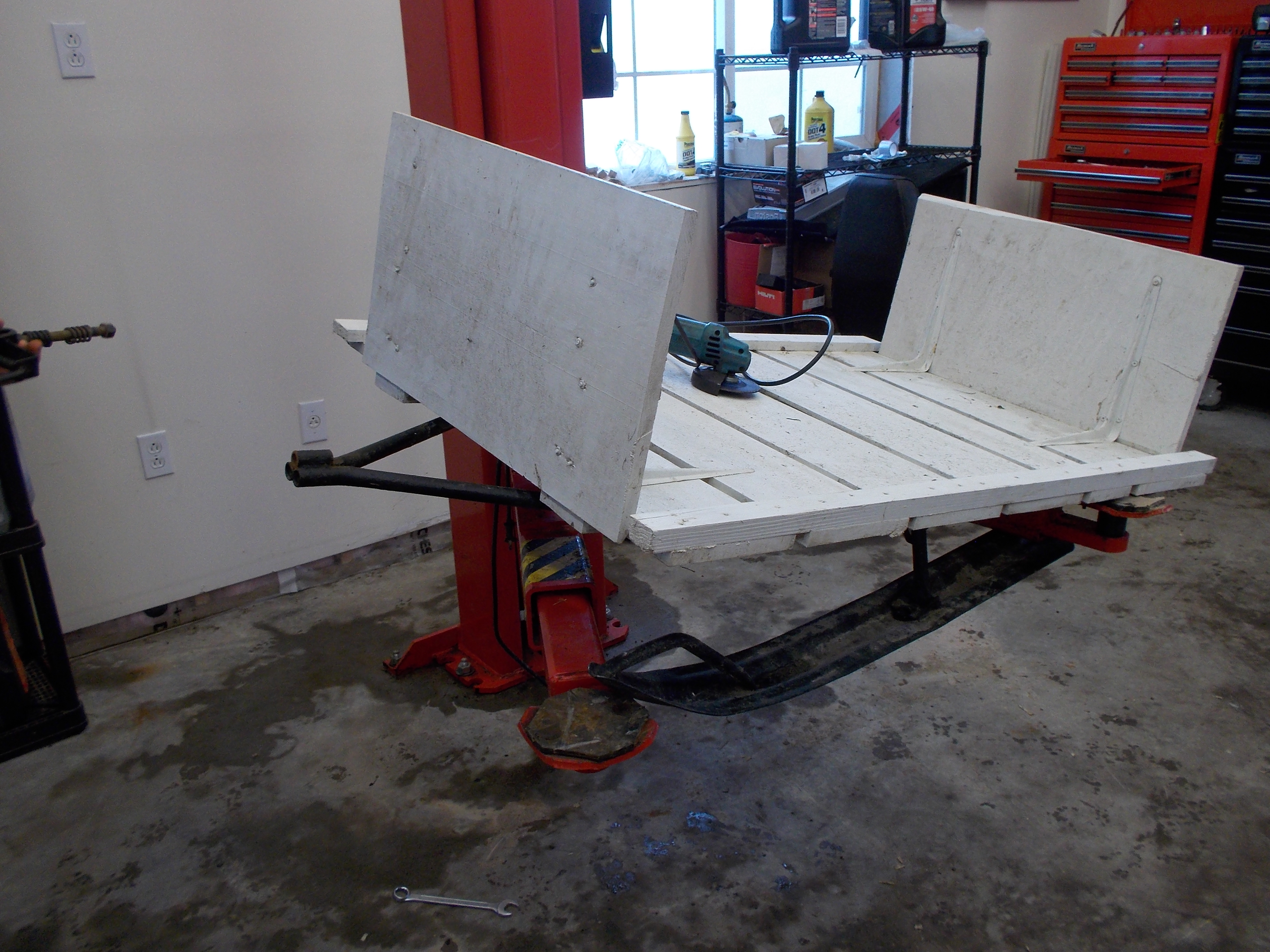
The sled project began as a set of skis and a snowmobile hitch and tongue. In an earlier life I built a mini-hayrack on it in the mistaken belief that it would be useful for cargo behind the 1976 Alpine. Turned out the Alpine came with an automotive trailer hitch as well as the snowmobile variety, so for cargo I simply pulled the utility trailer on which it rode between expeditions. The thing was way too much of a brute for a dinky little caboose like this. The utility trailer normally worked well, though we ran into a little problem once on Newboro Lake. Check out The Heroic Winter Assault on Scott Island at the bottom of the page for details.
The existing body was too short for my 35 lb. power ice auger, so I began modifications. The hitch height was 8″ too low, as well, so Peter Myers fabricated a new tongue and I added some length.

Then came sides, a pair of 12″ pine boards. In an effort to reduce weight, though, I fabricated a pair of lightweight doors from scrap pine and pieces of 1/4″ plywood I found in my shop. Then I raided a box of cabinet hinges I’d bought on eBay for fasteners.
Tremclad yellow seemed a reasonable match for the Ski-Doo palette, so I rolled a half-gallon onto available wooden surfaces, the skis, the floor, and my clothes.


With the doors removed the sled should handle sap collection duties in March as well.
Now all we need is snow.
https://rodcroskery.wordpress.com/2009/01/04/the-winter-assault-on-scott-island/
Why not?
December 8, 2014

It’s a 1999 (technically a classic) so it qualifies for the cut-rate trail pass. Insurance isn’t bad, and there was so much snow last March we couldn’t move from the driveway. I chose to frame the purchase as the reaction of a rational man to last winter’s claustrophobia.
10 December, 2014, 9:37 p.m.
It’s impossible to state how much snow there is outside as it’s all drifts and bare gravel on the way to my equipment shed. Suffice it that there’ll be snow in the fields for the Ski-Doo tomorrow.
Today I bought a trail pass online. Now I have to wait until they send the sticker to me, but the Ministry of Snowmobile Trails hasn’t opened them yet, anyway.
11 December, 2014
The recently-purchased Ski-Doo’s o.k. I’ve had a bit of trouble starting it when cold due to flooding. Maybe I’ll try without the choke next cold start.
The ’99 Touring LE offers an excellent ride with good steering which allowed me to follow paths through the woodlot without difficulty. This stands in sharp contrast to the behaviour of its predecessor, a ’76 Alpine, whose single ski worked more to separate the saplings for the massive, pointed bumper than it did to direct the sled. I had found it dangerous to sit on the Alpine’s seat when hurdling drifts, as the landings sometimes compressed one’s spine in a shocking manner. The long-legged Touring acts as though it would prefer a 20-mile run on packed trails to a poke around the sugar bush. It certainly shows more power than I’ll need in the woodlot.
This anti-Alpine will no doubt show its shortcomings in future rides, but for now I like the easy steering and cushy ride.
13 December, 2014
Apart from the use of a spark plug wrench to start the machine in the morning, it works very well. I’m studying everything written on the subject and watching every video even tangentally related to Ski Doo carburetor problems. Some headway has been detected.
The 13.6 mile tour took me across our fields to Forfar, through “town” on asphalt, then onto the Cataraqui Trail, across Hwy 15, and ending at Little Lake, a large pond accessible only by snowmobile.
The skis occasionally ground against coarse gravel on the old railway bed, but the machine’s ride reminded me far more of a Lexus sedan than an off-road vehicle. The hand and thumb warmers quickly warmed up digits frozen on that spark plug wrench.
I discovered that 25 mph is plenty fast enough on a straight, graded snowmobile trail at this time of year. 35 mph is marginally acceptable along a familiar path on a large field.
But the ’99 Ski Doo Touring is surprisingly competent and easy to drive. This has never been more apparent than when I tried to reverse my course. I turned off the trail onto an upward-sloping driveway, then reversed downhill. Starting off on the slope offered a whiff of warm drive belt, but the long sled turned as easily as an SUV and we were on our way home without fuss. A similar move with the intractable ’76 Alpine would have required considerable effort.
A cold start this afternoon brought the machine to life without the use of the spark plug ratchet, so I may yet learn how to operate this promising addition to the Young’s Hill motor pool.
14 December, 2014
This morning’s start with 1/2 choke didn’t work after a 2 second attempt, so I released the choke and rolled it with open throttle for a couple of 5 second bursts until it started. As usual, the engine performed flawlessly, once started.
The Ski Doo passed a milestone this morning when I climbed on behind my fishing buddy Tony for a spin around the field. Online advice had it that the machine was too light for anyone over 200 pounds, though it had seemed pretty good over rough fields with just me aboard. This test was with two passengers, combining considerably more weight than the sled’s modest 440 pounds. The ride was fine. It didn’t respond as readily to steering inputs as with a single rider, but handling was certainly controllable enough for an occasional ice fishing expedition.
Observing the machine in operation from a distance, I was amazed at its quiet. The more we drive it, the better it seems to run.
Next step: installing the hitch and modifying the snowmobile sled we found in the barn to carry a power ice auger and fishing tackle.
15 December, 2014
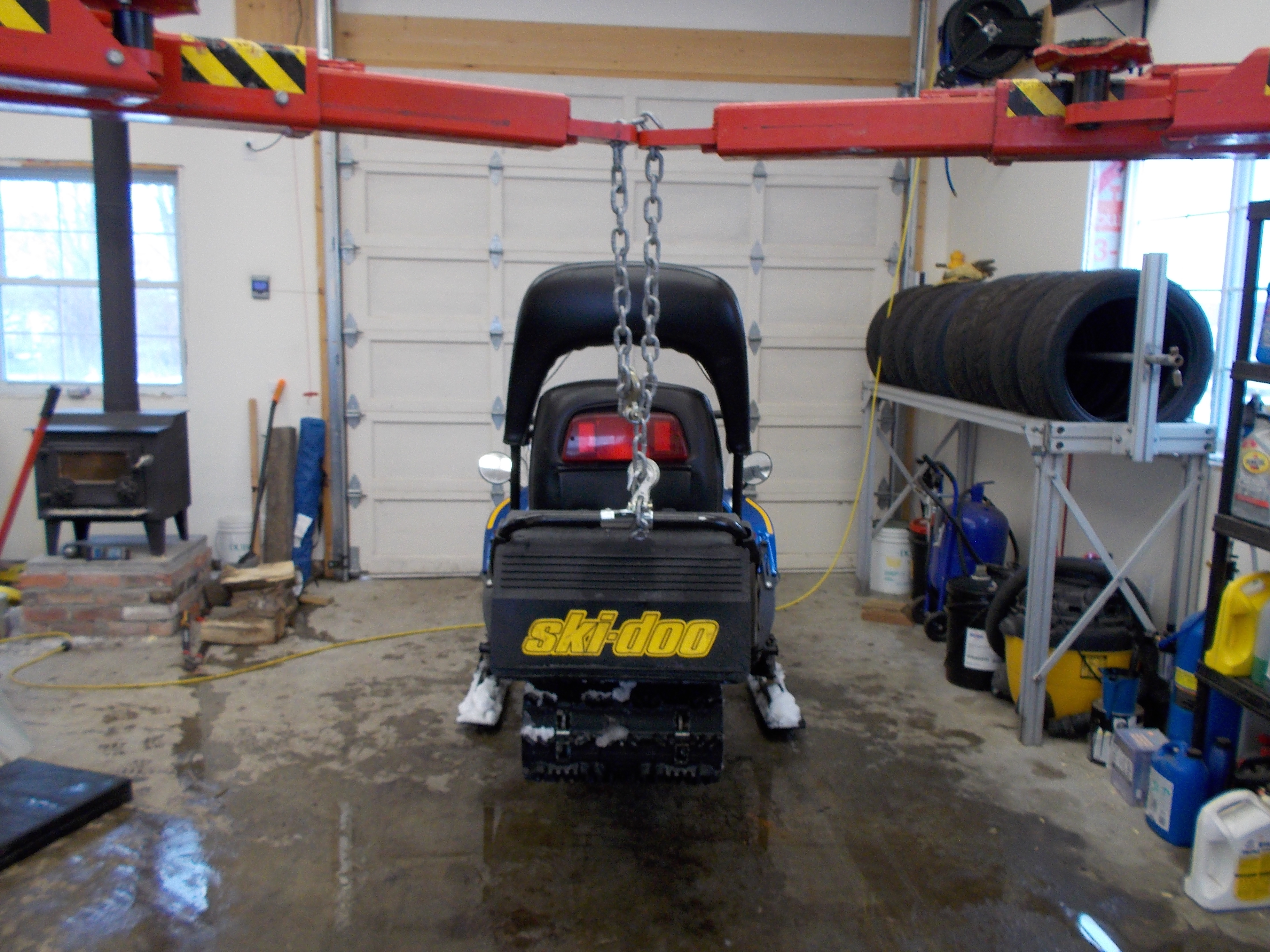
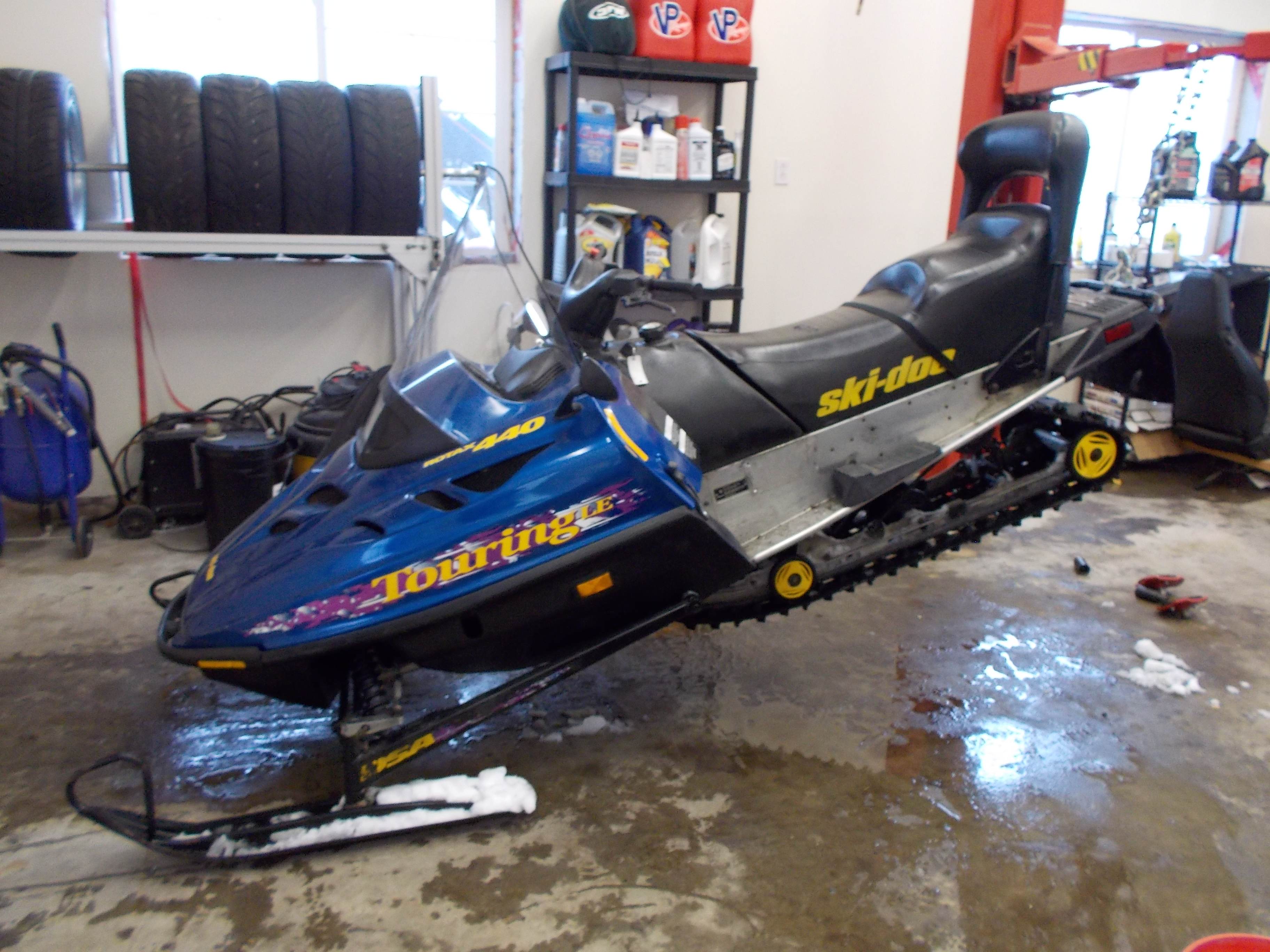
Today I put a fire on in the shop and attended to some of the maintenance tips I gleaned yesterday from a variety of online sources. First was the new belt, which went on easily with the tool I found in the carefully-packed tool case. The old belt’s still in good condition, so I stashed it under the rear seat.
The gear case dip stick had a few filings on its magnet, but the oil looked good, was at the correct level, and I saw no evidence of leaking below.
The main task was to grease the underpinnings, those unmentionable parts only a stern list of must-do’s could make me examine. The manual said to roll the machine onto its side… Uh, I stood on the edge of the running board and pulled on the handle bar, but it didn’t tip, just slammed its left ski down on the shop floor.
Further examination revealed a broken case for the right mirror: I’ll bet I know how that happened. With no desire to do further damage to the rather pristine coachwork on the Touring, I opted to use the system I developed for the 5′ mid-mount mower on my Kubota. The auto lift had no trouble with the weight, and I found three of the (alleged) four fittings under the track. The four fittings on the steering loosened up the my grease gun, and then I let loose with rustproofing oil on the various metal-to-metal moving parts.
The suspension immediately felt less notchy, and we glided fluidly over the local bumps as I put the machine away. Interestingly, the rear bumper now sits at 16″. Before the grease it sat at 17 1/2″.
Over the day I’ve learned that if 1/2 choke doesn’t start the engine, a second or two on the starter with the throttle open will do the job. At least at the freezing point.
There’s a good chance the starting problem is with the operator, not the machine.
UPDATE: 30 March, 2015
The starting problems ended when Cory Sly replaced the float valves in the carburetors (under warranty). From then on the engine started and ran very well. It logged about 300 miles on short runs around the property and a few local trail rides.
Diesel tractors and the cold
November 22, 2014
18 February, 2015
For the first time the TAFE has had its troubles with freeze-ups this winter. The addition of a diesel additive has improved starting to the point that it will light up unaided as long as it’s above 0 degrees F. As long as the electricals agree. I finally tightened a push-on connector to the solenoid as it tended to vibrate off, after starting the engine.
Sunday morning this trick no longer worked. Eventually it lit up while I was trying to figure out how to bypass the gearshift safety interlink, so I don’t know if it’s a broken wire to the solenoid, or an interlink switch gone.
20 November, 2014
While conditions local to the Newboro/Portland area have proven much less extreme than those to the south of Lake Erie, we have had more than our share of wind over the last three days, and today required that the mothballed snow removal equipment get to work.
For the first time in memory the 35 hp TAFE loader tractor froze a fuel line. At first it lit up in the best diesel tradition, but then starved for fuel and quit. Ulp.
Next on the depth chart was the Kubota whose normal role is mowing lawns. When I tried to hitch it to the snow blower, the abandoned implement was frozen so solidly into the ground that the little tractor couldn’t move it. I had to whack it with the old Massey Ferguson 35, which promptly decided it didn’t want to go any further in either direction because of a lack of hydraulic fluid and a large blade on the back.
The little Kubota dragged its belly out the lane and back again willingly enough, but cars don’t usually have 12″ ground clearance. With a sneering look at the idle TAFE with its cozy cabin, I took a deep breath, hooked a logging chain to the Kubota and yanked the now-loosened 5′ snowblower out of the tines of the Massey’s loader and around to where I could hitch it up. The wind kept dislodging my hat to the point that I squeezed into a snowmobile helmet I found in the shop.
Much fussing ensued before the blower was properly installed on the little tractor. What I had thought was a seized pto shaft turned out to be a telescoping shaft too long for its job. Shortening it by 1 1/2″ did the trick, but I had pounded on the thing in the blowing snow for about an hour before this insight came along.
Because it wasn’t all that cold outside, I was able to complete the blow-out of the driveway and related parking areas without a change of clothes, though by that point I was soaking wet. The 21 hp Kubota could handle the heavy drifts in low range if I eased off on the go-pedal when the engine began to labour. Without the three suitcase weights on the front it wouldn’t have had much steering control, though.
As I said the temperature was rising, so I tried the TAFE before retiring for a shower. It lit up a bit reluctantly but settled down once it had coughed that drop of water through its injectors. Next time I’ll park it out of the wind so I can have fun playing with the TAFE’s loader while sheltered within its cabin, instead of ducking a deluge of damp snow.
November 21, 2014
My neighbour Peter Myers provided an anti-gelling compound for the fuel because the TAFE repeated its trick of starting up, running for a short while, accelerating and then dying. This conditioner stresses on the label that it’s not for regular use, so I need to find something else, as well.
Dealer Paul Carson told me that an additive is necessary nowadays, as diesel is of much lower quality than it was even two years ago. He agreed to order new canister filters for the TAFE’s fuel supply.
I have never touched the diesel part of the tractor because I had little idea of how it worked, and my only experience with injector pumps occurred on a bitterly cold morning several years ago when I ran the Massey Ferguson 35 out of fuel while straddling Young’s Hill Road. Peter’s comment when I sought his help to restart the engine: “That’s an awful job! You … only … do …that … once!”
From that session I learned to keep the tanks full and pray the filters didn’t plug, because bleeding the system requires two men with frozen hands and feet, a portable generator, and a large tractor to chain-start the MF when everything else fails. Now that I think of it, add a new starter to the bill. It seems Lucas starters run on smoke, because when I let the smoke out of that one, it wouldn’t work any more. The rebuild guy in Smiths Falls tossed the Lucas into his dumpster and handed me a much cheaper Delco which has worked fine ever since.
After an hour with the block heater and the anti-gelling compound, the TAFE lit right up, but died again before I could get it into the heated garage.
I tried to tow it to where I could drag it in with the 12v winch I once bolted to the garage floor. The little Bolens scratched away at the frozen ground until it got the behemoth to move, but then it rolled off course and stopped on top of the chain. I hadn’t realized that a power steering tractor not only won’t follow a tow vehicle, you can’t steer the thing at all without the engine.
In desperation I tried the starter again. Perversely, it lit up and idled as if it had no memory of its earlier tantrum. Several breathless seconds passed before the tractor sat in the garage, beside the box stove. Then, of course, it ran perfectly. Perhaps the water has worked its way through the system, but I won’t trust the TAFE until the new filters are installed and the system bled.
It’s been a reliable workhorse for four years, so I won’t call it an evil beast yet…
UPDATE: 2 December
After I changed the fuel filters on the TAFE it started up well and continued to run as expected. The job wasn’t all that bad technically. I’ll still wait until it starts on a cold morning with a heavy snowfall before I pronounce the TAFE redeemed.
UPDATE: 12 January, 2017
So far, so good. No more problems with the fuel system in cold weather. I just keep the additive in the fuel.
Getting the Ranger ready for cold weather
October 21, 2014


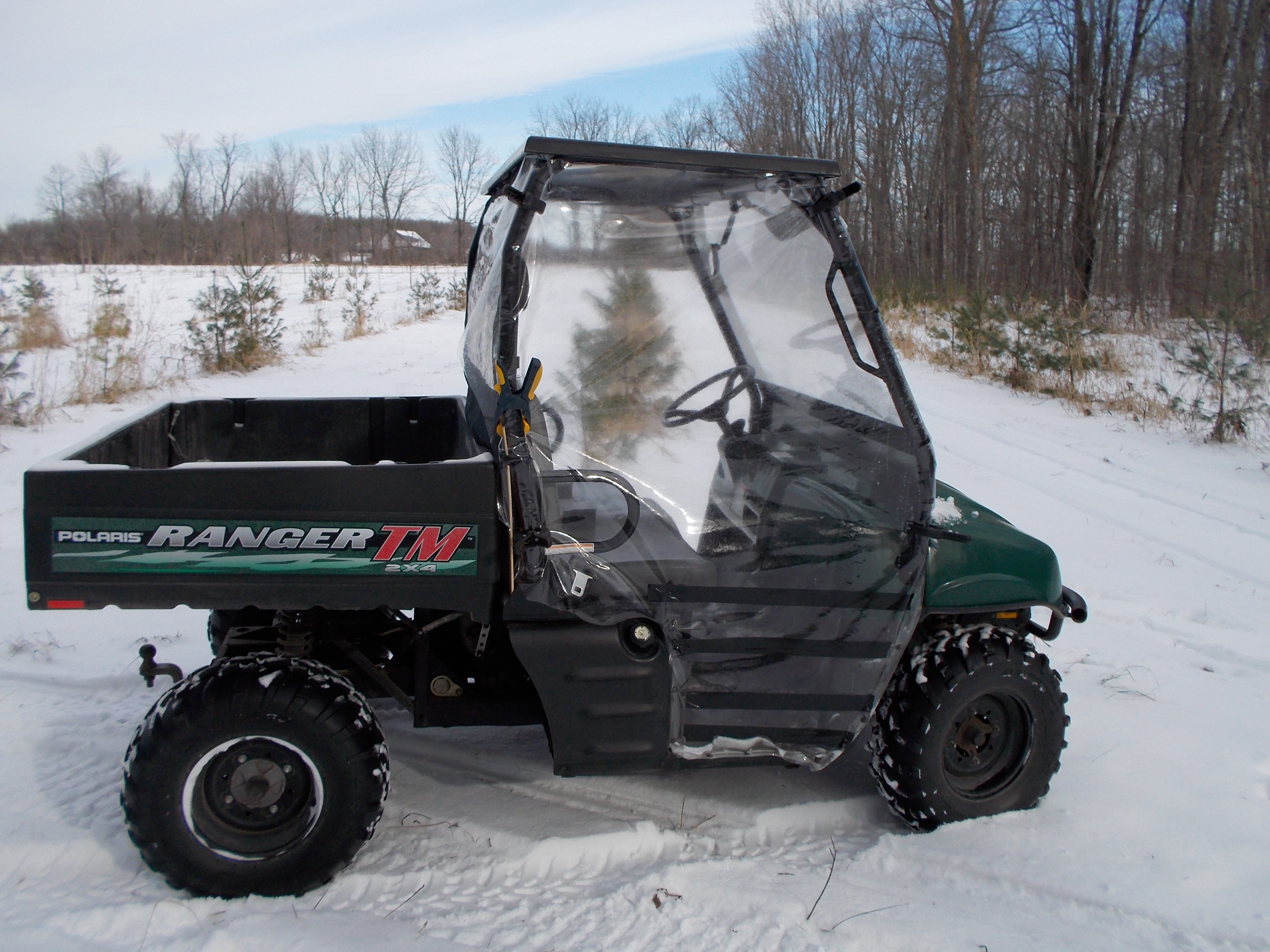
First came the cabin frame from Black’s Corners Motorsport to replace the original “roll bar” and screen on the Ranger TM. Turns out the stock cabin frame on early 2000’s Rangers wasn’t ROPS certified, so dealers had to install more robust frames for commercial use. Steve had three still in their original packages in his warehouse, so he sold me one for $250.
Then came a Kijiji purchase, a leftover metal roof ($150) from the dealer in North Bay. A centre-mounted mirror came from eBay for about $60.
As summer faded into fall I started to look for a windshield. The cheapie I picked is built from 3/16″ Lexan, ($256 from Extreme Metal Products). Then the exhaust fumes forced the dog to hang her head out into the slipstream, so the rear half of the enclosure was in order.
I had used spring clamps and red duct tape to hold the stern cover off our old sedan cruiser in place on Tony’s Ranger 500 last winter. This worked surprisingly well for ice fishing, so I ordered a pair of rear windows online at the lowest price I could find, $40 USD. The rather flimsy plastic in the new rear cover led me to suspect that it will likely break from impact during the winter, but if it does I’ll sew in a heavier vinyl panel from a boat canopy shop. The canvas portions and velcro straps should work well to hold a more durable rear panel.* (See update below.)
The Ranger’s definitely more liveable now on dog-walks in rainy or cold weather.
A new battery from Ward’s Marina in Kingston ($165) gives the starter a lot more torque than before and should help in cold weather. The guys at the counter were surprised when I asked for parts for a TM. They had thought their red 2004 TM was the only one in the area. Used on the lot as a tow vehicle since new, theirs has 1300 hours on it with just normal maintenance.
“They’re bulletproof,” the owner commented.
*UPDATE: 7 November, 2014
I had to move the rear window down a couple of inches on the cabin frame in order to block exhaust fumes which were permeating the cabin from below the seat back. The $40 rear window is a couple of inches too short-waisted to do its job properly. When I get around to it I’ll screw on a 9″ strip of plywood or metal to fill the gap between the bottom of the cabin frame and the lower edge of the rear cover. Then it should work fine. With the device lowered to where it shows 3″ of air below the cabin roof the fumes are no longer a problem, though it’s not a viable long-term solution. Next time I’d buy a more expensive model ($65.) which appears longer in the illustrations online.
UPDATE 7 December, 2014
It took a piece of 1/4″ plywood 59 7/8″ X 16″ to seal up the stern cover. The plywood sits on the frame and just under the black canvas of the stern cover. It does not interfere with the operation of the dump box. I drilled two oblong holes for the lower velcro straps of the stern cover to go through and over the plywood and still hold the roll bar in a death grip.
UPDATE 13 December, 2014
My friend Tom Stutzman handed me a roll of boat-cover-vinyl left over from the top on his pontoon boat. It looked to be about the right size and shape, so I clamped it into place to block air flow on the right side of the cabin. Next stage was to trim the small amount of excess vinyl and fasten it into place. The hex screws which hold body panels to the frame of the Ranger didn’t mind another layer of vinyl beneath their broad heads. The clamps stayed in place for now. Black duct tape presented a visual barrier for the spaniel who objected to losing her access route to the Ranger’s seat.
This may seem a bit extreme, but it’s a lot warmer in the cabin for the dog. As long as I don’t take the Ranger onto a lake, what’s the harm?

The Canadian car buyer and the new U.S. Automated Export System
September 22, 2014
With some shame I have plagiarized the following article from the excellent Winnipeg Free Press because I’m pretty sure it’s important to all Canadian gearheads.
Rod
———————————————————————–
By: Ashley Prest
Posted: 05/6/2014
WINNIPEG FREE PRESS
If you are planning to buy a used vehicle in the United States and bring it home to Canada, a new U.S. government rule means a bit more legwork. If you don’t do it, it could cost you a lot more money.
What is the Automated Export System?
The Automated Export System (AES) is a mandatory filing requirement by the U.S. Census Bureau of Electronic Export Information (EEI). The exporter or authorized agent must file the vehicle’s EEI information using AES.
From AES, the importer (or authorized agent) will receive an Internal Transaction Number (ITN) number in a confirmation message. This number must be presented to U.S. Customs to bring the vehicle into Canada. (www.riv.ca)
The rule requires electronic export information (EEI) to be filed for any used “self-propelled vehicles” — any automobile, truck, tractor, bus, motorcycle, motor home, agricultural machinery, construction equipment or any other kind of special-use machinery designed for running on land — through the U.S. Government’s automated export system (AES).
“Starting April 5, the exporter in the U.S. is required to file automated export system information. They have to report to the U.S. Census to tell them who they are, what they’re sending, whom it’s going to, in a nutshell,” said Trevor Franzmann, sales and marketing manager at A.D. Rutherford International, a Winnipeg customs broker who works with customers on both sides of the U.S./Canada border.
“This is absolutely making it more difficult to buy a vehicle in the U.S. and bring it across the border.”
Statistics Canada’s international accounts and trade division figures for 2013 showed there were 1,332 self-propelled vehicles imported to Manitoba alone from the U.S., for a total value of about $44 million. Across Canada in 2013, there were 18,441 vehicles brought in from the U.S., for a total value of more than $555 million.
Since April 5, self-propelled vehicles exported from the U.S. to Canada are no longer exempt from AES filing. The filing must take place 72 hours prior to crossing the border.
A fine up to $10,000, under the U.S. Census Bureau foreign trade regulations, can be levied for failing to submit the AES information.
“It’s excessive, to say the least. The bottom line is it (the vehicle purchased) is not going to be allowed in the country (Canada) if you don’t file your AES filing,” Franzmann said.
An “informed compliance” period is in place until Oct. 2, giving people time to figure out the new requirements. Franzmann said Canadian buyers of vehicles from the U.S. should start complying right now or risk having the vehicle held up at the border.
“People should also be aware that, even though there is informed compliance right now, U.S. Customs has the right to deny you entry if you don’t file the AES,” he said.
Once the AES filing has been completed, an internal transaction number (ITN) will be assigned. The importer or a customs broker needs to present that number to U.S. Customs and Border Protection to bring the vehicle across the border.
“Simply, it ends up being the Canadian (buyer’s) responsibility to make sure AES filing is done, because that vehicle is not going to get into the country (Canada) unless you are provided with an ITN, an internal transaction number,” Franzmann said.
A potential problem is that to complete the AES filing, the U.S. seller is required to have a federal tax identification number called an EIN. Private individuals in the U.S. might not have an EIN number but, under the new rule, the American seller will have to get one to comply with the AES filing.
That means taking the time to apply to the U.S. Internal Revenue Service, and some private sellers don’t want to do that.
“What we’re telling our customers is find out if the seller has or will get an EIN number. If the seller won’t, don’t buy or get your money back,” Franzmann said.
Another possible point of confusion is which person is ultimately responsible for the AES filing.
Dale Kelly, chief of the U.S. foreign trade division, said that can vary with the location of the Canadian purchasing the vehicle.
“If the person from Canada (the importer) is actually in the U.S. at the time the goods are purchased or obtained for export, then that person/company/individual is considered the U.S. principal party in interest and responsible for the filing of the AES,” Kelly said in a telephone interview from Washington, D.C.
“Only if the merchandise was sold by a U.S. person or company and the Canadian person never came to the U.S., then that U.S. company would be considered the U.S. principal party in interest.”
Canadians importing a vehicle must be prepared to meet all requirements at the U.S. border in addition to paying fees and taxes. Canadian Border Services Agency spokeswoman Esme Bailey said Canadians should contact the CBSA before they plan to import a vehicle by calling 1-800-461-9999 and visiting the website http://www.cbsa-asfc.gc.ca.
ashley.prest@freepress.mb.ca
Republished from the Winnipeg Free Press print edition May 6, 2014 A6
 the Walnut Diary