With five tractors and three cars in the motor pool at the farm, I have grown concerned about aging anti-freeze in aluminum engine blocks and radiators. As coolant grows old it becomes acidic and can eat its way though unprotected aluminum on a modern engine. Protecting against corrosion is as much coolant’s role as protecting against frost.
But a couple of looks at the Prestone wall at Canadian Tire have sent me on my way in despair, afraid that I might select a product which would do more harm than good. The various fluids are all in opaque containers and so I can’t even go by colour.
For anti-freeze is not a simple subject. I used to believe that there were two types: green and red. But that’s not true. There’s green ethylene glycol, the standard stuff, which the books suggest changing every two years. Then there’s the GM stuff, dex-something, which according to the Internet is Kryptonite to a lot of silicone-based head gaskets and other engine parts, especially on Cummins diesels. There’s been a class action lawsuit about Dex-Cool sludging up and destroying GM engines for which it was a warranty requirement.
And then there’s long-life coolant, and even extra-long life coolant for diesel tractor engines. And none of them are compatible. In fact a service manager told me that if I mix red and green coolant, the resulting liquid will coagulate and fail.
And the coolant in the Lexus, Scion, and Toyota in our motor pool is pink, not red. The Lexus service lady I called explained that the Toyota product is not the green-stuff-dyed-red, as one otherwise fairly well-informed Internet chemist suggested. “It’s a gell formulated to bubble and harden wherever there is a leak, so that the technicians can track the fault quickly.” She told me (correctly) that it’s very hard to find the source of a leak of the green glycol.
She further told me that the technicians use a float to measure how dense the coolant is, and hence how much cold it will protect against, but she knows of no chemical testing for PH at the dealership. If it’s not pink, though, they replace it. “If a water pump has failed, they replace the coolant,” her opposite number at Kingston Toyota told me.
No one I spoke to seemed to put much credence in the replace-every-two-years rule printed on the plastic jugs.
Today for the price of two-and-a-half gallons of Prestone I bought a bottle of 50 CoolTrak coolant test strips from the local UAP dealer. The bottle states clearly that the strips are not recommended for pink or red coolant. Great. I tried them anyway. The 2006 Kubota tractor needs its green coolant replaced. It tested a PH of about 7.25 and the ideal is 10 for my B7510, so it’s too acidic for that expensive little diesel engine and aluminum radiator which I want to keep for a long time. The 1981 Bolens has the best coolant of the fleet because I replaced it earlier in the summer after a heat-light malfunction. The 1995 TAFE’s green stuff also isn’t as bad as I expected because it’s a leaker and requires top-ups from time to time. The 1960 Massey-Ferguson, according to the test strip, is in a similar situation, though I don’t remember renewing its coolant.
So the Kubota needs Prestone. With the Bolens I just drained and refilled it with a 50:50 mix, but according to the Internet that may only remove half of the liquid. A backflush is more appropriate, but there’s the problem of vapour locks in the engine blocking the flow of coolant, and what do I do with the toxic waste? One sip of coolant from a spill or an open container will kill a bird.
The other problem is that I can usually rely upon Internet information, but on this subject everybody who has ever twisted a radiator cap feels compelled to offer advice, and some of it is dangerously inaccurate, even to my naive view. And one Internet wag suggested that the parts guy at the dealership inevitably has strong opinions about coolant, and most of the time they are unfounded and wrong.
What’s more, an Internet source informed me that coolant now comes in yellow and blue to suit warranty requirements of Korean cars. Something tells me that mixing yellow and blue to get green in my Kubota would boil that expensive little engine like an egg, so I’d better not try that.
More on this later — the test strips expire in a year.

I’ve never owned a boat which brought less drama, that demanded less of its owner.
Last fall I hauled it while incapacitated with a leg injury. Into the plastic shed it went with only the most rudimentary winterizing steps. It sat there for a couple of months, and as I recovered I took the contents of the locker out and dried them. The charger went onto the trolling motor battery, but the other one sat where it was.
In one boneheaded moment during a heavy snowstorm in February I put my fist through the 6 mm plastic roof above the bow seat. Hasty repairs with tuck tape controlled most of the leakage for the remainder of the winter, but some water found its way to the floor of the building through the bilge.
As soon as possible in spring I hauled it out and launched it. The fuel in the tanks had received ample stabilizer, but not what had actually been in the engine at layup. With some apprehension I turned the key. The Merc 40 purred to life as if it had last been operated the day before. I ran out to ensure that the ice was in fact out of the lake, and then announced the winner of the Newboro Lake Ice-Out Contest, Louise Pritchard of Newboro.
It turned out to be a quiet spring for boating, and by the first week in June when I hauled the Princecraft for a bath, I had to scrub hard to get the accumulated algae off the hull and lower unit. The interior was littered with the remains of flowers from the overhanging oak tree. An hour with the pressure washer took care of the grooming, though I don’t know how I could clean the textured vinyl flooring without a high pressure jet.
As far as the performance of the boat, I have become utterly spoiled. It runs beautifully at whatever speed I choose up to 29 mph. It handles a chop as well as can be expected from a vessel not built of wooden planks. There’s room for four fishing rods plus tackle in the locker. Life jackets lurk out of the way under the helm.
Early on I removed a spray head from the input to the live well after it had plugged with weeds. I wasn’t able to thread it back in so it rode around in the bottom of the tank until the tournament on June 15th. Somehow it found its way into the drain, and then a crewman screwed the top stalk into place over it, effectively plugging the overflow. To compound the problem I turned the pump on to keep our fish lively and before long there was more water than I would like on the lower deck of the boat. Ten minutes of bilge pump work and things were settled again, but I would recommend not abandoning that spray fitting in the bottom of the live well.
We placed third in the tournament that day, but it was not the fault of the boat. It performed flawlessly. Perhaps one reason for my reduced fish production this year is that the boat is so enjoyable at trolling speed that I have spent increasing amounts of time loafing around in deep water, looking at the scenery instead of digging aggressively for largemouths along the shoreline.
Anyway, so far, so good on the Princecraft/Mercury 40.
Bush hogging with the Kubota B7510 (continued)
June 12, 2013
When I bought a 48″ offshore rotary mower for my Bolens G174 I didn’t know any better but to use the same system of chains it used on the 48″ Woods 3 pt hitch finish mower to maintain cutting height while in operation. I just added a couple of appropriate chains to the front corners of the bush hog and away I went. Then when I lowered the hoist, the mower was sure to stop at the preset height. The system was crude, but quite effective. Larger tractors have more complex presets for height on their 3 pt hitch controls than the little ones, which basically lift up and down.
When the Kubota B7510 came along and I started to use it on the bush hog I discovered I had to fiddle with the hoist to get the proper height for mowing around my little trees. It would hold a position pretty well, but if I lifted to vault over a rock or make a tight turn, I’d have to reset the height by trial and error. I couldn’t figure out an easy way to preset the height of the cut on this model. Newer B-series tractors have a more sophisticated height setting system.
Today I took the Woods chain cleats off the Bolens and attached them to the pin which holds the upper end of the top link on the Kubota. The chains from the rotary mower will fit the larger tractor. Now I can hop the mower over an obstruction and return to the preset height of cut without undue attention to the operation.
Last week I ordered a second set of the chain plates to replace the set off the Bolens from Steensma Lawn and Mower Equipment in Kalamazoo, Michigan. Woods still stocks them.
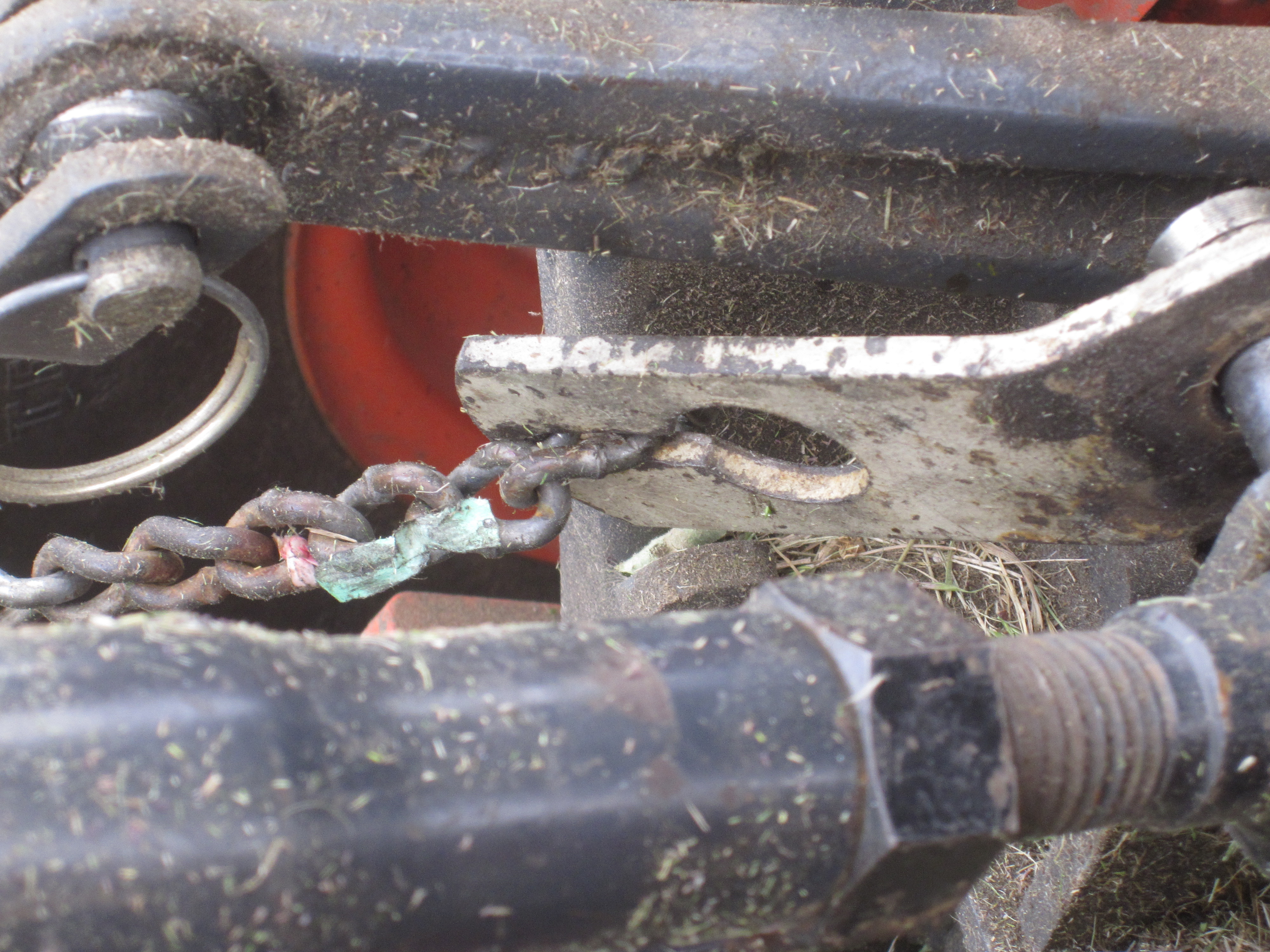
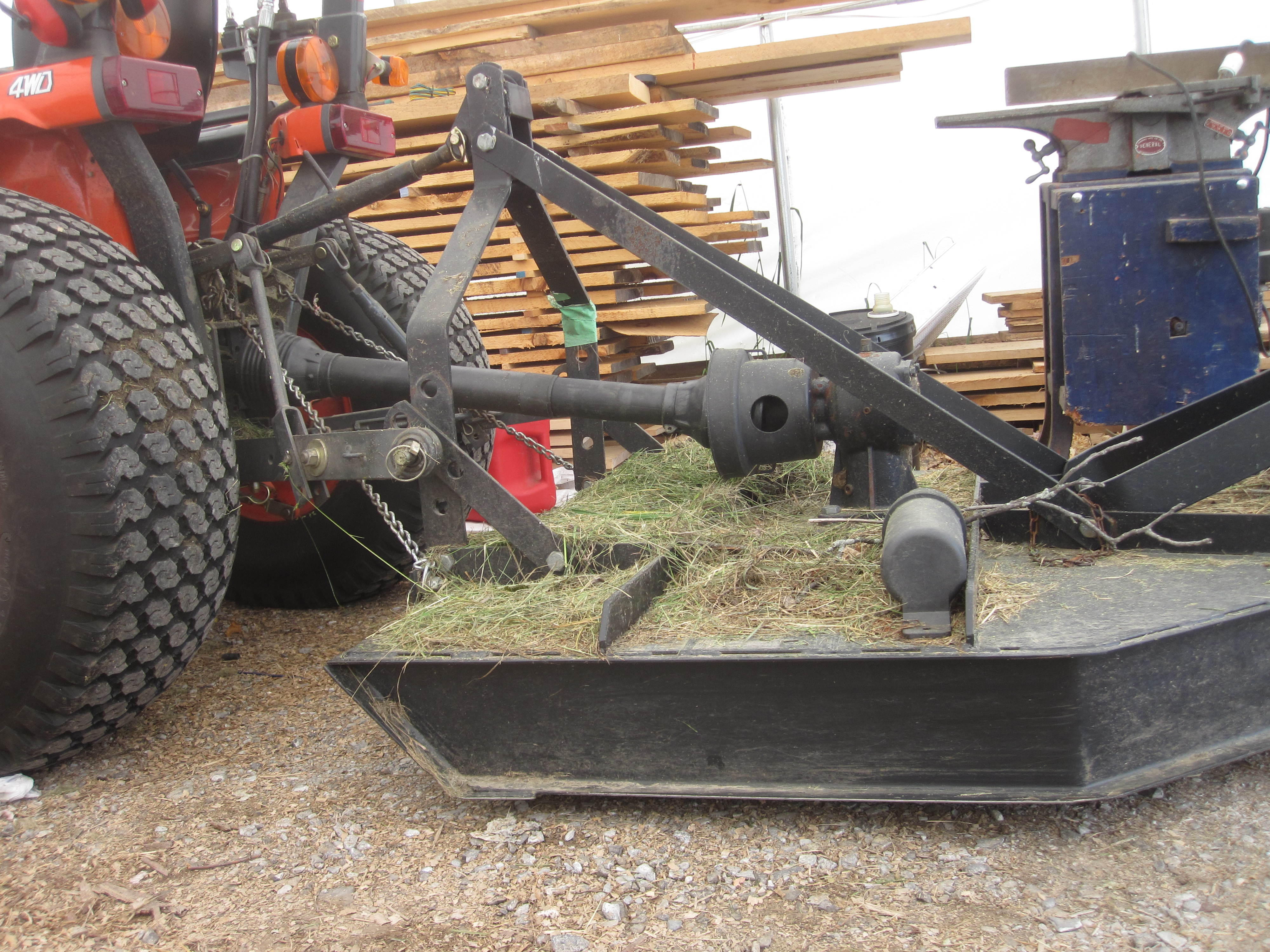
Bush hogging with the Kubota B7510
June 2, 2013
23 May, 2013
Today I prepared the B7510 for mowing around some of the 15,000 little trees on the farm. That involved removing the five-foot mid-mount mower and hooking on the 48″ rotary mower. The off-brand “bush hog” normally mounts on my Bolens G174 where height control is achieved by means of a pair of chains to the upper bolt on the 3 pt hitch. The fittings came with the 4′ Woods finish mower and it seemed reasonable to add the chains when I bought the rotary mower new.
Removing the MMM turned out to be a handful because I have it set for a 3 1/2″ cut and didn’t want to change it. That reduced clearance underneath, so I lifted the front with a floor jack. The little plates which hold the trailing arms for the mower had been mangled by frequent lifts and hydraulic force. I had to remove one and blacksmith it back into shape. Apart from that the dis-assembly went well.
Hitching the Kubota up to a 3 pt hitch implement was a pleasant surprise. The arms of the hitch arch together and above the implement, making it easy to centre things. When I lowered the hoist, I watched the arms spread out to about where they needed to be. Minor adjustments to position can be done from the ground by discreet pressure on the forward and reverse pedals. This was real bonus. Hitching up the idling tractor was surprisingly easy.
The 7510 doesn’t seem to need suitcase weights to balance the 405 pounds of the mower on the 3 pt. hitch. The chains were extraneous to this application so I taped them securely out of the way. The lift height control seems quite precise and it holds its position well. While I always used 4WD with the Bolens to allow it enough traction to turn the awkward implement, with its greater weight, longer wheelbase and larger tires, the ‘Bota gets along well in 2Wd on the rough field.
Mowing long rows of seedlings goes much more quickly on the Kubota than on the Bolens.
From two hours of field work, the B7510 seems poised to boot the Bolens out of the garage. At the moment I can’t think of anything the 1980 G174 can do which the ’05 Bota can’t do better, and with insolent ease.
24 May, 2013
Today I finished that 5 acre field of seedlings. It took another 2.3 hours to compete the job, so with a 48″ bush hog the Kubota covers a bit more than one acre per hour of mowing. That’s about what my TAFE 35 hp gear driven tractor does with a 5′ bush hog. There’s no doubt the HSD* is a time saver when cutting around trees. The Bolens was much slower at this job.
HSD: Hydro-static Drive
HST: Hydro-static Transmission
HST: 13% consumption tax in most Canadian provinces
UPDATE: 4 July, 2014
The attached photos show a safer method of lifting the front of the tractor for mower installation.

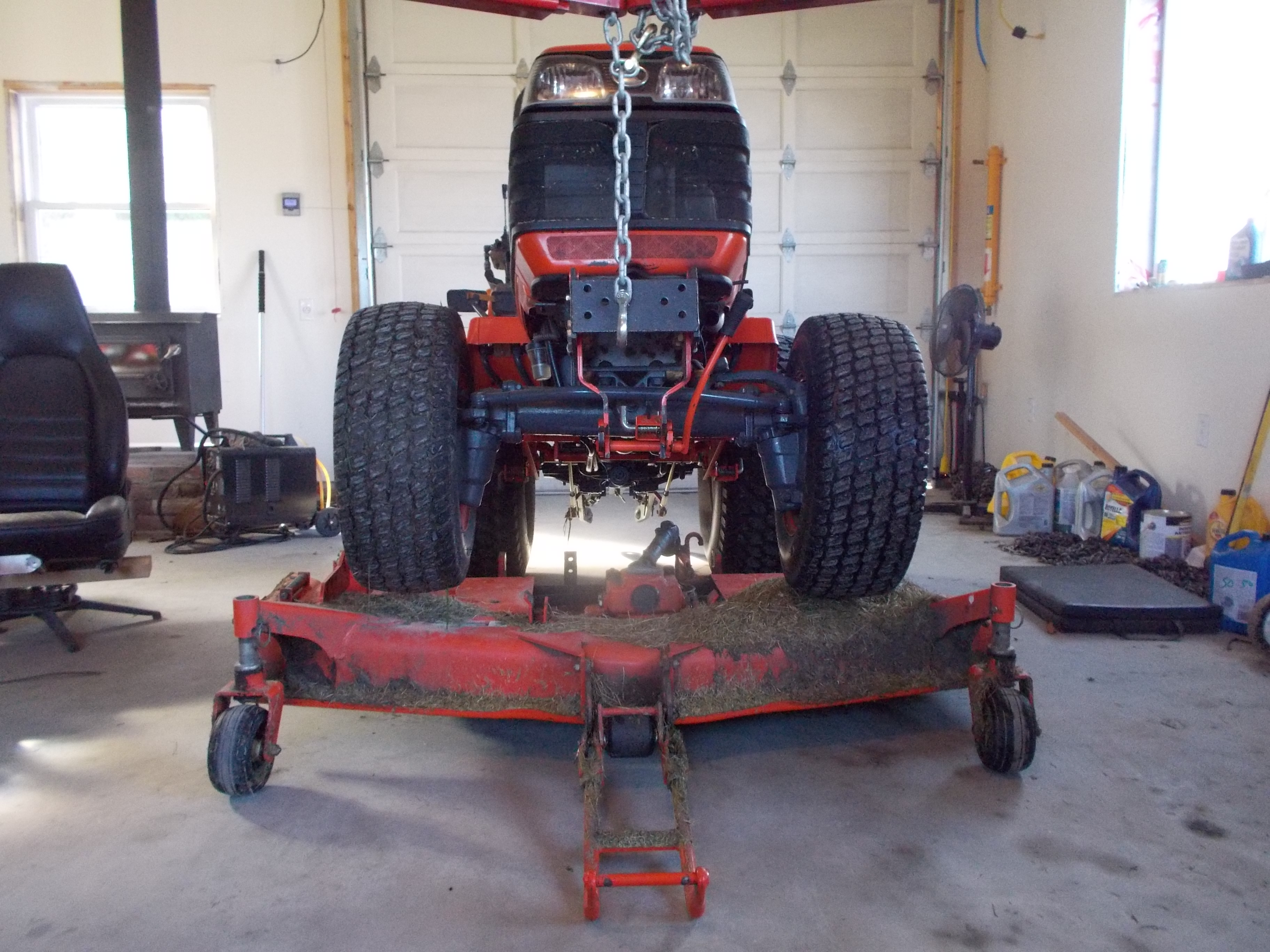

2 January, 2016
For two mowing seasons the chaining method illustrated above has worked without a hitch for weekly installations. Most weeks the B7510 runs other implements on the property between sessions on the 2 acre lawn.
UPDATE ends here.
____________________________________
Original article begins here:

As long as I used the Bolens compact tractor to mow the lawns I could sharpen the blades by the simple expedient of raising the mower on the 3 pt hitch and diving underneath with my trusty angle grinder.
The rocks haven’t changed, and though I am using the newly-acquired Kubota mower at its maximum height, occasional trolls have still lept out of the sod to engage the new knives in combat. Things came to a head yesterday when a suddenly-emerging rock caught the middle knife a good one. Things sounded rough, recovered, and I made another circuit of the plot where I park utility trailers before I realized that the grass was getting a Mohawk cut with the centre blade out of action. This wouldn’t do.
A check underneath indicated that the blade had come loose, so I moved into the auto shop to effect a repair. 30 mm sockets are not common in shops. My tractor wrenches wouldn’t fit, either. Fortunately I found a specialty wrench in one of Charlie’s tool drawers and it allowed me to tighten the thing up to where it would run again.
But the cut wasn’t very good. I had to accept that the blades were dull, and that this would be a regular problem. Standard procedure involves removing the mower deck each time to sharpen the blades. The B7510 is designed to drive its front wheels over the hulking pressed-steel deck, but everything has to be set to a 1″ cut for this to work well, and I need the 4″ height.
I needed a quick and efficient method to access the blades for maintenance.
The tractor is all-tires-no-frame from the point of view of a car hoist. After not very much thought this morning I grabbed a couple of hardwood boards off a lumber pile and set them across the arms of the car hoist to provide a wooden path for the tractor wheels. I added a collection of walnut blocks to allow the tractor to climb up onto this improvised cradle on the hoist. In low range, 4WD the tractor eased into position and I set the parking brake. No problem so far.

The standard shake of the vehicle when just off the floor proved that this was definitely not a car on the hoist. Cars lift by their frames and the metal-to-metal contact feels very solid. The tractor wobbled about far more than I liked. The tires are big and soft. They flex.
I kept my distance and ran the Kubota up for photos. I noticed that the left blade had a noticeable bend and would need to be replaced. The others were far from new.
Off I went to the local Kubota dealer, Weagant’s Farm Supply in Brockville. I showed a photo of the tractor on the hoist to the parts guy and he took all of the time he needed to convince me that I shouldn’t work on the tractor on the hoist. His line was that it would do a great deal of damage to the tractor if it fell off. He told me in the shop they always keep the wheels on the floor, and if they need serious lifting power, they bring over a portable chain lift. Big floppy tires don’t go well on car lifts, and the kind of yoke necessary to reach the frame past huge tires would be cumbersome indeed.
He suggested I hang the front of the tractor only from the hoist with a chain. This made sense, so I stole a choker chain from the timber winch and hooked it up.
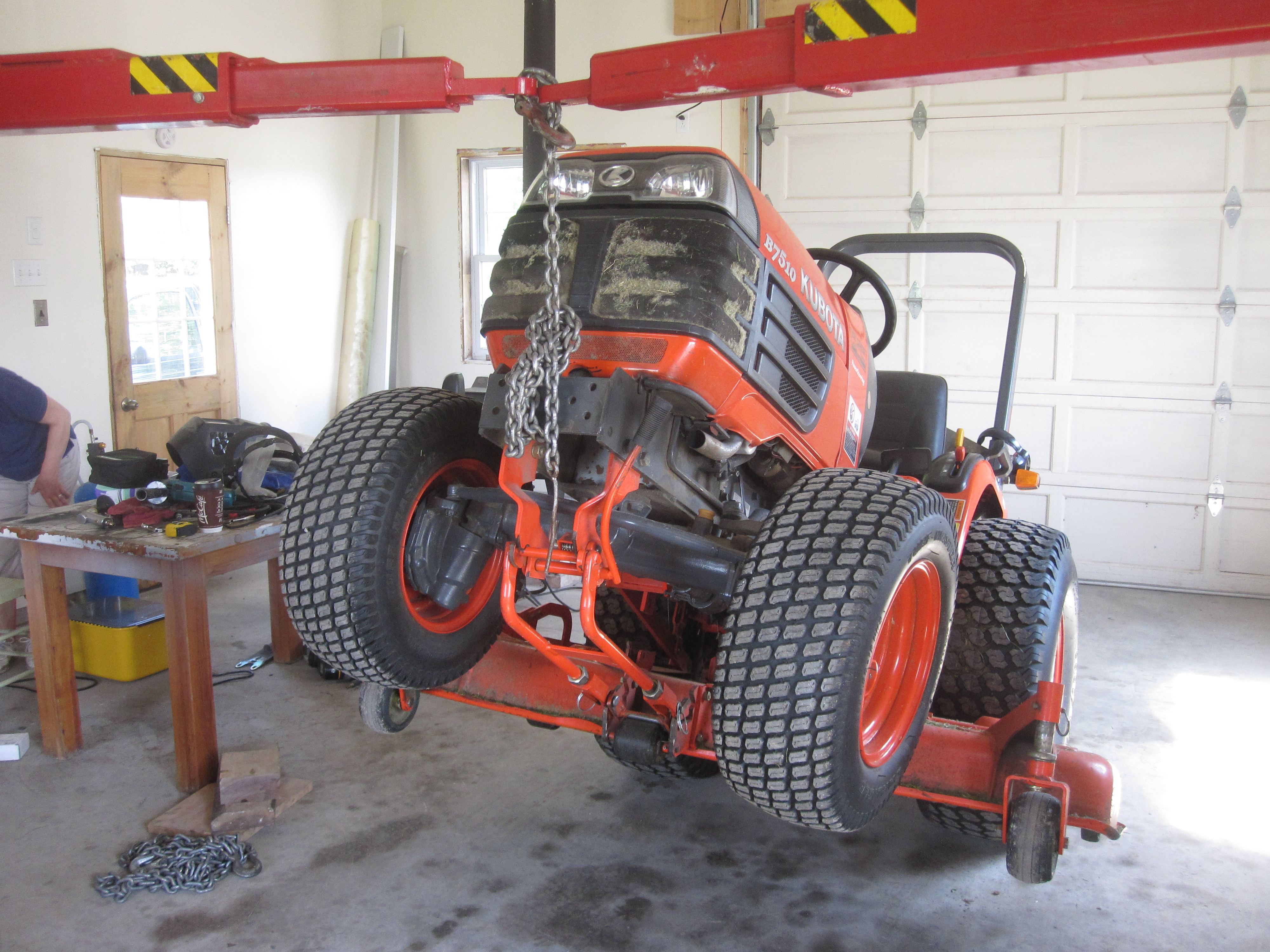
That worked fine. I crawled in and used the 1/2″ impact wrench on the 30 mm socket he sold me. The blades were changed in about fifteen minutes of work, so I may well have found my efficient method of attending to the service needs of this mower.
Comments from TractorByNet.com suggest that axle stands would be a good idea in case the chain fails. But the ones we have are much too short. I’ll improvise a pole under the front bumper. In conjunction with blocks for the rear wheels it should provide a usable device to improve the safety margin.
SAFETY UPDATE, 19 June, 2014:
During mowing season for the last year I have used the chain/hoist technique twice a week without mishap. Today while preparing to put the mower deck under the wheels of the tractor, I wound the chain around the front bumper in a more elegant manner than my usual tangle of knots. My dad used to call the knot a “cat’s paw” but I may not have tied it correctly. As I was lowering the tractor the winding suddenly let go and slid down the chain until wheels hit floor with a thump.
This provided cause for thought: once the chain slipped one link it sent a wave of shock through the chain/bumper structure which began to vibrate my tidy wrapping into a liquid cascade of chain, quickly dropping the tractor to the floor.
All of the other times I have lashed the chain to the tractor’s bumper, I have tied it untidily and irregularly. If the chain slipped a link, no matter. It just bound itself tighter. But not this time.
I’ll make up a prefabricated chain yoke to do the job and let you know. The hoist is still a great way to lift the front of the Kubota for mower installation. I just need to work on the chain part.
20 June, 2014: $27 worth of grab hooks and 5/16″ chain seems to have produced a workable solution (See above for photos). With the new hooking system it takes me four minutes to install or remove the mower.
11 October, 2016: The chain and grab hooks have continued to do a good job over many cycles.
30 May, 2018: The only problem comes if there is a vehicle on the hoist when it’s time to take the mower off.
Review: Kubota B7510 tractor (UPDATED)
May 18, 2013
I’ve spent the better part of the last week getting adjusted to the 2005 Kubota B7510 I purchased privately last weekend and trailered home. So here are some notes and a few questions. Please jump in with a comment where you have information to ad.
Towing
A few years ago I built a tandem trailer for my Polaris Ranger and usually tow it with a 4 cylinder, 4WD Toyota Tacoma, rated for 3500 pounds. The truck/trailer combination proved marginal at best for hauling a B7510 with belly mower. In hilly country I was genuinely worried about the rig’s stopping ability on the wet pavement of the day. For another trip of that duration (3 1/2 hours, one way) I will use a heavier vehicle and a trailer with brakes.
Mid-mount Mower
It’s quite an impressive implement. I spent the better part of two days on a flat garage floor adjusting the thing for a tall cut. It produces a fine mowed surface now, and the rocks are well below the cutters (ok, most of them). The vendor installed the mower by driving over it and clicking everything into place. It took him about ten minutes. To remove the MMM I slid it sideways on the garage floor. Because the mower was set to a 3 1/2″ setting, though, it lacked the clearance underneath. A floor jack raised the front enough to allow the belly mower to slide out to the right. A pair of link stoppers underneath (small plates to hold the mower arms when the mower’s not installed) proved crumbled by the hoist, so I had to remove one and take it to an anvil. The other I beat into place with a small ball-peen hammer. To hop forward in the chronology, after I had re-installed the mower and raised it once, the link stoppers were crumbled yet again. This time I removed both after a look in the manual. The problem was at the setup stage: heavy steel cotter pins were driven through the shaft retaining the link stoppers, and their bulk restricted the necessary rotation of the bits which are designed to clip onto other pins to keep them out of the way of harm from the mower mechanism. Out of curiosity I checked a 2011 B3000 at a local soccer field. Its link stoppers are also bent, caused again by too-thick steel cotter pins restricting the movement. To replace the mid-mount mower the manual calls for it to be set to the lowest possible setting. I didn’t want to do that and planned to store the MMM in a gravel-floored building, so I resolved to dig the mower into the gravel, provide appropriate blocks, and lighten the front wheels of the tractor by not removing the 405 lb. rotary mower from the 3 pt hitch. Then I removed the two flimsy metal covers on the top and drove over the MMM as the vendor had demonstrated. He was a bit better at it, but the process worked. UPDATE, OCTOBER, 2013: Turns out the best way to access the mid-mount mower is to raise the front of the tractor by chain from the car hoist. I use a choke chain off my timber skidder looped through the ends of the rear lift arms. It’s efficient and safe as long as I don’t hit my head on heavy metal while working.
Seat and seat belt
It’s impossible to mow without the seat belt fastened. Perhaps the tractor is designed that way. The seat is slippery enough I would fall off it on some of the slopes of our lawn, and without the down-force of the belt the tractor could easily flip me from the seat on full-speed, 400′ dashes to the end of the lawn. For the record, in light grass the mower cuts very well at max. cruising speed. The mower is indeed an impressive implement. UPDATE: I paid a lot of money for a new seat the parts guy and I found at the Kubota dealer. Enough’s enough. The hated original seat was actually the subject of an exchange program from Kubota a few years ago.
4WD
The extra wheels driving make treacherous slopes easy on this machine. That said, in one terraced section I did use the differential lock to get up over the top. The drive train provides seamless power in tough going, though to eliminate skid marks on corners I have learned to mow in 2WD much more frequently than I did with the Bolens. To its credit the G174 has very effective differentials, and skid marks on the lawn were never a problem until the Kubota took over.
Hoist
Is there any way to adjust things so that the mower doesn’t trail along on its front casters while lifted? (UPDATE, June 13, 2013: The centre roller is digging in on slopes because it can’t rotate around its shaft. It’s pinned in place by the hardware which trails from the front to the mower. Doesn’t seem adjustable. Must ponder this.) UPDATE: The parts guy suggested disassembling the centre roller and lubricating it carefully. Now it turns well but still digs ruts where the mower would otherwise high-centre.
Remotes
I switched the ends to fit my log splitter and tried it. Not bad at all. The splitter seems just as fast (not very) as when mounted on my 35 hp. TAFE, maybe a bit faster. My line pressure gauge reads 2600, which seems high. I tried to adjust the nut. The lock nut came loose easily, but the inner nut seemed to be soldered to the larger round end on the housing. Is the whole thing supposed to turn? I put all of the force I judged appropriate onto the end of a 9/16″ wrench and nothing moved. Perplexed. UPDATE, May 29, 2013: Embarrassed grin. When my neighbour Peter Myers dropped by I asked him about the adjustment. He looked and immediately noticed that the inside of the thing adjusts with an Allen key. A quick 1/4 turn and the pressure was at 1950 lb. and all was well. He further told me that the only thing the high pressure would damage would be a weak hose.
The Tractor
It runs very well, produces an excellent cut when mowing, maneuvers easily, provides great visibility, reasonable comfort, and an improved level of operator safety (I hope) over my elderly Bolens G174. But I still like the Bolens better. I almost never smell exhaust fumes from the Bolens, and I just like the feel/sound of the two cylinder engine better than the rather loud Kubota mill when it’s running the mower. The Bolens is a friend; the Kubota is a tractor. Now when I drive the Bolens I am very conscious of its apparent tippiness. While the ‘Bota has done all of the mowing since its arrival, both lawn and tree plantation (with 48″ rotary mower), the Bolens is still very handy for odd jobs. I don’t see selling it. Another job for the G174: I figured with the empty 3 pt hitch on the Kubota I could easily use the trailer hitch triangle to ferry trailers around the yard when mowing. But I find myself using the Bolens for the job instead. The Kubota’s range of travel on the 3 pt hitch is restricted by the MMM hardware, so it won’t reach down far enough to pick low-lying trailer couplers up off the ground. With unlimited height adjustment, the Bolens works better for this. It also turns out it’s a lot easier for me to turn and look backwards from the Bolens seat, unencumbered by seat, belt, ROPS, and hydraulic controls mounted at my right elbow on the Kubota. So ease of turning around in the seat and the ability to reach down trumps the step-through frame, HST and power steering when jockeying trailers. So far.
Mowing under apple trees
Forget it. It’s too tall. The Roll Over Protection System stands 75″ from the ground. To mow around the trees this time I pressed the old mowers into service to do the precise job for which I bought the new one. But I’m still glad I bought the Kubota. You just never know how something new will get used until it’s been around for a while. Seems there’s still a role for the Simplicity riding mower. With its hydro drive and small stature I can insinuate it under the pear trees with minimal damage to the branches. Its engine is on its last legs, but may last a long time if it only does 20 minutes of work per week. As my neighbours all keep telling me, you can’t have too many tractors.
A final word about the use of a rotary mower with the B7510
I have spent 500+ hours operating a succession of rotary mowers on various tractors since retiring to the farm in 2004. Precise height control on the 3 pt hitch is highly desirable, though not essential. The Massey Ferguson 35’s control was pretty good. The TAFE’s isn’t bad, though it often conflicts with the loader on the other end. For mowing season I bolt the lower setting down quite rigidly and then it cuts very well with a 5′ Rhino mower. The Bolens G174 does not have height control. The Woods 3 pt hitch finish mower which came with it uses chains attached from the leading edge of the mower to the tractor end of the top link for a minimum-height stop. Correctly adjusted, these chains do a good job of regulating the cut. They are particularly useful when the operator has to lift the cutter over an obstacle and then resume. What the 2005 Kubota B7510 lacks which I understand the new models have is precise height control. I’ve now trimmed around ten acres of trees with it and it has done a very good job, but I have to reset the height by trial and error every time I move it. This is an area for improvement. I may steal the check chain brackets off the top-link of the Bolens and install them on the comparable shaft on the Kubota. If anyone knows of a vendor for these simple Woods chain plates (check chain bracket, part #23898) stamped out of 1/4″ steel, I’d like an additional pair. Kurt at Steensma Lawn and Power Equipment in Kalamazoo, MI was happy to take my order for the parts.
Update, 6 January, 2014
The B7510 starts pretty well in winter. Frigid conditions required a block heater. The local dealer provided one which replaced a twist-in plug on the side of the engine block. Note that Kubota calls for very long (to me) preheating intervals. My Massey Ferguson and TAFE both need just ten seconds to preheat, but a Kubota needs upwards of a minute in cold weather, and 20 seconds at a minimum. 15W40 non-synthetic oil works fine in winter, as well.
Update, 2 January, 2016
The Kubota’s ease of winter starting contrasts sharply to the Bolens G174’s cold-bloodedness. Despite the rudimentary heating element glued to its crankcase, if I wish to use the Bolens in very cold weather I have to put it to bed each night beside the stove in my woodworking shop. It’s a garage queen from ice-in until ice-out.
A false economy 24 April, 2015
When I bought the tractor it was missing one cap on its battery, the hole covered with duct tape. By the time I replaced the tape with a plug borrowed from a Polaris battery, spilled acid had rusted the cooling tubes and radiator screen. Two years later I found myself with a set of HST cooling tubes glowing orange from rust. This required a thorough cleaning and paint job on the affected area. The replacement battery only cost $89.00 from the dealer and works much better than the 10 year-old leaker in front of the fan. Why had I waited this long to replace it?
A surprise: the engine needs far less pre-heating with the new battery. The thing had started well all winter, so I hadn’t suspected that the 10 year-old battery was losing its touch (apart from leaking acid out the top, of course).
Safe when others must operate it 2 December, 2017
Heart surgery slowed me down last summer. Running the Kubota was more than I could handle, so my wife decided to mow what parts of the 2 acres of rolling lawns that she could. Turns out she did most of the mowing over the summer and rather enjoyed her new gardening implement. A retired electrician returned a decade of favours by stopping by to do whatever climbing and heavy lifting required. He lifted the 5 gallon cans of diesel to fuel the Kubota and mowed under the apple trees on the steep slope. Bet did most of the rest.
Nobody removed the mower for service, though, so it went almost 200 hours without grease or sharpening. In the fall my wife even mowed 1-mile trails through the fields and woodlot so that I would have a good surface for the walks which were part of the post-surgery therapy. When I finally cleaned it up and greased the mower, it seemed not to have suffered for the neglect.
Yesterday we pressed the Kubota into service to power a medium-sized logging winch. While I did not need to skid logs with the tractor, just control the felling of a bunch of dead trees, it carried the 540 lb. weight and, with the blade of the winch dug into soft ground, had lots of pull. The B7510’s a little light for the job, as a couple of hard pulls to control the fall of tall, crooked trees produced 4 wheel wheelies. Nonetheless, the Kubota did the job safely in a pinch, without damage to anything. The short length was a real asset in this thickly forested area. Again the safety interlocks on the tractor made it safer for a visiting operator to run it.
UPDATE, 29 December, 2018
At well over 800 hours now, the Kubota has proven to be by far the most useful tractor in the shed. Its recent implements include the 7.5 kw generator, a lightweight chipper, the lawn rake and the sweeper, and occasional bouts on the snow blower, winch, and box blade. Last summer I actually had to repair it. The tachometer cable failed. The local dealer had one for $35, though I had to dislodge a mouse nest in the dash to effect the repair.
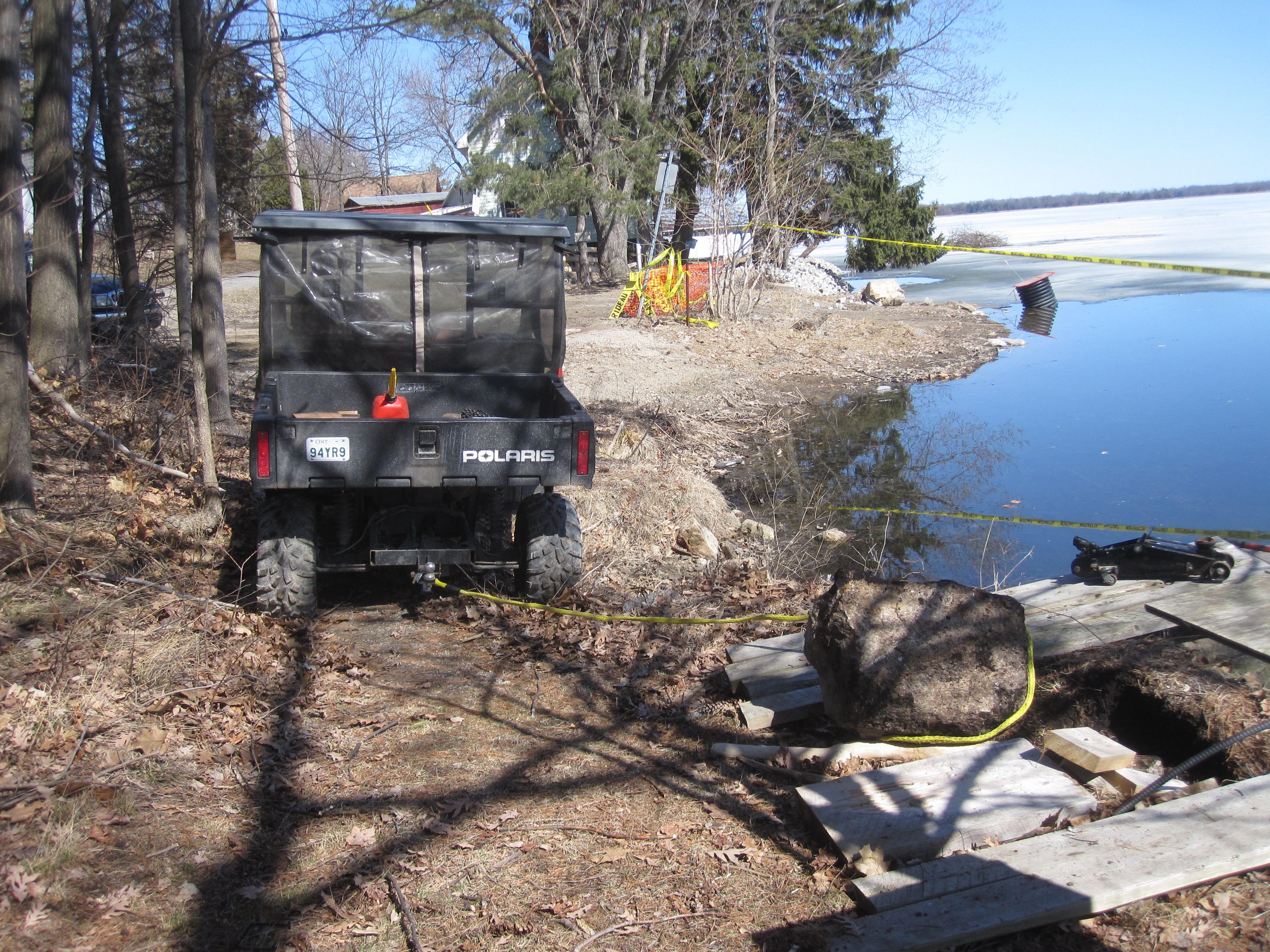
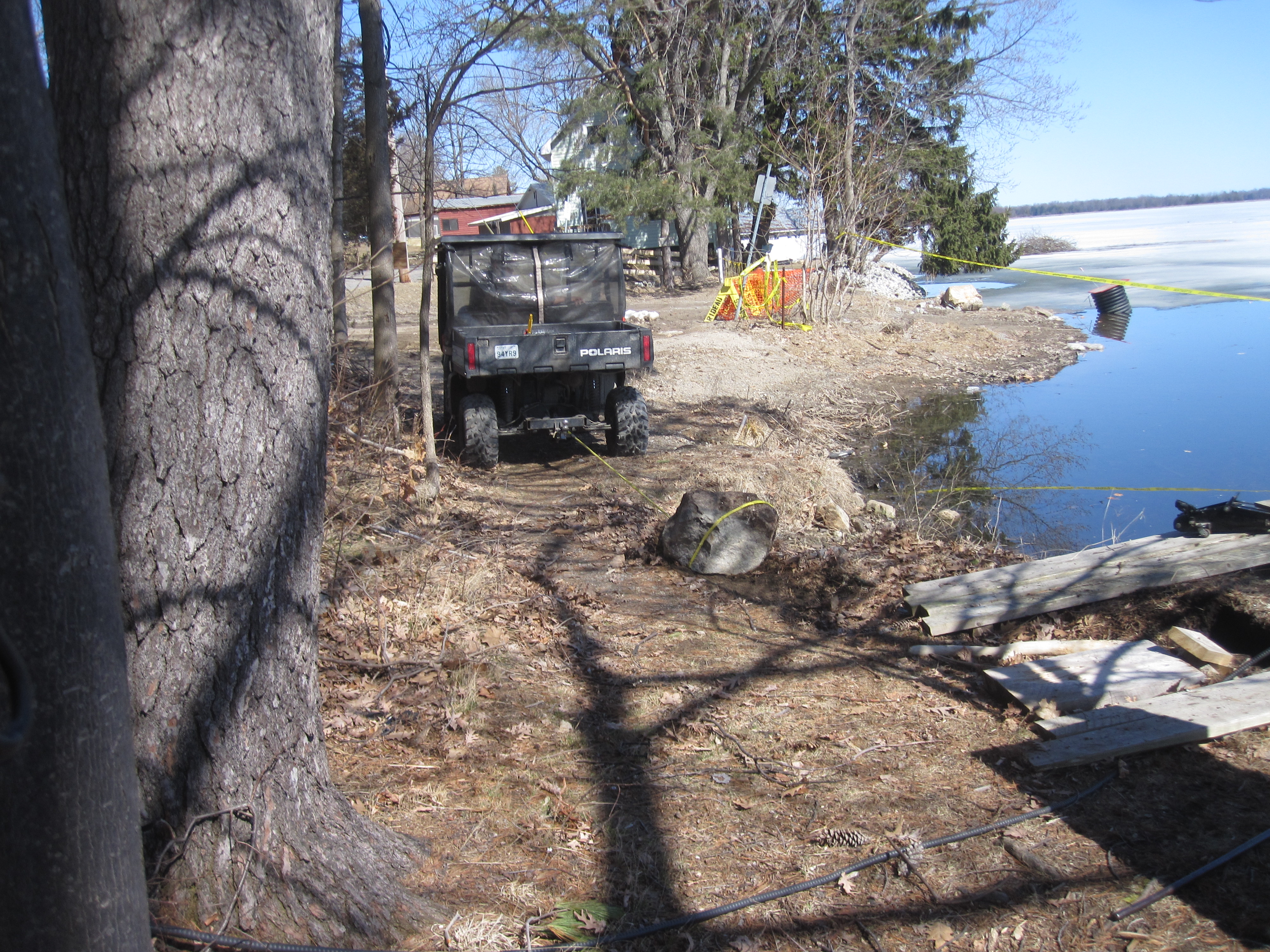
Ranger 500 VS rock
March 30, 2013
A sizable boulder has obstructed access to my friend’s dock since we put the thing in 3 years ago. Today the boulder met the old Polaris Ranger 500 at the end of a tow rope.
No contest.
Polaris Ranger shootout: 2WD vs 4WD in snow
March 10, 2013
Yesterday Tony brought his 2003 Ranger 500 to the farm and drove it around the trails in the woods I had established with my Massey Ferguson 35 and winch for hauling out logs. The wide body on full-sized Rangers may be a pain to fit onto a trailer, but the wheels fit nicely into a tractor track through deep snow. In anticipation of sugar making activities I had dragged the blade on the winch through the trails where the snow was very deep to provide ground clearance for the Rangers. Tony’s new to offroad driving so he wasn’t as impressed as I was by the 500’s ability to navigate sections that had stuck my 2004 2WD Ranger TM during the previous week.
Then we used the 500 to do something none of my toys could handle: move sugar-making equipment from the basement of the stone house up to the sugar shack. The 500 could move around in/on corn snow that had left the TM royally stuck. Just for the record, a standard 3/8″ dock line of the sort I use in summer is not strong enough to tow a Ranger when it won’t go any more on its own power. I stretched one past its breaking point twice with my Bolens 4WD tractor, then went with a prefab towing line out of yellow nylon which worked fine.
The first thing I tried with Tony’s Ranger was a slide down the hill. Why not? At full throttle off the top of the hill by the brick house we planed 600 feet down the slope until I could pick up a tractor trail back to the barn. Tony was a bit wide-eyed during the descent, but the machine worked fine in the granular snow.
After loading the gear in the deep corn around the south side of the house the 500 couldn’t back up the slope to get to the driveway, so I just booted it back down the hill and picked up the previous track across the field and up by the barn. It was an exhilarating ride for two guys, a dog, and a precious and fragile bit of kit, the boiling pan.
Eight 16 litre pails of water made another trip. Well, nine, but one didn’t have a lid, so Tony only filled it 2/3 full. Away we went. It was still more than half-full when we got to the shack. We didn’t get wet because of the rear windshield/stern cover. Pretty good ride with a partial load. Interestingly, with the extra 300 lb in the bed the 500 didn’t plane over the corn snow. The back wheels had to dig their way through. The 30 hp engine seems well suited to the chassis in tough going. I remained in high range throughout these adventures, of course, with the throttle pegged to the floorboards.
This week I plan to keep the 500 in the shed as a tow-truck and gather sap with the TM as long as it will do the job. If previous experience is any indicator, it will get through the syrup season just fine, floating over soggy turf which would bury heavier vehicles — even my little compact tractor, while carrying 14 pails of sap or up to nine volunteers per trip.
The TM is only 90% as capable as the 500, but its drivetrain is so simple I think it’s a better choice for multiple, inexperienced drivers.
Eskimo Stingray 33 cc Ice Auger Review
January 8, 2013
This nearly turned into one of those pieces where the author vents his frustrations about the worthless product. You know, the kind with the one star out of five rating at the bottom, and the word “junk” in the last sentence. But then I read the instructions.
The auger was an impulse buy at Canadian Tire during the Christmas blitz. Its sale price of $300. was the same as the best I could find on Amazon.com, only without the additional costs of delivery and a border crossing. So I bought it, torn package and all, at the risk of a scowl from my wife. After all I was supposed to be shopping for Christmas presents for family members at the time.
When an ice fishing buddy stopped by the workshop I decided it was time to fire up the new toy, so I grabbed the open can of chain saw gas, dumped a bit in, and let fly. The engine started only after I splashed fuel around the vicinity of the spark plug hole and re-inserted the plug, but then settled into a smooth idle, smoking enough to set off the alarm in my woodworking shop almost immediately. My pal suggested that the gas smelled a bit old, but you know how guys can be: “That gas was fine when I cut up those logs last spring, and it worked fine in the brush cutter all summer.”
The next trial was to start it in the cold at the lake. That required another drink through the spark plug hole to get it warmed up enough to drill. Once started, it cut a series of holes through soggy ice ranging from 12″ to 16″ with no difficulty. Clearly the auger works very well; it was just a matter of getting the Viper engine to start.
I was impressed with the design of the protective cover over the blades. It seems to allow you to stand the auger up for starting without damage to the blades or the surface below. The auger also has a point to centre the hole. No doubt this is good for starting cuts on hard, glare ice.
On Monday morning I tried to start the Viper under conditions I could expect to find on the lake. Zero degrees F, a wind, bright sunlight. No way would it start. Removed plug. Numb fingers. Dropped plug in snowbank. How do you get ice out of a spark plug? Place it in an interior pocket (the more interior the better) and wait for it to warm up. Pulled cowl off air cleaner with Philips screwdriver. Dropped screw into protective plate at bottom of auger. Mindful of razor-sharp blades, tried to get it out with pliers. No room. Tipped auger over. Lost screw in snow. Located with shop magnet. Lit fire in shop stove to thaw hands. Continued.
Failure syndrome beginning now. Narrowly avoided damaging prongs which hold cover for air cleaner. They looked fragile enough that I held back a bit. Reassembled. Cover loose under there, but recovered screw went in O.K.
No hint of life from motor.
In desperation I re-read starting instructions. Nope. They hadn’t changed. Checked Internet for tales of woe about Eskimo ice augers. Not much. Most people love them. Dug more deeply. Found a discussion group devoted to owners very much like me. One learned contributor posted a 500 word essay in which he explained that the Viper engine will start well if the fuel vapourizes properly. It needs winter gasoline, and 87 octane, not high test, as regular unleaded has more aromatic ingredients for winter starting.
I looked again at the instructions. No way was I going to buy a new can when the other one is only a year or two old, but I’d give it new fuel and oil. So off I went for five litres of regular, carefully mixed in the 50:1 synthetic I use in my chain saw, and dumped some into the newly-drained tank.
Halfway through the first tug the thing began to purr smoothly with little smoke. Oh.
Just to be sure I have left the motor unit (auger stowed away) in a snowbank in the shade for a series of cold-start trials over the next week. So far it has lit up on cue every time. It needs a bit of prime at each start and the choke set. But then it starts easily and idles without hesitation. Unlike some Chinese engines which won’t start without the choke, this one will start when warm with just a tug on the cord.
That old summer gas just wouldn’t vapourize, or maybe there were ice crystals in it. After all, it had sat in an open shed without a cap on the spout for several months.
Had I written the review at the spark-plug-in-the-snowbank stage I would have made a fool of myself, slagged the product, and contributed nothing useful to the discussion.
If all else fails, find somebody on the Internet to tell you what the instructions which came with the motor actually mean.
AFTERWORD, 9 January, 2013:
After a couple of days of cold starts I believe I have figured out the drill:
1. Turn switch to “on”.
2. Ensure choke lever is set to “run”. I don’t know why, but everybody says to do it, and it works.
3. Give primer a light squeeze, about 50% of maximum effort.
4. Turn lever to “choke”.
5. Tug cord lightly.
6. When it starts, gradually raise choke lever to “run”.
How do I like the auger? It’s too heavy to lug around on foot, but it starts and runs very well with fresh gas. With sharp blades it has abundant power to cut 8″ holes in ice. Overall I’d say it’s a pretty good machine and an excellent value. Just stay away from stale gas with this engine.
UPDATE, 12 January, 2013:
The auger worked very well on an exploratory fishing trip this morning. I drilled several holes to mark a route out to the fishing area, and then many more in an attempt to find a weed bed. No fish were forthcoming, but it wasn’t the auger’s fault. Over three hours and many starts I gave the cord a second tug only once when I miscalculated the choke.
On glare ice in deeper holes I found my inertia wasn’t quite enough to overcome the auger’s torque by the bottom of the hole, and I found myself beginning to slide. For even deeper cuts in soggy ice I might need another person (or better footing) to steady the auger, but the little engine produces plenty of torque. After lugging the thing over questionable ice for a half-mile on the way out, I was happy to load it into the box of the Ranger for the return trip. It’s heavy.
UPDATE: 1 February, 2013
So far this season we haven’t caught many good fish, but it’s not the equipment’s fault. The auger has drilled dozens of holes, trouble-free. We couldn’t ask more of it. It starts well in all weathers, and it’s not hard on fuel. The 33 cc engine is well matched to the 8″ auger size.
UPDATE: March 25, 2018
My friend asked me in an email to install a sump pump on his dock to begin to prepare for spring break-up. I got out the ice auger, only to discover that the fuel line had dissolved. Without a practical way to clean the gorp out of the fuel tank, I rinsed it as well as I could, cleaned up the carburetor, fitted the requisite new parts, and couldn’t get the thing to run with any consistency. After several hours of work spread over a week and too much expense, I scrapped the thing and used my friend’s cordless drill with a 5″ auger attachment.
A fuel system should not dissolve over time.
Firewood handled only twice
December 23, 2012
Ironwood (hornbeam) is an inconspicuous weed tree which grows beneath the maples, walnuts, and towering beeches of the forest crown. It fills in sunlit spaces if it can, and if not will stretch up forty feet until it eventually dies from root disease and falls over. Its cadavers litter the forest floor, often suspended a foot or so above the ground, dried like bones.
My dad built fences with them. He claimed ironwood rails would last twenty years, and a horse couldn’t break them. But now that there’s no more livestock on the farm, the dead ironwoods have become a mess of pick-up sticks.
I decided it was time to launch a small campaign to clean up the view from the trails.
My new Husqvarna 346 is light and fast. The 20” bar reaches the ground with little back strain.
At 44” in width and with excellent ground clearance, the Bolens G174 can get to any part of the woodlot to pick up cut blocks.
Last winter I discovered that the Walco 3 pt hitch dump box on the Bolens holds as much firewood as the 5’ bucket on the larger tractor. What’s more, it can back directly into my workshop and unload at the woodpile beside the stove.
Think of it: firewood handled only twice.
But a run back with the Ranger to cut a couple of ironwoods and then returning with the tractor to haul it out seemed wasteful to me, so on a wet day I built a scabbard from two 6” boards rabbetted to create a slot for the saw’s blade.
First I bolted it vertically to the bumper of the tractor. That worked fine until I tried to change the oil. Oops. Couldn’t open the hood. Off it came. Internet searches offered no real suggestions apart from the odd bit of butchery of the tractor’s sheet metal. The scabbard wouldn’t mount behind the seat. There wasn’t room on the little tractor.
Then I looked at the right fender. If I could hold it in place there, it wouldn’t interfere with much of anything. A leftover fitting from a plastic tractor canopy spanned the handrail and bolted the scabbard in place. A loop of string slipped over the starter cord to keep the saw from working its way out while underway if I forgot to set the chain brake.
It takes an hour on a fine day to cut enough ironwood to fill the box, bring it to the shop and add it to the woodpile. No block is larger than 6”, so the splitter isn’t needed. The surprise is how well the forest-dried wood lasts overnight. Ironwood, it turns out, makes excellent firewood.
There’ll still be lots of use for the logging winch, the hydraulic splitter, the loader on the tractor with a cab, even the manure spreader with beaters removed, but firewood handled with all of this equipment requires many stages of production and quite a bit of diesel.
The little tractor-with-saw-attached uses less than a litre of diesel per hour of operation and requires little strength of its operator. It looks like a system which could work for me well into my seventies.


 the Walnut Diary