2002 Polaris Ranger 500 after 1650 hours: Review
November 15, 2012
My friend Tony ran across an elderly Ranger 500, a recent trade-in at the dealership where I bought my Ranger TM some years ago. He asked me to have a look if I got the chance.
We drove to Carleton Place today to see how much worse (or better) the vehicle in question was than our 2004 two-wheel drive TM. My first impression wasn’t good. The solenoid wouldn’t even click when I tried to start it. The booster battery didn’t work either. Then the sales guy remembered to touch the brake while starting, and it purred to life. Polaris put on a safety interlink which allows starting in gear. Once started, the engine ran very well. Bet was impressed by its smoothness and its quiet.
Two different guys at the dealership told me about the two Ranger 500’s at the Carp landfill which have run all day, every working day, since they were bought in the early 2000’s. I don’t know how they’d measure such a high number on an hour meter, but one’s supposed to have almost 17,000 hours on it. No motor job on either yet.
This test vehicle’s a trade-in from a farm with a maple sugar operation. From where the mud is caked underneath, mixed with bits of hay and bark, that makes sense. The clutch take-up is still smooth, so I don’t think it has ever towed a heavy trailer. On a farm there’s a tractor (or four) to do most heavy jobs. A large dent in the front plate indicates that somebody hit a rock or solid stump up front. That can happen. The radiator is untouched after a considerable impact from the front and below. The choke cable hangs out of the dash. It’s stiff and needs to be replaced. The torn seat bottom has been replaced by a borrowed one, but it still needs the heavy rubber grommets which allow the front of the seat to snap into the frame.
I didn’t check the oil or the air filter, but the machine looks to me as though it has had normal use around a farm over a long period of time. Farmers take care of stuff. Possible trouble spots? Old cable and leaking tires, upholstery. It needs new wiper blades. As nearly as I could tell the drive train works properly, as do the brakes and suspension.
I understand the engine received a rebuild a few years ago. The 500 cc single is smooth, quiet, and powerful in comparison to the detuned 650 cc twin in my Ranger TM.
The cuts/scratches on the right side of the plastic box likely came from an encounter with a barbed wire fence. The box is in better condition than the one on our TM. This one’s nice and straight. Ours droops over the axle a bit due to what I assume was an outrageous load before we bought it. Similarly, this roll cage is still solid. Mine needs a bit of welding. The TM’s “roll bar” is much less sturdy than the 500’s.
One reason why the 500 is set up to start in gear with the brake on no doubt is because of the involved procedure to get the thing into road gear. Shift from N to L to another N to H. Or shut it off in H and drive it that way until you need to back up. The separate shift for differential lock is the same as on the TM. AWD engages with a rocker switch on the dash.
The roof and glass windshield (with wipers) are desirable features, but I expected dust and exhaust fumes to make their way up around the box and into the cabin. I wasn’t disappointed. I understand a second windshield to close off the rear of the cabin is necessary for proper protection against weather and fumes. That said, I could likely get by with the slightly smelly air as the exhaust from the little engine wasn’t that bad.
After fifteen minutes of driving in a large flat lot I didn’t see or feel anything about the Ranger to ring any warning bells. I think this 2002 Ranger 500 is exactly what it appears to be, a solid machine traded in on a new one of the same model after 10 years of service.
I would own it.
UPDATE: 4 MARCH, 2013
The dealer replaced the choke cable and the front ball joints before he released it for sale. Turned out the joints were very bad. A session with the mechanic taught me the trick with the oil changes on a dry sump engine: after the sump is drained there is still a cup of oil in the engine block. Remove the spark plug and flip the engine over a couple of times to allow the pump to empty this residual oil out. Then add two litres and start. If the dip stick still reads high there’s a vapour lock, so squeeze the soft rubber vent tube from the sump to the engine and try again. This will usually allow the oil to pump through. When the dip stick reads properly, the job is done.
I put the 500 into my shop and went to work on the little things. The rear lights needed bulbs, but the wiring was intact. The wiper motor’s connection was weak. Tire pressures needed adjustment. When I retired my sedan cruiser to the corner of the back field I removed the vinyl side curtains from the expensive stern cover. They had sat for years in an equipment bag. It was the work of a couple of minutes, two spring clamps and a couple of feet of red duct tape to put a temporary rear windshield on the 500’s cab. It has served so well in that application — even with a couple of trailer rides on the highway, that it’s likely to stay there. The cab/windshield/rear screen is surprisingly comfortable against winter’s blasts.
AWD makes a huge difference with the Ranger in winter. While I wouldn’t take it out on the lake in 10″ of snow, it can go very well in six inches with occasional drifts deeper than that. The 500 has proven amazingly agile when climbing over obstacles, powerful enough to push through heavy snow and slush, and capable of sustained, 30 mph speeds over distances.
The 500’s engine starts very well in winter. There was a phantom electrical fault which drained its battery a couple of times, but we have traced that to a sticky light switch. The thing always smelled strongly of gasoline. Replacing the gas cap didn’t help. After a couple of weekends it quit starting and dumped the contents of its fuel tank onto the ground by way of the carburetor overflow whenever we operated the starter.
A call to the dealer revealed that it was a needle valve plugged with dirt in the carburetor, so off it came — a simple job except for the cables, which were tricky. It went back on minus one of the two screws which hold it in place. We’ll find the screw in the spring, with any luck. The engine runs very well once more.
The odd electrical glitch and crud in the gas line are to be expected from an old machine. Apart from that, it’s a surprisingly capable and pleasant UTV.
Princecraft Starfish 16′ DLX SC review #2:
October 16, 2012
A reader confronted me: “I tried to find my way around your blog and couldn’t make any headway. I was looking for your series of reviews of the Princecraft. Where are #2 and #3?”
Blushingly I admitted that I hadn’t written them.
“You shouldn’t do that.”
“I guess I’ve been more interested in producing content than curating a library.”
So here goes Review #2, wildly out of chronological order. Call it a flash forward or something.
The boat’s currently in the yard, hauled in advance of a promised storm which turned out to be a shower. But therein lies a tale. A couple of weeks ago I pulled a muscle in my leg and it grew steadily more painful until I took to bed for a week or so to let it heal. Calling upon his immense experience but little actual observation, my Portland G.P. insisted it was a hamstring pull. Paul, a physiotherapist at the Athens clinic, explained it was an adductor tear, and quite a nasty one with a lot of bruising.
Adductors enable one to raise the leg for steps over objects. I wasn’t looking forward to hauling a boat with limited mobility. Bet agreed to crew, so I backed the trailer down the ramp beside the slip, set the brake, and limped over to the dock. Stepping down into the boat wasn’t all that bad. I had the tall seat and a dock post for balance, and the wide step on the starboard side provided a good target for my lurch down into the boat. One more weight shift over the stiff leg and I stood on the floor of the boat at the stern, still balanced by the seat.
I released the stern safety rope which snaps into a towing eye, then reached over and twisted the key as I sat down. The engine purred to life. Bet tossed the two bow lines into the cockpit. The boat gently eased backward to where I could release the final stern line and I was away.
Did I mention it was blowing whitecaps in the bay? I realized I would have to run onto the trailer with a strong cross wind and occasional drifting patches of weeds. Oh well. Normally hauling a 16′ boat just involves taking aim and shutting off when it gets to the trailer. This would be a little more difficult.
I remembered a time-honoured boating adage: Good seamanship is never getting into a situation where you need to use it. Well I had a bum leg, an audience, and a strong cross wind, so I guessed I’d better raise my game a bit, anyway. Early on I’d installed a couple of tall PVC tubes at the corners of the trailer to protect the hull during capers like this. I decided to use the wind, so I raised the motor a bit to clear the silt along the shore and began to drift toward the trailer. This seemed controllable at low speed, so I slid the nose in quite close to the upwind post, just touching it, then gently nudged forward into the gap between the posts until the boat stopped. Bet hooked the winch into its ring and started to crank. I shut off and reached across to hold the upwind post to centre the hull on the trailer. That worked, so after she’d attached the safety chain at the bow I raised the engine a bit and asked Bet to drive ahead.
The part of this I had dreaded most was my departure from the boat on the trailer. No way was I going to jump today. But the step up out of the cockpit floor and the wide port gunwale allowed me to drop the bum leg over onto the trailer fender. The handhold on the cockpit bulkhead turned out to be ideally placed for this. Another step down the side of the fender and I was on the ground.
I’d always detested climbing over the side of the old Springbok when it was on its narrow trailer. The new trailer allowed me to make the climb with an injured leg. Bet and I realized right then that the Starfish and its matching trailer have a few ergonomic touches worth their weight in gold for someone with restricted mobility. It’s a great geezer boat.
Felix Baumgartner and an afternoon of excellence on the Internet
October 15, 2012
Like many others, no doubt, I watched online while the balloon inflated and the flight got underway.
The streamed transmission in HD worked splendidly on my MacBook Pro. During the time that not much was happening, I kept watching for the occasional bits of movement: what’s that guy doing with the lift truck by the crane’s back wheels? Those guys holding that big air hose must be getting tired. Are they ever going to set it down?
My immediate praise went out to the crane operator for his flawless handling of the launch. Everything rode on his timing and control. As the massive bag of gas swept up he drove the capsule down the runway underneath until the tether was vertical, and released it without stressing the thing in any way I could see.
From there Red Bull and Felix set up the story line as a legitimate piece of space travel/research, complete with Old Joe on the microphone. The subtext was that Joe, who set the records in 1960, was bringing along a successor. His kindly mentoring was flawless throughout the script. His voice was a welcome and unifying substitute for the babble of radio traffic and static I remember from radio broadcasts of early launches from Cape Canaveral.
Photography took quite a leap with clear images from over 40 miles away as the ground crew followed the craft. The jet stream now makes sense to those of us who were along in that capsule. We watched the displays: interesting how it gets cold, and then warmer as the balloon goes higher. It hovered, then took off again, no doubt due to the sun’s action on the bag. How much can it inflate before it bursts?
The jump was flat-out terrifying when we saw the image start to spin as Felix hit the sound barrier. Then after a beat, magically, he was stable again and we were back into our space-fantasy storyline.
Perhaps the classiest part of a very well done Internet show was the decision to open the parachute seconds before breaking the longest-freefall record. Nothing was said of it (classy again) but Old Joe will go to his grave with his record intact.
Red Bull has pulled off a major coup in sponsoring this event and telling the story the way they did, and I’ll never look at a Glad sandwich bag in quite the same way again.
Replacement Windows in a Brick Victorian
October 2, 2012
While trivial workshop stuff is a sitting duck for the blogger, large projects can be so all-encompassing that there’s no room for journal reports. I guess that’s the way it was with the windows in the brick house. It has taken a pulled hamstring and a day of boredom in bed to let the ideas coalesce into a report.
The most conspicuous evidence that the project has progressed beyond the first stage is the little pile of bits for my impact driver which has sat untouched on the kitchen counter for a couple of days. For a week they made the trip from one pocket to another, everything coming to a halt if one of them was lost.
The green Robertson fitted the screws which held the seventeen aluminum storms in place. The red Robertson drove the 2” screws out of the big plastic jar which followed me around, first to secure the new windows in place and then to fasten them permanently. The 1/8” drill with 3/8” countersink got me through one layer of vinyl at the bottom of each window so that the screw wouldn’t interfere with the window mechanism. Phillips and flat bits were largely passengers in my pocket, though they were pressed into service occasionally to remove old screws in window trim which were too firmly attached for the chisel and mallet.
When it came right down to it, the window installation was pretty simple. Remove the storm window. Pry off the interior trim. Lift out the bottom window. Chisel out the ½” separator between the two halves of the window. Remove the top half. Measure for the base adapter and the side fillers. Machine them in the shop. Caulk everything. Set the 11 degree base piece in. Tack in the 7/8” by ½” pine fillers over the caulk beads with 2” galvanized finishing nails. Drop the window into the space. Screw it in with six screws, taking great care not to over-tighten. Foam a bit. Let dry. Check operation of windows. Foam some more if it’s o.k. Clean up.
I should emphasize that this flurry of activity wouldn’t have gone smoothly without a few preconditions:
1. confidence that the new replacements from Marlboro Windows in Ottawa would fit;
2. easy access to a well-equipped woodworking shop;
3. abundant scaffolding and ladders of various sizes.
Brian Doherty of Rideau Lumber in Smiths Falls came to the house and in an hour produced his list of dimensions. He told me he allowed ¾” for side clearance (measured from the vertical surfaces after the chiseling was complete) and ½” top-to-bottom clearance (measured from the window sill to the highest point in the window frame the tape could reach). This is accurate to the best of my recollection. On the estimate, however, he ordered windows 1″ shorter and 1″ narrower than the rough openings listed on the invoice. A few windows were out of square, but Brian’s generous space allowance was just right. What I would infer from this (now that all of the windows have fitted perfectly) is that window measurement is an art, and it might be a good idea to have an expert do the measurements.
There was space for foam, but not too much. I did, however, decide to add ½” fillers to the exterior stops after the caulking bead on the first window shrank and let go on one portion of the joint. This was a ground floor joint and easily serviceable, but for nine of the windows I would be up petty high, and I didn’t want to make any return trips for leak repair in the middle of the winter.
On the first window I also put in too much foam. Even the low-expansion stuff will jam the window if squirted in liberally. This is where the burnt-fingers technique with its constant feedback loop works well: as the window grew tight, I tightened up the screws and added a few more to push back on the foam. That worked. Having learned my lesson, I extended the foaming over three sessions from then on.
And so the windows went in without much drama. The double hung white vinyl Marlboro product was what the owner had promised when I visited the factory in Ottawa before making the order. They were dimensionally accurate, solid windows with good hardware. As Brian Doherty had told me, “Installers love them.”
The other variable was my woodworking shop within easy walking distance of the project. The 8” General jointer with its 3 hp motor proved very important: the adapter plate was an 11 degree taper where I cut a piece of 2” pine down to a wedge 7/8” thick on the narrow side. The jointer cheerfully chewed through a lot of pine to make the wedges. Because I have made beveled panels freehand on the jointer for many projects over the years, I could make these beveled pieces easily.
The 10” Rockwell Unisaw did the ripping without fuss. I quickly realized that the filler strips shouldn’t be one-offs. Too much time would be involved, so I ripped up a few 7/8” clear pine boards and then planed the strips to the proper thickness, thereby providing a jointed surface and predictable dimensions for a bunch of material.
What I hadn’t anticipated was that the window installation would be only part of the project. The first window sill which came apart in my hands changed all of that. I suddenly needed 4” material for a new sill, so out came the clamps. I felt very glad I’d bought 300 bd. ft. of dry pine and planed it to 2” and 1” before the project started. Lumber yard 1 ½” plank would have required a lot more work to get ready to make a sill. With a 9” X 48” x 4” blank glued up, I reconstructed the sill from the pieces removed and dropped 25’ to the ground (the ground slopes away steeply from the south side of the building).
But the sill’s just a 4” thick piece cut on an 11 degree angle on both edges, sized to fit the space. Ripping 4” material on a 10” saw is a pain, so I just chewed the 4X9 into place with the jointer. I took off about an inch.
I put a couple of coats of white exterior stain on the sill, then tried setting it into place. Never did take it out again. It was fine. I foamed and caulked, then put a wider adapter plate over the top to cover the joint between the sill and the interior sheeting. The other plates were 3 3/8″ wide. This one was 5″. Then I dropped in the window. The repair cost me a day or so, but the work wasn’t difficult.
Gradually I was coming to realize that the real work of the project would be at the painting stage. In the late fifties or early sixties the aluminum storms had gone in over a wide bead of caulk which had hardened in most cases, but on the north side of the house remained gooey enough to confound sanders and scrapers. Fortunately the sun on the south-side windows had baked the caulk to where it would chip off.
The only new tool for the project was a Mastercraft 12v cordless sander/scraper I found on a half-price sale at Canadian Tire for $70. With a thin stainless steel blade it dislodged the caulk on the upper windows, but produced a rough, unpredictable surface. So I recharged and went at the window casings with 80 grit sanding pads and the same machine. This worked. The very light tool proved well worth the purchase price as it fitted into my back pocket for the long climb to the second floor. Battery life with the suspiciously small lithium power pack was considerably better than I expected. On the lower windows I wheeled out the Dremel 120v equivalent and gloried in its abundant torque and noise, but the lightweight portable detail sander has done a fine job so far.
Next:
Dealing with bees, scaffold, caulking and dust.
UPDATED! Princecraft Starfish 16′ DLX SC review #6: preliminary fuel consumption figure
August 30, 2012
One day last week I attached a full tank of high test to the Mercury EFI 40 with a recorded hour meter reading of 10.1 hours. Last night I switched the tank out at 14.9 hours, even though there was some fuel left. This morning I added 18.8 litres at $24.63 to top the tank up.
What was the engine doing in that interval? Two evenings involved running 6 miles to Indian Lake to troll. Others involved the usual jaunts at cruising speed out to fishing spots on Newboro and Pollywog. These involved considerable slogging through weeds. One chore was towing a full-dress Ranger bass boat and its owners back to Newboro in the dark after its engine mysteriously quit*. I’d never seen a five-blade prop for an outboard before.
* January 30, 2013: After several months of thinking about this fuel consumption anomaly, I must conclude that someone added fuel to the tank of the unattended boat without my knowledge. The prime suspect would be the owner of the Ranger bass boat I towed in to Newboro.
Note:
My hour meter measures time that the key is on, not revolutions, so a trolling hour counts the same as an hour on plane.
18.81 litres is 4.96 US gallons or 4.13762 Imperial gallons.
hours 4.8
UPDATE: 7 September, 2012
I may not have put enough gas in the tank at the station the last time, because today’s top-up came at 16.5 hours. I put a bit more fuel in this time and it took 21.32 litres at a cost of $28.56.
The boat usage during this interval involved trips on plane of two to six miles in length.
Obviously it takes a large sample to provide a reasonable estimate of fuel consumption with measurement as clumsy as what I am using. But I shall persist.
UPDATE: 18 September, 2012
I switched for a full tank at 18.4 hours after a series of three-mile runs on plane over the course of a week. So that’s 1.9 hours per tank at cruising speed. I think there would have been enough fuel for a bit more. Perhaps two hours per tank is a reasonable estimate of fuel consumption under normal conditions and load — as long as there is a second fuel supply available if the tank runs dry.
How to change a lawn mower tire
August 25, 2012
Yesterday I resolved to fix the left front tire on the Simplicity lawn mower, so after an extended session with a pitcher of water I located and marked a crack in the sidewall of the offending tire. Trouble was I marked it with a lumber crayon and the tire was wet at the time. It proved an imprecise indicator of the actual leak location, for when I probed with the sticking tool I almost found the hole. No matter, now there were two leaks to patch. More practice. It was such a small tire that I decided to cut the sticky string in the kit into half to get twice as much. Learned why those gooey strings are that long. Used two more. Added some goo outside, just in case. Ate supper while it set.
Added air. Whoosh! It sounded more like a deflating balloon than a working tire. I resolved to make a proper repair. Googled for a while, not finding any 15 X 6 turf tires without four-hole rims attached. The Simplicity uses a bronze bearing surrounding a ¾” axle, secured by a clip hidden under an impossible vinyl thing which sorta holds grease.
Eventually found the correct rig at Canadian Tire, of all places, a universal kit which promises to fit almost all lawn mowers. $59.99 plus taxes. But comments warned about the vinyl centre of the wheel, so I questioned the replacement wheel’s suitability. Tried the same phrase in Google and found that Home Depot has them for $35. In Watertown. Tried Kingston. Frustrating process here, but basically Canadian stores don’t stock them at any price.
Oh yeah, there was a place in Texas which sells the tires for 21 dollars, with free shipping within the U.S.
Under the circumstances I decided to try the CTC model, but on the way to spending 60 dollars plus taxes I stopped at TSC and asked if they had any tires. Surely enough, the guy had two at 35 dollars, but they were on sale for $20.50. I took them both and went home happy at the deal, but a bit apprehensive about the task the guy at the counter assured me I had in store. He said it would take an hour to change one wheel. He further suggested that I soak the things in warm sunlight and then sock the soapy water to them.
The old one wasn’t all that bad to take off: I used a 1/2″ socket extension down through the wheel to anchor it to my woodworking vice. Then I had at it with anything that would pry. Eventually it gave up before I got out the reciprocating saw to cut the bead.
For the new tire I decided that water would make a mess, so I sprayed everything with lithium grease. That made things slippery, all right. The first side went on not too badly. I hoped the various slips with a wrecking bar wouldn’t wreck the seal. Then came the hard side. It didn’t want to go on. Nothing was working so I squeezed the two sides of the tire body together with woodworking clamps to make a bit more room inside the wheel for fitting. Then I held the tire in place with my gut and pried with both bars at the same time. It eventually reached the point where the bead was so jammed on it didn’t want to slide away from the rim any more, and after another couple of pries it slid into shape.
Then it blew up fine and held air.
The guy wasn’t kidding about the hour of hard work, but the time wasn’t wasted.
Oh yeah: I used one corner of the hoist in the new garage to lift the front of the mower up on its hind wheels. Solid.
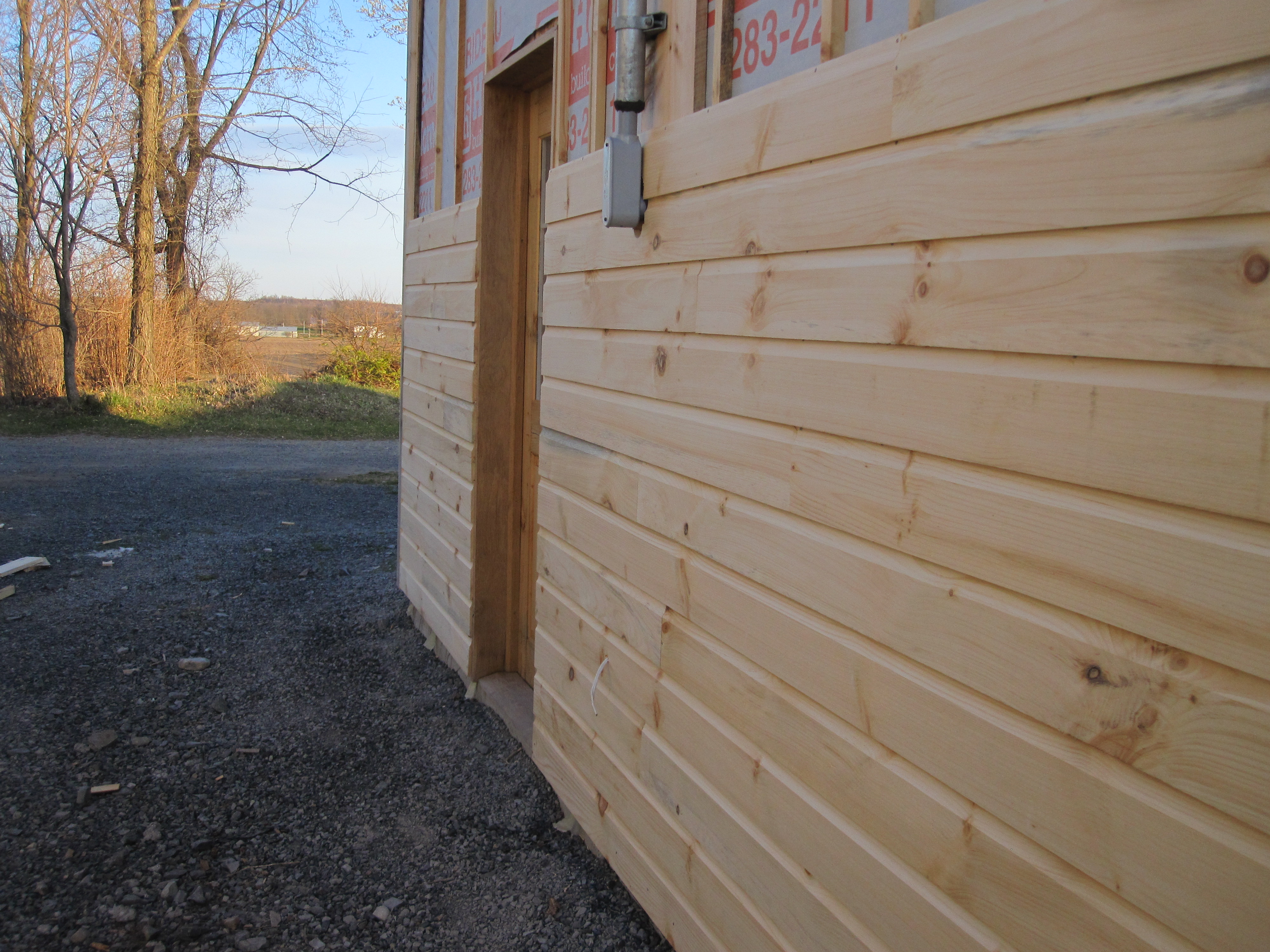
The first garage went together pretty well, but I somehow hadn’t gotten around to putting the corners and window trim on after construction and painting. After I figured out the right way to trim a garage built with cove siding, I doubt if I’ll ever get back to the exterior trim on the shop.
You see, I did the siding wrong. That’s the trouble with the burnt fingers method of construction (and life, and everything): it provides lots of short-term feedback but little external guidance. And I hadn’t thought about a critical step, the construction of the corners of the building so that the siding would have somewhere to begin and end.
An experienced old guy could have taken me aside and said, “Lad, you have to put the corner pieces on first, nailed flush with the cove siding (not on top of it) and then you butt the horizontal stuff to those vertical boards. I would have argued, made excuses, checked the Internet, and eventually seen the obvious.
Instead I figured it out this winter by accident while looking at an old Parks Canada horse-stable at Chaffey’s Locks. Once I saw the corners and realized they and the cove siding were on the same plane, the whole thing made sense.
Anyway, I think I’ve corrected the mistake on Charlie’s garage. The new batch of siding is going on well, but the 12′ walls still have another six feet to go, and so from here on the project will require extra crew.
Charlie and I have agreed to cater to our puritan streak and leave the windows unembellished in the new garage, same as the previous building.

Review: Husqvarna 346xp chain saw
February 21, 2012
See below for a review of the Husqvarna 346xp.
Short version:
Don’t order a chain for a Husqvarna saw from Alamia.com unless you know exactly what you are doing.
Longer version:
I learned of http://www.alamia.com from this forum, and when I decided to buy a new saw, their price for a Husqvarna 346XP was very attractive. I ordered it online and had it shipped to Wellesley Island NY where I picked it up and brought it across the border into Ontario myself.
At the $468. US I paid, the saw is a very good machine, well worth the money and the trouble to get it here.
Last week I decided to lay in a couple of chains for the saw, so I clicked the appropriate boxes and paid online, all without any need to speak to a sales person. That was my first mistake.
After three days I drove to Wellesley Island Bld. Supply and picked up my chains. When I tried to put one on today, it was too short. A call to Alania and Sean answered:
“Oh, you likely need an 80 rather than a 78. Husqvarna uses both, depending upon which bars they have in stock at the time. Send them back and I’ll send you some 80’s.”
I expressed my disappointment with their online sales software that this eventuality was not addressed, and given the complexity of the shipping arrangements, decided to write the transaction off to experience.
Then I looked at the bar. It’s printed right there, the last number, 80 (drivers).
I thought I could maybe cut a chain down for my Husky 51, 64 drivers. Nope. It’s a wider chain, a .58, whereas the new one is a .50.
After 32 years as an English teacher, I still find new ways to be illiterate. $42.00 for the chains, $12 for shipping, $2.50 for bridge toll, $12.00 for gas. $68.50 to learn something completely new? Not so bad.
Conclusion:
Cory Sly at his small engines shop in Elgin extended the chains and made me a new one for the Husky 51 for a total of $30. Turns out Cory’s prices are better on chains than Alamia’s.
Online shopping is great, but sometimes it’s better to buy local.
.
.
While I’m at it, I should comment on the saw in question:
The following is a contribution to a discussion on the Chain Saw forum of TractorByNet.com
DisplacedPA:
Your original question was a request for feedback on the Husqvarna 346XP, so here goes:
I bought one last fall from Alamia for 468 USD. They were about 800 CDN at the time in Ontario. I was looking for a lightweight, high performance saw, as I’m not getting any younger or fitter. In my salad years I proudly wielded a McCullough ProMac 85 with a 28″ bar because I loved its cutting speed. Needless to say, I concentrated on the block wood and left the limbing to my dad with his lighter saw.
More recently I have used an inherited Husqvarna 51 with a 13″ bar. It’s a good saw, but limited in what it can cut. I bought the 346 with a 20″ bar to fill that gap, and it has filled that role well.
So far I have blocked up five trees over 20″, two wind-fallen Manitoba maples (box elder), two hard maples, and a bitternut hickory. When sharp, the saw cuts very well. I touched a rock and ruined a chain, but you can’t blame the saw for that.
Cutting speed in block wood is good. The real difference, though, is in the limbing. The 346 with a 20″ bar still weighs a lot less than the 51 with a 13″ bar. It is much less tiring to use because, apart from the weight, it reaches 7″ further. That means less back fatigue from stooping.
One surprise with the lightweight bar came when I jammed the tip roller after a pinch. I’m a bit prone to this particular goof. Once I had to pry the tip apart with a screwdriver to allow the chain to move. I’d never seen that before in 50 years of chainsawing. The bar still works fine, but it brought to my attention the fact that this is a lightweight, high performance machine, and shouldn’t be abused.
The safety concerns I read online are over-rated. Just don’t start cutting up loose blocks in a woodpile. It works like any other chain saw, just better.
I would definitely buy another 346XP. Thr new chain on the 51 is for volunteers. I’ll keep the light one for myself.
Rod
 the Walnut Diary