Notes from the workshop
January 22, 2012
All fall I’ve scrambled to get things done before the snow came. This has left a workshop crammed with firewood and the tools shoved aside to provide space for ice-covered vehicles. Bags of hardware for various small tasks cluttered every horizontal surface in the shop.
But I hadn’t done enough. The storm last week left snow banks all the way out the lane. Friday I realized that if the wind drifted the driveway full, the tractor couldn’t push it clear with the loader. I’d have to use the snowblower, currently forgotten below the barn in an unplowed area.
The tractor wasn’t about to make it back up the slope to the driveway with the snowblower hanging from the loader, so after a few tries I unchained the implement and tried to hitch it up in the snow where it landed.
Larger and smaller tractors are easy to connect to three-point-hitch implements, but the 35 hp TAFE lacks the extendable hitches of more sophisticated machines, yet is too heavy to push around. Hitch-ups are a big pain, and this one was worse than most. I must learn not to forget the snowblower at the bottom of a hill.
The problem with a fall spent cutting and splitting firewood for winter was that the lack of indoor projects had left the shop stove without any kindling wood. Out of necessity I turned to a jug of used crankcase oil to start my fires. Did you know that synthetic oil will barely burn?
Bemused by the fireproof oil, I posted a question on TractorByNet.com. Responses agreed that synthetic oils have a very high fuming point, so they are slow to ignite. One guy said owners of used-oil furnaces don’t like synthetic.
Locked in the wood-stove loop, I wasn’t getting anything done in the shop. It came down to Martin to clear the helmets, mitts and hardware off the bench with another of his madcap projects. He emailed me a diagram for an oyster shucking board midweek, then came along with Roz and Charlie on Saturday to build it while they finished the paint in the new garage.
Imagine a sturdy cutting board with a strong ledge on the bottom to butt against a counter top, and another shaped lip against which to jam an oyster. The area below the oyster is hollowed out to provide a convenient place to plunk the victim. While the board would face rough use from abrasive oyster shells, it should look good, as most of its time in Kingston it would be a kitchen decoration.
We settled on a thick cherry board with walnut cross-pieces and pinned mortises. Martin had a great time with the mortiser built long ago by the Cawley brothers in Westport, then found how versatile a band saw can be for cutting large tenons. By the time he had finished the second lip to hold the oysters (he discovered curved, angle cuts on the band saw) the completed board looked nothing like the sketch, but we both figured it would work.
It turned out Martin had a reason to build the board at this time. This week he defended his Ph.D. thesis in biology at Queen’s and is now Dr. Martin Mallet. In celebration his father sent him a case of fresh oysters from the family seafood operation in New Brunswick. Unfortunately the package disappeared from the front step of their home on Sydenham Street soon after the courier dropped it off. ARGH!
Anyway, the workshop had been jolted back into operation and I’d noticed my mother using an unsightly metal stand to hold her telephone. I found a nicely figured walnut board and a likely piece of plank to build her a phone table. The woodworking tools slid back into place. The only problem was the woodpile encroaching on the tenon cutter, so I hauled enough blocks out of the way to allow it to function.
Motors sang and sawdust filled the air. It was fun building the little table. Mortises and tenons cut beautifully in black walnut. It truly is the king of furniture woods.
Everything went fine until the sanding stage. Turns out I am running out of pads for the random orbital sander. It’s hard to go from 50 grit to 220, even with black walnut.
With the outside work as complete as it’s going to get until the snow goes, it’s time to stock up on sandpaper and make sawdust in the shop for the rest of the winter. It isn’t good to run out of scrap for kindling wood.
How to build your own garage door
January 2, 2012
Note:
There’ve been several hits on this blog on the subject listed above, so I decided to put up a page dealing with the process. A copy of the text lies below, but it will fall off the edge of the posts after a month or so. A permanent copy is up as a page to be found in the list down the right hand side of the page. One of these days I have find a way to organize the posts. This one is number 367, and I confess I often use Google to find things on the site.
Rod
I bought the first door, a 10′ wide by 7′ high, “stain grade, mahogany” raised-panel model. It was in storage in a builder’s locker after a mixup in plans for a new house.
The “mahogany” was the meranti panels, 1″ material. The remainder of the door turned out to be western hemlock. To discover this I called the builder, Stewart Garage Doors, then an obscure factory in Toronto where I spoke to the subcontractor: “We use hemlock because it’s strong, holds fasteners, and it resists rot well.”
The hardware had come with the door, and it was complete, except for the weather stripping, which was advertised but not available at the time of the sale. That was a $150. mistake.
I spent two weeks of evenings staining the door with an off-white latex stain, the current state-of-the-art product from a home centre. It was expensive, but good enough that I used it for the siding on the garage and the next garage door, as well.
Fitted with a cheap Sears opener, this door has served very well in the workshop. To my relief, splashes from the eaves haven’t seemed to bother the door thus far. The stain seems to be worth the money.
For my son’s taller garage I resolved to build a copy of the door (only 9′ high), so I ordered 1 3/4″ stile-and-rail cutters for my shaper which would provide the appropriate pattern for rails and stiles. I already had a good cove cutter for the raised panels. Ordering from Freud was a comedy of errors. After three tries from different vendors, each of which mysteriously disappeared from everyone’s records, a Freud employee rather arrogantly suggested that online vendors aren’t very smart. For example, a part named EU-264 must be typed “EU-264″ and not “EU 264″. I privately thought that perhaps it was the Freud programmer who wasn’t the sharpest chisel in the drawer, but at length I received my cutters.
https://picasaweb.google.com/106258965296428632652/BuildingGarageII#5663056998575824386
A pile of 1″ walnut had sat outside too long, so I planed it up and trimmed the good parts out of the rather scrubby boards to make twenty four, 26 X 14″ panels. To save time at the gluing stage I tongue-and-grooved the parts, then just clamped them together with a bit of Gorilla Glue. Before cutting the panels to final dimensions I ran them through my double drum sander to produce a consistent texture for staining. Then came the coves. The heavy cut required three passes per surface, but I ended up with 7/8″ boards with deep coves cut entirely on the front side (leaving the back surface flush) with just under 1/4″ to fit the stiles and rails. This was the hardest my old Poitras/General 3/4″ shaper with its small power feeder had worked in a long time. I gave it a new set of bearings soon after.
Earlier in the year I had bought locally 220 bd ft. of eastern hemlock 2 X 6″ planks about 11′ long to air dry for the rails and stiles. After planing the stock I found six months in the sun hadn’t dried it well enough, so I put it into the greenhouse for a month to reduce the moisture content.
I quickly discovered that the best hemlock is good wood. The rest is useless for garage door building as it tends to split and shake unexpectedly. It will twist, too, though this might have been because of a lack of seasoning. Another time I would order double the amount the plan calls for. The wood is cheap and available; it just needs sorting.
Planed to 1 3/4″, the hemlock ripped and machined very well. For example I was able to cut the end-grain pattern for the stiles freehand, using only the fence as a guide. This is not a trick for the uninitiated, but the cutters were sharp and hemlock machines very well across the end grain. Knots tend to be hard, but workable.
I remembered to cut a 5/16″ rabbet into each of the rails to allow for overlap with the door sections above and below. Be careful at this stage: top and bottom sections are not the same.
With limited space in my shop I found the easiest way to assemble the six, 10 foot door sections was to clamp one rail in my bench vice and then assemble the section above that rail, gluing as I went. (I have built a lot of doors over the last few years, so this went quite easily.)
I noticed that the professionally-built door is only 1 3/8″ thick, but has tenons and rabbets which extend an extra 1/4″ beyond the face of the rails and stiles. My amateur cutters left me with no extra tenon, so I hedged my bets with one #10, 6″ Robertson screw carefully driven through the rail into the end of each stile.
Some shakes or splits in the frames threatened to degrade the quality of the project, so I bought a litre kit of WEST System epoxy (a holdover from my old boat days) and had at anything which needed patching. This worked well. A bit of sawdust mixed in provided a good filler for the odd imperfection in the panels, as well. The beauty of WEST System is the wax in the epoxy which makes the surface touchable before it is completely set.
Some of the coves were fuzzy on the walnut so from Princess Auto I bought a refurbished Dremel sonic vibrator multitool (?) to sand the corners and the coves. It turned out to be a fine little machine, much more effective than I had expected. My PC 6″ random orbital sander finished up the sanding.
Staining went as expected, though I had some trouble with rails warping. Clamping the six panels to scaffolding used as shelves helped a bit, but I couldn’t get the hinges on quickly enough to ensure continued straightness.
I approached a commercial door vendor for a materials kit for the installation. He took an interest in the project and for a bit over $600 provided me with a heavy duty hardware set.
What turned out to be a critical question didn’t get adequate attention from me. “How much does the door weigh?” He wouldn’t order the springs without that weight. I provided an estimate by weighing the panels on my bathroom scale and adding the weights up. 246 pounds turned out to be too much spring for this door. So we backed it off two quarter-turns so that it would stay down. Now it won’t stay up. Looks as though we’ll have to screw some brake rotors to the door and then reset the spring to its proper tension to enable the mechanism to work properly.
Pay attention to the door’s weight when talking to the hardware guy.
More later, after we get the spring situation worked out and the shaft-type garage door opener installed.
UPDATE December 30, 2012:
This week I’ve been using the garage to make repairs to my snow removal tractor and blower. This has involved many trips in and out with the returning vehicle covered with snow which melts in the heat. The surprise has been how much a difference in humidity in the garage affects the weight of the large door. At its current spring settings, after a night of heat and water on the floor the door is almost too heavy to lift above the 9′ height of the 2X6 I’m using as a prop.. If it is allowed to dry out with the same heat, it’s not bad at all to lift above the 9′ height.
No doubt this will have to be a factor when determining proper spring settings, whenever we get around to installing the electric opener.
UPDATE 3 January, 2013:
We finally got started on the garage door opener project after a week of arduous pushes to raise the door against an imbalanced spring as the wood absorbed more and more humidity from the slush on the floor inside. Charlie counted the coils on the springs and discovered the left was at 189 coils and the right at 188. So I turned them both to 189 and tried it. A bit more lift was needed. Another 1/4 turn on each did the trick. No additional weights were needed and we were back to factory specifications for the springs.
If reduced humidity makes the door want to float away on the springs, we plan to fasten counter-weights to it to level it out, but at the moment it is well-balanced.
The garage door opener also turned out to be our New Year’s Day project this year. It fell to Charlie and Roz to sort out the various wiring and electronic tricks involved in making the thing function. So I tried to stay out of the way while they ran the wires, set the spring tolerances, and taught the remotes how to interact with the power unit. The final touch was to teach the Lexus to announce its presence to the door.
The shaft-drive power unit is very quiet and systematic. The smooth start and finish surprised me at first, but this unit is a far cry from the simple Sears in my workshop. The only trouble now is that the Sears remote somehow has learned both codes, and opens both doors at the same time. The Lexus, on the other hand, hasn’t yet deigned to notice the new Chamberline. Instructions call for the home owner to press the program button on the opener, then dash to the car and hold down on a couple of buttons until it learns the code. But the power unit is 12′ up a wall, with the only access by a ladder leaning against the garage door, and I’m not as quick as I used to be.
I’m sure we’ll figure something out.
FURTHER, SLIGHTLY EMBARRASSED UPDATE:
Turns out the Lexus had the Chamberline all figured out. It’s the humans that were the problem. I asked my assistant to press buttons 1 and 3 to cancel the codes prior to learning the new one. The door calmly rose. “Bet, would you press 1 and 3 again?” Down went the door. The adjoining workshop showed no activity from its door, so I’m prepared to go with that. To open the wood shop, press 1. To open the auto shop, press 1 and 3.
Time for my afternoon nap.
Standing up the new garage door
November 18, 2011

Homemade overhead garage door
The light was better inside than out by the time we had finished the preliminary fitting, so I took a photo of the back of the door. The bevels face out, of course. The sharp-eyed will see some horizontal cracks in the panels. Not to worry: the walnut panels are tongue-and-grooved as well as coved on the outside to fit the frames.
As it looks I’m going to need to cut the base to fit the contour of the concrete. To the left of the photo you’ll see a piece of 1/2″ sheetrock under the bottom of the door. But the sections are still out of alignment. If I raise the bottom panel another 1/8 to 1/4″ until it’s level, though, and scribe the bottom rail, cut to the contour and then re-install the aluminum and rubber bottom fitting, it should work.
The door, btw, is ten feet wide and nine high. The ceiling is 12′ 2″ in height to accommodate the car hoist.
How to cover a tall ceiling with sheetrock
November 5, 2011
How to install a mobile base on a heavy shop tool
October 1, 2011
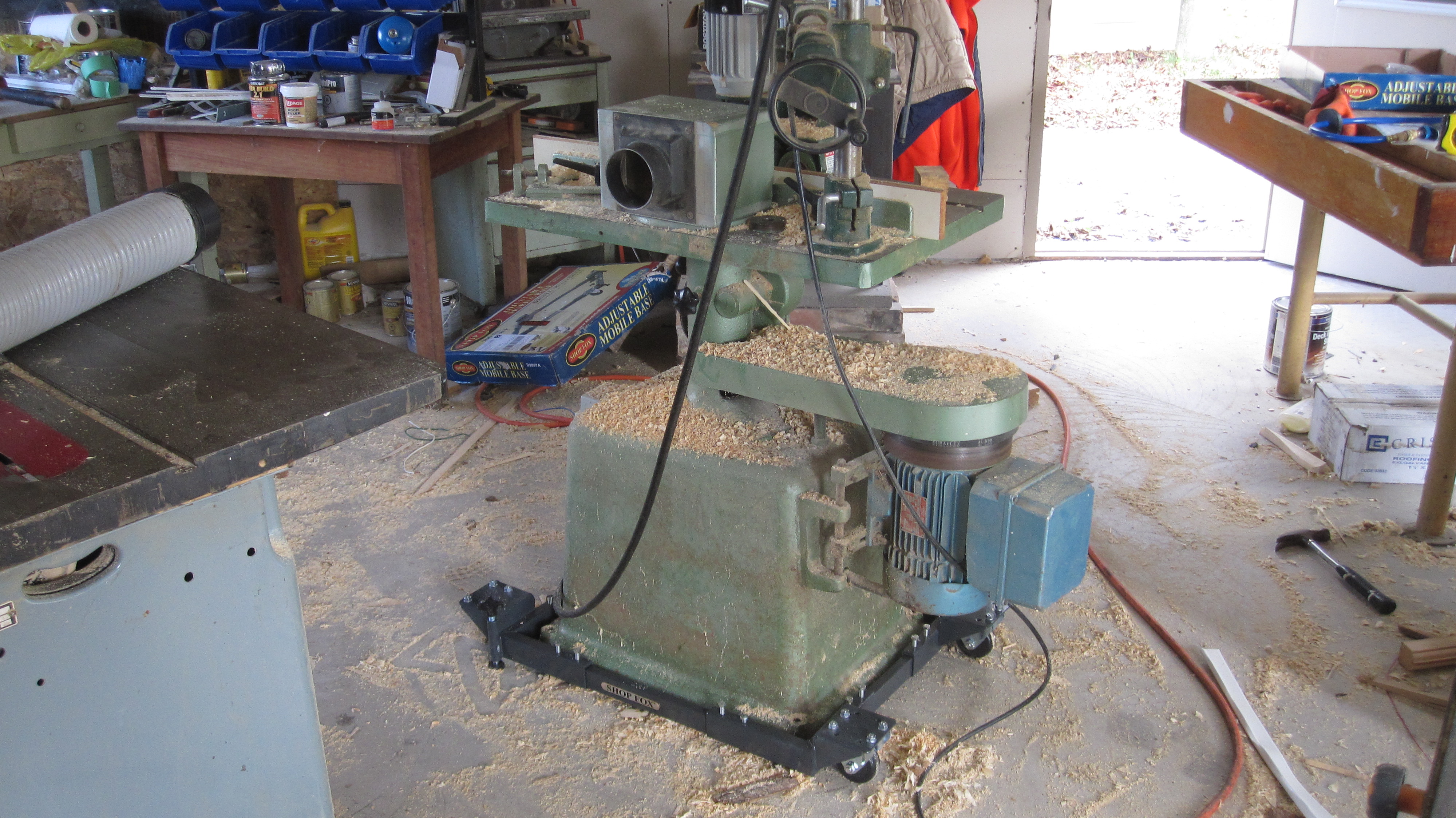
The problem with a small workshop is moving the stationary tools around to make space for others or to handle long stock. Up till now the other tools made way for the old Poitras B2800 shaper, but I needed to make a bannister to replace the temporary one I screwed to the stairway in the house three years ago, so I would need 16′ of clearance at either end of the machine.
Short of cutting a hole in the wall, this would involve wheeling the shaper around, so I bought the heaviest mobile base I could find (700 lb rating) and ordered it online through Busy Bee Machine Tools. Familiar with the routine from installing one on the Unisaw, I ripped through the assembly process with the help of a 13 mm socket and the 3/8″ impact wrench.
But the shaper weighs 380 pounds, plus motor. Plus fence. Plus power feeder. The cast iron base sits flat on the concrete floor. It has enough flex that it doesn’t wobble. Getting the assembled base under the shaper would be a challenge.
So I assembled the corners, then the side rails, leaving me with two opposing units. Tipping the thing a bit was quite easy. It’s top-heavy and I used the mast of the power feeder for leverage. The back rail unit was in place. Then the fun began. I decided to drive small oak wedges into place to raise the front. Nope. The cast base flexed enough I feared cracking it. The tiniest of wedges pulverized, rather than lifting the base. The next size couldn’t get into the narrow opening I managed to create with the first.
The pry bar was still on the roof from the most recent incomplete project. While looking around for a suitable implement I happened upon the shingle shovel. It looked strong and designed to pry. Perfect. In it went and up came the shaper, without effort. I had clearance enough with it in place to insert the end bars into the two halves of the base unit, and start tapping them together with a rubber mallet. Then it just became a matter of figuring out where to place the thing at the ends of the shaper to enable me gradually to wiggle the side unit fully into place. A quick walk around the unit with the impact wrench and the job was done.
When a new tool comes to the farm you never quite know what role it will find for itself. Tom Stutzman’s shingle shovel has proven a handy machinery jack.
How to make your own cove siding
August 21, 2011
Over the last year Charlie, Martin and I have put up a fine workshop where the horse stable once stood. Apart from sheetrock taping and interior trim, the only remaining task is the exterior siding. Building inspector Anpalahan Kandasamy told me that the final approval requires permanent siding, so I couldn’t leave the fading gray fabric on the outside for another winter.
The problem was that while I like the trim appearance of vinyl from a distance, up close I hate it. The double joints on long runs ruin a pretty good effect. So I decided to design and build my own horizontal siding.
The tool drawer contained a good set of tongue-and-groove knives for the shaper and a convex cutter designed for raised panels. I went to work on samples. To fit the tooling I would have to plane each board down to just below an inch, then cut the cove on top of the tongue so that the tongue and groove would fit together normally, but with a recess on the top edge of the board to give the traditional appearance. I hoped to be able to blind-nail the interlocked boards to the stud wall.
If this worked the project would give the old Poitras shaper and its power feeder a good workout.
Two years ago when I remarked at how well his fiberglass building dried a stack of wide ash boards he sold me, band-mill owner George Sheffield suggested that I should have my own solar kiln.
Over the winter I had ordered a couple of thousand feet of pine for spring delivery. I decided to follow George’s advice and try kiln drying this stuff in the “plastic palace” to speed the project up. Twenty-five hundred board feet of pine made for impressive piles in the low shed.
Even with large openings in the ends, a greenhouse-type building gets very hot in summer. Lumber apparently likes this as a drying environment. So do wasps. When it came time to take out a trailer-load I discovered that the wasps had colonized the electrical boxes and the rolled-tarp door. They didn’t leave gracefully, either. They like the dry heat.
The first batch of 12” boards I cut up to make siding had been piled outside over the winter, and did not take kindly to ripping on a table saw. The ends had dried a lot and the middle stayed green, so there were huge tensions in most boards. Some actually exploded from the stress during cutting. The 6” siding-candidates came out so crooked I re-piled them in the palace for a couple of months of further drying.
The stuff I cut up this week had gone into the palace in early May, and seemed very nice to work after three months in the “kiln”. The terrific tensions of the outdoor boards just weren’t there.
At the planing stage a new problem cropped up. Normally I run lumber through a trailer-load at a time, let the shavings land on the floor and then shovel them into an old spreader for mechanized unloading elsewhere.
But this dry pine planed off in light, fluffy shavings which plugged the machine. I was forced to hook up the heavy vacuum system I had earlier installed for the sander. That worked nicely until I had finished the third board. Then the planer plugged again, this time because the chip barrel was full. This would take some learning.
I gradually figured out the timing on the barrel and discovered the planer in fact works better with the chip collector installed.
The first batch of siding came out at 5” in width, and I was able to cover the front and half of one side of the 24 X 24 shop. The next batch is almost finished, and I can’t decide whether to try to hit the 5” mark again, or leave these at 5 ½” and reduce waste. This stock was a little wider than the previous lot.
In any case, the 1” cove siding nails onto ¼” strapping quite nicely with galvanized siding nails. Anpalahan insisted upon the strapping to provide an air space so that the siding can adjust to humidity changes and water infiltration. Turns out these little straps enabled me to locate the studs in advance, preventing chaos later.
Making cove siding is nice, mindless work. If you don’t count labour, tools, and the paint yet to come, it’s cheap, too.
https://picasaweb.google.com/106258965296428632652/MakingCoveSiding
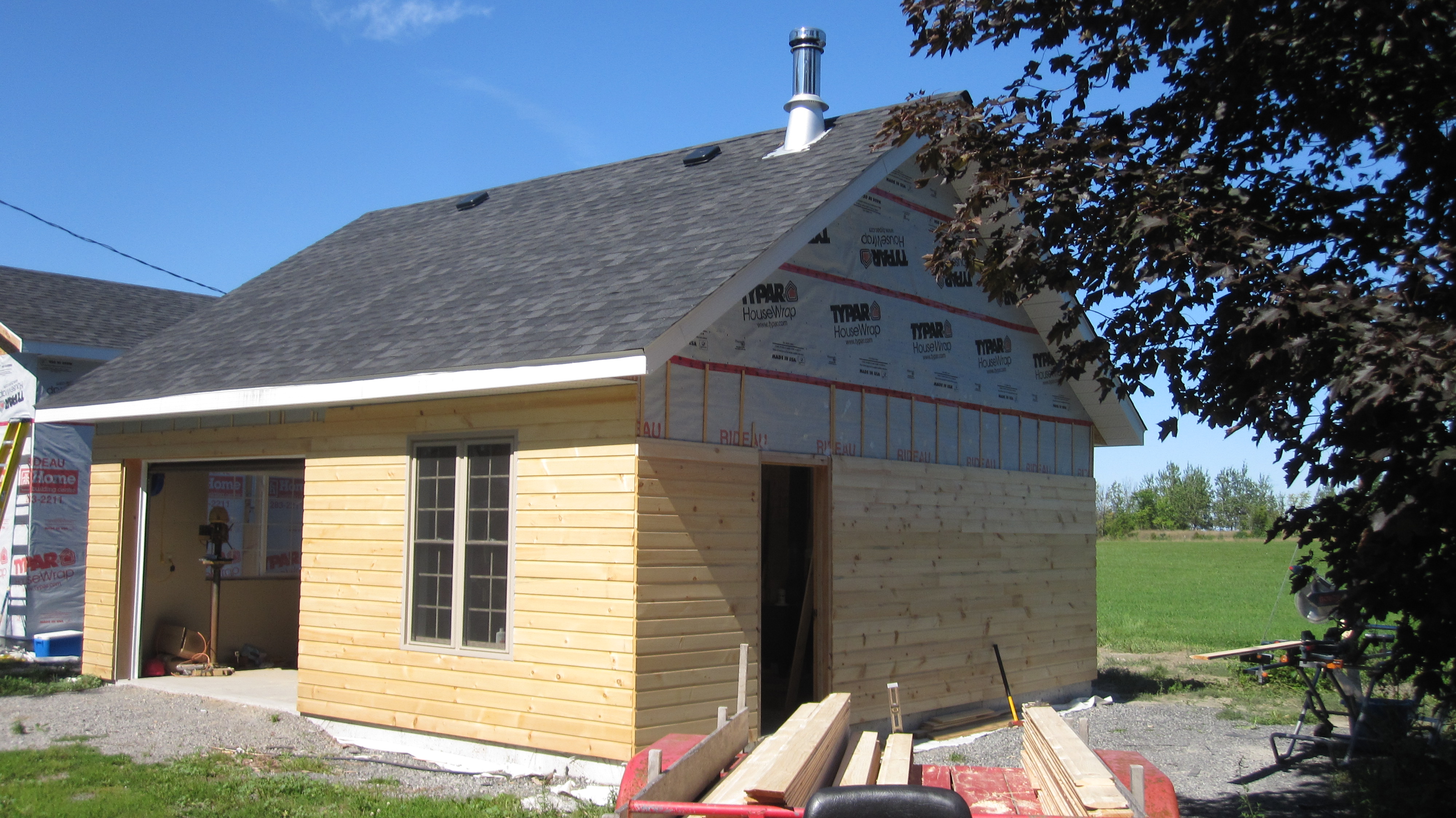
That’s all before the scaffold goes up.
Bolens G174/Iseki 1500 Review
August 10, 2011
Mike
Northeast Connecticut
——————————————————————————–
Mike:
Yes, the 17 hp diesel has lots of power to run 48″ mowers through whatever I face. Its radiator sheds seeds well and doesn’t plug in tall hay or weeds. It bulls through spruce boughs without damage. In 4 low it’s a mountain goat, even with turf tires. The diff lock is occasionally useful.
The smooth tires aren’t so great in mud pulling a trailer, but that’s to be expected. On the other hand the Bolens will mow over soft ground that I can’t touch with my heavier tractors until much later in the year.
It doesn’t have enough lift to skid logs with my mid-sized winch, but the pto will pull them out to the road and it will carry the 500 pound implement around for me.
It needs the three weights on the front. Beware rearing with a load on the 3 pt hitch on a hill unless you have the weights. It has no overrunning clutch, so you MUST buy and attach one to the pto shaft before running a rotary mower. A finish mower is fine without.
Without live pto the Bolens would make a lousy snowblower tractor. Beware leaving the key on. It kills the battery on mine. Parts are available.
The thing gets way more hours than I anticipated.
Buy one of those triangles for trailer hitches. It’s very handy for jockeying trailers around the lawn between mowing sessions.
—————–
UPDATE, 14 MARCH, 2013
For the winter I have fitted the tractor with a pair of tire chains off my dad’s old military surplus jeep. I extended the chains about 2 to 3″ with extra links for the fit. The increase in traction meant that the Bolens could work all winter if I kept it out of the cold. It doesn’t like to start without plugging in if it’s much below freezing. The simple solution was to appoint it Garage Queen for the winter. That way there was always a clear path among the woodworking tools to the woodpile, and its primary function was to haul wood to the pile on its 10 cu. ft. 3 pt hitch dump box, anyway.
BTW: that dump box is an excellent implement for this tractor, if you can find one. Mine was marketed by Walco and I found it used at a farm equipment dealer. Several searches of the Internet haven’t turned up another example of the type, though.
In early winter while my 35 hp loader tractor was broken down I pressed the Bolens into service on a 7′ 3 pt hitch blade. It lifted and dragged the blade well enough, but as snow volume increased it had nowhere nearly enough weight to shift the drifts away from the centre of the long driveway. If you want to use the blade to clear a rink, the Bolens would likely do a good job, but it’s outgunned in heavy snow unless it has a front blower. The front pto operates independently of the 1 stage clutch, so it likely works well in this application.
———————
The Bolens uses about 1 litre of diesel per hour, and it’s a pleasant thing to run.
UPDATE, 29 December, 2014
The Bolens originally had a pair of hydraulic auxiliary fittings installed, so I reconnected them.
I have used the Bolens a great deal over the last year on a small hydraulic tipping trailer I bought new. The single axle Chinese import is 44″ wide and about 7′ long with sides about 15″ high. A pair of off-road tires sit beneath the box. The sides and/or the tailgate fold down for loading, and of course it can be configured as a little dump truck. It holds about 3500 pounds of gravel without distress.
It’s very handy for pruning trees. The rig fits down narrow alleys and turns easily.
For firewood I find the best feature of the trailer is the folding sides. I can slide substantial blocks onto the bed, then shift them to the block splitter with only the single lift from the ground.
The rig is also small enough I can back it into my workshop for easy stacking of firewood right from the trailer bed.
While the Bolens doesn’t have the hydraulic pressure (1600 lb/sq. in.)to dump a trailer load of gravel (neither does my TAFE), my 21 hp Kubota B7510 with its system tuned to 2600 lb. tows and dumps gravel quite well.
Hope this helps,
Rod
Update 13 September, 2015
The following article contains an accident report of some significance. Short version: don’t tow a trailer much wider than your tractor.
UPDATE: 18 MARCH, 2019
The Bolens is still working around the farm. I should mention a session it had at the local tractor dealer, though. The clutch began to misbehave in early 2017, working only intermittently. Eventually it quit clutching, so I loaded the tractor onto a trailer and dropped it at Feenstra’s Farm Equipment in Athens.
A few days later they called and I picked it up only to face a bill of a bit over $900. It was all for labour.
Turned out the clutch was full of mud, and it took twelve hours with a toothbrush (metaphor) to clean up the bell housing, the clutch plate and the rest, and re-assemble the tractor. The tech also cleaned the glow plugs.
The only time the tractor had been stuck in mud was when I buried it in clay at my friend’s house while we were landscaping under his deck posts with a box scraper. It spent the night in the springy bog, and the clutch-contaminant must have leaked back into the bell housing through the drain. That was four or five years before the clutch actually quit working.
It starts better in winter now since I went with Shell Rotella 0W50 synthetic oil. The tractor hauls the trailer when the Kubota is on the wood chipper. Around the lawns it’s handy to get rid of the chips without having to rake them up. For extended runs on the 7.5 kw pto generator, I use the Bolens because it uses so much less diesel than the 21 hp Kubota, as well. But its primary use is to jockey trailers around the yard. Its 3 pt hitch will lower the hitch bar right down to the ground. The Kubota’s is held up pretty high by the design of the tractor and the mid-mount mower.
Spring and fall involve lawn cleanup. I run both small tractors at this, the Kubota on an estate rake, one of those things with a series of four rotating, vertical rakes suspended over a little triangular trailer, producing a windrow. I follow it with the Bolens on a ground-driven sweeper to gather up the munge in spring and the leaves in fall. I can get over the two acres of lawns in a few hours, spread over about a week, as things dry out in spring or leaves fall in October.
I should mention as well that I had to order new front tires for the Bolens from the local tire dealer. They cost a bit over $400 installed for the pair, but they are identical to the original tires. I don’t know if they make rear tires for the tractor any more, but there are still years of life left in them yet.
What are the odds?
August 5, 2011
This week our son located a large pile of used, good quality fluorescent lights taken from a drugstore undergoing renovations. Desiring an ample supply of lighting for his new garage, he bought the contents of the large pallet which turned out to contain seventy lights of the eight-foot size, each with four thin, energy efficient bulbs, and three shorter units.
To our astonishment the poor Tacoma could barely carry the load. The reflectors stacked together densely and Charlie and I discovered we could lift only small piles of them. And there were a lot. Similarly, there were a great many bulbs to load onto the top of the pile in my sagging pickup. Everything rode well on the road home after the vendor added air to my tires, though.
In anticipation of the weekend rush I picked a few lights out of the back of the truck, cleaned and assembled them. The first two lit up like champions. Out of the first bundle of bulbs I had two rejects: one was burned, I guess (no way to tell), and one had a prong bent at one end, so I disposed of it.
Bet and I hung the two completed prototypes from the ceiling of my new workshop, “as an experiment.” Yeah, right. I like the even light.
Flushed with success, I assembled another for Charlie to put up in his garage. All went well until I added power. Nothing. Now what?
I dutifully took the thing apart and checked each connection. No dice. Ballast? I pulled one out of another light from the pile and spent twenty minutes wiring it in. Still nothing.
Time for the burnt fingers method. In I went with the multi-meter with the current on. Power to one end was fine. Voltage was a little variable at the other end. Re-jigged things until the flow was steady. Still no lights.
What does a ballast do, anyway? On my way to the house to ask Google, I thought, “What are the odds of having two bad ballasts from a collection of working lights? About four times the odds of having four bad bulbs from a similar collection. Come on, now. Four bad bulbs in a row? No way.”
I pulled an unwashed bulb from the centre of a bundle and put it in. It lit up. Three more, same story.
Do you apologize to a ballast you have wronged?
So what are the odds of hitting four bad bulbs in a row out of 286 which were working when they took them apart?
Could their failure have anything to do with my amusing discovery that they make a high- pitched hamonic sound when polished with a wet towel? It didn’t hurt the others, though.
An experiment the following morning with damp cloth produced the expected (and hilarious) high-pitched screech on the first one I cleaned. Then the cloth grew drier or gummier from the dust and didn’t sing any more as I worked through the four new (dusty) bulbs. It looks as though I had just hit a phenomenal run of bad bulbs last evening, and the harmonic effect doesn’t destroy fluorescent bulbs.
You know what? There’s a huge gap in the world of knowledge here. Google doesn’t know about this phenomenon! I typed in “Why does a fluorescent bulb squeal when rubbed with a damp cloth?” and Google served up stern lectures by talking heads about the dangers of compact fluorescent bulbs. YouTube offered a how-to lecture on repairing Apple mouse balls and some dude with a wash cloth on his bald head.
Clearly this is an area for further research, or at least an amusing YouTube clip. Tip: not the whole tube sings. On 48″ bulbs, the harmonic point is about 7″ in from the ends. I used a dirty blue terrycloth towel, fairly wet. As the towel dried, the tube performed less energetically. Enjoy. Get back to us on this one with your results.
For American readers I’ll add the expected caveat: Rubbing glass rods with towels is a dangerous activity and may produce broken glass, spilled toxic chemicals, or annoyed family members. Do not do this at home! The owner of this website, the Review-Mirror and Google accept no responsibility whatever for injury or property damage which results from foolish experiments in this area.
The final adventure with the red 4X6 trailer
June 29, 2011
See UPDATE at the end of the article.
Rod
The new tandem trailer was still loaded with plywood from the previous day’s shopping expedition when I realized that we would need shingles for Garage #2 before the weekend was out. Off I went to Smiths Falls with a list and the old 4X6 trailer. It was rusty, but the tires held air and the lights worked.
My estimate of 26 bundles of shingles was pushing its weight capacity. The guy at the counter at Rideau Lumber explained that I would run short unless I added enough for cutting, so the order went up to 30 bundles of the textured, architectural shingles. “But you won’t use architecturals across the top of the roof to form a cap. You’ll need at least two bundles of regular three-tab shingles to cut up for the top.” Turns out we used 25 bundles of architectural shingles, and one bundle for across the top. Had I stuck to my own estimate, this sorry tale might not have occurred.
But I listened to expert advice and the load on the pallet grew pretty tall before they set it onto the trailer. The tires took the load well, to the surprise of the lift truck operator.
Away I went through the maze of streets in downtown Smiths Falls in search of Hwy 15. Everything worked fine until I turned off the bridge at the Combined Lock. Then suddenly I heard the sound I like the least when towing, a high-pitched screeching, accompanied by billowing clouds of white smoke: the death throes of a tire. I ducked out of the traffic and had a look. The right wheel was tilted so that it was rubbing on the box of the trailer, producing considerable friction.
Still less than a mile from Rideau Lumber, I thought I might be able to limp back across the river and through the park to the yard and have them transfer the shingles to a truck for normal delivery. Off I went, trailing a major cloud of strangely white smoke. Cars went to some lengths to avoid the cloud in the heavy traffic, but I persevered.
The load was within two blocks of the Rideau Lumber yard when the tire finally let go with a muffled bang. Rolling became very difficult after that, as the flat tire soon shredded off and despite my slow, deliberate pace, the wheel started to dig a furrow through the pristine asphalt of the quiet residential street. This was unlikely to go over well with the residents of the neighbourhood, and I was stopped right outside Walter Cecchini’s house. Years ago Wally was a colleague at Smiths Falls Collegiate, and his favourite wisecrack about me was, “I never liked him!” Now unless I was careful he’d have some justification for that prophetic comment.
So I phoned Rideau Lumber to ask if they would send their lift truck to undo the burden which had broken my trailer’s back. A look underneath revealed that, weakened by rust, the axle had snapped off when negotiating the corner. Mike told me that they couldn’t take the lift truck off the lot because of insurance requirements, but he would see if they could send the boom truck.
Before long a new SUV stopped. Arnold Mosher got out to look. Arnold operates the pride of the Rideau Lumber fleet, the boom truck. He eventually decided the job was feasible, so he came back with the huge rig while I directed traffic.
I love to watch Arnold operate his boom. He has this wireless, waist-mounted console on a belt with which he controls the thing, so Arnold and the truck perform this ballet during which they move heavy objects and avoid each other and trees, wires, and vehicles. If you enjoyed the Transformers movies, you’ll get a big kick out of having Arnold deliver a pallet of shingles or a lift of 2X4’s to your project site.
Scott Fleming, my former student and the owner of Rideau Lumber, drifted quietly by in his pickup truck, keeping an eye on things.
The shingles were no problem. Arnold lifted the pallet off my severely tilted trailer and placed it fairly far back on the bed. “Think there’d be room for the trailer up there, as well?”
Arnold nodded to the space at the front. “I can strap it on there if you like.”
So that’s how the red 4X6 trailer made the final trip back to the farm with its load.
UPDATE:
The concluding sentence above makes a fine, sentimental farewell to a beloved tool, but the truth is somewhat in abeyance with this story.
In fact, the wrecked trailer lay in the yard for a month or so until Princess Auto had a sale on axles and wheels. Then for about $300 and a couple of hours of work I had the trailer back on the road, somewhat battered, but seemingly capable of carrying 1 cubic yard of gravel home from the quarry yet again.
It was just too good a trailer to lose and I couldn’t find a suitable replacement, regardless of price, on the new or used market. So far it has hauled two heaping loads of gravel from the quarry for various jobs around the property and is fixing to do more. In between it carried a set of 10′ garage door hardware from Kingston and a load of lumber from Smiths Falls lashed to the top of the box while the tandem trailer sat under a ton and a half of drywall.
So I guess it’s made a round trip to trailer Heaven.
 the Walnut Diary