Polaris Ranger shootout: 2WD vs 4WD in snow
March 10, 2013
Yesterday Tony brought his 2003 Ranger 500 to the farm and drove it around the trails in the woods I had established with my Massey Ferguson 35 and winch for hauling out logs. The wide body on full-sized Rangers may be a pain to fit onto a trailer, but the wheels fit nicely into a tractor track through deep snow. In anticipation of sugar making activities I had dragged the blade on the winch through the trails where the snow was very deep to provide ground clearance for the Rangers. Tony’s new to offroad driving so he wasn’t as impressed as I was by the 500’s ability to navigate sections that had stuck my 2004 2WD Ranger TM during the previous week.
Then we used the 500 to do something none of my toys could handle: move sugar-making equipment from the basement of the stone house up to the sugar shack. The 500 could move around in/on corn snow that had left the TM royally stuck. Just for the record, a standard 3/8″ dock line of the sort I use in summer is not strong enough to tow a Ranger when it won’t go any more on its own power. I stretched one past its breaking point twice with my Bolens 4WD tractor, then went with a prefab towing line out of yellow nylon which worked fine.
The first thing I tried with Tony’s Ranger was a slide down the hill. Why not? At full throttle off the top of the hill by the brick house we planed 600 feet down the slope until I could pick up a tractor trail back to the barn. Tony was a bit wide-eyed during the descent, but the machine worked fine in the granular snow.
After loading the gear in the deep corn around the south side of the house the 500 couldn’t back up the slope to get to the driveway, so I just booted it back down the hill and picked up the previous track across the field and up by the barn. It was an exhilarating ride for two guys, a dog, and a precious and fragile bit of kit, the boiling pan.
Eight 16 litre pails of water made another trip. Well, nine, but one didn’t have a lid, so Tony only filled it 2/3 full. Away we went. It was still more than half-full when we got to the shack. We didn’t get wet because of the rear windshield/stern cover. Pretty good ride with a partial load. Interestingly, with the extra 300 lb in the bed the 500 didn’t plane over the corn snow. The back wheels had to dig their way through. The 30 hp engine seems well suited to the chassis in tough going. I remained in high range throughout these adventures, of course, with the throttle pegged to the floorboards.
This week I plan to keep the 500 in the shed as a tow-truck and gather sap with the TM as long as it will do the job. If previous experience is any indicator, it will get through the syrup season just fine, floating over soggy turf which would bury heavier vehicles — even my little compact tractor, while carrying 14 pails of sap or up to nine volunteers per trip.
The TM is only 90% as capable as the 500, but its drivetrain is so simple I think it’s a better choice for multiple, inexperienced drivers.
The Good Ice Tour, 2013
January 27, 2013

The full moon made it inevitable: no fish bit for an hour this morning, the air was clear, cold and still, and the thin crust of white on Newboro Lake over 13″ of ice made for perfect driving conditions for Tony’s Polaris Ranger.
We resolved to find the winter route to Chaffey’s Locks. Open water or at least weak ice at the Elbow and the Isthmus meant a trip across Scott Island if we wanted to look for splake on Indian Lake.
Yesterday we’d noticed a pack of wolf hunters coming out of the upper reaches of Stout’s Lower Bay, so we followed their tracks to a rugged trail off the ice. Tony had never faced driving conditions like these. On the other hand the Ranger 500 gave evidence that it has had lots of practice over rugged terrain, idling over breathtaking moguls, ducking its windshield under overhanging pines, and ploughing fearlessly through frozen muskeg until we reached a better trail.
We were pretty lost until Tony noticed that this looked like our friend Tom’s cottage road, so we oriented ourselves from there. I must emphasize that it is very easy — in any season — to become lost on Scott Island.
The township road is little more than a snowmobile track at this time of year, but the Ranger had no trouble on the hard, rutted, snow. Just short of the ferry dock we turned off onto a short trail and drove out onto Indian Lake.
Clusters of vehicles indicated the splake fishermen at work. We drove up to veteran Chaffey’s Locks fishing guide Lennie Pyne, comfortably ensconced in a mobile shelter above a shoal in the middle of the lake. Lennie told us that he had lost a good fish this morning, but that otherwise fishing was slow with the full moon.
Lennie showed us where he had driven on with his pickup truck, so we followed a minivan off the lake and out to the township road which runs around the south end of the lake, took our bearings, and headed back across to Scott Island. Tony decided it was time for a change of drivers.
The 2003 Ranger 500 4X4 has just over 1700 hours on it, but the engine is fresh and the rest of the UTV works well. I noticed immediately that the 500 is more softly sprung than my 2004 Ranger TM. On the open ice at 30 mph the steering feels light, yet stable. It didn’t offer to break the back end loose, though I was careful, mindful of the rig’s high centre of gravity. On the island trails the suspension worked its way over bumps and obstructions so that the passengers and equipment enjoyed a comfortable ride at a reasonably brisk speed. The optional cab and windshield enabled riders to retain at least some body heat on the cold day, and an improvised rear windshield kept snow and exhaust back there where they belonged.
According to the owner’s manual the AWD only engages a front drive wheel if one of the rear wheels slips, but I found the system distributes power very effectively without input from the driver. To cover the same terrain with my 2WD TM I’d be shifting the differential lock in and out at every obstruction. We didn’t use the diff lock on the 500 at all during today’s fairly demanding outing on the Island.
A wrong turn led us down a narrow and steep cottage road. Tony dismounted to move an oak branch out of the way and nearly slid down the hill when he picked up the limb. He climbed happily back into the Ranger and we sure-footedly made our way on to the point that further progress was unlikely. Then we made a 3-point turn on the narrow trail and regained our proper route.
The drive from Indian Lake to Newboro by Scott Island is quite scenic, but too long for a convenient fisherman’s commute. Tony timed our island transit at 30 minutes, though that included the time lost on the dead end. Add fifteen more minutes for lake travel and it would make more sense to drive a 4X4 out on the lake at the Chaffey’s end, if the ice permits.
On the way back we stopped to photograph a remarkable beaver project: an enterprising rodent has half cut down a 30″ pin oak overlooking the bay.
So it was a great day to explore. The ice was hard and strong and the crusted snow felt like concrete beneath the tires of the Ranger. Conditions don’t get better than this for cross-country winter travel.
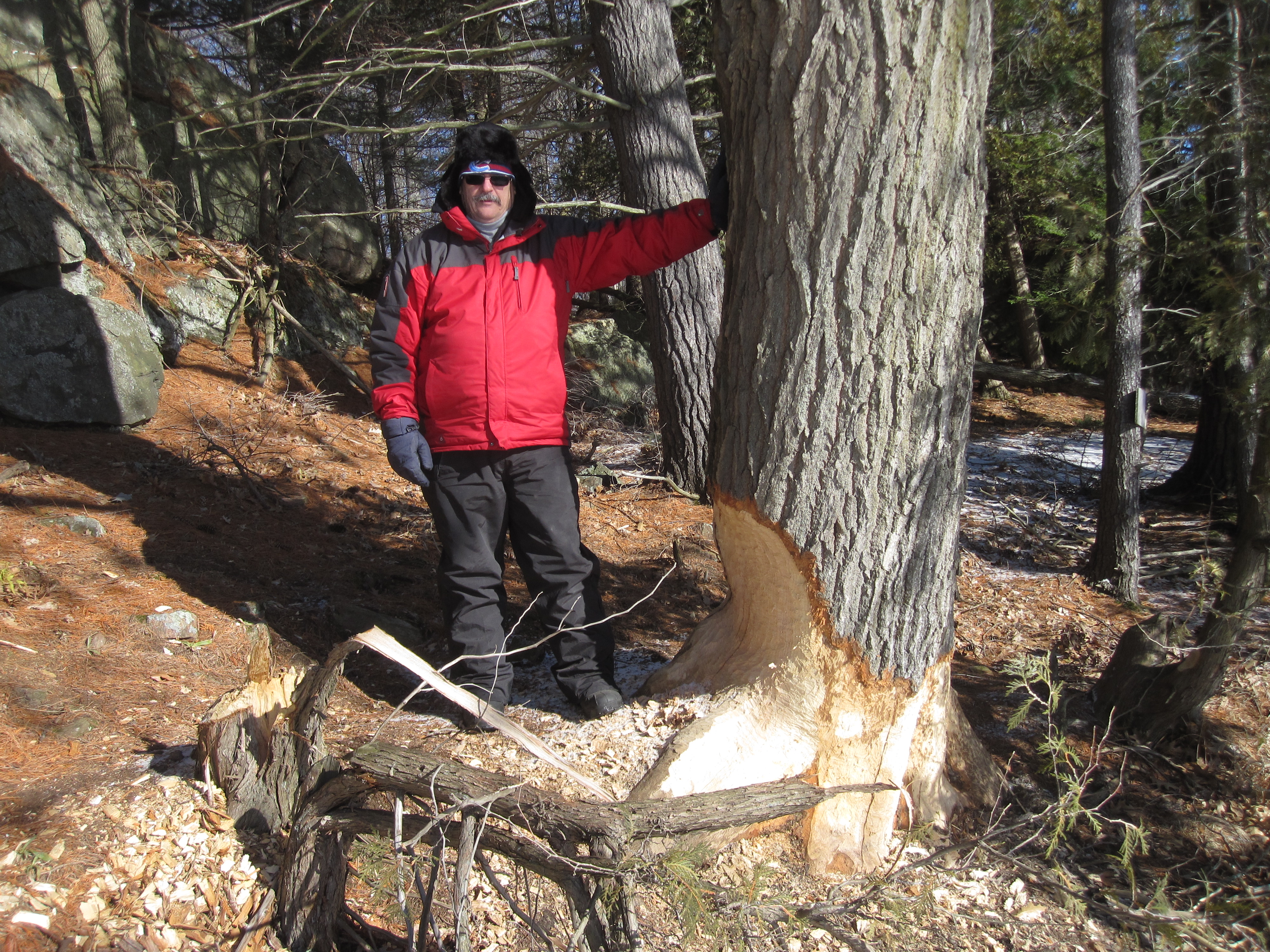
We grow our rodents big in Leeds County.
The Third Annual Tired Iron Tour
October 16, 2011
Last year’s tour was a bit too eventful, with two tractors of four requiring repairs after the run up Foley Mountain. This year Peter Myers scheduled the event a couple of weeks earlier to avoid the blizzard conditions of the drive last year, as well. But the plan was to cross at Narrows Lock and make a run down the north shore to Rideau Ferry, with the return trip along the Old Kingston Road. That’s a long way on an antique tractor.
All week through the wretched weather I’d rehearsed my excuses. Saturday I gave the Massey Harris a chance to vote on our participation in this year’s run. It sputtered so badly I barely made it home from Forfar. A call to Peter to cancel just resulted in a house call to the ailing Massey. Once the newly-cleaned carburetor had a final adjustment it worked fine, so the trip was a go.
At 10:00 Sunday morning we started off. It was a pretty nice day by the standards of these things. The gusts of wind only buffeted the tractor a little; most times I had no trouble at all keeping it on the road. Doing anything else while driving the beast was quite another matter, though. It took me almost the length of the Big Rideau to tighten the velcro straps on the sleeves of my coat: only one hand was available at a time, and I didn’t dare risk losing a glove. Fortunately my coat’s hood was easy to put up and secure with one hand.
Burt Mattice joined us along the route with a different ride: a mid-40’s Cockshutt 30 with a high-low range adaptor he installed himself. While no show model like the McCormick W30 he left at home, the Cockshutt ran reliably throughout the day. Over the winter Burt did locate a new exhaust manifold to replace the one which the W30 grenaded on Foley Mountain last year, but he wisely chose to bring the newer machine on this trip.
The shortcut from the Stanleyville road to the Rideau Ferry Road is a picturesque bit of Canadian Shield with occasional gentrified settlements, all in all a beautiful drive on a bright fall afternoon. I could tell the scenery was nice when the convoy slowed down frequently to enjoy the view. Peter has developed a tendency to race his John Deere A from one sheltered patch to another on cold, windy days, so the journey had moved along quite quickly this morning.
My Massey seems to have reconciled itself to higher engine revolutions, running well past the throttle gate in order to keep up with the tractors with larger back wheels, but I refused to run at full emergency power for fear of a repeat of last year’s debacle with a broken rotor and ignition points welded together.
Keeping the chain snug during the long tow home behind Peter’s “A” had worn half the life off the Massey’s pristine brake pads.
I noticed a lot of nut trees growing along the fence of Murphy’s Point Provincial Park. Some looked like black walnuts, others like the strain of butternuts which grow in my woodlot. Black walnuts don’t usually grow in the thin soil of the Canadian Shield. Perhaps they are two different strains of butternut. In any case things were going by too steadily for more than a quick look, and after a single attempt to take photos I gave up and concentrated upon keeping warm.
As we backed into parking spaces at the lunch stop I noticed Chris Myers cranking hard on his John Deere B’s steering wheel to get it to turn. Maybe that’s the purpose of the Tired Iron Tour: to give these old gems enough exercise that they don’t seize up from disuse.
The dining room at the Rideau Ferry Inn boasts a large box stove which was extremely welcome to this tractor driver. The food was good.
Water surrounds the Rideau Ferry Inn, with the Upper Rideau on one side and the Lower Rideau on the other, divided by the iconic bridge which gives the community its name.
The whitecaps out there made boating an uninviting prospect today. All in all I felt better off to be driving an antique tractor to God knows where down a back road, rather than bouncing around on Big Rideau swells in a craft of similar vintage and reliability, trying to get back to Merrickville for winter storage.
Thoughts of getting stranded in a windy bay while the light fades don’t have the same appeal now that they had thirty years ago. If the tractor quits I can get off and catch a ride home, or even walk. I won’t likely freeze or drown.
But the freshly-tuned Massey worked like a trooper all day, and it coasted into its spot in my backyard at about 2:30. An uneventful trip! Trouble with such a debacle for a columnist is that it doesn’t provide any narrative fodder for readers.
Oh well. Peter’s now talking about a run to Perth Road Village next year. I hope they’ve fixed the Hutchings Road by then.
For more action, check: https://rodcroskery.wordpress.com/2010/10/31/the-second-annual-tired-iron-tour/
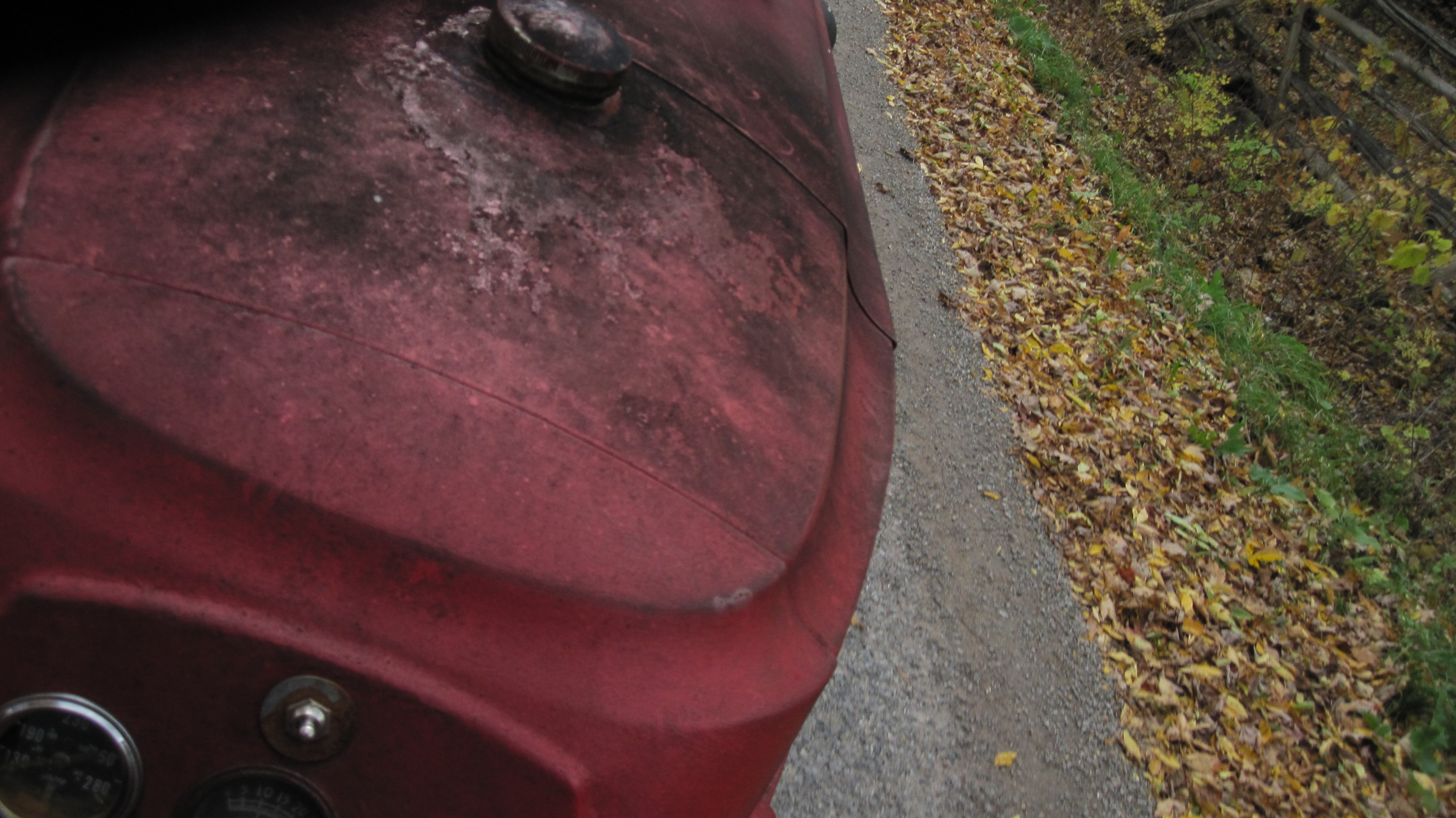
Below please note the only usable photo from the trip. I missed some fine scenery. The tractor requires a surprising amount of driving; the camera is too complex to operate without two hands and some attention. Sorry about that.
The Trailer Bearing Project
May 27, 2011
One evening last week I spent 2 ½ hours on a simple bearing replacement on my trailer. Blame it on middle-aged ineptitude or bad lighting, for it wasn’t for a lack of tools, parts, or place to work. I just couldn’t get the thing to fit back together.
To my credit I must protest that I did spot the bad wheel and attempt to repair it before heading out onto the highway and endangering others. I have learned something in the aftermath of last summer’s loose-bolt debacle.
The clinical definition of insanity is repeatedly to try the same thing in the expectation of different results. Friday I must have gone a little crazy, because I kept thinking that if I could just get that big nut to catch on those threads, I could force the thing into place with the ¾” ratchet.
The fog of war has nothing on the confusion surrounding a dark trailer hub full of black grease, miscellaneous metal parts, and bits of gray limestone from each time I dropped it on the driveway.
Number one rule: don’t take a trailer bearing apart on a fresh gravel driveway, especially when there’s a nice clean garage floor twenty feet away. Grease is a gravel-magnet, and when things get sticky, my mind seems to seize up.
A question emerged when I looked up the broken bearing in the Princess Auto Catalog. It listed 1 inch and 1 1/16” splines for 2000 lb trailer axles. Mine measured 1 1/32”. Uh? Maybe they under-or over-estimate sizes, like the nominal measurements at lumber yards.
When I arrived at the store the following afternoon, bearings for 1 1/16” splines were not in evidence at all, but the 1.03125” size was available. That worked out to 1 1/32, so I bought a set of bearings, washers, nuts and seals for this size, but hedged my bets with the 1” size, as well. There are lots of other trailers at the farm which will need a set of bearings, I’m sure.
The new parts matched the old ones, so I was away to the races once the rain stopped. Removing the remains of the broken inside bearing the previous night had required the sacrifice of a small screwdriver, the services of a larger one and a 3 lb sledge, and finally a bearing puller once I had come to my senses. Add another hour to the time for the project, come to think of it.
On went the vinyl gloves. I tentatively wiped the black goo out of the hub, somewhat taken aback by all of the chunks of rock in there until I realized they were roller bearings which had been chewed up after their holder had disintegrated.
First I needed to seat the back bearing. I carefully checked the spline. It would fit fine. So I tapped the tapered holder into place on the back of the hub. It wouldn’t go far enough. Tap harder, with a piece of oak cut to fit on the amazingly dull band saw. I guess that alternator body Charlie was cutting up was made of something other than aluminum.
No luck. I measured the diameter of the race, then headed for the other garage and my ¾” sockets. Surely enough, a 1 7/16” socket fits the space nicely. Taps didn’t work. Harder taps started to crack the hub, so I decided that was far enough.
I emptied the grease gun into the cavity, then slipped it onto the spline. In went the front bearing, almost far enough. The bolt, even without a washer, just wouldn’t reach. Much insane wiggling, tapping with the sledge, imprecations to the twin deities of grease and gravel, came to naught.
When in doubt, remove the wheel and look. Off it came, with insolent ease, on the garage floor. The now-lighter hub still wouldn’t fit. Tried to measure. My expensive electronic measuring thing wasn’t going into that greasy hub. A piece of oak went in. Should work.
After an amazingly long time I realized that while I had put a tapered bearing sleeve into the hub part, I hadn’t previously removed the one that was in it. Inspection revealed that the poor fit was caused by two of the tapered sleeves jammed together in the back of the hub. A tap with a screwdriver and the extra race dropped out and rang triumphantly on the concrete floor.
From there it went together without difficulty.
What have I learned? In a bad wheel, even when some parts have disintegrated, the round, flat ones likely haven’t, and if you try to put an extra round flat thing into a hub without taking the other one out, the bearings won’t fit, no matter how much you tap them with a sledge hammer or ask them nicely.
If I hadn’t written this down I would have forgotten about my stupidity already. Amazing how the human mind heals the ego.
There’s stuck and there’s stuck.
February 13, 2011
A few years ago Tom and Kate came up for a mid-February expedition to their beloved cottage, ostensibly to see if the roof was all right after the heavy snowfalls, but really because they were homesick for Scott Island.
We unloaded the snowmobiles near the Isthmus, drove them down the road to the ferry landing, then ducked out onto Clear Lake over a snowmobile trail which avoided the questionable ice near the current. All went well until we hit the deep snow of the Island. On eBay Tom had bought a new drive pulley for his pristine 1970 Skeeter, but he had expressed some worry about the rust on the polished steel where it met the belt. I had assured him it would soon wear smooth with use. What did I know, eh?
The first deep snowdrift left Tom and Kate straddling a smoking, roaring snowmobile which clearly wasn’t going anywhere. A look under the hood showed a lot of fragments of belt, and big holes worn in the sides from the rusty drive pulley. O.K., I guess they don’t polish themselves.
Determined to carry on, we left Bet and Kate with the crippled Skeeter and pressed on with the Alpine. The biggest Skidoo is a brutal machine to control, but its one saving grace is that it can plough through deep snow. It picked its way through the island snowdrifts without difficulty. Trouble only came when we got off the thing and tried to snowshoe down the hill to the cottage. In the deep, wet snow it was a cursory check of the property before exhaustion drove us back to the Alpine.
Out the trail we went to where we had left Bet and Kate. Tom reversed the Skeeter out of the snowdrift, looked ruefully at his frayed drive belt, and gingerly set off in the lead on the return course. Halfway across the Clear Lake stretch, the Skeeter abruptly disappeared into a cloud of gray smoke and came to a halt in front of me. The eyes of Tom and Kate grew wide as they gazed at the water oozing up around their stalled machine. I wasn’t going to stop the Alpine in a pool of slush, so I moved it and Bet to shore before I let off the throttle.
Then we walked back to the Skeeter. Yep, the slush had gotten it all right. The Alpine had had enough power to blast through, but the Skeeter’s wonky pulley had torn up the weakened drive belt when stressed. Now the machine sat up to its running boards in slush. The footing was too questionable to work around, so we retreated to Smiths Falls to recover and plan.
Sunday morning rose clear and very cold. No problem with the footing on the ice this day, so Tom and I headed out with ropes, axes, and an ice spud, not to mention an auger and a ratchet winch. On a whim I threw in a couple of 5” walnut boards I found in the shop, as well.
What followed was a four-hour session of chopping a heavy snowmobile out of six inches of ice. Tom and I emphatically do not recommend this activity.
We discovered that a large snowmobile encased in a block of ice is very heavy, too heavy to move even after we had chopped the ice free around it.
I drilled a hole, stuck the two walnut boards down it, then anchored the come-along to them to stretch the Skeeter enough to pry it forward when we lifted up with the axes and the ice spud. This actually worked, though it was brutally hard work. With two hundred yards to go to shore, we’d be worn out long before we got there.
So I took a hundred-foot 3/4″ yellow tow rope out of the Alpine and tied it to the front of the Skeeter, did a bowline around the trailer hitch on the Alpine, and headed for shore.
There’s quite a bit of spring in nylon rope, so it brought the straining Alpine to a halt with the Skeeter unmoved. Next time I backed up beside the Skeeter and took a running start at the rope. That worked. I heard the loud “SPROING!” even over the roar of the engine, but the ice block and its snowmobile were ten feet closer to shore. Now if we could get it moving again before it froze down…
I tried again, full throttle. Another ten feet. It became a matter of momentum: the Alpine with me on it weighed about nine hundred pounds; the Skeeter with a full load of ice around it weighed anywhere from 1000 pounds to a ton. How can you tell? The rope did not snap and decapitate anybody and Tom kept it from tangling, but it was a long, rough tow as we bungee-corded the Skeeter to safety.
It took a month for all of the ice to melt out of the flooded running gear. Then one sunny day in March I started the derelict up and loaded it onto its trailer.
Tom and Kate got their vintage Evinrude back, but somehow they had lost the urge to cross onto Scott Island with it. Last I heard the Skeeter’s for sale.
New vs Old: Simplicity Regent 18 hp hydro riding lawn mower vs Bolens G174 diesel compact tractor
June 19, 2010
Comparative tests seem to be popular here, so I’ll throw this one in. For the last four years I have used a foot-controlled 18 hp Simplicity Hydro lawn tractor to mow about two acres of lawn, orchard, berms and garden borders at the farm. Far too often it was pressed into service to mow grassed parking lots and occasional stands of tree seedlings for want of another tool to do the job.
That has now changed with the acquisition of a narrow tractor to mow around my 15,000 young trees. I must stress that I currently have a 35 hp tractor with rotary mower for the bulk of the cutting, but as the trees get larger, more and more areas can’t be mowed without casualties.
I decided that the tree farm needed a diesel tractor narrower than 48″. The candidates on Kijiji were a 2WD 15 hp Massey-Ferguson 1010 with a belly mower and this Bolens 17 hp 4WD with a rear-mounted finish mower. I picked the Bolens for its tall stance and versatility.
After a tank of diesel I think I can comment upon the Bolens as a mower. After four years with the Simplicity I have a very good idea of its strengths and limitations.
Simplicity 18 Hydro with 38″ deck:
I paid the extra $300. for the foot-controlled model and it was money well spent. The hydro is so smooth to control around trees and obstructions that a first-time operator likens it to waltzing. It’s an excellent mower on the flat where you have to work around stuff. Only on slopes does it run into trouble with a lack of traction. Strategies develop to deal with the traction problem, so the only galling problem I found with the mower was its ineptitude in dealing with dips in the ground which result in the loss of traction to one back wheel. Much hiking out by the operator proved the solution to these frequent spinning situations. I also learned to hike out over the edge to keep my balance when mowing along banks, a common occurrence on this lawn. This involved a fair amount of effort on my part, but the ballast enabled the light mower to do a pretty good job on angular terrain. I always found this a spooky activity, though, and wouldn’t let anyone else run the mower on steep slopes, regardless of the safety interlocks. The nice thing about the foot control when cutting under trees, of course, is that if you stop driving, the mower halts immediately. This is good when one finds himself skewered by an apple bough.
We don’t have much open lawn to cut, just one 400 by 80′ section. The Simplicity eats it up on cruise control at a top speed of around 5 1/2 mph. Reclaimed from a pasture, this section has a few low-lying rocks which jump up and whack the trailing roller an occasional good one. This is distracting to the operator, but doesn’t seem to have harmed the deck. The surveyor’s stake under a pile of leaves on my sister’s lawn, on the other hand, bent the roller, affecting the cut quality until I devised a way to straighten it by removing the rubber rollers and having at it with a 4′ pipe to bend it back.
I should stress that the Simplicity has done a fine job under difficult circumstances. There are a lot of rocks. I have learned to avoid them and mow most of the lawn at a 3″ cutting height. Two 400′ rows of 15 year-old spruces are a pain, but duty requires that I slalom around them at least every two weeks. The Simplicity has been rammed through a lot of foliage over that time and doesn’t show any ill-effects from the abuse. My body, on the other hand, has developed a deep antipathy to the blue spruce as a species. On a hot summer day it’s like running into a barbed wire fence to come up against one of those things. White spruce foliage is much softer.
Anyway, mowing along the ditch which separates the spruces from the flower beds is always an adventure. Larger wheels would be good for clearing occasional washouts. Mowing the berm behind the flower beds is too hard on the Simplicity, though. Basically this is a pile of boulders dug up by the excavator and piled along a fence row. I removed the fence and determined that the only sensible way to reduce string-trimming time would be by mowing the hay and weeds growing between the rocks. Rough going, mitigated slightly by several yards of topsoil brought in by Ranger to build a road for the mower.
But that’s the easy stuff. Last week I had to mow a slalom around 16, 680′ rows of seedlings, one turn every 10′. Thought I’d grind the steering gear right off the poor thing. That’s when I decided we needed a heavier machine for this kind of work. To its credit, though, over three evenings the Simplicity hung in there for about six hours of sustained, low speed mowing of very long grass in a rough field. That’s not the first time, either.
My main criticisms of the Simplicity? Its 18 hp Kohler engine needs to rev at full speed to work the hydraulic pump property. It’s thirsty on fuel and noisy. The ride’s a bit punishing compared to my larger tractors. On the other hand the lawn looks terrific and the mower hasn’t fallen apart after quite a lot of abuse.
Bolens G174 Compact Diesel Tractor with 48″ Woods RM48YM-2 rear mower:
At 1200 pounds and another 305 for the mower, this is a substantial machine. It rides pretty well if you keep a pillow on the seat and the twin cylinder Mitsubishi 17 makes a lot less fuss than the hysterical 18 hp Kohler single on the Simplicity. Traction is excellent in 2WD, let alone 4WD with differential lock. It’s tall and looks tippy. At one point mowing across a slope under an apple tree I stopped the machine and climbed off, fearing a roll-over. I lifted as hard as I could on the uphill fender, though, and couldn’t budge the thing. Hiking out over the side is out of the question on this machine.
A rear-mounted mower can do a fine job on the flat. Sharply undulating terrain, on the other hand, causes problems of geometry and unmowed patches of grass. Even with its traction problems, the Simplicity does a better job on the uneven lawn. The big problem with the Bolens, of course, is that you are cruising along with all gears turning. You aren’t going to stop suddenly and back up the way you do routinely with the Simplicity. Thus the mowing job will consist of gradual, sweeping turns, leaving a lot undone. There’s a reason why the hydraulic mower has taken over the market.
In the field, on the other hand, the Bolens shines. It will power through very long grass leaving the old Woods mower no choice but to follow along. When the three blades are sharp, it does a very good job. Hit enough rocks and the blades will become dull, but the Bolens still has lots of power to beat the blazes out of the hay, even if it can no longer cut it. Sharp turns swing the mower wide, and casualties result if the operator doesn’t plan ahead. And things go by fairly quickly. The mower runs fast, at the middle pto speed of around 700 rpm. 4th gear of 6 seems to be about right, and about 2/3 rpms. Some horses are clearly larger than others.
Update, 24 June, 2010:
Over its first week at the farm the Bolens has been busy. One six-acre field of seedlings has proven too closely-planted to mow with the wider equipment, so it looks as though it will belong to the 48″ mower for the foreseeable future. This work involved long runs down rows of seedlings, cutting weeds out of the way.
When the contractor sprayed with herbicide last fall in anticipation of the spring planting he dug up the ground with a crude spring-tooth rig to mark each row. This produced an unusable trough down the centre of each cleared area which the planters dutifully avoided with the trees, veering occasionally over almost to the grassy verge in search of plantable soil. Hence the rough ground and the wonky rows.
This meant the Bolens had to work over rough soil for at least half of its passes down the field. 4WD makes steering easier and improves the ride. The mower thus had to power through a fair amount of sandy soil, though rocks are scarce in this field. Long hay was definitely a factor, but the Bolens seems to have plenty of power to tear its way through heavy stuff, albeit in 3rd gear, low range. It’s awkward to go from 1 hi to 3 low when the grass gets heavy because of the complex shifting involved.
The tractor is durable, though. Two tankfuls of diesel this week have resulted in no oil consumption and no maintenance required save the replacement of the ancient drive belt on the mower and three blade sharpenings. One strong advantage of the 3 point hitch mower is the ease with which one may sharpen the blades on the machine. Just raise the mower up, put a jack stand underneath for safety, and have at it with an angle grinder.
Just for the record the tractor’s headlights are highly functional, focusing in a useful manner on where the mower will next cut.
I’ve mowed the lawn twice with the Bolens now and am getting better at it. Learning to trust it on slopes was the big thing. It can climb its way out of awkward situations very well — as long as the mower is down. When the belt broke I lifted the rig and headed for the garage, up a steep slope. Not a good idea. The beast reared and pivoted 90 degrees on me before I could regain control. This is potentially very dangerous, so today I’m off to get weights for the front. I’ve also started planning a weight-distributing hitch to allow the towing of trailers once mowing season ends. No way will I hang a trailer off the end of the 3 pt. hitch. Too unstable. (UPDATE, 30 July, 2011: Turns out I was wrong on the previous statement. I bought a 3 pt hitch trailer hitch and use it whenever I need to wrangle trailers. The Bolens has no trouble with a bunch of hitch weight or a tandem trailer with a half-ton on it. Negative hitch weights are something to watch, though, as the bar can ride up.)
Which is better?
For cool factor, the Bolens wins, hands down.
For a tame lawn with trees and other objects to mow around, the Simplicity is the clear choice. For field and woodlot work where a conventional tractor is too wide to fit, the Bolens is an awesome addition to the collection. The diesel, gear-driven Bolens is easier on fuel than the hydraulic Simplicity.
Coincidentally, we bought the new Simplicity and the 1981 Bolens for the same price. I expect the diesel tractor to be at work on the property long after the gas mower has departed for the junk yard, but a parts shortage or catastrophic failure might change things.
Actually, the real competition is between the Bolens and my TAFE 35 tractor equipped with a new Rhino 160 rotary mower. The Bolens is doing the lion’s share of the mowing because it is so much handier around little trees. So the TAFE, four times its weight and twice its horsepower, complete with new canopy and expensive mower, sits in the yard while I bounce around on this handy little beast.
UPDATE: 30 July, 2011
Last summer I bought a 48″ off-brand rotary mower for the Bolens. At about 400 pounds it’s no problem for the little tractor, but I immediately realized I had to add an overrun clutch to the PTO shaft before I rolled through a building, driven by the flywheel effect of the mower on the drive wheels. No live PTO, eh? With the extra clutch it works fine, and has proven a good deal handier than the larger rig mentioned above for mowing over soft turf, under overhanging black walnuts with brittle branches, and of course down rows too narrow for the wider mower. To my surprise the little rig can cut through long hay just as well as the larger one, though with less groundspeed and coverage.
A three-point hitch dump box sized for this tractor turned up used at the local equipment dealer. I think Walco calls it a 10 cubic foot dump box. It’s pretty handy for cleanup around the property when another implement isn’t already hanging from the 3 pt. hitch. My plan is to use the box for deep incursions into the woodlot after clean firewood. If I drag the same wood out to the road with the winch it’s all coated with grit and a pain to saw into stovewood, so I have decided to go directly to the pile of limbs and trim it there.
The Bolens will carry the 8000 pound winch and the pto will move impressive logs with the cable, but it lacks the lifting power to skid logs after they’re chained to the unit.
UPDATE: 26 March, 2013
The Bolens has spent the winter as a garage queen. Equipped with the 3 pt hitch dump box it’s exceptionally handy to hit the remote I clipped to the hood, back out, close the door, run over to the woodpile, load up and back the load up to the woodpile in the shop for unloading. I even fitted the right fender with a scabbard for my chain saw so that we can make brief sorties into the woodlot for dry ironwoods when conditions permit.
During an interval when the power steering on the TAFE was broken, I pressed the Bolens into service on a 7′ rear-mounted blade in an attempt to clear the driveway. It worked until the snow became too deep. Then it was hopelessly outgunned by the laws of physics. It didn’t have the traction with turf tires, and it lacked the mass to shift heavy snow sideways with the blade angled. I was very happy to obtain the part to put the TAFE (with its winter cab, loader, snowblower and loaded tires) back into operation.
Out of the debacle with the blade, however, I discovered that a pair of tire chains off an army surplus Jeep would fit the rear wheels on the Bolens with a little fixing. The chains greatly increased winter traction without causing any serious problems. Rust on the garage floor and a lumpy ride aren’t so bad in mid-winter.
During sugar season I contemplated using the Bolens to gather sap, but it’s remained on woodpile duty with the dump box. My Polaris Ranger TM (2WD) is still the go-to vehicle for personnel movement and sap hauling. The Bolens is too awkward to get on and off for repeated stops.
Trailering the Polaris Ranger: a near-miss
February 19, 2010
I tow the Ranger on a 6X11 custom built trailer. A winch pulls the front wheels up against a solid “headache bar” at the front and the bar and the side rails hold it in place. That system had worked well for a year. And then it didn’t…..
It was time to clean the chainsaw oil out of the back of the Ranger, so I loaded it onto its trailer and headed for the local car wash in Elgin. The road was a bit bumpy with frost heaves and all of the sudden the tandem trailer started to sway. I pulled off and checked the load, expecting a flat tire.
The tires were fine, but the Ranger had unhooked itself and was on the verge of dropping off the back of the trailer. YIKES!
Chastened, I moved it back up into position, set the brake again, and checked the retaining strap. Turns out the cutout I had selected on the pan underneath the Ranger doesn’t allow the hook on the webbed strap to seat very well: there’s a beam welded to the upper surface of the plate about 1/4″ from the hole. I hadn’t noticed that, and had blindly hooked at the most convenient cutout. I certainly won’t do that again.
I re-hooked in a safer cutout and proceeded on to Elgin. When I got to the car wash the thing was loose again, though it had not come adrift this time. Why would this slick system go so wrong, so suddenly? Frost heaves on the road! The way I have the thing hooked, a bump which causes the front suspension to flex will temporarily loosen, and potentially unhook, the strap. Clearly I need to develop a more secure fastening system, and as well come up with an additional safety strap which I can monitor from the driver’s seat of the truck.
To get home I tied a stout rope to the bumper of the Ranger and to a cross bar on the A-frame of the trailer. If the rope got tight, I’d know I was in danger, but it would keep the UV from rolling off the back of the trailer until I could stop.
Once home I checked tire pressures. In mid-winter this is always embarrassing. Three of the trailer tires were low. All of the Ranger tires were below 5 p.s.i. as well. Much puffing later, the rig was ready for another cautious roll-out, but I’ll look for a snap system for that web strap which will hold securely without making a mess of the bottom of the Ranger.
Landing craft/utility trailer?
June 7, 2009
No kidding, this morning in Portland I examined a 15′ aluminum landing craft/trailer. It was hitched to a full-size Mitsubishi SUV and had a 25 hp Merc mounted on the transom, which faced forward, surrounded by the trailer’s A-frame. The frame decoupled with pins, then a handy little hydraulic pump raised it to provide a radar arch, I guess, above the motor. Two seats at the stern protected fuel tanks and allowed for tiller steering. Amidships, wells allowed the wheels to rise into compartments which were then shielded, if not sealed, by sliding panels to improve the hydrodynamics of the hull. But the clincher came at the bow of the craft (back of the trailer). A wide, boiler plate aluminum ramp unclips and drops for beach landings. It’s all carefully sealed, but you can drive your lawn mower ashore and up onto hostile crabgrass in one easy motion if you haven’t been hit by artillery fire on the way in.
I stopped and gaped at this thing for quite a while. It’s Ontario-registered, and I think it might be Ontario-built. It’s an amazing bit of misplaced ingenuity, to my view.
Men who eat quiche can’t back up a trailer.
March 1, 2009
The utility trailer has emerged as the best transportation value in our modern world. Its overhead is negligible: $35. will license it for life. Insurance is unnecessary. It will do all a pickup truck will do, but you don’t have to worry about scratching it, and you can unhook it and leave a partly-completed task behind.
A bit of skill is the main requirement to benefit from this transportation boon. The driver has to be able to back it up, and thus we come to one of the defining tasks of manhood for my generation: backing up a trailer.
Learning the skill was a long and difficult journey for me in my sixteenth year, committed to a summer of mornings hauling firewood into Alan Earl’s basement with a tractor and trailer. The firewood followed a serpentine route down a driveway, between a shed and a brick house, then around a 180 degree turn under a clothes line and up a slight incline to the basement door. I had to back a loaded trailer through this maze, several times per day.
I soon knew every inch of that route, and still rue the day I left a series of bolt-shaped swirls in the gray boards of the shed wall when I edged the tractor too close in an effort to make the turn. No doubt those scratches are still there today.
Later on I learned that it’s much easier to handle a trailer with a vehicle which has a rear-view mirror. All you need do is take a sighting of the corner of the trailer in the mirror, and then if you hold that image still as you back up, the trailer will go straight.
Longer wheelbases are easier, as well, but if you want to observe the true test of a marriage, just watch a couple launching a boat at a ramp without a dock. Logic indicates that if one partner is in the boat at the time of the launch, nobody need get wet. The trick is to have one trained to start and free the boat from the trailer and the other equipped to back the vehicle and its load down the ramp into the water. The problem is that usually the same partner feels uniquely qualified to do both jobs.
The first time Bet tried backing in at Forrester’s Landing, my shouted instructions didn’t seem to help, and she actually ended up sideways on the ramp before leaping from the vehicle in disgust. From that point on my wife has put trailers out of her mind. When I asked for her opinion for this article she paused, thought, and said, “They’re for hauling garbage and moving university students.”
A friend from Ottawa was more forthcoming: “I have a history of poor choices with men, and not one of them could back up a trailer. Maybe it’s that men who eat quiche can’t back up trailers.”
Of course the trailer challenge is specific to my age group. Our son’s generation never had to learn. From hours of play with remote control cars, reverse-steering is hard-wired into their brains. You see, with an RC car the controls steer one way going out and the opposite way on the return trip. The crossover to trailers is a breeze. Charlie was about twelve when he learned how to drive his Grandpa’s Jeep around the farm, and the next day I looked over to see him with a trailer attached, backing the rig straight across an eight-acre field.
One of the most insidious things about trailers is how easily an owner can be persuaded to add another to his fleet.
Last fall when I bought a utility vehicle I gradually realized that I couldn’t take it anywhere because it was too big to fit any trailer I owned. Soon a Kijiji ad put me on to a pair of axles, so I drove to Kingston and picked them up. My neighbour Peter Myers straightened one axle and lengthened both to give the 6′ bed width the UV required, then guided me through the design process to produce quite a wonderful flat-bed trailer. He accepted that I wanted a trailer which was neither too big nor too small, and all it took was a week of work and a lot of steel. I quickly added low wooden sideboards and stakes to go with the magnificent “headache bar” he rigged across the front to provide a positive stop for the front wheels of my UV. Before I got at it with a paint roller, Peter’s creation was a thing of beauty.
Painting steel in late November is strangely difficult, but Tremclad will dry at below-freezing temperatures. It just won’t spray, so the roller was a must. Wiring trailer lights is never fun, but it’s worse when your fingers stick to the pliers, the trailer, and even the bolts.
Notwithstanding the crude paint job, the new trailer has fitted in well with the other eight in the barn. Bet suggests this fondness for trailers must be compensation for my utter inability to back up a farm wagon. There, I’ve admitted it.
 the Walnut Diary