Building a play structure for an adult
November 28, 2011
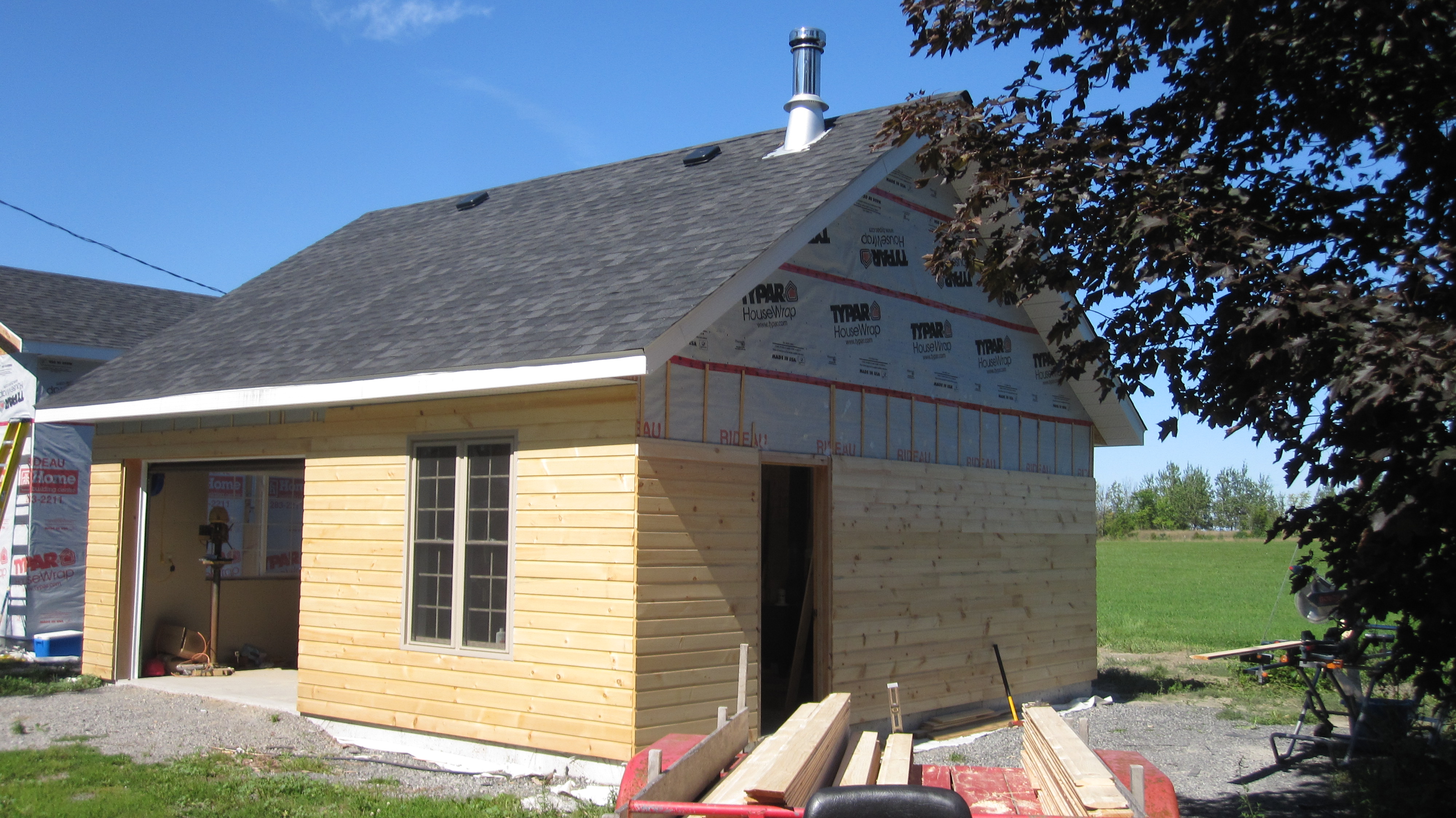
The local code was clear: if I confined the size of the building to 580 square feet, a concrete slab would do as a foundation. Because I had no idea of what getting a set of engineer’s drawings entailed, this do-it-yourself option looked good to me. 29 by 20 provided a useful hobby room, though Charlie insisted upon a twelve-foot ceiling to accommodate a full-height car hoist.
A year earlier we had started a play structure for a sixty year-old male child, and the workshop had taken shape nicely over the winter. So we knew the basics.
A succession of Charlie’s pals from Kingston poured the slab on a busy fall day.
In spring the walls went up. In real dollars, spruce lumber is cheaper now than at any time I recall. Most of what we used was also of remarkably high quality, evidence of a depressed lumber market. OSB sheeting is also cheap. We wore out one nail gun and replaced it with another.
I had the task of lifting the walls into place. For the workshop the previous year the panels were made of 2X4’s and only stood 9’ high. The old Massey Ferguson proved able to tip them up, sheeting and all, and place them with careful manoeuvres within the 24 by 24 footprint. But these panels were made of 2X6’s and stood 12’ 3” tall. And the floor was only 19’ wide. How could we do it?
Over the winter Peter Myers had welded some lifting hooks onto the upper corners of the bucket of the more modern 35 hp. TAFE tractor, so I determined to use its loader for the task. Nine feet in lift height didn’t seem a problem, so I drilled holes at that level in a couple of studs in each panel, then threaded short chains through them before the sheeting went on.
For each panel lying on the concrete floor I would get the bucket as close as possible to the top, hook on the chains, then lift and curl the bucket as the wall came up. This took the slack out of the chains and allowed the panels to balance pretty well on their suspension points 3/4 of the way up. With the help of an assistant I was able to fit the panels neatly over the anchor bolts in the concrete. The TAFE’s power steering let me make some pretty designs in shredded rubber on the fresh gray floor, but to my disappointment they faded soon after.
The trusses were much lighter than those for the workshop, so placing them on the high walls proved easier than I had hoped. Martin and Charlie practically did this operation by themselves.
A year before I had let a salesman talk me into ¾” OSB sheeting for the roof of the workshop. The sheets proved too heavy for one man to handle, so we went with the lighter size for this roof. The modest 5:12 pitch also made work on the roof less fraught with anxiety than on the ostentatious 8:12 of my workshop. My two sessions of shingle surfing* had left Bet a nervous wreck as soon as I touched a ladder and Charlie determined to keep me off his roof.
But an additional trailer-load of scaffold enabled us to work efficiently around the new building. A pair of white oak forks bolted to the bucket of the TAFE did the heavy lifting.
We had three large windows left over from the workshop project and I later found a fourth on Kijiji. Martin and Charlie insisted on doing the soffits and fascia on their own. All I got to do was cut the aluminum on my ancient radial arm saw.
Fibreglass insulation is expensive. A heavy vapour barrier is essential. Sheetrock is cheap. These stages of construction go quickly.
Last week Charlie and Rob showed up to lay the bricks for the stove pedestal. For safety reasons a wood stove must be at least 18” above the floor in a room which may house a motor vehicle. Gas fumes are heavier than air. At the end of the evening they proudly lifted the stove into place on their masterpiece. The next day Bet and I hooked up the stove pipes.
So then it came down to me to close in the gaping 10 X 9 entrance. For my workshop I had found a mahogany door left over from a building project in Lakefield. To justify its price I resolved to build a copy of it for another building, so I ordered the shaper cutters, laid in a supply of hemlock (what they use for frames on a “solid mahogany” door) and glued up and beveled twenty-four black walnut panels. Though it’s strong and resistant to rot, in quality local hemlock ranges from excellent to unusable, so it’s wise to buy lots of material for something like this.
Kevin at Commercial Door Systems of Kingston took an interest in the project and set me up with a kit of heavy duty hardware. Yesterday we completed the assembly, so now Charlie has a weatherproof play structure for his automotive activities. Next step: assemble the hydraulic hoist.
Standing up the new garage door
November 18, 2011

Homemade overhead garage door
The light was better inside than out by the time we had finished the preliminary fitting, so I took a photo of the back of the door. The bevels face out, of course. The sharp-eyed will see some horizontal cracks in the panels. Not to worry: the walnut panels are tongue-and-grooved as well as coved on the outside to fit the frames.
As it looks I’m going to need to cut the base to fit the contour of the concrete. To the left of the photo you’ll see a piece of 1/2″ sheetrock under the bottom of the door. But the sections are still out of alignment. If I raise the bottom panel another 1/8 to 1/4″ until it’s level, though, and scribe the bottom rail, cut to the contour and then re-install the aluminum and rubber bottom fitting, it should work.
The door, btw, is ten feet wide and nine high. The ceiling is 12′ 2″ in height to accommodate the car hoist.
Stone House Reno 7: The Basement Floor
November 12, 2011
For as long as I can remember the basement of our old stone house has been a warren of horrible little rooms only entered by necessity, but over the last two weeks I have poured concrete in the two areas which still had dirt floors.
The holes in the walls created by small animals over many generations are an affront to my sense of what is right. It doesn’t seem reasonable that critters should have free passage through the basement, even if they do no apparent damage. So I plugged as many low-lying holes in the mortar as I could while dumping the concrete for the floor. Mortar will follow later to seal the walls.
The former wood-storage area has always had air so bad our son couldn’t stay in the room. Turned out that was from an ancient block of firewood lodged behind the oil tank which was slowly turning to dust and releasing spores. Once it was out of there and a cubic yard of concrete mixed and poured, the room developed a completely different air. New florescent lights didn’t hurt, either. The fall vegetable harvest took over the new space with an electronic thermometer so we can monitor storage temperatures from the kitchen. Old horrors die hard.
The room next to the cistern is larger and the footings for the massive wood furnace had to be removed. Early in the renovation process I had pulled the cast iron monster out through the doorways with a long chain and my old Massey Harris 30. But the elevated base remained, so I dug it out, piece by piece.
My friend and companion in this project was my little Bolens tractor. Equipped with a three point hitch dump box I bought on impulse, the Bolens is small enough to back in under the outside stairs and deck, right up to the basement door. It carries away anything I can load into the box, which holds about two good wheelbarrow loads.
So the large slabs of sandstone have been relocated to a storage pile. All I had to do at that end of each trip was back up to the pile, dump, then drive back to the doorway while the little diesel pumped its comforting rhythm beneath me.
In this main room of the basement the 1970’s ductwork cut into the headroom. What’s more, I found the flagstones and concrete of the furnace footings were supported by a pad of crushed limestone gravel. It raked around quite easily. So I dug out a few more stones for the Bolens to haul. I could locate them with a hoe and tip them up, then carry them by hand the twenty feet to the tractor’s box. Easy. The headroom continued to increase as the tractor hauled rocks and grit away.
The job grew strenuous occasionally during battles between larger rocks and my pick, but I could cool down afterward with a tractor ride. That’s the advantage of a very small dump box: lots of breaks keep you going.
Before long the room, which used to consist of walls and a big hump in the middle, became flat enough that I could walk around upright without hitting my head. I even dug down a couple of more inches to leave room for concrete. Over by the water pump it still sloped down a bit, but I put an ABS fitting with a plug there to drain seepage from the pump back down into the dry glacial till below. That’s one advantage to living in a house built on a drumlin.
Then came the concrete. Compared to the complex recipe for mortar, the mix for concrete with Tackaberry’s sand/gravel combination is dead easy: shovel five scoops out of the trailer and into the mixer, add one of portland cement, spray until wet, five more gravel, one more cement, water, gravel, cement, water, then leave to mix while you dump the wheel barrow load already waiting.
It’s not a bad job at all, mixing concrete. The only problem lies at the other end, after dumping it. Proper concrete finishing involves a lot of steps and a complex timeline. All I wanted was to get the floor covered up so the mice would look elsewhere for winter accommodation.
I’d put the plastic vapour barrier down to prevent loss of moisture before the curing process was complete, but the screed, bull float and power trowel stages became a few tentative pokes with a rake to push down the larger gravel, then a float over the surface with a trowel before the next wheelbarrow loads cut off access to this area of the floor.
But gravity is a great help when pouring a floor. Nothing fell off, regardless of how badly I did.
So the floor is crude, but complete. To the satisfaction of the furnace inspector, the line from the tank to the furnace now floats above the new concrete rather than hiding from view in the dirt below.
The new basement should provide about 2500 cubic feet of fresh storage space. That should hold us until Christmas, at least. At under $200 in materials for a week’s worth of home improvements, the project hasn’t broken the bank, either.
How to cover a tall ceiling with sheetrock
November 5, 2011
How to make your own cove siding
August 21, 2011
Over the last year Charlie, Martin and I have put up a fine workshop where the horse stable once stood. Apart from sheetrock taping and interior trim, the only remaining task is the exterior siding. Building inspector Anpalahan Kandasamy told me that the final approval requires permanent siding, so I couldn’t leave the fading gray fabric on the outside for another winter.
The problem was that while I like the trim appearance of vinyl from a distance, up close I hate it. The double joints on long runs ruin a pretty good effect. So I decided to design and build my own horizontal siding.
The tool drawer contained a good set of tongue-and-groove knives for the shaper and a convex cutter designed for raised panels. I went to work on samples. To fit the tooling I would have to plane each board down to just below an inch, then cut the cove on top of the tongue so that the tongue and groove would fit together normally, but with a recess on the top edge of the board to give the traditional appearance. I hoped to be able to blind-nail the interlocked boards to the stud wall.
If this worked the project would give the old Poitras shaper and its power feeder a good workout.
Two years ago when I remarked at how well his fiberglass building dried a stack of wide ash boards he sold me, band-mill owner George Sheffield suggested that I should have my own solar kiln.
Over the winter I had ordered a couple of thousand feet of pine for spring delivery. I decided to follow George’s advice and try kiln drying this stuff in the “plastic palace” to speed the project up. Twenty-five hundred board feet of pine made for impressive piles in the low shed.
Even with large openings in the ends, a greenhouse-type building gets very hot in summer. Lumber apparently likes this as a drying environment. So do wasps. When it came time to take out a trailer-load I discovered that the wasps had colonized the electrical boxes and the rolled-tarp door. They didn’t leave gracefully, either. They like the dry heat.
The first batch of 12” boards I cut up to make siding had been piled outside over the winter, and did not take kindly to ripping on a table saw. The ends had dried a lot and the middle stayed green, so there were huge tensions in most boards. Some actually exploded from the stress during cutting. The 6” siding-candidates came out so crooked I re-piled them in the palace for a couple of months of further drying.
The stuff I cut up this week had gone into the palace in early May, and seemed very nice to work after three months in the “kiln”. The terrific tensions of the outdoor boards just weren’t there.
At the planing stage a new problem cropped up. Normally I run lumber through a trailer-load at a time, let the shavings land on the floor and then shovel them into an old spreader for mechanized unloading elsewhere.
But this dry pine planed off in light, fluffy shavings which plugged the machine. I was forced to hook up the heavy vacuum system I had earlier installed for the sander. That worked nicely until I had finished the third board. Then the planer plugged again, this time because the chip barrel was full. This would take some learning.
I gradually figured out the timing on the barrel and discovered the planer in fact works better with the chip collector installed.
The first batch of siding came out at 5” in width, and I was able to cover the front and half of one side of the 24 X 24 shop. The next batch is almost finished, and I can’t decide whether to try to hit the 5” mark again, or leave these at 5 ½” and reduce waste. This stock was a little wider than the previous lot.
In any case, the 1” cove siding nails onto ¼” strapping quite nicely with galvanized siding nails. Anpalahan insisted upon the strapping to provide an air space so that the siding can adjust to humidity changes and water infiltration. Turns out these little straps enabled me to locate the studs in advance, preventing chaos later.
Making cove siding is nice, mindless work. If you don’t count labour, tools, and the paint yet to come, it’s cheap, too.
https://picasaweb.google.com/106258965296428632652/MakingCoveSiding
That’s all before the scaffold goes up.
A Real Garage Door
January 7, 2011
That’s the one we’ll use to visit the garage and to fix the fire, not the one reserved for whatever mechanical pet is currently occupying the service bay.
The new door’s made of white oak grown locally by Ed Rowswell and sawn on his mill. The planer had no trouble with the wide planks, but my old tenon cutter had its work cut out for it, and I had to stand on the foot pedal of the mortiser for each of the many cuts into the dense, stringy wood. It was good to get my woodworking tools back into operation. They’ve been in storage ever since we moved into my shop of 30 years, a stone house on the property.
Now my beloved Poitras shaper and 8″ General jointer are snuggled neatly around the box stove. No more damp barns for them. The band saw’s just to one side and the tenon cutter’s back in operation for the joinery projects involved in the final touchups on the house — primarily armoires in the bedrooms. The other tools can stay out in the cold.
A 1.75″ oak door is incredibly heavy to lift around. Once it’s mounted on hinges, of course, it swings just like any other, though perhaps with more authority.
Suburban homeowners discover they can take their entry doors apart and replace the muntined thermal panes with opaque glass for privacy. Then the rejects sit around their garages until they put them on Kijiji for a few dollars. I bought two last summer in Ottawa. The current glass in the door cracked when I drove a screw into a mortise in the door frame to tighten it. Then the sledge hammer did it no good when I whacked the prehung door into position. I’ll drop the second one in a little later in the process.
Normally I fit a sheet of 1/4″ plate into doors like this, but I decided a replaceable panel would be better for a door likely to be used as an entrance from a woodshed. Surely enough, as soon as I make a replaceable window, I end up replacing it.

The Garage Door Spring
December 27, 2010
The design for the new garage featured a single ten-foot garage door. It needed to be that size because I have a trailer almost eight feet wide.
But it couldn’t be just any door. It had to be a bit special. Internet searches proved fruitless until I finally spotted the perfect 10X7 in a Kijiji ad in Lakefield. It claimed to be a mahogany-paneled door, but the two-tone photo made it clear that it had luan panels and some white wood I couldn’t identify for its rails and stiles. Nonetheless, it looked good, though the price was steep.
We towed the trailer to Lakefield and bought the door from a custom house builder who had it left over after a change in plans. Considerable research traced it from Stewart Garage Doors Ltd. to its original builder, a small factory in Toronto. The wood other than “mahogany” turned out to be hemlock, admired by the builders for its strength and resistance to rot.
I spent two weeks applying the latest opaque stain to it in preparation for installation day. But then came the sheetrock which dragged on until Roz fitted and screwed the bottom foot around the walls on Christmas Day.
So yesterday we began. The door went together quickly and well until we came to the spring-loaded gizmo that mounts above the door to serve as a counterweight.
The instruction booklet from Stewart’s was obviously never intended for use.
“Professionals install these doors,” the builder had told me. Nonetheless I resolved to rely upon the burnt-fingers method and twenty-five years of experience repairing an ancient 17′ plywood monster. It didn’t have this spring-around-a-shaft mechanism, though.
The Internet provided several good videos on the subject, most of which emphasized the sheer insanity of torquing the spring with anything except a pair of purpose-built 1/2″ steel rods. Pieces of rebar and screw drivers were uniformly dismissed as insanity likely to maim, if not kill. I took that part seriously and made two fine bars, even marking the ends with tape to indicate when they were fully inserted into one of the four holes to turn the end of the spring.
Stewart’s let us down at a critical point. By following their instructions to the letter, I was doomed to fail. When I tightened it, the spring eventually gave a terrifying lurch and crawled up both of its hubs, jamming against the adjusting mechanism on one end and the stationary support on the other. Now what?
Charlie and I managed to pry up the door and escape the garage, but a night of worry produced no real alternatives. By morning, though, tractorbynet.com contributors responded to my plea and explained that I had probably assembled the thing backwards. They suggested a couple of websites which provided good information. Charlie returned and we went from there.
The spring was partially blocking one of the four holes into which I needed to insert the two winding bars in turn. A couple of seconds at the grinder created a flat 1/8″ deep area on the other end of a winding bar. This allowed it to slide by the offending spring and deep into the hole in question. We were back in business, only this time on the right side of centre, rather than the left. (Conservatives reading this will no doubt clap with glee at the irony.)
Winding this spring is difficult and dangerous. Fastening the little gibs on the hubs is equally stressful, as they must be torqued with a tiny wrench to between 22 and 44 pounds, but the hollow jackshaft keeps collapsing underneath them, so it’s very hard to know how tight to make the screws. Then try it with the end of a large spring up against the square gib so that it makes a loud “sproing” every agonizing quarter-turn.
Part of the burnt-fingers methodology involves frequent stops for feedback. This meant many attempts at raising the door to see if the spring was tight enough yet. Each time we had to fasten the shaft again with the vice grips, inserting a rod to hold things, then back out the gibs and torque the spring yet another turn or two. Force required and stress created increase exponentially throughout this process. Misadventures with these springs resulting in amputation or death are widely reported on home improvement sites.
By the middle of the afternoon, though, Charlie and I were still very much alive with all of our fingers, and the door operated acceptably. On we went to the remote opener. Charlie had never installed one of these before, so he watched a bit bemused as I whipped the familiar parts together. I had installed two.
But he was on hand for the heavy lifting. The simple way to install an opener involves assembling this long beam, bolting one end to the opener mechanism and the other to the garage wall above the door. Then you lift the unit into place and fasten it with metal straps to the ceiling. This is a breeze if you have someone to hold the unit in place.
After the stress of the counterweight, the electronics can wait for another day. The safety beam can be tricky, and training the cars to talk to the opener requires Charlie’s brand of patience.
As for that infernal spring, by the time we’d figured out how to deal with it, the job was done.
The Roofer’s Dictionary
September 19, 2010
Shingle-surfing: a giddy sensation of movement one experiences when the shingle on which one is standing detaches from the nails holding it and begins a descent of the roof, necessitating rapid instinctive movements to restore balance and control before collision with the scaffold or the ground below. The adrenaline rush is palpable, though because this activity fits the definition of an extreme sport, participation by persons older than forty years should be discouraged.
Chalk line: container for string which can be unwound and stretched from time to time to 1) illustrate by the depth of the gaps below the string how uneven the rafters are 2) demonstrate how leaving tools out in the rain turns blue chalk into an interesting paste.
Magnet: efficient device for the salvage of used shingle nails when the calculated allotment of “1000 nails” runs out.
Ice spud: useful device for the scraping of old shingles from the roof (see also shovel, kitchen knife, bread board).
Roll-up: what occurs when an energetic newbie discovers that the soft, bonded-together shingles can be rolled up (nails and all) like a piece of old carpet and dumped over the edge of the roof into the backyard (see beginner’s luck).
Hammer: common construction tool available in a variety of weights and configurations in student households, marginally suitable for the pulling of bent nails but remarkably efficient at mutilating aluminum trim and fingernails. Straight-claw variants of this common tool can actually be used in construction, though the pulling of nails turns this common type into a catapult for the projection of bent nails in all directions.
Tin snips: reinforced scissors for the cutting of sheet metal until pressed into service to cut shingles when the knife blades run out.
Utility knife: oft-maligned disposable cutting device invaluable for the trimming of shingles, thin aluminum trim and roofing membrane. When used freehand, occasionally allows the user to produce artistic shapes in shingles, which earn negative reviews from gallery viewers. Used in conjunction with a straight-edge, has the effect of slowing the entire project down, enabling volunteers to concentrate upon consolidating the shingles into a solid mass by aimless rambling around the roof waiting for something to do.
Mazda 3: modern hatchback automobile, utterly unsuited to the transport of shingles, even though the internal capacity of the vehicle with seats folded down is about right.
2 X 4: common softwood product which can be cut, shaped and adapted to any number of applications in roof repair, limited only by the supply of such products, a saw which has not yet cut any shingles, and a supply of 4” Robertson screws.
Robertson screw: ubiquitous fastening device in Canadian workshops, banned by patent law from American building sites. In conjunction with the cordless drill and screwdriver bit, produces the characteristic loud “churrrrl” sound of the handyman at work.
Roofing membrane: delivered to the jobsite in ridiculously heavy rolls, a new wonder product for use as an ice dam on low-slope roofs. Two broad plastic strips protect the adhesive side. In some cases these can be removed by pulling after the product is in position on the roof. Other attempts produce lumps of mangled plastic under the adhesive, imparting an interesting architectural contour to the otherwise bland plane of the roof. If freed from their adhesive, the white plastic strips can then blow about the building site, imparting a festive air to the project.
Flashing: sheet metal product configured to exploit principles of differential expansion and solar heat to lever fastening devices out of brick walls, utilizing hardened tar as a fulcrum; traditional behaviour of high steel workers to commemorate the completion of a project.
Rules for volunteers on the roof: 1) bring the shingles 2) lay the shingles 3) get out of the way.
Ladder: portable grounding device for the testing of the current-carrying status of overhead wires; wind gauge indicating unsatisfactory weather conditions for roofing when it blows over; justification for the wearing of hard hats on construction sites (see above).
Stepladder: useful device for climbing if set up on a flat, horizontal surface; unstable platform for balancing and contortion acts for the entertainment of spectators when installed anywhere else (see extreme sports).
Backyard: landing area for used shingles, scrap, tools, wrappers, flashing, so that the roof can appear neat and tidy in photographs. Cleaning up the backyard is never figured into calculations of cost or labour allotments.
Volunteerism: strange psychological disorder compounded of empathy and testosterone imbalance leading friends or the curious to pitch in and help. Generally one work session is sufficient to cure sufferers of this strange malady, but some will keep coming back until the shingling is complete. Even these few rare individuals will never, however, show up when it’s time to gather up the shingles and other junk in the back yard.
Used asphalt shingles: hazardous waste to the budget of the homeowner, accepted reluctantly at landfill sites after payment approaching the cost of the replacement shingles. Profit source for removal contractors.
Pickup truck: highly desirable possession of a friend, suitable for the hauling of shingles, brush, old appliances and other debris piled high in the backyard of the recently-purchased house.
Newbies: new owners of older home, prone to embarking upon major projects without knowledge or experience, relying upon energy, the Internet, and considerable intelligence to make their way through. When asked if she would do this again, this one responded: “Sure. Now we’ve done it I would never pay someone to do a roof.”
Putting up the trusses
September 6, 2010
Instead of a tale of foible and error, I offer this week one of sore muscles and fatigue. Putting up trusses is strenuous work for an old guy who thinks twice about a trip up the stairs, let alone an excursion across wobbling trusses at the top of a roof. But Martin and Charlie were available, and it was the best chance we would have to get the trusses installed and keep the project moving.
The last time I hauled trusses along a top plate was in the summer of 1974, and I was flat-out terrified. We were building the house on the hill now owned by Joe and Elaine Laxton, and all I can remember is that the huge trusses were on a tractor-trailer bed at one end of the house, and I had to pull one end of these thirty-foot monsters along this narrow, wobbly top plate, the full length of the house while staring down sixteen feet to rocks and concrete below. I hadn’t figured out how to backfill at the rear of the house, so things were a bit ragged down there. Falling was not an option.
The worst of it was that my dad was fearless around heights. My nephew Jonathan picked up the same gene, but it skipped a generation with me. But it wouldn’t be manly to show fear. The house wouldn’t get built, either. Better to risk a fall. So off I went, dragging this truss across the tops of the interior partitions of the house, my dad on the other side, cheerfully picking his way along. Then came the the living room/dining room with no central partition, and the top of the truss dropped into the gap. Yikes! Turned out it was easier to carry in this position, so on we went, tiptoeing down our parallel tightropes.
I was very pleased to complete that day’s work with all my limbs and some of my dignity intact.
But that was then. Today’s trusses seem a bit lighter in construction. And there are no partitions inside a garage, so we were able to bring them in through the opening for the wide door, push one end up onto the far wall, then combine our efforts to gain the other wall. Then it got tricky. The guy on the bottom, usually Charlie, hooked a 2X4 into the top of the truss and pushed while Martin and I reached down and grabbed.
It looked risky but it worked. Nobody had to walk the top plate. Martin was even able to lounge on a rolling scaffold unit. Equipment has improved since the seventies.
Unfortunately the nail gun didn’t seem all that good at driving spikes through the plates holding the ends of trusses together. The hammers came out. Charlie started a strong, steady routine with the spikes, but Martin’s taps showed great effort, reasonable accuracy, but little skill or effect. Charlie explained what his grandpa had taught him, and Martin immediately improved his swing.
My job was to crawl around in the middle with the nail gun, installing braces as needed to keep the whole thing from falling down. Hurricane Earl had sent a few tentacles northwest, and we found it wasn’t hard to tip the trusses up — just let the wind get under them — but bracing needed to be quick and sure.
Gradually we ran out of space inside the garage for the nine-foot-high trusses. This meant hauling them up over the end of the building, but that went pretty well until the final truss, #13. Have I mentioned how the number thirteen seems to have it in for me? I could hardly wait to see what was in store.
Just to play it safe I lifted the heavy end-truss onto the top plate with the tractor. No disaster, despite Charlie’s worry and Martin’s objection to the slowness of the machine. Everyone’s back was still intact. We slid it into place and tacked the ends. And then the air strike hit. A sudden downpour of water and hail pummeled us as we struggled to brace the truss, but one shot from the nail gun connected with a 2X4 in the right place and we dashed for cover. They were up.
The following day Charlie and I faced the sobering challenge of the package of “ladders” which had come with the trusses. The end units are smaller than the others by the thickness of these ladders which fit over the ends and nail to the side of the next truss in. The 16″ of the ladder which hangs over then becomes the overhang for the roof.
I had no idea how to put these things up. Charlie suggested a scaffold, so we set up three lifts at the west end of the building. Some of my climbing planks are a bit old, so I grabbed a 10 inch oak plank off a pile of new lumber in the yard. My goodness, a chunk of green oak is heavy to place up 15′ on a scaffold. On the other hand, once it’s there it doesn’t move.
By the fourth section of ladder we had the system figured out and the only question remained, “How will we get the scaffold down now that we have built the eaves of the garage over it?”
http://picasaweb.google.com/rodcros/BuildingAGarageWorkshop#
Anyone can do basic carpentry. All you have to know is how to read and which way is up.
August 29, 2010
Turns out each of these is a tall order. My usual crew members have departed for B.C., one on vacation and the other to a conference, but the trusses for the garage arrived a week early. With thoughts of the pristine trusses turning to pretzels in the August sun, I made a quick call to former student Dale Edwards at Rideau Lumber and soon had materials for the walls to hold the trusses up.
Years ago when I worked in the shop at Rothwell-Perrin someone else did the layout on the panels we banged together all day. The houses seemed to assemble at a fairly quick pace. It’s another matter entirely when there’s just one old guy, a pile of new, straight 2X4’s starting to curl in the heat, and the Ranger to serve as cart and workbench.
The first task on the first panel was to fit the treated-pine 2X4 which sits on the concrete pad. The anchor bolts looked a little snaggle-toothed when I approached them with a drill. How would I get all of those angles correctly copied into the bottom of the wood?
I placed the green scantling on top of the row of bolts and gave each a firm tap with a hammer to mark the spot. Then I guessed. I drilled the holes out and the 2X4 fitted over the bolts neatly, so it was on to the layout stage.
I pressed the Massey-Ferguson into service to lift the panels with the loader. I’d left off the last foot of sheeting to create space for a chain. This worked.
But then it got tricky. Do you know how many ways there are to foul up the arrangement of two 2X4’s lying beside each other on a bench? On that third panel I think I discovered all of them. Two attempts at a very simple wall were abandoned to confusion on the first day. The following morning I laid it out again, this time with a black magic marker. I’d reached the point of no return.
The tractor lifted the panel onto the anchor bolts, two in this case. They went on fine, but one end of the panel now hung over the yard and the other was dangerously close to the centre of the garage. What?
It’s all about knowing which way is up. I had figured out how to nail up the panel without having to turn it over or reverse it, but in the process I lost track of which surface of the bottom plate had to be UP to fit over the bolts. It cost a few frenetic minutes with a hammer drill and what had been a pretty good woodworking bit to set this error right. Bet’s confidence in my abilities as a carpenter did not increase that morning.
What’s worse, I wasn’t sure the same thing wouldn’t happen on the next wall.
Then comes the second half of the woodworking prescription: the ability to read. An email from a truss manufacturer which promises delivery before September 3rd may mean the truck will arrive without warning on August 25, so it would be wise to have the space ready well in advance. I had to make the guy wait while I leveled 18 yards of gravel to make a semi-flat surface for his load.
But that’s not the only kind of reading required of a framing carpenter. My dad always put great faith in his square, but I’ve never trusted the thing. Unless you’re an expert it’s too easy to build a cumulative error into layout with one.
I remember in the mid-seventies when a group of us put up the trusses on colleague Robin Fraser’s garage. Paul Smith went down one wall with a square and I shinnied down the other. Nobody thought to check if we ended up with the same number of spaces at the end. Brimming with testosterone, the gang of young teachers on a Saturday morning had the things up and braced before anyone could look. Robin told us later that Paul and I did, in fact, end up with the same number of trusses by the end of the garage, but he had to cut every sheet of plywood they installed on that roof because of the errors accumulated over 30 feet with coarse marking crayons.
The same thing happened when I tried to transfer the marks around to the other side of 2X4’s after laying them out upside down. Factory-machined dimensional lumber has rounded edges and every line requires guesswork to transfer from one surface to the next. Things just didn’t line up right on the panels. Window frames were a little crooked. I compensated by making the openings a little larger and soldiered on. There’s always foam, and for really big gaps I can cut shims with my band saw.
What I had thought would be an easy woodworking job has turned into a real challenge because I keep losing track of which way is up. But this is the easy part. Wait until those trusses go up.
 the Walnut Diary