Fake news and NAFTA
June 28, 2018
Donald Trump has regularly used lies and exaggerations in his public pronouncements. According to the Globe and Mail, a fake chart of Canadian tariffs levied against the United States is making the rounds, with no effort to correct the record by the posting websites when presented with the facts by the Globe. The tacit approval of this misinformation from the White House seems as to indicate that in the current administration’s view, lies are fair game in beating down an opponent. No wonder Canadians are staying away from the border and making their Internet purchases on Canadian sites.
The following appeared in the Globe and Mail this morning:
ADRIAN MORROW U.S. CORRESPONDENT
WASHINGTON
PUBLISHED JUNE 27, 2018
UPDATED 12 HOURS AGO
If you believe a chart of tariff rates circulating on Facebook and Twitter by supporters of U.S. President Donald Trump, Canada is egregiously gouging the United States.
Under the North American free-trade agreement, the table claims, Canada charges levies of 45 per cent on aluminum, HVAC equipment and televisions; 35 per cent on vacuums and cable boxes; 25 per cent on cars and steel; and 48 per cent on copper. The highest U.S. rate for any of these items, by contrast, is listed at just 5 per cent.
There’s just one problem: Every Canadian number on the chart is false. Under NAFTA, the tariff Canada charges the United States for every one of the listed items is zero.
(Graphic missing here)
Globe and Mail Evening Update, June 28, 2018, provided a summary:
Have you seen the chart of tariff rates circulating on Facebook and Twitter by supporters of U.S. President Donald Trump, suggesting Canada is gouging the United States? Under the North American free-trade agreement, it says, Canada charges levies of 45 per cent on aluminum, HVAC equipment and televisions; 35 per cent on vacuums and cable boxes; 25 per cent on cars and steel; and 48 per cent on copper. The highest U.S. rate for any of these items, by contrast, is listed at just 5 per cent. One problem: Every Canadian number on the chart is false. Under NAFTA, the tariff Canada charges the United States for every item listed is zero. The origin of the fake tariff chart is not clear. It first cropped up on social media in the days after the Group of Seven summit in Quebec, when Trump called Prime Minister Justin Trudeau “dishonest and weak” for complaining about the President’s metals tariffs. (subscribers)
The only thing ‘wrong’ about this chart is that all the numbers are completely wrong. There are no such tariffs.
The misinformation comes as Mr. Trump ratchets up his trade attacks on Canada. He has hit the country with steel and aluminum tariffs, demanded changes to NAFTA to tilt the playing field toward the United States and threatened crippling levies of 25 per cent on Canadian-made cars.
False, shareable memes, including some created by Russian agents, have been circulating among Trump supporters for years. But they have usually targeted emotionally charged topics, not dry policy matters. The emergence of the chart reflects the increasing furor with which the President’s base sees international trade. And it has observers worried that such misinformation will contribute to the momentum Mr. Trump is building for an escalating continental trade war.
“The President is purposefully evoking a fight against Canada right now. He has an agenda to demonize the trade relationship,” said Bruce Heyman, a former U.S. ambassador to Canada, who said the popularity of the chart is an outgrowth of Mr. Trump’s misleading and hyperbolic trade rhetoric.
The President has, for instance, repeatedly accused Canada of “taking advantage” of the U.S. with its high tariffs on dairy – one of the few barriers that remain under NAFTA – but has been silent on the United States’ own tariffs on a range of food products from sugar to peanuts to sour cream.
At a Monday rally in South Carolina, the mere mention of Prime Minister Justin Trudeau’s name drew boos from the crowd. “Justin, what’s your problem, Justin?” Mr. Trump said. “Canada has a 275-per-cent tariff on dairy products … I said, ‘Look, if you want to do that, we’re going to put a little tariff on your cars coming in.’ ”
The exact origin of the fake tariff chart is not clear. It first cropped up on social media in the days after the Group of Seven summit in Quebec, when Mr. Trump called Mr. Trudeau “dishonest and weak” for complaining about the President’s metals tariffs.
On June 13, a pro-Trump Twitter account called @TakebkUS tweeted the chart. Both the chart and the tweet contained the same grammatical error, mistakenly inserting an apostrophe to pluralize “tariffs” and “TVs.” But the person who runs @TakebkUS, who would not give his or her name, told The Globe he or she did not create the chart and did not remember where it came from.
The next day, a Trump-supporting Facebook page called The Federalist Papers posted the chart with the comment “Does this seem wrong to you?” and garnered 27,000 reactions.
On June 21, Charlie Kirk, the founder of a conservative student group, fell for the hoax. “Trump is levelling the playing field with Canada who has been ripping us off,” he tweeted, along with the false Canadian tariff levels. His tweet received more than 10,000 retweets and 20,000 likes.
Neither Mr. Kirk nor The Federalist Papers responded to requests for comment. None of the people who shared the table erased or corrected it after informed by The Globe that the numbers are fake.
Scott Lincicome, a trade expert with the Cato Institute think tank, said the chart’s figures are so outlandish that it is clearly a deliberate hoax and not an honest mistake.
“It strikes me as so obviously wrong that it wasn’t unintentional,” he said. “Someone sat down and decided they would create a fake chart.”
The table’s creator even cited three supposed sources for the false numbers: The Office of the United States Trade Representative, the U.S. International Trade Commission and the Canadian Minister of International Trade. None of the three show figures on their websites anywhere close to the supposed Canadian NAFTA tariffs in the chart. The spread of politically charged internet hoaxes first came to public attention during the 2016 presidential election, when made-up news stories and memes – generally targeted at Trump supporters – spread through Facebook and Twitter. Some were allegedly built by Russian agents trying to tip the election to Mr. Trump.
“Trump made NAFTA an emotional issue and made his supporters think about it in emotional terms,” said David Carroll, an associate professor at the Parsons School of Design who has tracked the rise of false news. “There’s no issue that isn’t seen through a sense of resentment.”
In reality, Mr. Heyman said, the few trade disputes between the two countries are small blemishes in a mostly harmonious and 99-per-cent tariff-free trading relationship worth $900-billion last year.
“Imagine a pristine sports field, and in the middle of it, Trump sees a single dandelion,” Mr. Heyman said. “He says, ‘Oh my God, look at that – it’s full of weeds, we’d better rip up the whole field.’ ”
Here’s a link worth a click.
June 19, 2018
Remember the great fuss about BPA, the toxic lining in baby bottles which was run out of North American stores? It’s returning to popularity as toxin-of-the-month, tied with Roundup, the popular herbicide.
https://www.treehugger.com/health/who-cares-about-bpa-canned-beer-more-popular-ever.html
And this is just sickening:
How can the American people allow abuse like this in their own country? It’s fascism, folks. Remember, Hitler was elected to power. It took the German people seventy years to get over that mistake.
from Macleans, June 12, 2018
June 13, 2018
Why pharmaceuticals could be the prescription for trade warfare that truly hurts America
Opinion: If Canada wants to decisively threaten maximum pain and stop the escalating trade war with the U.S., it should propose expropriating pharmaceutical patents
by Amir Attaran
Amir Attaran is a lawyer, biomedical scientist, and professor in the faculty of law and the faculty of medicine at the University of Ottawa.
What began as a trade skirmish over Donald Trump’s imposition of a 10-per-cent tariff on Canadian steel and aluminum is now clearly a trade war. The miasma is only just lifting from the G7 summit in Charlevoix, Que., in which a Justin Trudeau press conference over a spiked communiqué sparked a Trump tantrum.
But the war’s final battle will not be the tariff that our government has already imposed in retaliation on American pizza, whisky, mattresses, coffee, et cetera—in fact, our tit-for-tat tariffs have only caused the White House to double down and promise even more tariffs against Canada soon. That means that Canada’s symmetrical retaliation is not working—and if we do not rethink our strategy now, we could soon be inside a tornado-like spiral of escalating tariffs, causing rising prices, sinking economies, and growing joblessness on both sides of the border.
If we are not to let the bully win, Canada must find an asymmetrical way to retaliate in this trade war. One that destroys American resolve, but spares us—or even benefits us. But how?
There are several ways, but Canada should consider—and threaten—expropriating American pharmaceutical patents.
Pharmaceutical patents are ultra-valuable assets. Whoever controls a drug’s patent has the exclusive right to make and export that drug. With typical drug prices growing an average of 12 per cent annually, and with certain specialty drugs priced over $500,000, controlling the right pharmaceutical patents is like having several gold mines.
But what makes pharmaceutical patents ripe for retaliation is the vulnerability of America’s pharmaceutical industry. Six of the world’s top ten pharmaceutical companies are American. No industry throws more lobbying dollars around Washington—more than the banking, defence, and automobile industries combined. Any trade retaliation aimed at pharmaceuticals certainly will be felt on Wall Street and heard in the White House.
Canada has already expropriated pharmaceutical patents in the past: The federal government did so hundreds of times in the 1970s and 1980s, but stopped because of the 1988 Canada-U.S. Free Trade Agreement, which later inspired NAFTA. Now that the White House wants to back out of our trading relations and NAFTA too, it is fair to revisit that decision.
Thanks to an obscure twist of world trade law, doing so is perfectly legal, too. In the years since NAFTA, developments in international law have made expropriation of pharmaceutical patents easier and less risky than ever. Between 1998 and 2005, at the height of the HIV/AIDS crisis, the World Trade Organization cobbled together special rules making it lawful to “compulsory license”—or, essentially, expropriate—pharmaceutical patents. The rules allow Canada’s government to authorize Canadian companies to copy patented drugs controlled by U.S. companies. There is no need for an AIDS-like health emergency, so long as certain manageable procedural steps are followed. Further, those procedural steps can be shortcut “to remedy a practice determined after … administrative process to be anti-competitive”—likely an easy determination for President Trump’s bogus claim that aluminum and steel tariffs are needed for national security.
Once granted, a compulsory license leaves Canadian firms with the right to copy, sell, and potentially export the targeted drug, at the expense of a U.S. firm who is compensated only pennies on the dollar for the lost value of its patent monopoly. The White House would be left furious by Canada’s decision, but it would be without legal recourse.
There would be several advantages to this move. Macroeconomically, compulsory licensing would mean growth for the Canadian pharmaceutical industry, and decline for the U.S. pharmaceutical industry. Microeconomically, it would mean cheaper drugs for Canadian households, once the American companies’ patent monopoly is broken. From a domestic policy angle, it would mean billions of dollars of savings for Canada’s publicly-funded Medicare system.
And most importantly, diplomatically, it would mean unleashing the most powerful industrial lobby in Washington to beat up the White House on our behalf.
Normally, I wouldn’t advocate for compulsory licensing. Throughout my career, writing public health and legal reports for the United Nations, I have been skeptical of it, because there are almost always better ways to obtain drugs cheaply than snatching patents. But in a trade war, that’s beside the point. Winning means using economic and political power to intimidate and injure your opponent while staying legally onside yourself. The asymmetrical warfare of pharmaceutical compulsory licensing would be unsurpassable for that.
Just look at the threat posed by a precision offensive of Canadian compulsory licensing. For the American pharmaceutical industry, which claims to be worth USD$1.3 trillion to the American economy, picking off its most profitable drugs poses a near-existential threat, because once Canada shows how to unravel patents, other countries will copy us. There would also probably be no greater disaster for the White House’s trade agenda, which has made a priority to demand stronger pharmaceutical patent protection fromCanada, Mexico, the EU, China, India, Japan, and elsewhere. If Canada started with the drugs of Eli Lilly and Company, say—headquartered in Vice President Mike Pence’s home state of Indiana—fear would set in quickly.
With President Trump intent on trashing America’s allies and wrecking the postwar trade order, Canada has reason to threaten compulsory licensing and show the White House where its folly will lead. Republicans and Democrats benefit about equally from the pharmaceutical industry’s campaign donations, so a credible outcome would be that the industry lobbies furiously for a bipartisan agreement in Congress overriding President Trump’s misbegotten tariffs.
In short, this strategy would inflict far greater agony on the White House, at a lower risk, than retaliatory tariffs alone—and boost Canada’s economy and health care system while it was at it.
Expropriating pharmaceutical patents sounds like a significant, hardball play—and that is what it is, undeniably. But as huge as the impact would be, it wouldn’t permanently damage relations not just because Canada has made this threat before—a 2001 ultimatum over anthrax drugs—but because the threat would never need to be enacted. Congress would intervene, thanks to the ferocious pharma lobby, and relations would return to normal.
And remember: that free, global trade has kept the peace for decades by making customers of former enemies who once fought real wars. We cannot afford to forget that a hard-fought trade war is conservative and preferable in comparison.

This morning we tipped over a 20″ elm which had died near the shops. The PTO winch on the TAFE did the job and enabled me to place the fallen tree in a rather confined area without damage.
The chain saw was low on power. Eventually I blew out the air cleaner and that improved things, especially the operating revs. Four tanks of gas and the cant hook Bet found in my shop, and the tree was sawn up.
Then came the 3 pt hitch wood chopper. Run by the Kubota, it’s pretty good on dead elm branches up to 2 1/2″ and down to 1/4″. Tiny, stiff and long live twigs clog it up. So I took to hanging onto the tops of the branches I fed in, depositing the little stuff in a pile I’ll throw onto the trailer with the load of chips later. Standards aren’t high on woodland trail improvements, and this really cuts down on sessions with the chopper apart to clear blockages.
Next I’ll load the small wood into the loader bucket and have Bet dump it on the main wood pile. She’s been hanging around all day for the chance, I think.
The blocks will go upright on the little dump trailer with a side folded down (towed by the Bolens). From there I can swing them onto the block splitter (run off the Kubota’s hydraulics) without lifting them a second time. The pile of split wood then gets unceremoniously bucketed onto the main pile, topsoil, grass and all, with the TAFE.
Only trouble with all of this efficiency of effort is that I now burn very little wood…
The battle of the pollsters
May 30, 2018
As the clock ticks down to the June 7th provincial election in Ontario, almost half of the voters are undecided. Global News and Angus Reid regularly publish polls showing Doug Ford’s Progressive Conservatives in the lead. Mainstreet, MacLean’s, the Sun chain, the Globe and Mail and the Toronto Star run stories about the rising momentum of the NDP under leader Andrea Horwath.
The consensus holds that the election is far too close to call due to the percentage of voters (up to 43% in one report) who will make up their minds in the booth. I guess that’s an invitation for some pollsters to whip up a bandwagon effect with their surveys, if they think it will work.
The Toronto Star editorial board commented in an interview with Liberal leader Kathleen Wynn this week that the recent round of complimentary articles from columnists traditionally opposed to her “must give you the feel of a political obituary.”
Wynn cracked back, “Reports of my demise have been greatly exaggerated.”
An editor did quote one sharp-tongued critic with a particularly conciliatory remark: “Kathleen Wynn has been a better premier than we deserve.”
If the desire for change is the overwhelming ballot box issue in this election, then Wynn’s Liberals are toast. Andrea Horwath seems the beneficiary of the PC’s turmoil prior to the election, and then their bone-headed choice of Doug Ford as leader. Ford has yet to come up with a platform and fills his speeches with muttered bromides, but I guess if you want to believe a leader’s promises enough, objectivity has nothing to do with one’s choice.
For ten years Andrea Horwath has been a cipher as leader of the Ontario NDP. Now she has been presented by circumstance as the least repugnant of the leading candidates.
Personally I would prefer to see an NDP minority so that an NDP/Liberal coalition would offer some guidance to the naive Horwath and her motley crew of MPPs. Anybody but Ford, in any case. From my perspective as an educator, success as a middle-level high-school drug dealer and the legacy of drug abuse and ruined lives in his family make Doug Ford the worst possible choice for premier of Ontario.
Last provincial election I voted NDP because the local guy impressed me far more than the other three candidates whom I also sat down in my living room for interviews. This time I haven’t spoken to any of them. PC Steve Clark can mail this one in and still return to Queen’s Park, but I’ll vote Liberal out of respect for Wynn.
Cayenne S tows into the wind
May 5, 2018
It was a hell of a wind yesterday evening, but Charlie had to get to Canadian Tire Motorsport Park just east of Toronto to play with his BMW and work as a Porsche Club of Canada instructor for the weekend, so he set off at 6:00 from the farm towing the 20 X 8.5 enclosed trailer loaded with his car and equipment. I checked with him at 9:50. He had just arrived.
The load-levelling hitch evened the suspension out pretty well, but the problem was SW winds were so high they had closed the airports in Toronto, and the Hamilton Skyway Bridge shut down as well because of wind gusts over 75 mph. Headwinds were a minimum of 30 miles per hour, with gusts passing 50 mph.
The 2004 Cayenne S pulled the bulky trailer through it well, according to Charlie. I asked him about the fuel consumption.
28.5 L/100 km. Normal is in the low 12’s for mixed driving. That was a serious pull over a relatively flat road. He did say it was very windy.
UPDATE: 6 May, 2018
This evening Charlie told me that when towing the trailer into in that 60 mph headwind, there was no change in engine effort when going down hills. I insisted that he check the engine oil. No change in oil level from before the vigorous exercise.
Trees, Youth, Our Future
May 4, 2018
The Eastern Ontario Model Forest has produced an outstanding film series narrated by Andy Kerr-Wilson on the history and future of the forests of Ontario.
Look below for links to the films, including a 12 minute preview. The first film runs 47 minutes, and the second runs 50 minutes.
If you found Two Billion Trees and Counting an interesting read, you’ll certainly want to have these films at your disposal.
Senior moment
April 25, 2018
In the Costco parking lot this afternoon I found myself tightening the left front lug nuts on my Porsche Cayenne. Of course today had been the day I decided to put the summer tires on, so I had Ruby up on the hoist and the wheels switched before 9:00 a.m. Seems the studs were rustier than they looked, and I forgot the torque-wrench stage.
It was fortunate that I had had to back out of a trick parking space at the Rose and Crown (fish and chips to die for) and the studs alerted me to their looseness after the prolonged full-lock maneuver. What astonished me was how many turns it took to make the four loose studs tight again. One was still intact. The studs must have been working themselves loose while I was driving down the 401 at high speed. And there was no warning until I cranked the steering enough to allow the wheel to rattle a bit, fifty miles into the trip.
Initially it sounded like a rear brake spring loose, but over a mile of driving it became steadier and louder. I parked, loosed Bet into the store, and set about with the on-board tool kit.
The tire wrench works, and I couldn’t bend it with the limited brute force I could generate. Later the torque wrench set at 105 foot pounds only tightened one stud any more before clicking. But on the left front, four of those studs had required many turns with the emergency wrench.
Crisis ended, I headed for the lunch bar and a dish of chocolate ice cream. Then came my only inspired moment of the day. My wife habitually vanishes into Costco and I can’t find her until she is ready to come out. Instead, this time I texted: “Chocolate ice cream in dish with two spoons, at the tables.” Very soon thereafter Bet showed up, took a spoon, and helped herself to the bait. She knew I would eat it all, so she had temporarily abandoned her cart to protect my blood sugar. Kind, self-sacrificing woman.
Even kinder, she did not rail upon me for forgetting to tighten the lug nuts, and even offered not to tell Charlie. Oh well, if he reads this he’ll know, and resume clandestinely torquing the wheels on his Dad’s cars.
Various journalists have written about methods to undo the knotted rope of obligation which is the Kimberly-Morgan Pipeline conflict. I would like to suggest a modest proposal which could free up the wheels of commerce and progress, once again foster amity between the western provinces, and leave Quebec out of the discussion before they over-reach their special status in Canada and provoke a backlash from the other nine provinces and three territories, and most of all, cost the taxpayer not one dollar.
The proposal would also allow the First Nations who are still holding out for a better deal to blame Ottawa for their intransigence and extract whatever largesse these moans might generate.
John Horgan feels a deep personal need for power. In order to gain it after the last election he formed a coalition with the B.C. Green Party to turf the ruling Liberals. Those three Green Party seats have put him and the B.C. Government into the position of blocking the K-M pipeline on questionable legal grounds and damaging the economic prospects of his own province’s interior and the entire province of Alberta.
Horgan must see that this arrangement with the Greens is running away from him. Protestors are turning out to be the professional radicals who are opposed to everything. He is well on the way to appearing the dupe of the most corrupt elements of B.C. politics. Jobs for thousands of B.C. construction workers are being sacrificed each day so that Liberals rich enough to own seaside estates can continue to look out their windows over the Pacific without the sight of grimy tankers interfering with their view. Is David Suzuki’s window the hill on which John Horgan is prepared to allow his political career to die?
What if there were another way, a political move often used in western provincial politics, to dissolve this blockage? Would not a grateful public flock to the leaders who saw the way to eliminate this conflict? Would John Horgan not emerge as the statesman-premier who cooled down Rachel Notley’s rage and ensured jobs for a vast number of potential NDP voters from the interior of his own province?
John Horgan needs reassurance that his government can survive the no-confidence vote he would face if he calls the Green Party’s bluff. Why not arrange a floor-crossing of let’s say five Liberals to the NDP? Who knows? Perhaps more would be delighted to find a berth as backbenchers in government again. One would hope the groundswell wouldn’t be as dramatic as the one that did in the Wild Rose Party in Alberta a couple of years ago, but the shuffling of a few seats could definitely change the political map over a weekend, reassure the Houston billionaires, gladden the Prime Minister, and give status to the beleaguered Notley.
For this boon to Western Canada I can claim no personal benefit, seated as I am on a tree farm in Eastern Ontario, drawing an indexed pension, and with no desire to enter politics at this late stage in my life.
Do you have any idea how much that hose costs?
April 14, 2018
The sole casualty of my bumbling exploration of the area under Ruby’s manifold was the following little crankcase vent hose. Pelican Parts offers it for $183. USD, plus shipping, exchange, taxes and fees. All for a little crack.
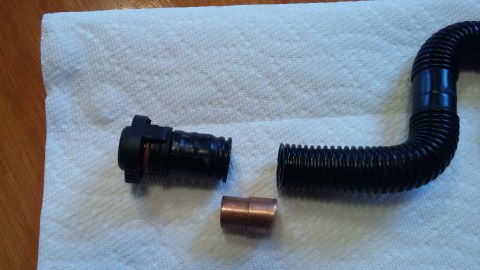
The trouble was that there was no space for clamps.
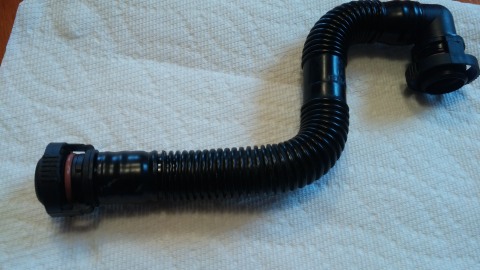
One contributor suggested gluing a copper junction piece in, but one end needed a regular piece of copper pipe, so I modified it a bit, then cut the end off at an angle to accommodate a slight bend in the hose. The moderator of Rennlist.com warned me in no uncertain terms not to use any product with silicone in it or it would kill the O2 sensors on the engine.
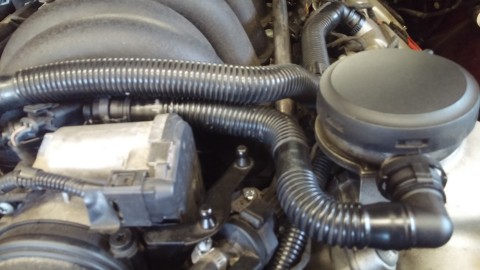
JB Weld is apparently as good as its reputation. A mixture of limestone, steel filings, and epoxy, it works well in engines.
After a couple of hours to set, the repaired hose slid neatly into position. I left it for a day to finish its cure in a warm shop; then it worked fine.
 the Walnut Diary