Check the new ice report: See right ——>
December 24, 2011
Executive summary:
There’s a bit over 3″ of ice now on Newboro Lake.
The latest ice report
December 11, 2011
As regulars know, I start the winter’s ice report as a post on the blog. Google loves blog posts, but ignores pages on the same site until traffic forces it to take notice. Reverse chronological order of postings makes this post soon fade into the other three hundred entries, so you’ll soon find this material posted as as page on the top of the blue column to your right. With enough contributions of data, I’ll be able to keep it up until spring breakup.
Sunday, 11 December, 2011
Intrepid hunters Vanya Rohwer and Martin Mallett report that between Lower Rock Lake and Opinicon Lake the beaver ponds this morning were frozen to a depth of about 1″, thereby depriving the area of puddle ducks. The streams remain open, and they saw no ice on Rock or Opinicon.
Saturday, 10 December, 2011
Tony Izatt, from Newboro, Ontario, on Newboro Lake, reports no ice yet. “According to my neighbour Greg Monk there was a thin covering earlier this morning along shore, but I guess the wind broke it up. Another neighbour Bob French was out in his boat today. He would have been ice-breaking this morning at the ramp.”
Dump Bev Oda petition link
February 17, 2011
Enough is enough! It’s one thing to sit back and make occasional sarcastic comments about the totalitarian nature of the Harper regime; it’s another matter to have one’s face rubbed in this muck. Truth is no longer an absolute in Harperland — Hell, truth isn’t even a value, apparently. Harper’s performance in Question Period Wednesday was as obscene as Bill Clinton’s when faced with the Monica Lewinsky accusation.
These guys are not my grandmother’s Conservatives, and the sooner they’re out of Ottawa, the better for Canada.
http://petition.liberal.ca/bevodamustresign
http://stuffoccurs.wordpress.com/2011/02/19/minister-oda-and-not-why-i-agree-with-the-minister/
Marjory Loveys worked in the PMO for ten years before becoming the Leeds-Grenville Liberal Candidate. I suggested that the comment above passes my personal sniff test, and asked her for further comment on it.
What it really means to have a Managed Forest
October 24, 2010
A couple of weeks ago I noticed something had broken a number of the white pines we planted just before the Plowing Match back in 2007. I suspected something had knocked them over, but when I examined another tree that looked sickly, it tipped over at my barest touch, severed neatly across the trunk about half-way up. With lots of sap around the wound and evidence of insect activity, I figured some sort of weevil had hit, so because these trees are part of a managed forest under the MFTIP plan, I dashed off an email to Martin Streit, Leeds Stewardship Co-ordinator, and asked for help.
Resource technician Donna O’Connor responded to my plea, combining the visit with a survival assessment of the new seedlings planted last spring as part of the Trees Ontario program. She listened to my theory that somehow the western pine weevil had made its way east and vectored in on my trees, then suggested that this looked more like white pine blister rust, a common affliction in white pine stands in Eastern Ontario. It’s a fungus which settles in on the trunk of a pine and causes a series of little holes to appear in the bark. The holes, of course, fill with sap. Secondary insect infestations likely account for the boring through the trunk.
While there’s no real treatment for blister rust, it’s not a new problem and the stand will generally survive it. Donna will definitely report the problem to Martin for further investigation, though.
Then she moved over a couple of rows to the new seedlings the crew planted this spring. I’d kept them mowed quite carefully all summer, so they looked pretty good. She was pleased with the survival rate, which she placed at 98% in the first field she examined. It seems that pine seedlings in good soil are pretty resilient: until I bought a narrow tractor and mower, I had stubbornly tried to mow the plantation with my 5 foot Rhino. This produced several rows of seedlings just as lively as the others, but several inches shorter (oops!).
This summer the Roundup ran out long before the grass quit for the season, so I had to mow the new trees out of overwhelming vegetation a couple of times. By this time of year, though, the 5000 young pine, tamarac and hardwoods were clearly winning on the north side of the property.
Donna applied the same survey method to the five-acre walnut/pine patch on the south face of the drumlin. The survival rate for the white pine seedlings there was considerably lower, almost entirely due to my mowing habits. A walnut field must be mowed both down and across. I avoided all the pine seedlings I could with the narrow mower on the cross cuts, but the walnuts came first. To my credit, Donna admitted that the pines still standing are in excellent health. “Mind you, if you couldn’t grow trees with the climate this summer, you can’t grow trees.”
She checked the progress of the butternuts. The hundred or so viable trees from the 2006 stand are doing very well, with good growth on the trunks. Of the thirty blight-resistant stems I planted three years ago, all but two remain healthy but most are in serious need of pruning. “These butternut have excessive lateral bud growth due to twig borer attacks on the branch leaders, Rod. Butternut don’t normally have the kind of sprouting that yours are showing.”
Because these are test trees Donna suggested I contact the Butternut Lady, Rose Fleguel, for further instructions about a pruning regimen for these valuable young trees.
Back in the woodlot Donna wanted to see the cherry and red oak we planted four years ago to see how they are doing in the clearings we created for them within the canopy. Red oaks are easy to find at this time of year because they retain their dark red leaves. Most of the oaks are hanging on, but could use more sunlight, so she suggested cutting some of the tall ironwood and basswood to allow more light into the two cleared areas. The young maples in that area are fine trees and we should be able to work around them.
Donna found a group of young cherry which have grown much taller than the others. She used them to illustrate how the seedlings will grow if they get the correct amount of sunlight. Some of the little bushy ones will either need more sunlight or perhaps relocation to the front lawn. “They grow outward looking for the bits of light instead of upward. We use the term ‘umbrellaing’.”
A quick lesson on pruning the double-stems of some new spruce seedlings, and away she went to meet with another landowner. These visits from Donna O’Connor and Martin Streit give me much of the support I need to look after the property, and to my mind they are the biggest advantage of the Managed Forest Tax Incentive Program.
Canine encounters
October 3, 2010
September 10, 2010:
The young coyote visited the orchard at suppertime today, sampling the fruit of every tree, but returning to pick up fallen pears several times. I moved out on the elevated deck to try for a photo and to my surprise she co-operated, then began a game of peek-a-boo with me. She stepped behind a trunk. I moved for a better angle. She looked me in the eye and stepped behind another tree, but she kept picking up windfalls throughout the game. Coyotes really like apples, but the one I’ve named Erin seems fond of pears as well. She must have a sweet tooth.
I’ve watched Erin and her two siblings play tag and hide-and-seek quite often during the summer as they grew up in the field just below the orchard. They love to dodge around the bales of hay and climb on them.
The best episode of the summer had to be the day four turkeys decided to forage in their field. I looked out to see two adult turkeys flying and two half-grown chicks running behind, chased by a young coyote. The birds could easily outdistance their foe, but there were large windrows in the field and traffic became a bit confused. At one point the coyote got ahead of one of the young turkeys, but by the time the bizarre chase passed out of sight of my window, the bird was doing its best to catch up.
Only later did Dr. Bill Barrett explain to me that this family of coyotes have decided defend their field. “Near Forfar I had sea gulls all over the place when I was raking and baling, but the in next field the coyotes came out and wouldn’t let one land. The mice in the windrows were theirs, and they weren’t going to share them. When I moved up to the field above the barn they didn’t follow, but that big gray hawk kept me company all day.”
Construction on the garage is an ordeal for the coyotes. The nail guns must be too loud for their sensitive ears because they disappear until they are sure no more loud bangs will come from the human’s den.
October 2:
Coyotes certainly can adapt. After I devoutly claimed that the nail guns had scared the coyotes away, on Friday Erin resumed her afternoon visits to the orchard while I banged away on the roof of the garage. Bet watched her languidly select each apple, return to her temporary nest, lie down and chew it up with great enjoyment.
But today took the cake for coyote sightings. As I drove out the lane on the Ranger this morning I spotted two little heads peeking out of a bush in Laxton’s fence row, 400 feet to the north. The two heads were very close together, as though the pups had lain down shoulder-to-shoulder to enjoy the show. I shut off the UV to watch. One pair of ears tracked every sound. The other was so still I became convinced it was a bunch of leaves. Eventually the still creature stood up and walked away, leaving Mobile-ears to keep watch on the noisy human.
In the afternoon I was mowing the orchard when my peripheral vision picked up Erin, seated just out of the way, clearly impatient for me to leave so that she could have her afternoon meal. I explained to her that I needed to cut the grass and she retreated a bit, but returned.
“You want an apple? Here!” And I fired an empire I had picked off a passing tree at her. She fielded it like a shortstop and wolfed it down. Next apple, same thing. Erin seemed to like this game. Over the space of five laps of the orchard she snagged the five apples I threw her way, and also four mice she found in the grass. Then she disappeared.
This evening behind the garage I was explaining to Martin the habits of the coyote family when the large male raised his head from the foliage to the west of Laxton’s bush, yawned, and resumed his nap. He seems curious to identify new voices, but very calm in his demeanour. He looks and acts very much like a middle-aged German shepherd.
October 3:
This morning produced a canine encounter which proved much more frenetic than the coyote visits. Towards the end of her walk, Bet came around the end of the barn and spotted “two beige bullets blasting down the lane from the woods. One jumped up on me and then collapsed on the ground, wiggling in excitement.”
She rolled me out of bed to deal with the crisis. I nabbed the male, Georgy, and Bet located his sister, Gillie, who was raiding the cat’s food dish. Keen on a Ranger-ride, the west highland terriers nodded eagerly at the scenery as we drove up the hill to their home.
With a population of at least four coyotes in the neighbourhood, these little bait dogs (and four turkeys) seem to be able to share the territory without ill effects. The resident coyotes don’t behave at all like the pack of four furtive strangers I saw in the quarry last fall. They were scary, but didn’t stick around.
October 12:
My mother spent the afternoon in and around the orchard, so Erin’s schedule was off today. At suppertime I noticed a larger and furrier coyote in her usual haunts, but with Erin’s characteristic markings around the muzzle. Apparently she’s experimenting with her new body after the growth spurt, because windfall apples no longer appeal to her. Now she stands up on her hind legs to pick fresh apples off the trees, often settling down on her haunches to leap straight up to snap fruit from higher branches. She seems curious to see how high she can jump, an adolescent testing her limits.
You can’t get there from here.
September 19, 2010
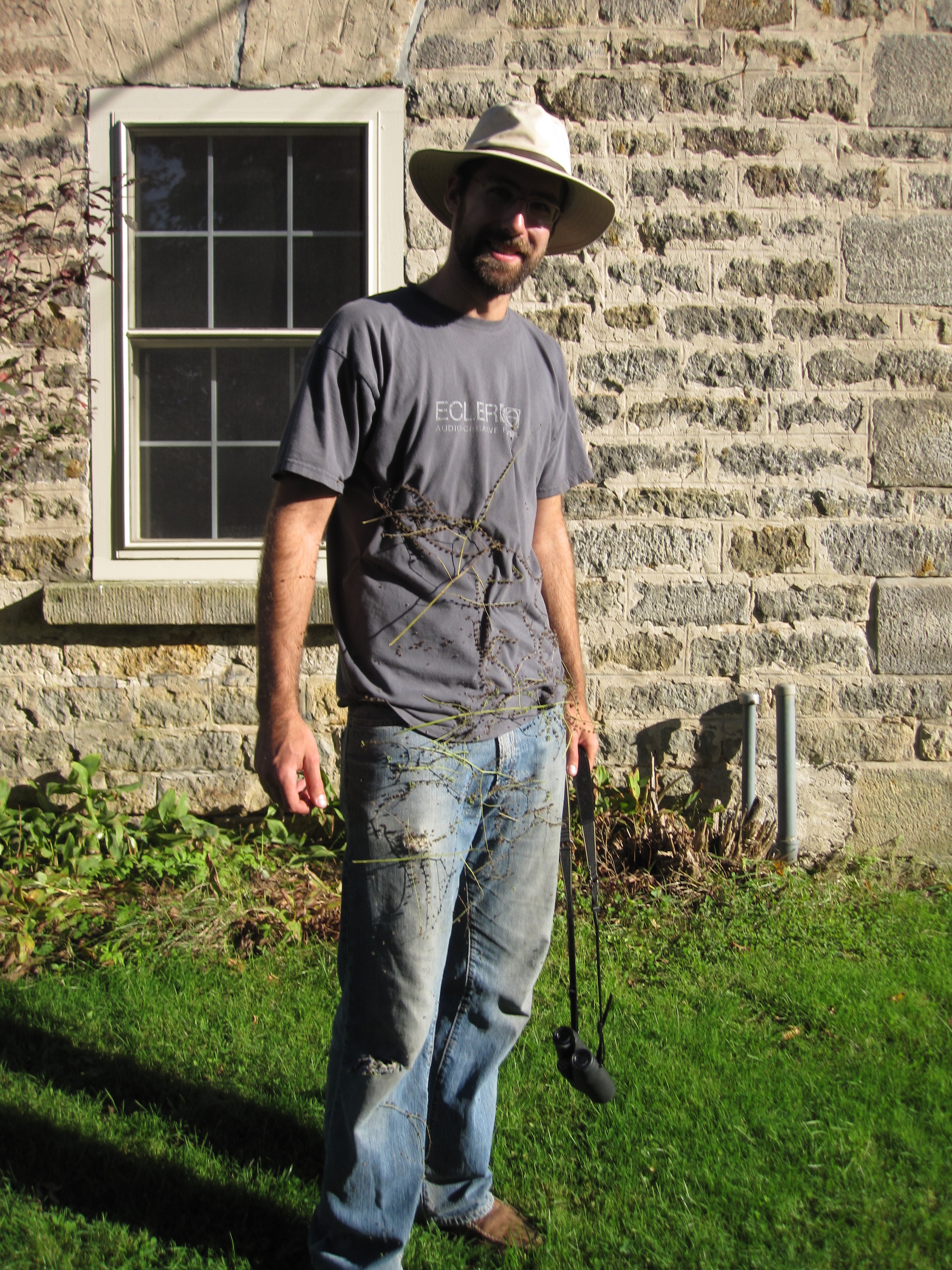
We finished a bit early after a day of shingling on the garage, so Martin grabbed the .22 and went looking for a squirrel for the pot. Eventually Charlie went to round him up for supper with the Ranger. Martin heard the UV and took a shortcut across a brush pile to intercept him. Unfortunately the brush turned out to be old fence wire and poor Martin found himself entwined, losing a shoe. But that wasn’t the bad part. On the way out he pushed through a clump of sheep burrs.
Bet compared his antics to those of the springer spaniels whose lives were made miserable by sheep burr season.
TED
August 15, 2010
Charlie and Roz showed up on Saturday and the new iPad soon made an appearance. It’s a neat device for Internet browsing with very good picture resolution, but without the versatility or sheer power of my laptop. As Roz said, “It’s a good computer for reading the newspaper in bed.” Charlie loaded up a file from TED.com and handed the iPad to me. I didn’t know what to expect.
On a small stage stood a young woman who looked funny. O.k., I thought, a standup comedienne. I settled in to listen to her pitch. Well spoken for a comic, I thought. And bright. Laurie Santos talked about how our brains are wired to make the same stupid mistakes, time and again. Pretty standard stuff.
Then she wheeled out photos of a distant relative, a Columbian monkey, and explained how in her lab her staff taught a group of them how to use money, seeking to prove that the kind of errors which produced the financial collapse were no accident nor the result of the work of a few bad apples: the collapse was a result of errors genetically built into our species. Hmmm.
To prove her point she taught a group of monkeys to use money, then in experiments observed them making the same mistakes their human cousins make. For example, if the subject had some money and had a choice of taking a risk or not to gain more, the primate would often stand pat rather than risk a loss.
She suggested her audience members should not immediately fire their financial advisors and hire the monkey, though, because it turned out the chimp would likely make the same mistakes as the first guy.
In the other half of the experiment, when the same subjects had money and faced the prospect of losing it, they would often take risks out of proportion to the benefit to preserve their current level of wealth, much in the manner of Wall Street investors over the last two years.
She concluded, however, that Man is very smart, and armed with this observation should be able to learn from it.
I felt a bit like a laboratory subject myself as I experimented with the iPad. Charlie bought it to develop applications for use by elderly patients in doctor’s offices, and I think he let me loose with it to see how a clumsy and myopic senior would handle the touch-sensitive pad. Right off he decided that any sensors toward the outer perimeter of the pad are too touchy to use in an application for inexperienced users.
But actually I liked the little thing. It’s light and relatively easy to operate, with very good resolution, especially when Charlie configured it for HD. But the real surprise was the content of the film I watched.
TED.com offers a tremendous variety of short, illustrated presentations on topics of general interest. Call it an on-line Popular Science magazine. Many articles deal with global warming, the oil spill, finding life on other planets, but there is also humour.
For example comedian Poet Rives runs through a routine on 4:00 a.m. If you loved the Da Vinci Code (or maybe if you love to laugh at Da Vinci Code fans), you’ll get a big kick out of Rives’s satire.
I could rant on here about how wonderful this site is, but a quote from one of the programs should do the job. Elif Shafak is a writer. Her twenty-minute lecture, The Politics of Fiction, is one of the best I have seen. Here are two paragraphs from it:
Many people visited my grandmother, people with severe acne on their faces or warts on their hands. Each time, my grandmother would utter some words in Arabic, take a red apple and stab it with as many rose thorns as the number of warts she wanted to remove. Then one by one, she would encircle these thorns with dark ink. A week later, the patient would come back for a follow-up examination. Now, I’m aware that I should not be saying such things in front of an audience of scholars and scientists, but the truth is, of all the people who visited my grandmother for their skin conditions, I did not see anyone go back unhappy or unhealed. I asked her how she did this. Was it the power of praying? In response she said, ‘Yes, praying is effective. But also beware of the power of circles.’
From her, I learned, among many other things, one very precious lesson. That if you want to destroy something in this life, be it an acne, a blemish or the human soul, all you need to do is to surround it with thick walls. It will dry up inside. Now we all live in some kind of a social and cultural circle. We all do. We’re born into a certain family, nation, class. But if we have no connection whatsoever with the worlds beyond the one we take for granted, then we too run the risk of drying up inside. Our imagination might shrink. Our hearts might dwindle. And our humanness might wither if we stay for too long inside our cultural cocoons. Our friends, neighbors, colleagues, family — if all the people in our inner circle resemble us, it means we are surrounded with our mirror image.
Catch the rest of Shafak’s presentation at http://www.ted.com Don’t be surprised if this site quickly becomes your timewaster of choice.
Mowing
July 12, 2010
Engines fascinate me. I love the way they run, their sound, the sweet spots on the throttle where they don’t shake, even their distinct aromas. How they’re built is largely beyond my ken, but old engines can run a long time with proper care. I still remember their smell from my early years as I carefully followed my father into the otherwise-forbidden garages and barns of his associates.
Our cruiser WYBMADIITY II had a sweet old Chrysler Crown six. In a marina full of V8’s it sounded like a mourning dove among crows. WYB would announce her presence with this gentle, burbling purr wherever she went. Maybe that’s why people liked the boat. It’s certainly one reason why we kept her for a generation.
My current fishing boat has a Mercury outboard. It’s very reliable and uses little fuel for what it does, but the vibrations turn the whole aluminum hull into a drum whenever I slow down and at certain unpredictable speeds, so cruising with the Merc involves searching the throttle for a spot where the thing doesn’t shake the fillings out of my teeth.
This is all by way of explaining why these days I don’t fish as much as I used to. Seems most of my free time this summer is spent on one tractor or another, mowing.
I googled articles on men and mowing and came up with a trunkload of material on the subject. Robert Fulford ran “The Lawn: North America’s magnificent obsession” in Azure magazine in July of 1998. Fulford rather playfully suggested that the suburban lawn is the public moral statement of the male of the household. But that’s not it. My neighbours are too far away to care about dandelions (though my mother obsesses about them, in season), and I needn’t worry about vicious telephone conversations among Forfar residents about my lax mowing habits if I slacken off and let the sumacs sprout on the margins of the orchard.
Daniel Wood in Air Canada magazine suggested that lawn care is a pagan religion in much of North America. Enormous quantities of water, fertilizer, fuel and time are sacrificed to the small patch of turf in an effort to restore it to the virginal green blankness which we idealize as the perfect lawn.
“I mean, how is it that North Americans spend more on grass than the entire world spends on foreign aid? How is it that during the continent’s increasingly dry summers, over 60 percent of drinking water goes to quenching the thirst of fundamentally decorative turf? How is it that the typical North American homeowner spends 150 hours on lawn care annually and 35 hours on sex?”
Wood further comments: “North Americans spend an estimated $100- billion annually on lawns. In value, grass is, by far, the most important agricultural crop on the continent.” I wonder where Wood gets his statistics?
In his blog The Discerning Brute, Joshua Katcher offers the following historical background to the lawn:
“In the sixteenth century and continuing through the eighteenth, the “launde”, an open space or glade maintained by laborers wielding scythes, began to appear throughout the residences of British aristocrats. Obviously, it soon came to represent the leisure of class privilege, wealth, and power, and the culmination of lawn culture, according to Jenkins (The Lawn, a History of an American Obsession), was the establishment of twentieth century golf courses and country clubs. But as Steinburg (American Green: The Obsessive Quest for the Perfect Lawn) argues, it never became the moral crusade it has become in America quite possibly because grass grows so effortlessly in Britain, and turfgrass is not at all native to North America – not even Kentucky Bluegrass. The early colonizers’ cattle quickly destroyed the native grasses, not used to grazing, and in came bluegrass seeds from Europe to fill that niche.
“On a deeper level, the lawn represents a desire to control unpredictable, wild nature. Some anthropologists argue that the lawn comes from self-defense. When nomadic gatherer-hunters began settling into sedentary and semi-sedentary homes, they cleared the vegetation surrounding their dwellings in order to foresee potential danger coming – a predator, a snake, an enemy. The lawn is a bastion between the fearful individual and a dangerous wilderness. Even more so, it is the manifestation of the deepest-seeded principles of our culture and civilization: man’s control over nature. Therefore, those who let their lawns go wild are threats to the foundation of civilization itself.”
Naw. I like the sound of a diesel as it powers the mower through a row of grass. It sends the message that it will run tirelessly for as long as I want it to, and for just a little fuel.
I like the feel of the tractor at work, the way it moves over uneven turf. The TAFE has foot pegs like a motorcycle, and that seating position with pegs-seat-steering wheel works better for me for a long drive than the cushy seats of a Lexus. I can also stand up and stretch under the canopy on long rows, a welcome relief to tired muscles and joints. And the expensive new rotary mower works great.
But the Bolens has no foot pegs. There’s no room to stand up either. The ride is so harsh I have to add a pillow, yet the little tractor lures me onto its seat more than the larger TAFE with its fancy shield against the sun. So it has to be the engine.
He shoulda spent the money on a dentist.
July 3, 2010
Canadian Press, July 3, 2010
WARWICK, ONT.—A man trying to pull his tooth out while driving has been charged.
Provincial police say around 11:30 a.m. on June 30, an officer responded to a complaint of a tractor trailer allegedly driving “all over the road” on Highway 402 in Warwick, Ont.
The officer pulled the vehicle over and discovered the man was trying to yank out his tooth while driving.
Police say the driver allegedly rigged a string around the affected tooth, mounted the string to a fixed point on the roof of the cab and waited for a bump to yank it out.
Police say the bloody tooth and string lay next to the man when he was pulled over.
A 58-year-old man has been charged with careless driving.
I want one of those (bicycle dept).
June 2, 2010
Yesterday’s Toronto Star had an article about suspicions that a Swiss competitive rider won two stages in a recent race with a motorized bike. Such a device exists, and looks just like a regular bike. Ingenious. Watch the film attached to the article. There couldn’t be a better advertisement for this motor.
http://www.thestar.com/sports/article/817545–easy-rider-did-swiss-cycling-star-use-motorized-bike
 the Walnut Diary