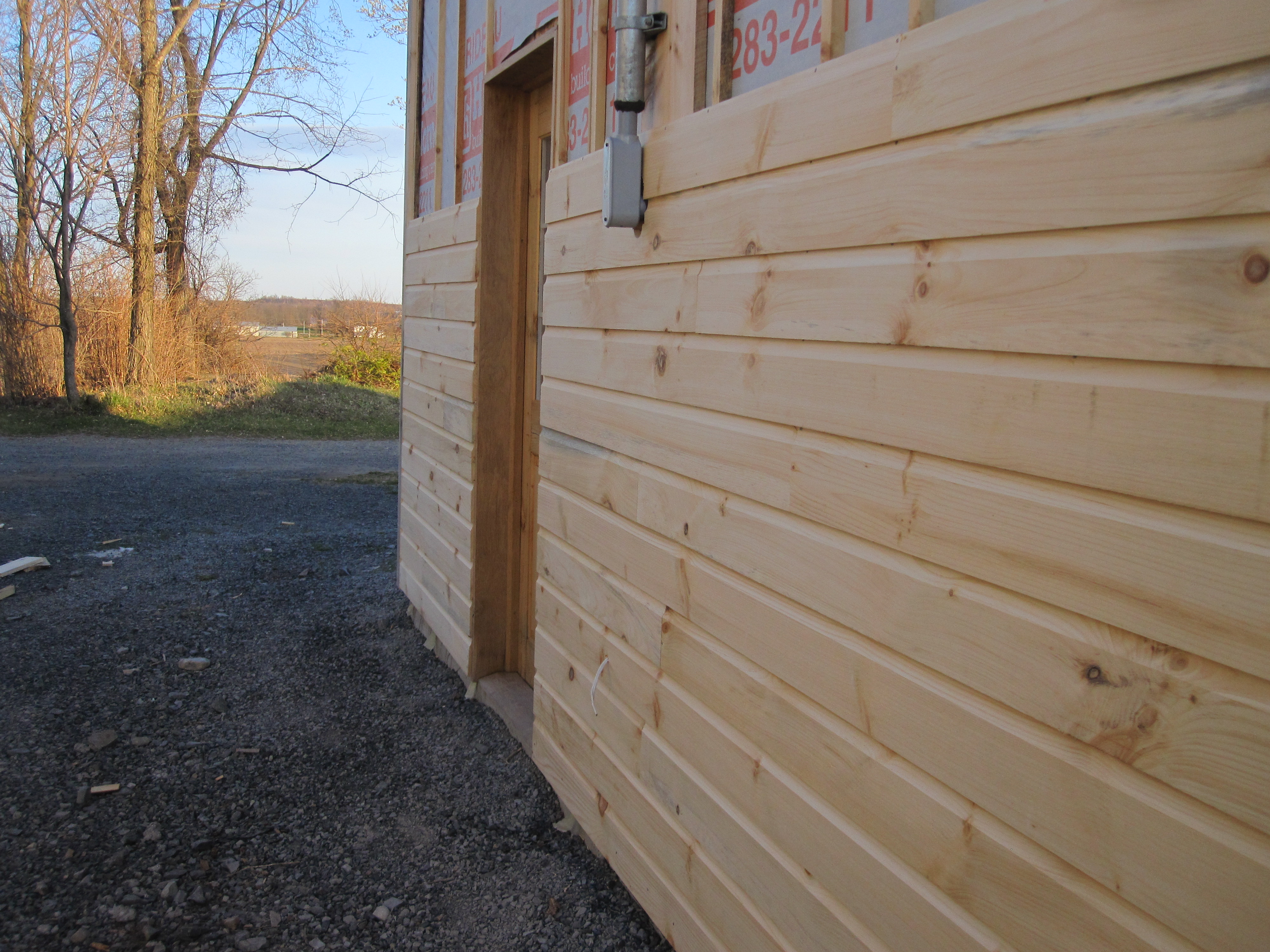
The first garage went together pretty well, but I somehow hadn’t gotten around to putting the corners and window trim on after construction and painting. After I figured out the right way to trim a garage built with cove siding, I doubt if I’ll ever get back to the exterior trim on the shop.
You see, I did the siding wrong. That’s the trouble with the burnt fingers method of construction (and life, and everything): it provides lots of short-term feedback but little external guidance. And I hadn’t thought about a critical step, the construction of the corners of the building so that the siding would have somewhere to begin and end.
An experienced old guy could have taken me aside and said, “Lad, you have to put the corner pieces on first, nailed flush with the cove siding (not on top of it) and then you butt the horizontal stuff to those vertical boards. I would have argued, made excuses, checked the Internet, and eventually seen the obvious.
Instead I figured it out this winter by accident while looking at an old Parks Canada horse-stable at Chaffey’s Locks. Once I saw the corners and realized they and the cove siding were on the same plane, the whole thing made sense.
Anyway, I think I’ve corrected the mistake on Charlie’s garage. The new batch of siding is going on well, but the 12′ walls still have another six feet to go, and so from here on the project will require extra crew.
Charlie and I have agreed to cater to our puritan streak and leave the windows unembellished in the new garage, same as the previous building.

Time to plant a couple of maples
March 18, 2012
My dad always had the view that if you were going to plant a tree, you should choose the biggest you could handle because it would produce shade more quickly that way. On the 24th of May, 1984, I used my dad’s loader to lift three, twenty-five foot maples out of the woodlot, hauled them, leaves and all, to Smiths Falls in the back of my Ford Courier, and planted them on Ted and Maria Ferrant’s lawn. When we moved away twenty-six years later, the three maples were fine shade trees.


Around the house on Young’s Hill I used the same technique: dig a hole with the forked bucket on the loader. Then, as soon as the footing allowed it during spring thaw, drive into the woods and pick up an appropriate maple to fill the hole. Keep the tree out of the ground for as little time as possible. Water sporadically the following summer.
As long as I dug the trees into a sloping bank in a fairly dry location, they all lived. Similar plantings along the road did not succeed, though. I guess a shoulder next to a ditch, showered regularly by sand and salt, is too extreme an environment for a hard maple.
This weekend Charlie wanted trees to shade the back windows of his garage. The only problem was the high water table where he wanted to plant them. If we dug them down, the maples would have wet feet, and when we planted the maple orchard on the northern corner of the property for the plowing match, any of the bare-root saplings we plunged into a flooded hole died soon after.
Mom and I had decided to cull one maple from her perennial bed. It grew in the shadow of a promising, taller maple, so it was the first target today. Charlie and I dug enthusiastically around the root ball, but we couldn’t move it, no matter how much we pried.
Away I went for the old Massey Ferguson 35. Its lopsided loader has a narrow bucket with forks, though Peter Myers made me a plate to keep topsoil from falling off the root ball during these operations. It could be relied upon to push a 29″ wide “shovel” quite deeply beneath the roots of the tree. Charlie directed me into position with a series of frenetic hand movements. The tractor grunted, but the down pressure on the loader enabled me to get under it and lift the ball free of the rose bushes.
We carried our victim over to the back of the garage and I plunked it down on the turf. The tree needed to be higher than the surrounding land, so I brought a bucket-full of topsoil from a pile and put Charlie to work with a shovel. I think the covered root ball made a rather elegant berm on the lawn. Promising to do all mowing around them, Charlie brought stakes from the shed and carefully tied the sapling into place. The thing was done.
That had gone well. I had earlier shown Charlie a larger maple on a corner in the woodlot where it clearly wasn’t enjoying itself, covered with several species of vines and overshadowed by a black walnut tree. We decided we might as well try to dig it up and drop it into an abandoned hole at the other side of the garage.
My early memories of the Massey 35 involve getting the thing stuck in the road to the woodlot, two springs running. But conditions have improved with gravel imported for the plowing match. The ground showed no frost when I skidded the bucket off various rocks in an attempt to undermine the maple. Overpowering this tree wouldn’t work; I’d have to dig all around it. The poor old Massey dug and pried. On the fourth attempt the tree came free of the ground. With large pruning sheers Charlie disconnected our specimen from the trailing vines and we headed for the house.
This tree with its root ball was pretty heavy, but it slid into place just like the other maple. It sat up quite high above the soil level, hole or not, so I hope this maple will find enough dry soil to survive.
Family members came to look and all agreed that the back of the garage looks better with a couple of shade trees.
Ice out yet?
March 12, 2012
That’s one of the key questions of the year for the cottage owner in this area. The frozen lake provides a route to island cottages for a brief interval each winter, but as the sun warms that highway turns into a sword of Damocles poised to destroy docks, boathouses, and shoreline.
The question is when to stop using the ice as a playground and work surface and start fighting it off your property. The wind that tore roofs off buildings on March 3rd apparently caused the ice to shift on Newboro Lake, even though it was still a foot thick. Tony Izatt arrived at the Lodge last weekend to discover his dock had moved six inches inland.
“I guess I waited a week too long to put the pump in this year,” he told me by email. “I couldn’t believe that ice that thick could move around, but somehow it did. In any case, the bubbler is now in place, the barriers and signs are up, so we’ll see how things go as the ice breaks up.”
For the last four years I have maintained an ice report on my blog. At this time of year it is easily the most popular page on The Walnut Diary.
It started as a series of emails to keep volunteers up-to-date while we built Tony’s dock. That was in the spring of 2009. Here are some excerpts from that year:
March 4, 2009: We’ve spent the last two days driving pilings for the new dock on Newboro Lake. The ice is strong and thick out from shore, though I put a foot through at one point as I moved from the sloping ice on shore to the flat part. Water levels seem to have dropped steadily over the last two weeks. Nevertheless we were able to work with three tractors and a couple of trucks on the ice in fairly close proximity and there was no sign of movement in the ice.
March 20, 2009: We finished sheeting the dock in Newboro this morning, and none too soon. Yesterday’s task was to haul 150 2 X 6″ planks across 100′ of ice to the dock frame. Walking was generally solid in the open, but we had to build a bridge of planks near shore. Vehicles on the ice now in this area? Crazy. Would I still walk on it? Yes, with precautions against falling through.
The big mistake in 2009 was that I didn’t bother to include an all-clear notification after a check that the ice was in fact all melted. I rectified that oversight the next year:
28 March, 2010: Tony Izatt wrote: “I watched a stand-off between 1/4 acre ice sheet and my dock pump on Sunday afternoon. The pump held its own against that high wind and didn’t allow the ice sheet within 15′. What was also really cool was to see the wave action at the back of the ice floe eat away at it.”
1 April, 2010: The ice is out on the Newboro/Chaffey’s/Bedford Mills level except for a few floes in the middle of the lakes.
Next year after pack ice knocked the huge concrete dock at the Newboro Lock off its footing, wrecking it, I ran into some of my Ice Report correspondents:
10 April, 2011: This morning at the public dock at Newboro I watched a pontoon boat come ashore and disgorge four cold, but euphoric voyageurs. Bill and Kohar Palimenakos and their guests Perry and Soula Pezoulas came back in after the first night at the cottage this year. Perry joked: “Bill and Kohar have the motto: ‘Last to leave, first to open.’
Then they all jumped in, telling me about how they had battered their way through the ice with two-by-fours to make way for the trusty pontoon boat. I guess that’s what cottage life is about.
Perhaps the highlight of the 2012 Ice Report was the following:
7 March, 2012: I wandered over to the beach to look out onto the Big Rideau. From the north a pickup truck was throwing a bow wake a cruiser would envy. The driver was making pretty good time, obviously heading for Portland. I shut off and watched. At one point the truck disappeared into the spray, but it ploughed through the low spot and continued unerringly towards the Bayview launch ramp. Remembering my own misadventure with rotten ice at that ramp many years ago, I booted the Ranger over to where I could watch and see if the truck emerged o.k. onto Hwy 15. Surely enough, a very clean, late-model gray Ford made its way past me on the highway, occupants grinning and giggling like adolescents. The man and his blonde companion looked to be in their late sixties. They’d certainly gotten their thrill today.
You can watch ice-out for yourself on the webcam at
http://www.lenscove.com/Page.aspx/pageId/92750/Webcam.aspx
Video-chat with a Snowbird
March 4, 2012
My sister Glenda’s rapidly settling into life in central Florida, where she has rented a home and golf cart for a couple of months in a gated community. I decided to find out about Snowbird life by asking her about her electric vehicle (EV). She shouted answers into the screen of her laptop over a fresh breeze. To gain Internet access she parks her cart close to the clubhouse to pick up wireless reception. Spotting her online, I called her on voice, then switched to video. At that point Glenda stood up and showed me around the cart and the adjacent area with the camera on her laptop. She took great pride in reaching around the display to point out the little Canadian flag on her cart.
1. What services does the electric vehicle provide for you?
All transportation within the park, which means I cannot go out on the highway. If I could I would go shopping with it, but I can’t.
I go to everybody’s houses, to the pool, to open houses, I run all dreadful errands, like delivering grapefruit off my tree to those who want it, and I check out all of the houses for sale and nobody knows that I am doing it. Of course if I were a golfer the cart would be crucial. For me it’s just fundamental. There’s a difference. Sometimes I am challenged to a race by 80 and 90-year-olds who want attention because to them I appear young.
Yesterday was interesting. Connie and I were travelling in tandem and Carol turned out of a side street and cut us off. Three of us were stopped talking in the middle of the road on all different angles. A truck came along, so we pulled into Mary-Anne’s driveway and the renter came out to find out what’s going on, so before long we were all sitting in our golf carts, engaged in a four-way conversation.
Most people have a Canadian flag, sometimes teamed up with their provincial flag on their cart. I’m going to buy some Canadian paraphernalia at the Dollar Store for next winter.
2. In what situations does the EV do a better job than a car?
What I like best is that there are no noise or fumes. It’s very easy to drive. When all of the carts are lined up they take very little space in comparison to the car parking lot. There’s no privacy and so you can wheel up beside somebody and chat. An old guy this morning was taking his dog for a joyride in the rain. Dogs love their chariots.
3. How well accepted is the EV in your environment?
Listen, it’s major for fun. There’s also the functional aspect, but I would suggest you really need one here in order to maximize the pleasure. Some owners of adjoining houses pour shared concrete runways for the carts so that the driveway isn’t blocked.
4. Do you have to break the law in order to drive your EV?
No. But if I were to look at the regulations, you need to be 16 with a driver’s license, and you’re only allowed two riders on a regular golf cart. Some put their kids where the golf bags go, but you don’t want to have an accident.
5. What changes would be required to allow the use of a similar EV in the Smiths Falls area?
I would only be able to use it on my property, and that would be confining. We’d need a change of mentality because cars would over-run you on the Golf Club Road. The same applies for the ZENN electric car produced in Quebec for $12 k but we aren’t allowed to drive it. That’s what I’d love to have to go shopping.
They have the laws in place for EV’s on low-speed roads in Quebec and B.C., but not in Ontario. I would love one of those cars. They’re designed with lots of space for groceries, and they’re easy to park.
6. Do you miss a gas engine when using your EV?
Absolutely not. I don’t miss the price, either. I like the roof over my head. This one is well designed and I have a windshield if I want it and a fold-down cover at back, but I don’t have side curtains.
7. How would you improve your current ride?
Ideally EVs would come in designer colours. Your house should match your golf cart, or at least the shutters should. I’m sitting next to this EZ-Go and it’s white and black like mine, but it has a burled elm dashboard, and I’m turning green with envy here, looking at that dashboard.
I don’t have signal lights, so I have to use hand signals. I can’t quite remember what they are, so I just turn around and wave.
8. So life in the sunny south is good?
It’s gorgeous here at this time of year. I’m surrounded by hibiscus plants and palm trees. The house backs up onto an orange grove at the back and the third hole of a golf course at the side. What’s not to love?
Ice!!!
January 27, 2012

Even sanders occasionally need a sander.
Ice is so central to our experience in Eastern Ontario that we don’t think about it much. It’s just there, an underlying challenge and occasionally a threat, until it erupts into a major problem the way it did last week.
The eerie part of the recent ice storm is how similar the weather was to many days before it. Every time the thermometer rises and clouds form, we come under the gun. But most times the shot misses, because weather is not the malevolent force we see on American television. No, Mother Nature in Canada just doesn’t give a damn, so it’s up to us to adapt.
Since 2001 our culture has elevated the firefighter to heroic status, and deservedly so. But how about the snowplow driver who day in and day out goes before us, quietly and invisibly battling the most dangerous thing we face in our lives, the icy road? For the most part we curse the guy for slowing us down, or curse him for not showing up, or for abrading our paint and windshields if we get stuck behind him in traffic. But that driver keeps us alive.
I met one of these invisible men last Friday when we woke to the sound of shouting and the sight of a rotating blue light stopped in the middle of Young’s Hill.
Speaking of ice, the dog fell flat when she stepped out the door. Then she scratched her way back up to safety and slipped past me into the safety of the living room.
You know how after you’ve finally gotten stopped on a difficult ski run a little voice in you asks for a rope or railing to help you down to the foot of the hill? Well that little voice was whimpering pretty loudly as I prepared to face the two-foot drop over twenty feet to the driveway. I picked up the pail of sand I am normally too proud to use. A sprinkle before each step took me to flat land.
But on the driveway the footing didn’t improve. Two days earlier I had spread a trailer-load of salted sand from the quarry because Frank the fuel guy called and told me that if we wanted oil, he needed sand. Oil trucks do not have sophisticated winter tires, and if they start to slide they’re in big trouble. The new layer of ice completely covered that sand, even though I could see every grain through the transparent covering. Yikes!
Normally on icy days I slip and slide over to the Ranger, fire it up and rely upon its traction to move me around. But I wasn’t sure even it would make it back up the lane today. I’d have to walk out first.
So I grabbed a larger pail of sand, wrapped an arm around it, and gritted my way out 500 feet of sloping driveway. I was sure that the centre-bare section half-way down would be good walking once I got to it. Nearly broke my neck. Just because you can see gravel through the ice doesn’t mean you can walk on it.
Quite a while later I fetched up at the scene of the confusion on the hill. A tow truck with a car on its bed was nosed up behind the county snowplow, which seemed to be holding itself in place on the hill by one wheel carefully planted in the right hand ditch. The rig sat about two feet up the slope from the hydro pole which supplies our house.
The driver, Steve Halladay, explained to me that his truck’s sanding wheel spreads grit only on the left side so as to cover both lanes of the road. But the truck’s drive wheels are on the passenger side, so in some situations the snowplow’s as badly off as any other vehicle.
His overloaded rig had run out of traction on the steep part of the hill and subsided into the ditch. Steve said he could easily back out, but he was concerned that the plow would hit the hydro pole if he didn’t have a better grip on the ice.
We heard a roar. A small township truck with a sander on the back came screaming up Young’s Hill Road from Forfar – in reverse. I couldn’t believe how fast a GM pickup with a determined operator can go backwards. The unseen driver pulled up tight to the car hauler, then backed into our driveway to make a path to allow the wrecker to turn around.
After a conference with Steve, the rescuer decided to sand his way up over the hill, spreading enough grit to get the plow out of trouble and enable the wrecker to free two cars in the ditch on the Hwy. 15 side. He backed up the steep slope, passing close enough to the larger truck to make Steve hold his breath, then blasted on over the hill and out of sight.
Steve backed out onto the gritty surface, put the sanding disk in gear, and continued his morning’s work.
A few hours later a small dump of soggy snow stuck to the ice and the crisis was over.
Lessons from another Friday 13th
January 13, 2012
If you have read many of these posts you will be aware of my deep antipathy toward Friday 13th. It’s not that I am normally superstitious, but too many bizarre and horrible things have happened to me on the date. So I go into each of these days with considerable apprehension and a marked reluctance to take chances, not that it does any good.
It all started on Friday, April 13, 1971 when I wrote two final examinations at Queen’s. My Shakespeare prof had warned us: “Be sure that you have read all of the plays.” She wasn’t kidding; she had set a compulsory 45 mark question on three plays I hadn’t read.
The craziest episode had to be the time a neighbour’s 1986 Ford Bronco slipped out of park, rolled down Church Street in Smiths Falls, through the George Street intersection, and sideswiped my unsuspecting 4Runner before wrapping itself around a pole. This all happened during my morning shower on another Friday 13th. What’s even stranger, the insurance underwriter classified the accident as an animal collision as there was a Bronco involved.
So today when it dropped six inches of slush on top of an inch of new ice, I figured it was just business as usual for a Friday 13th. My tractor normally does a good job on snow with its loader. I set the bucket to automatic leveler and run down the lane at a good pace, cross the road and stop over the opposing ditch, where I dump the snow and back down the hill to turn around and return for another run.
But the paved road on Young’s Hill was far too slippery for such antics today. I ran out of momentum or stopped early out of caution most runs, leaving mountains of slush blocking the lane. The one time I went over to the opposing ditch I had no traction to back out, so was forced to lever the tractor backwards with the loader while three trucks waited impatiently for me to get out of the way. This was obviously not the way to clean the driveway on a Friday the 13th, so I spent the afternoon developing new tactics to do a ten-minute job. My timid efforts with the tractor eventually relocated the slush mountains without catastrophe. Fine.
Then came the little snow blower for detail work around the garages and sidewalks. It wouldn’t start. I dumped the gas and poured in new, but it still wouldn’t go. But that was a result of forgotten fuel stabilizer, not the act of a perverse fate.
So I backed my truck out through a snowbank and drove down to Forfar to get the mail. The faint rattle in the front suspension had suddenly become a lot more noticeable. Perhaps I should have a look. I dropped a piece of plywood on the ground and crawled under. I started at the gas tank and worked forward. Everything seemed solid. The shocks and ball joints were fine. Then something moved when I reached past the shocks and wiggled.
The brake caliper I replaced three weeks ago had come loose and was hanging by one bolt! Yikes! Perhaps those bolts don’t need to be protected with anti-seize compound like wheel nuts and spark plugs. Maybe it’s Lock-Tite that goes on them. Maybe I didn’t tighten them enough. Anyway, this bizarre and dangerous fail met all of the criteria of a Friday 13th disaster, so I was able to relax for the rest of the day. My truck certainly wasn’t going anywhere without a new bolt.
Out of Friday’s confusion I have learned three lessons:
1. Modern gasoline with its high methanol content deteriorates quickly if left sitting in an engine. When I took the snowblower’s carburetor apart, internal parts were crusted with a green, crystalline material unlike anything I had seen before. It’s not like the ring of varnish which used to form around abandoned gas cans. Without stabilizer I can’t see a small gas engine surviving long in storage if there’s any fuel left in it.
2. It takes more than a hoist and set of air wrenches to make a mechanic. Those caliper bolts needed to be torqued to 90 foot-pounds. We have to get Internet service in the garage.
3. My tractor’s two previous owners traded it in at the same dealership on the same 4WD model. After last Friday that doesn’t seem like a bad idea.
Also check out:
https://rodcroskery.wordpress.com/2009/02/15/the-mysterious-case-of-the-runaway-bronco/
It begins.
December 6, 2011

It all begins with putting up the tree.
With the raising of the tree the Christmas season begins on Young’s Hill. For the next few days Bet will load the tree to the toppling point with lights and ornaments. Any horizontal surface above the floor will gradually grow a spray of boughs and berries. Little-remembered nicknacks will appear from wherever they have been hiding since last January and join the festoons of greenery which put the very spiders to shame with their cleverness, and Bet will positively purr with anticipation of her favourite season.
Lesley, the Rockies, and a new Jag
November 20, 2011
Every time I take a bite of halibut or salmon from the freezer, I think kind thoughts of Mrs. Lesley Reid for deciding to send her little brother Tony and his friend on a fishing trip to Northern British Columbia last June. As earlier columns no doubt made it clear, this was my first trip to the west coast, first helicopter ride, first encounter with a huge tree, first look at a whale, and the list goes on.
I could add to the list my first chauffeured drive in a new Jaguar XJL and my first meal at an Elvis-themed restaurant, for on one of our sight-seeing days Lesley determined that we should visit Hell’s Gate, the point at which the Fraser River, which is over a mile wide outside their guest house, narrows down to a roaring gulch accessible only by cable car and suspension bridge.
While exploring on our own Tony and I had borrowed Alex’s Cadillac, but Lesley suggested that we take her XJL on this longer trip, so Tony twisted the shift dial to reverse, the navigation system switched over to a camera view of the flower beds and other obstacles behind (courteously showing where the wheels will go in yellow dotted lines on the screen), and we backed out of the driveway and onto our adventure. To say the big Jag is an impressive touring car is to understate the obvious: it’s a car fit for a queen. In fact, Queen Elizabeth has one.
On the road it was quiet and very comfortable. Tony seemed to rein in his normal dodgem-cars-driving style in favour of a more sedate pace, and the cat purred us up and down the steep slopes while I took photos of more and more of the guard rails on the Trans-Canada Highway. The Rocky Mountains are huge and magnificent, but they won’t fit into my little Canon.
I couldn’t help but think of how hard it must have been to live in or travel through this section of the country before the tunnels and the highway were built. The Fraser is a wild river with enormous fluctuations in flow over the course of the year. It shows no consideration whatever for life forms trying to live in its path.
After an hour or so of this fascinating drive we fetched up in a crowded parking lot: Hell’s Gate. Lesley asked us to wait while she walked over to the ticket booth, then returned, suggested proper clothing and cameras, and we stepped onto the cable car which sloped down to a museum on the other side of the river.
A pleasant young woman introduced us to the spectacle. She launched into a witty speech describing a colourful history of this point on the river as we dropped into the dark of the gorge. She ended her pitch just as the Airtram bumped against its stop. I saw satisfaction in her face: she had timed it just right.
The tourist complex down in the gorge is part museum, part gift shop, part fish-viewing station. The artist’s renderings of the original trail through the gorge nearly made me air-sick. To avoid high water the aboriginal builders suspended scaffolds half-way up the sheer side of the gorge as a trail through the difficult sections. From the murals these primitive structures seemed to require a great deal of climbing ability, nonetheless. Now I understood why it cost so much to ship freight to the inland of British Columbia during the gold rush. They had to pay men to carry the stuff on their backs over mile after mile of these terrifying scaffolds, and also pay tolls to the tribes who owned the structures.
But soon a sign read “fish ladder” and Tony and I were off to find salmon. Lesley hit the book store and loaded a shopping bag with titles on the Fraser and Hell’s Gate.
She gave me three of them, suggesting that I could find answers to some of my many questions. She only gave Tony one. Squeaky wheel syndrome, I guess.
On the other end of the tunnel just up the road lies the Elvis Rocks the Canyon Cafe. It was kind of a seedy place, but with a certain charm, too. The menu was loaded with Elvis favourites. No wonder the man weighed over 240 pounds at the time of his death. The food was greasy, heavy, and quite delicious.
But the patrons were more interested in who had arrived in the Jaguar than in their food. Lesley shortly was holding court with Winnebego owners, a pair of Harley riders, and a vegetable truck driver. It’s a very nice car, especially in the context of a gravel parking lot overlooking the river, and a quarter-mile-high rock cut on the other side of the Trans-Canada Highway.
On the return trip Lesley suggested a massage, so Tony flicked the switches, and a series of rollers began a gentle, soothing trip up and down my spine. I might have nodded off for a bit there, because the trip back to Abbotsford seemed shorter than the run out.
What is a senior citizen?
November 6, 2011
“How come you old guys are still working? Last week I had a customer in here from Montreal who bought a load of scaffold. He was starting a new house at 85.”
To say this comment took me aback was an understatement. The owner of the Ottawa scaffold supply company, a genial man of about my age, greeted his customers in person, wrote his bills out in longhand and used a filing cabinet. Yet he saw me as old. What’s more, he lumped me in with an eighty-five year-old.
I wanted to say, “But I’m not of that generation. I’m of the younger generation, a baby boomer. I use a Macbook Pro laptop!” As long as I don’t look in a mirror I’m still the youngest kid in the class. But gray hair and a few years of retirement tends to blur that distinction for others, I guess.
It’s not without its advantages: I don’t get carded at Value Village any more on Tuesdays when I ask for the senior’s 20% discount.
And the income tax break for pensioners is a real help.
But Bangs Fuels has a not-so-fast attitude, and cranked my fuel bill up a notch when Bet and I took ownership of the property. My mother is a senior on their books, but I am not.
Last week when Mom and I were guests at the Portland Senior Citizens lunch I got to speak to the group. They were more polite than most classes I have had, though this might have been because of President Edgar “Thor” Connell’s firm hand on the gavel. While we were setting up one man walked by the screen, looked closely at a shot of three of us blasting down a snow trail on the Ranger and muttered, “That looks like fun.” They liked the aerial shots of the farm in the opening of the slide show, got a kick out of the sugar-making, and agreed that one of Rob Ewart’s low-light photographs had a Norman Rockwell quality.
With a bit of time left at the end I offered a choice of three short stories. They went with “Why nobody will take Bet fishing – more than once.” They seemed to get a kick out of it. For the ten minutes it took me read the story they were just like a high school class.
Warmed by our welcome to this most congenial group, I decided to ask family members and a few correspondents on the Internet for their views on the subject of “What is a senior citizen?”
My former classmate and fellow Old Eight’s member Dave Roberts weighed in from Toronto:
“As Jane and I worked our way through our 50s – we are now 62 – we started to become conscious of our seniority and how others perceived the senior citizen. As you can understand, we had no preconceived notions or definitions. Early retirement and pension questions gave us some early warning signals and benchmarks. Being offered a seat on the bus, to my acute embarrassment, set another. Others came from the different ages attached to discounts, at places like Tim Horton’s, movie theatres, and that ultimate test-track, Florida. Of course too, at any gathering of our peers, including our fabled 8s, we all talk about seniority and our respective aches and ailments. Combine it all: we have a definition.”
My wife offered the following critique of my form during a recent session of shingling:
“You’re too old to be on a roof. Have you ever seen yourself walk around up there? You make little, lurchy steps and look as if you are terrified. Perhaps you are. But there is also a good deal of terror involved on the part of the observer. I find it really nerve wracking to be the one on the ground.”
To get the perspective of someone in her eighties, I asked my mother to define the senior citizen.
“It’s primarily a matter of health. At seventy I did not feel like a senior, though at eighty-five I feel old. But some days I feel pretty good. I think I’m in good health for my age. In my last year of teaching when I had a huge special ed class I felt a lot older than I do now.”
Moored4 from Washington wrote:
“I used to think that anyone over 50 was old or “a senior citizen” but then at 60 I redefined that to be the age of 70, but now that I’m 67 I think maybe it ought to be 80 years old. I still have the same thought patterns that I had when I was in my mid-20s, I still do all the things I have always done, do my own tractor work and repair, break my own horses, play pranks on my friends. So maybe at 90 you might be a senior! I guess as long as the buzzards aren’t sitting on my stomach I’ll still think I’m young.”
 the Walnut Diary