It went dark.
March 7, 2017
This evening I was just going to sleep when the bedside lamp suddenly went out. Then I noticed all of the LEDs in the room were no longer there. It was very dark. And I had lost my sense of direction.
With no idea of where a flashlight might be, I opened my MacBook and used its powerful flare until I could find my phone, then searched out flashlights, then candles. No matches. Found a lighter. A lifetime non-smoker, I couldn’t remember how to operate one. Woke my wife up to light a candle. She was less than pleased, but co-operated.
All lights off as far as I could see. Eerie. Then the street lights in Crosby came up. A utility truck began to flash lights in Forfar, lighting up half the houses in the hamlet.
My Internet was out, so I couldn’t even instant-message anyone on my phone. Had to text.
Soon I became bored with the darkness, so I went outside in the rain (46 F, thank goodness), lit up the Kubota, hitched it to the generator, and backed it up to the dangling emergency cable. I had already flipped the generator switch in the basement, so in a couple of minutes I had the 220v feed adjusted to 60 hz, and we now had heat, water, and refrigeration. And Internet, it turns out. Seems at some point I must have deemed the circuit to power the router essential, because I noticed it was lit up. I plugged a lamp into one of the plugs in the load centre, and we now had one light on the main floor, though the basement lights proved to be on the generator panel, as well.
A flashlight search of the house eventually located my laptop (upstairs bathroom, exchanged for large candle) and I logged onto the Hydro Storm Site. Surely enough, we have a power outage from a pole fire.
.Incident Id: 4919341
Customers Affected: 285
Crew Status: Dispatched
Cause: Pole Fire
Estimated Restoration: Mar 8, 12:45 AM
Oh, well. I didn’t miss anything on TV, and I finally had a chance to run the little pto generator I bought 3 years ago.
We don’t get many outages in Forfar since the Ice Storm.
Funny how dark it felt when the lights went out, though.
Update: 12:01, 8 March, 2017
There’s no longer evidence of work progressing in Forfar. All is dark. I checked the Storm Site:
Incident Id: 4919341
Customers Affected: 307
Crew Status: Crew Working in Area
Cause: Pole Fire
Estimated Restoration: Mar 8, 2:00 AM
Maybe they had to go get a pole, or a transformer. Meanwhile, the Kubota’s humming contentedly as the wind steadily rises.
Update: 4:04 a.m., 8 March, 2017
Power restored at 3:40. I had just refuelled the Kubota on-the-fly when the fire alarms bleeped and the lights came on. I waited for the furnace to finish its cycle and then switched the generator panel back to Ontario Hydro power. Neither the Kubota nor the 7.5 KW generator showed any sign of stress from about 15 litres of fuel turned into electricity over five hours on a warm, rainy night.
We are now in mud season.
Update: 1:30 p.m., 8 March, 2017
I have just spent an interesting hour researching pole fires. The short version is that at this time of year, dirt and road salt can build up on the ceramic insulators which keep the wires away from the large bolts which support the wires and connect them to the pole. Dry salt does not conduct, but under the right conditions of humidity, the accumulated salt can begin to conduct current through to the metal bolt beneath the insulation. This can in its turn heat the bolt which chars the post, sometimes to the point that the wood ignites. This produces a pole fire, the most common cause of power outages in cold climates. Repairs typically involve replacing the pole and any hardware attached to it, as it’s all toast if there is a fire.
Last night’s pole fire resulted in a six-hour outage to four hundred customers. Though they restored the power in that interval, I saw the crew was still at work on the pole (which appears to hold three transformers) in front of Baker’s Feeds at noon today.
The runaway elephant and the handler’s son
March 1, 2017
On March 25, 1969, Canadian Prime Minister Pierre Elliot Trudeau famously told the Washington D.C. Press Club:
Living next to you is in some ways like sleeping with an elephant. No matter how friendly and even-tempered is the beast, if I can call it that, one is affected by every twitch and grunt.
This quotation has stood until now as the preeminent metaphor to describe Canada’s attitude toward relations with the United States. I’d suggest that Trudeau-the-elder’s quip has worn itself out.
With the surprise victory of Donald Trump in the recent presidential election, an Indian folk tale* of the boy on the runaway elephant might apply more readily to the situation. Seized by the hormone surge of the must season, the massive creature, driven by his instincts and appetites, careens down jungle roads with little awareness of his direction or his effect upon the villagers in his path.
Enter the handler’s son, a young man with some understanding of elephants from his father and a good deal of pluck. He seems to have dropped from an overhanging branch onto the runaway’s back, and now has the task of doing what he can to calm the valuable behemoth and as much as possible direct him away from the more obvious hazards as he plunges through the labyrinth of jungle roads until the panic abates and the elephant can return to his work of moving logs as the economic engine of the village.
Having dropped into this unexpected role, Prime Minister Justin Trudeau has done rather well so far. His initial heroic impulse to leap astride the beast rather than confront him has received support from a team of wise and resourceful villagers who have run alongside and hung baskets of food and water bottles from branches in his path.
In President Donald Trump’s speech to the Joint Session of Congress yesterday he indicated at least an awareness of his youthful passenger, and generally accepts his presence.
—–
Once the cartoonists draw it, it’s fact, so I eagerly await the first artist’s attempt at this meme. I’ve never liked the elephant-mouse bit.
* Dr. Robert Moore, a diplomat from Guyana, included this story in a lecture to the Lanark County Board of Education, sometime in the late 1980’s.
It’s time for the Annual Ice-out Competition on Newboro Lake
February 25, 2017
13 April, 2017 Douglas Fyfe accepts the proffered mantle.
Jim, thank you for graciously passing of the Mantel. In this increasingly unpredictable world we live I am grateful for the constants, including Rod and his diligent efforts to keep us informed and distracted with all things ice and snow. Of course, Newboro Lake is far from predictable – indeed she is complicated. I would never claim to know her secrets and any indications otherwise are simply the result of her toying with us. I am lucky – very lucky to have bestowed on me the honour or Ice Out winner for 2017. More importantly, I am lucky to be able to spend quality time on Newboro lake year after year and to share in her delights with so many others. See you all on the lake!
Doug (Emerald Island)
12 April, 2017 Jim Waterbury relinquishes the Mantle:
Hello Rod,
As the proud bearer of the 2016 Ice-Out Mantle I am very pleased to relinquish it to Doug. Doug seems to have a good nose for the lake as this is the second time in 3 years he has been correct in his predictions!
Doug, I know you will bear the Mantle with grace and humility, while entertaining all onlookers with your acumen and keen insight. Congratulations!
May 2017 be another wonderful year for all of us on the lake.
Regards,
Jim Waterbury
11 April, 2017, 8:45 a.m.
There being no contrary assertions to Maggie Fleming’s report of 10 April, 2017, I hereby declare Doug Fyfe of Emerald Island the 2017 winner of the guess-the-ice-out contest for Newboro Lake. Congratulations, Doug, and may you enjoy the all of the rights and privileges which come with this award.
Thanks to all who took the time to enter this competition and follow through its tumultuous progress. My thoughts remain on the loss to the ice of Doug Good, a neighbour and good friend to the Rideau Lakes and Cataraqui Trail.
5:00 p.m., 10 April, 2017.
Maggie Fleming of Newboro has just announced that the ice is out of Newboro Lake.
A look at the remaining entries shows Doug Fyfe of Emerald Island (2015 winner) with his selection of April 8th as the likely winner, as I have no other remaining contestants but Dr. Roz Dakin (2014 winner) on April 14th.
Due diligence requires a delay to allow news of a remaining section of ice of an area greater than 100 square feet remaining in some isolated bay, though I see little need for an inspection voyage in the Judge’s Launch this year. Perhaps it’s time for Jim to prepare to hand the mantle on to Doug, who will no doubt offer an acceptance speech befitting the solemnity of this grand occasion.
Feel free to post any parting thoughts here, Mr. Waterbury.
If no one reports an ice floe on Newboro Lake by 8:00 a.m. Tuesday, April 11th, I shall declare Doug Fyfe the 2017 winner of bragging rights for the season on Newboro Lake.
Past-winners of the Newboro Lake Ice-out Guessing Competition
2016: Jim Waterbury (current holder of the bragging-rights mantle)
2015: Doug Fyfe
2014 Dr. Roslyn Dakin
2013 Louise Pritchard
2012 George Kitching
Rewards
To the winner of this competition passes the mantle of Ice-Master/Mistress of the Lake, with all of the bragging rights and free-beverage privileges which go with it, until the mantle again passes on at the conclusion of the 2018 competition.
Rules
Entries may only be made by posting comments at the end of this post with the entrant’s first and last name and the geographical area of the Lake each has chosen to represent, and of course the date in 2017 on which the entrant predicts that judges and volunteers will no longer be able to find a patch of floating ice of greater than 100 square feet in surface area on Newboro Lake.
As usual, the dates are on a first-posted basis. If someone double-posts on an already-taken date, the moderator will void the second entry, using the date stamp of the message software to establish priority. The moderator will make a reasonable attempt to notify any thwarted aspirants to a particular date, but entrants would do well to read the comments section of this post religiously.
Emails to Rod with dates, or postings to the Ice Observations Page will not be accepted as entries this year.
Contest entries will be accepted until 11:59 P.M. on March 15, 2017, so beware the ides of March.
Turkey vultures make good neighbours.
February 13, 2017
In Eastern Ontario turkey vultures arrived in 1969. We didn’t know what these strange birds were. Thinking it was a goose, my room-mate from Toronto shot one. That was my one up-close encounter with this spectacularly ugly bird. Its beak was strange. I could see through it: a big hole for nostrils with what must have been scenting equipment lying below the holes. But the consistency of the beak was even stranger. It reminded me a great deal of my thumb nail, flexible and not very thick.
A Canada Goose would be a more formidable predator than this critter.
While commuting to Smiths Falls for my first teaching job I began to pay attention to these ungainly birds after I noticed how a pair had figured out Hwy. 15 traffic. A tasty bit of carrion lay on the pavement near the centre line on an open section of road. These two evidently had decided that it wasn’t worth the effort to fly away from their feast every time a car came by. They simply stepped across the centre line to the other lane and waited for me to pass. That was pretty smart.
Turkey vultures always loved the buildings on the farm, especially the tall Victorian house jutting up from the side of the hill. I gradually realized that the expert sail planers were using the air currents for altitude. A couple of loops around the roof of the brick house on a hot day and the bird would be off on his afternoon glide. The lazy birds love to glide, and put considerable intelligence into perfecting their craft.
Many years later I was forced to abandon the barn on the property when the foundation collapsed but the timbers still held the thing in place a few feet downhill from its original position. It was too dangerous to enter. Expecting a quiet abode due to the diminished activity, a pair of ravens spent the late winter building a nest somewhere on the second floor, but then they abandoned it because I persisted in mowing the lawn around the barn. A family of vultures sat on the peak of the smooth metal roof of the barn and pondered these developments. Eventually they decided that my wife and I were harmless, though they made themselves scarce if strangers came around.
So for the last three years we’ve gotten to know a group of five turkey vultures. It’s clear their evolutionary advantage is their brain power. They recognize human faces. They observe. One of the summers I conducted trench warfare with the local raccoon population over a stand of sweet corn in my garden. After I had live-trapped and euthanized sixteen raccoons and had harvested a mere three dozen ears of corn, I gave up. By that time the vultures had learned that if I started my UTV and drove it down the hill to the garden, game was afoot. They’d be circling my carcass-dumping ground in a distant field by the time I got there.
Waking up in the morning is a chore for turkey vultures. The sun gradually thaws them out and they extend their wings a little bit and they seem to freeze there. Then the wings go out a little further to let the dew dry off. Much later, someone will try a tentative flap or two. Eventually one will catch a breeze and lift off the peak of the barn.
Then one morning I watched a sleepy vulture put a foot wrong and begin to slide down the long, smooth slope of the roof. He didn’t panic and flap, just controlled his slide, gained speed, and gently lifted off in a glide. From then on more and more of them tried this approach at the first hint of a breeze in the morning. They seemed to get a big kick out of their playground slide.
This year it was clear that someone was nesting in the barn, rather than merely using it as a roost. That fact slipped my mind when I needed a trailer wheel from the abandoned barn, so I wiggled through a collapsing door, hopped four feet across a chasm onto the rickety second floor, and with some trepidation located the trailer wheel. I heard a scuffle behind me and turned around to see a large turkey vulture frantically trying to fly straight up and over a beam 14′ in the air, and then make her way across two other similar beams and down through the open door to the other bay of the barn.
Turkey vultures don’t look all that big when they’re 200′ in the air. Inside an empty hay mow, trying to escape, the same bird is huge.
After the insult to his mate, the largest of the birds circled me steadily whenever I was outside the house. Then I guess he forgave me.
A couple of months later the barn fell down. It was far from sudden. At first it sounded like a heavily-loaded farm wagon being towed down the paved hill road, over bumps, but with no wheels. This went on for about fifteen minutes, amid a great cloud of dust. It had been very dry. The lime mortar in one section of the wall must have failed and the wall fell apart.
The vultures were quite perturbed about this noisy re-location of their home, but they continued to perch on the collapsed roof for several days, then one by one they went away. Except for one. She maintained a vigil over her lost nest for two weeks to the day. Others came back to visit her, but I don’t think she left to feed or drink, though I wasn’t watching all of the time. And then she was gone.
I should mention in conclusion that I detest pigeons because of their filthy habits. Our turkey vultures were very tidy birds: there were no streaks on the steel of the barn roof, even after years of summer roosting. As neighbours they were polite and clean. While up close they were far from beautiful, when aloft they moved with grace and elegance.
Not bad neighbours at all.
UPDATE, 8 April, 2017
Three of them were awkwardly perched in a dying maple to confront me as I drove the Ranger out of the woodlot. “Where is our barn?” In their demeanour and attire they looked like a trio of pencil-necked old guys at a funeral. I explained as well as I could that the barn was still there, just lower and spread around in unsightly piles.
They eventually soared off to a dead raccoon one field away. Then today I came out of my shop and the three were trying out the roof of the brick house as a new residence. Enough was enough! I shouted at them and they flew away, rather apologetically, I thought.
Maybe they’ve been reading my blog. Good fences and all that, guys!
Kubota B7510 in winter
February 12, 2017
Over the last week I’ve been up to my elbows in barn demolition, a massive, high-budget job. The excavator arrived Tuesday and worked until mid-morning Friday. The knoll below the barn foundation is now festooned with hewn 35′ ash timbers on display for buyers.
The rest sits in massive piles: crumpled metal shingles, hay and broken wood, barn boards, choice hardwood accumulated over 40 years, roofing boards, rafters, feeding racks, old hay, and so on.
My immediate job was to rescue as much of the hardwood as I could in the face of the onslaught of the excavator. Of course everything was icy, and my landing area was uphill from the work site. My two 35 hp tractors have implements on them and couldn’t tow. The ancient trailer-hauler, the Massey-Harris 30, wouldn’t spark.
In desperation I pressed the little Kubota into service. It starts very well in winter. Its 4WD system with turf tires grips surprisingly well on icy snow. With trailer-loads of lumber it needed low range to climb the hill, but balked only on one occasion with an overloaded 6X11 tandem. Turned out the Massey Ferguson 35, even with the help of sand, couldn’t get the load up the hill, either. I had to use the winch.
The icy surface the 21 hp Kubota had worked on routinely was more than a conventional 2WD tractor could handle. The short wheelbase of the B7510 and its hydraulic drive made complex manoeuvres much easier in the frigid north wind around the lumber piles. With assorted lengths on every load, I’d move the trailer between piles, leaving the little diesel to idle while I worked.
With an excavator on site it’s easy to maintain a rubbish fire: just start it up, reach over to a pile, grab a bucketful with the thumb, drop it on the fire. It’s a lot more work to do the same thing with a pair of gloves and a pitchfork. I’m reluctant to risk one of the loader tractors on the barn-floor burn area for fear of damage to the calcium-loaded rear tires. The Kubota’s non-loaded tires would be much easier to repair, if punctured. If I mounted the winch on it, I’d have pulling power, as well as a very rugged 5′ blade on the back. This seems a brutal job for the lawn mower, but one fall the little Bolens pulled a lot of cordwood out to the logging road. It couldn’t tow a log, but it would sit crossways on the road and winch with the p.t.o. quite effectively.
And now for something completely different:
January 31, 2017
The family pool vehicle is a 2008 Scion xB, purchased used from the Smiths Falls Honda dealership when we collectively decided that my mother’s beloved Honda CRV was too old for her to drive safely any more. Mom and I picked the car because it was the easiest thing on the lot to get into and exit because of its height-adjustable front seats. Very few cars for sale in North America have height-adjustable passenger seats.
The Florida-import posed a few difficulties for Mom in that the heater controls were counter-intuitive to an elderly person used to her Honda. Nonetheless, it was mechanically sound and she drove it until her eighty-eighth year.
Then the car became a pool vehicle, used primarily for ferrying Mom around, but also available when another family car was out of the country, broken down, or on loan to a friend. It had proven a favourite to leave in airport parking lots, for example.
Understandably, a machine this low on the depth chart would sit for considerable periods of time between uses. It’s always been pretty reliable. It needed ignition coils and plugs last year, but that’s been it.
But then it started to sputter when I was turning around after a visit to the Scott Island Ferry. Barely got home. Error codes blamed cylinder #3, then #2, Then 1, 2, 3 and 4, finally settling on 1 and 2. What the???
I went back to United Auto Parts in Smiths Falls where I had bought the coils and recounted my tale of woe to the guy in there who is both older and balder than me. I asked if there was some magic solution which would make the fuel injection system work, because I had no idea how to fix fuel injectors, and a new computer was too expensive.
“I use Sea Foam.” He walked over to a counter and handed me a can. “It’s very quick. Put it in and run the engine for ten minutes and see.”
I tried it and it worked. The Scion is restored to service again. I still don’t know what the problem was, but it was somewhere between fuel and injectors, and it’s better now. So I guess this is a testimonial to one of those products that line the shelves of parts stores which I have never noticed before.
What’s wrong with Sean Spicer?
January 25, 2017
Sean Spicer seems determined to protect Donald Trump from his own fabrications. This requires a level of intellectual dishonesty inconsistent with the correct use of English grammar. Look at the sentence below which I culled from today’s Toronto Star:
“He believes what he believes based on the information he was provided,” said Spicer, who provided no evidence to back up the president’s statements.
The use of the noun clause what he believes indicates a relatively sophisticated intelligence in that it indicates a willingness to deal with a known unknown.
But then comes the dreadful passive construction based on the information he was provided. Nobody believes the voice who utters a clunker like this. It’s a childish attempt to hide either the facts, or the lack of facts. It’s a passive “The front window was broken” when only the active “I broke the front window” will do.
So what’s wrong with Spicer? He uses the passive voice. The information he was provided will not do it. The White House Press Corps, the American People, and certainly we, Canadians, will have no use for him until he uses the active voice exclusively and he shows the source of every single bit of information which crosses his podium.
It’s all in the grammar.
To the Tower with him!
January 24, 2017
If Trump’s crew continue with their program of alternative facts, what if journalists created an alternative president? What could Trump do if CNN, BBC, CBC, Reuters and other media outlets reported thoughts and activities of Mike Pence as though he were already Head of State? How long would it take for White House sycophants to catch on and switch their allegiance? A gradual increase of Pence standing could lessen the load of expectations for which Trump is clearly not prepared.
If world leaders denied standing to Trump and looked instead to Pence, could the Donald’s lies and loose-cannon rants be contained before he does any real damage? A figurehead president, Rapunsel-like, could live out his term away from the White House, pressing buttons on a mere video-game representation of World politics, and given his lack of interest in real input, remain none the wiser.
Over the years the Tower of London has housed kings and pretenders in similar fashion. This is not a new idea.
Tuesday, August 15, 2017
Late night TV host Jimmy Kimmel offered a long monologue on the collected ills of the Trump administration to the conclusion that he has to go, and he has a suggestion for the American People: make Donald Trump King. This would feed his ego but simultaneously take away all of his power.
Kimmel’s pitch is not bad, but I prefer my suggestion that they Rapunsel (vt.) him.
Exercise in winter
January 20, 2017
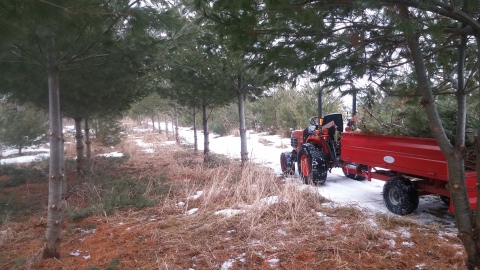
Today conditions were perfect for a bit of exercise, so I began to gather up slash left over from the trimming job on a stand of ten-year-old white pines.
Last fall a contractor offered the trimming in return for the pine needles which he sells in Toronto for wreaths at Christmas. The crew came back a couple of weeks later and dutifully trimmed the stubby branches off the trees, but I decided if I got a chance I’d clean up under the canopy so that I could mow it once or twice a year.
Five loads of branches transported to a burn pile were enough for today. If the weather holds I’ll get back at it. There’s little danger of running out of branches to gather in the near future: these rows are 700′ long.
Of course the best part is the unloading: just back up to the pile and flick a lever. The trailer dumps itself. A little overcapitalized? Maybe, but it’s fun.
Offroad Adventures with a 1973 VW Beetle
January 15, 2017
A few years ago I let a Netherlands blogger post this. Last time I looked it had received 8000 hits. Europeans and South Africans seem particularly interested in driving on a huge sheet of glare ice.
—————————————————————
Later on in life a man may forget the name of his first love, but he will never forget the intimate details of his first new car. Mine was a yellow 1973 VW Beetle Custom. I chose the Custom model rather than the Superbeetle, because I was skeptical of those newfangled MacPherson struts — thought they were a fad, and CV joints looked to be a maintenance nightmare.
The Beetle was a great car on the road, especially after I replaced the stock bias-ply tires with oversized radials. The thing was amazing on ice: just how amazing I was to discover one Sunday afternoon in February.
The Big Rideau had watered up in mid-winter, leaving a triangular, five-mile expanse of perfectly glare ice. This was too much to resist. Gingerly I drove on at Portland and worked my way up through the gears, getting the feel of the unfamiliar car on the unfamiliar surface. Everything seemed quite well balanced, so I got up into 4th gear and settled into a cruising speed at what I considered the limit of adhesion, 68 miles per hour.
A Ford Courier with a cement mixer in the back came up behind me and then pulled ahead. This would not do. Determined to catch this upstart, I gradually sped up. The Beetle complained, squirmed a bit, then, resigned, settled in all the way up to 80. All of the sudden everything let go at once. There was no gradually-increasing oscillation which normally leads to a spin-out with a Beetle. Nope. All of the sudden I was spinning like a top.
This was quite an interesting sensation: on a zero-traction plane, you go from a vector of 80 mph north to a similar vector counting in about sixty revolutions per minute. I’d never spun that fast or for that long. I started to worry about oil pressure, so I shut the engine off and shifted into neutral. Still spinning, not even slowing, I turned on the tape deck. It worked fine. I was still a mile from any shore and still spinning, so I just settled back and enjoyed the ride.
Eventually the back wheels caught up and the Beetle coasted to a stop. The Ford Courier was long gone over the horizon. I started up again and continued my tour. A new Corvette blew by me, and I chose not to take up the chase. After about an hour of glare-ice driving and a tour to Rideau Ferry and back I had a pretty good feel for the car. 68 miles per hour remained the optimal cruising speed on ice.
The Beetle served us faithfully for ten years and 130 thousand miles. Then it received new floorboards and lived with my cousin for another three. Its only ill-effect from its many off-road adventures was that when we sold the car it was 1 ½ inches longer than when it was new. My dad’s horses had had to tow it quite a lot, sometimes out of ditches, and sometimes like a toboggan over the snowdrifts to the ploughed road. A couple of times I buried the thing while driving on the crust. Once, disgusted, my dad made me wait until spring to recover it. I had to use my wife’s Datsun for a month until the snow melted. What a grouch!
We got rid of the Beetle when our new son arrived. The Rabbit was much safer, but useless off-road. My dad could hardly contain his relief, but two months later he bought his new grandson an army surplus Jeep to drive around the farm.
 the Walnut Diary