Elf-mode
December 4, 2016
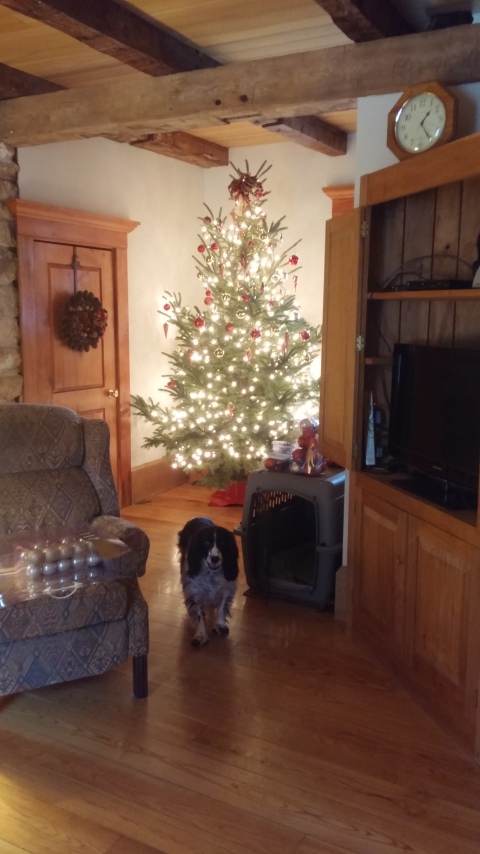
Every year about this time Mommy goes into what Dad calls “elf-mode.” Yesterday she tried to fasten a wreath to the door of my house, but I put an end to that with a baleful glare. Anyway, she’s cheerful in elf-mode, so there are lots of treats.
Barks,
Taffy
New CV boots for Ruby
December 2, 2016
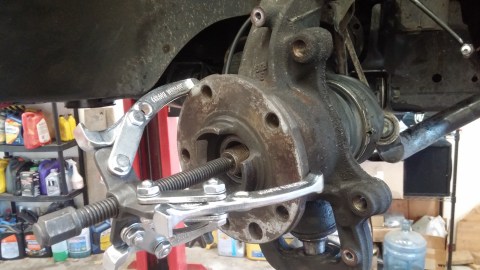
Background
When I switched to winter tires I was surprised to find a substantial deposit of grease inside the right front rim. The boot looked intact, but closer examination revealed a bit of cracking in one location, so axle disassembly seemed inevitable before I took the car on a sanded road.
The local auto parts supplier had access to the boots, but I had to resort to Amazon for a 32mm, 12 point impact socket for the axle bolt. Two days later the set of sockets appeared at the house, courtesy of Canada Post.
There are no videos explaining how to perform this unglamorous repair to a Cayenne. I found one cryptic explanation on RennTech.org by a man named Whippet who popped one in to fill a need. Perhaps I’ll post an addendum to fill in a few gaps where I was left bewildered.

Morning
I removed the right front half-shaft successfully in pursuit of the cracked boot. After a thorough bath in the parts washer, there wasn’t any apparent internal damage to the joints, but now I have to figure out how to pop off one end or the other prior to re-lubing both cv’s and adding boots. Major cleanup around the brakes is in order. Fun, but messy.
At the moment I’m stuck until I find instructions on how to disassemble the half-shaft. 
Early Afternoon
I had to search VW sites to gain insight into how the half-shafts come apart. Eventually I ran across a video where a guy separated one with a slide hammer, but he said that a flat board with a slot for the axle would work pretty well for removing the outer joint if you hit it sharply with a hammer, only his board broke. Mine didn’t until the part which goes through the brake rotor had come apart.
I’m beginning to believe that the trick to working on a Porsche is to use a heavy enough hammer. A light mallet had no effect on the axle, but a 20 ounce construction hammer’s effect was smooth and incremental. (Similarly, I have found an eight-pound sledge perfect for the disassembly of ball joints and wheel removal.)
The cleaning of the CV joints involved hosing down each in its turn in a stream of varsol over the parts washer. Not bad at all, though I’ll need to buy more solvent.
Then came the battle-of-the-day with after-market clamps which came for the boots. The two which fasten the narrow ends to the axle were perilously large for the job, but might work. The others were too small. After a long battle I managed to fit the outboard clamp (no other type of clamp will work in this position because of narrow clearances). The clamp next to the front differential was 1/4″ short, so after almost two hours of trying, I twisted on a 4″ plumbing clamp. There’s no shortage of clearance in there. I read somewhere that the pipe clamp’s a stronger alternative to the ubiquitous zip-tie on DIY boot-repair projects.
The Hint
A hint I read online eventually allowed the breakthrough on the outboard boot: a contributor recommended drilling a small hole 1/4″ ahead of the other holes on the boot clamp. He said this allows the use of needle-nose pliers to pull the clamp together enough for it to latch when other attempts are unsuccessful.
Surely enough, with the extra hole I was able to snug up the clamp enough that it would hold its place so that I could use the specialized crimping pliers purchased for the purpose. I guess it’s hard to visualize the benefit of drilling a hole in a pipe clamp, but smooth pieces of stainless steel offer very little to hang onto, especially when one attempts to install them over a neoprene enclosure bursting with grease.
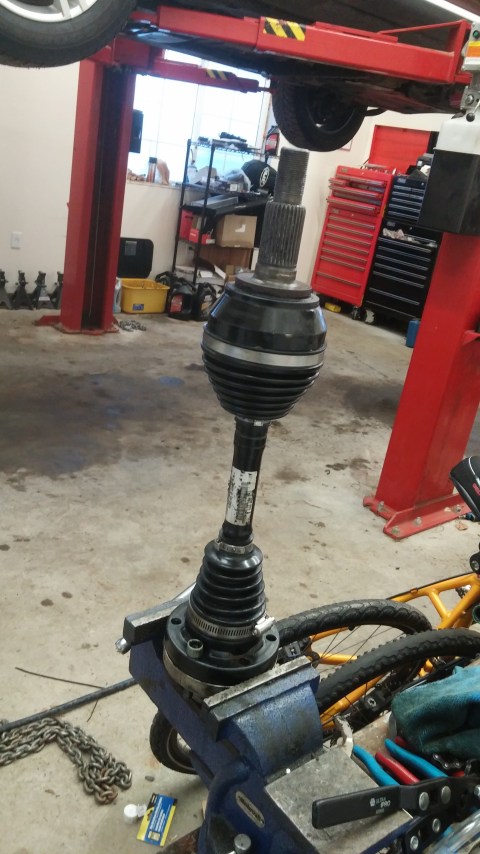
My day with the quarter-shaft was quite challenging. What vexes me more than anything is that I spent a day trying to salvage one of the only inexpensive parts on this car: rebuilt quarter shafts are very cheap on the gray market. On the other hand, my labour is free.
Monday, 5 December, 2016 5:54 a.m.
The axle went back into the car yesterday. Everything went surprisingly well until it came time to torque the six studs to the differential. I couldn’t keep the axle from turning, so I pressed Bet into service on the brake pedal. After I wore out both her legs pumping the dead pedal, we concluded that the brakes wouldn’t hold sufficiently for me to put 60 lbs of torque onto the studs, so brake bleeding moved up in the schedule.
Careful not to damage the brake line or electronic feed from the ABS, I had removed and stored the calliper early in the process. This left the line dripping brake fluid into a tray for two days. Now I can’t get the brakes to bleed, I assume because there’s an air lock in the system.
Charlie told me at various times he had dealt with dry brake lines on his 968 during an extensive rebuild, and it took a while to get the fluid to flow. His old bleeding pump applied pressure at Ruby’s fluid reservoir*, but to no effect. I’m nervous about online reports of broken pump lines spraying paint-destroying brake fluid all over everywhere, so I’ve been very tentative in my use of this unknown tool.
Ruby’s paint is still almost perfect.
Resetting of the two alignment-critical bolts and torquing of suspension and axle parts remains incomplete.
If anybody has any ideas on reviving brake fluid flow, please chip in.
*Number 1 rule: Make SURE you’re pouring the brake fluid into the correct reservoir. For the record, Pelican’s lavish shop tutorial photos are not always correct. In this case I beat myself up for six months about this blooper until my son found a Pelican diagram on Google which labeled the power steering reservoir “brake reservoir.”
3:30 p.m., Monday, 5 December
Brakes now work. Under a concealment panel I found the actual brake reservoir. No amount of positive air pressure on the power steering reservoir would bleed the brakes. So I siphoned nearly 1/2 litre of Motul DOT 4 brake fluid out of it. Then I refilled the reservoir with hydraulic oil (like it said on the reservoir, only for the Kubota). Shall drain and refill the power steering system asap. The unlabelled plastic tank was nearly empty when I opened it, expecting a brake reservoir, so I looked no further.
Bleeding the brakes was straightforward once I had located the right reservoir and put some brake fluid in it. To its credit, the car’s sensors quit complaining as soon as the brakes worked. Ruby didn’t hold my mistake against me.
When I told Bet she asked, “Are you going to tell Charlie?”
Now all I have to do is torque everything. The brake calipers are already at about 200 lb. The torque wrench clicked at 140. Then I added a 2’pipe to an old ratchet and tightened them up one lurch. The axle nut goes to 340, but I’ll use my tractor wrench with a 4′ cheater pipe and take it easy: for my rotary mower blades it calls for 540 foot pounds torque. Immediately after it’s tightened, the nut is too hot to touch.
I’ll have Bet hold the brake for the six axle screws which torque to 60 pounds. And so on. I’ll look up the suspension numbers. Then off for alignment again.
A Subversive meme in Barney and Clyde
November 30, 2016
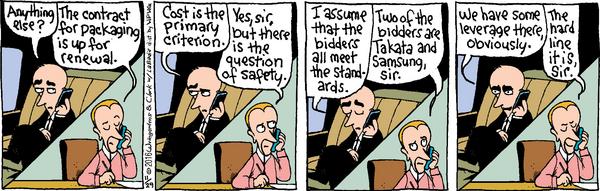
This Barney and Clyde strip appeared November 29, 2016. How it caused a few minutes’ anxiety for the service manager of a local Toyota dealership is a tale possibly worth recounting.
Barney and Clyde is one of my favourite Arcamax Publications online offerings. The strip often sends me to Google to track down obscure facts and theories I wouldn’t otherwise encounter.
In this strip I had a good idea that Samsung owns the notoriety associated with the exploding Galaxy 7 Smartphone, but I had to look up Takata.
The horror story of the 17 year-old girl bleeding to death from a shrapnel cut from a prematurely detonating air bag in a Honda Civic definitely caught my attention. Of course Google provided many references to track down the car models into which the potentially defective airbags had been installed.
On a US government site I ran through the family fleet. My models of Porsche, Lexus, and Toyota do not have Takata airbags. My mother’s 2008 Scion xB, a Florida purchase, was the only one which appeared on the list. I plugged in the VIN. Yep, it has the bad airbag.
Toyota/Lexus Canada is very good at maintaining contact with their owners, but this car came from a Florida auction to a local Honda dealer, and then was sold off his used car lot. I would need to register the car in Canada for the recall.
I called Kingston Toyota and spoke to the service manager. Impressive acceleration there. Over the course of a few halting sentences of dialogue while he no doubt searched his computer, he went from zero knowledge on the subject to enough information to at least sound competent and book the car for a recall a month later.
The only evidence that he was scrambling to get his feet under him was the question: “How did you hear about this?”
“It was in Barney and Clyde, a comic strip.”
Ten minutes later he called me back. Toyota has no plans yet for a recall, though that may change in the next few weeks. I responded that because I was essentially removing the family pool vehicle from service for a month, perhaps I should hold onto the appointment and confirm a day or two in advance of the date. He agreed that that would be a good strategy.
I asked how big a risk the exploding ignitor on the airbag presents to occupants of the car, and if it would be better simply to disable the device. He advised against that, but suggested that the car would be fine to drive in the interim as long as no one sits in the passenger seat. An empty seat disables the airbag.
So I left it.
Then I called my sister who has been using the car to ferry Mom around. She appeared uncharacteristically calm about my warning. She also knew considerably more about the Takata SNAFU than I did.
She owns a Honda Element. Her recall notification caught up with her last January at her winter residence in Florida. After many conversations with “a highly intelligent woman at the Honda hot-line over six months,” in early July her relieved Ottawa dealer gained access to an airbag and repaired her Honda Element. “The problem at that time was that half the airbags in the world needed to be replaced, all at the same time, and all from the same company. They were in short supply. Perhaps they have the shortage under control by now, a year later.” She further told me that she had simply shut off the airbag with the ignition key and gone about her business as usual. She saw no reason not to do the same with the Scion.
I guess you can get used to anything if you have a bit of time to adjust to it. That’s pretty much the central thesis of the Barney and Clyde comic strip, come to think of it.
UPDATE: 1 January, 2017
The December 29th recall appointment came and went. Toyota Canada still can’t provide the airbag. The service manager strongly suggested that I bring the Scion in for another recall on the master power window switch, though. I asked how the problem manifested itself. Apparently the master switch becomes sticky and some handymen spray it with penetrating oil, creating an alarming fire when the circuit is next closed in the presence of the volatile liquid. I suggested I’d keep the WD-40 away from window switches and would get both jobs done when they inform me that they have the air bag.
That’s when things got interesting. Seems I need to provide a recall letter from Scion USA, and they don’t have my address, so if I want things to proceed, I should call their 1-800 number and get on the list. Oh. I dialled, and on the third try spoke to a very helpful woman who carefully took down the VIN, my contact details, and again informed me that Toyota has no replacement air bags yet, but they’ll send me a letter when one becomes available. She further warned me about the window switch recall and we parted friends.
Ice-in reported on Newboro Lake
November 28, 2016
Photographer Maggie Fleming of Newboro reported this morning that the ice is in.
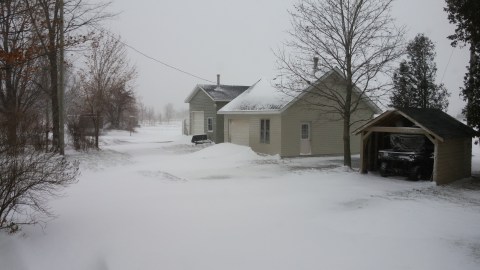
First snow
November 21, 2016
This is admittedly click-bait, but first snow is a fairly big deal up here. Let’s call it kitchen table journalism.
Media-saturation and leadership
November 20, 2016
*To non-Canadian readers I apologize for a column which must look like inside baseball. Rather than load the piece up with parentheses and marginal notes, I’ll leave it to Google to provide explanations on demand. After considerable thought I hope that I have found a context within which to respond to the recent U.S. election.
It’s a scifi world in politics now, where there is literally no such thing as bad press. The only losing strategy any more seems to be the pursuit of a quiet, principled and dignified campaign. Canada’s Dr. Kellie Leitch has caught onto this meme and decided to get herself some Trump in an effort to avoid irrelevance.
What galls me is the commodification of this package of negative attitudes as a prefabricated political strategy.
The question for Canadians is how can we sanction the McVetys, the Fords and the Leitches without simply inflaming the virus with the heat of publicity, which is all they seek?
The only immediate suggestion would be to lapse into autocracy — what Trudeau bluntly used to prevent the (Sam Oosterhoff-style) packing of nomination meetings in 2015 — but to do that is to allow the virus attacking democracy to advance as well.
So the old debate question emerges again: how can a democracy protect itself against attacks upon truth as the the informed news editor is supplanted by the writer of fake news?
Ruby has visitors
November 13, 2016
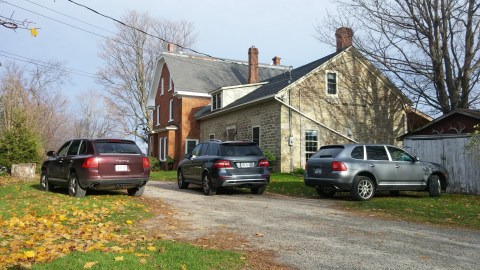
I posted this photo before my typing skills had returned, so I’ll tap a few notes three weeks later. Ruby’s visitors, a sister Cayenne S from Ottawa and a diesel Mercedes from Montreal (I dare not guess at the model number) were both purchased as tow vehicles for track expeditions.
Both track haulers fill the rest of their days transporting infant daughters, so their bullet-proof qualities rank high with the new fathers.
UPDATE: 16 DECEMBER, 2017
Whenever the three SUVs get together the drivers update repairs which have occurred over the last interval. A sensor for the Mercedes diesel system has needed attention twice since first writing, and the transmission needed extensive work to cure a leak. My son’s Cayenne needed a suspension part after an altercation with a curb hidden under snow, brake pads and front rotors, and a set of tires. Ruby had an A/C refrigerant top-up.
UPDATE: 2 FEBRUARY, 2019
The Mercedes was the first to go. The owner got fed up with expensive repairs to the diesel system and he traded it on a Range Rover for greater reliability. ?????? My son’s silver Cayenne S was replaced by a CPO 2015 BMW 528i with AWD and a turbo-4 for improved fuel efficiency in city traffic. It’s cleaned up and sitting in the yard, waiting for a spring private sale. Ruby’s fine.
A Ridiculous Ailment
November 8, 2016
Cervical radiculitis is a compression of neck vertebrae where a nerve or two radiating off from the spinal cord swells and cuts off fluid transfers along the line. In my case constriction of nerves # 6 and 7 have given me a numb left arm and destroyed my ability to touch-type.
After many weeks of physio I’m getting strength back in the arm, but touch-typing will be the last skill to return.
Too many trips under my Porsche Cayenne’s dash to fix the air conditioning caused this pinched nerve, but the HVAC system now works, and the rest of the car has provided good service.
Where does it hurt, Ruby?
October 5, 2016
Today I pulled out to pass a minivan and the car began to shake. I’d been expecting this. At 127,000 km Ruby’s overdue for Cardan shaft work, so I eased out of traffic and skulked home, avoiding accelerating on hills to lessen the strain on the drivetrain.
Up onto the hoist Ruby went. Off came the covering plate, and there was the carrier bearing, its rubber membrane cracked, but still in place.

Nonetheless, I set out with a knife to hack the thin rubber membrane away, then followed with an air-driven hone to polish the last of the rubber off the carrier bearing.
Unwilling to leave the bare metal to rust, I sprayed several coats of black shop paint in the general direction of the bearing case.
Then came the Jimi Fix. As claimed, it was a “twenty-minute” procedure to compress a series of cross sections of heater hose between the bearing and its frame and hold them in position with a latticework of zip ties. By the second hour of the twenty minutes Bet had warmed to the job and insisted that I lower Ruby on the hoist “another inch” so that she could finish the last three ties at the top of the bearing. (My left arm was out of commission at the time due to a couple of pinched nerves from several days under the steering wheel, fighting with A/C boxes in an impossible location.)
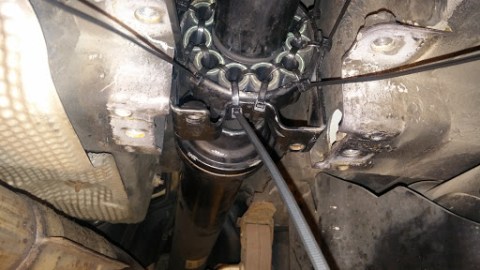
We cut off the ends and back on went the plate which hides everything, and Ruby seemed as good as new.
But when I started up, the “Check Engine” symbol popped. Ruby idled roughly as I backed out of the garage, then showed an ominous triangular warning, so back into her nest she went.
The meter showed Error Code P0307. Google told me that means a misfire on cylinder 7. Off came a panel covering the left hand coils, fuel injectors, and spark plugs. The various specialized screws and nuts weren’t about to stop me after the A/C actuator experience last week. Out came coil #7. Yep, a 2″ split right there on the side of the coil.
I ordered a set of eight from Amazon.ca, called it a night, and watched the Jays beat the Orioles with a three-run, walk-off home run in the bottom of the eleventh.
The rubber on the bearing support was brittle and cracked, though strictly speaking the Jimi Fix had been premature. Even though Ruby’s Cardan shaft had felt much sloppier than the new one on my son’s 04 Cayenne S, the bearing carrier had still been functional when I butchered it.
Update: 10 October, 2016
The coils arrived from Vancouver Island in four days. As soon as I slipped a new one into place, Ruby’s engine settled right down. Why the disproportionate reaction to a single mis-firing cylinder? Charlie explained that the unburned fuel alerts the O2 sensor, which then leans the whole bank of cylinders out to try to rectify the problem, so a single misfire affects four cylinders. That made sense.
BTW: Until that plastic cover removed to access the coils is properly screwed down, the engine seems alarmingly noisy. It’s likely fuel injector noise, but to my fevered imagination it just had to be the dreaded start-up death rattle of Cayenne V8’s. Once the cover was properly installed, Ruby purred once again.
Ruby has returned to normal duty. The drive shaft works fine, so I’d have to conclude that the Jimi fix seems a viable solution to a Cardan shaft problem, at least in the short term. Ruby now has 127,500 km on the odometer. I’ll report back on this periodically.
Update: 25 December, 2016
At 131,000 km Ruby’s Cardan shaft still performs perfectly. We tested it over the last couple of weeks with a 20′ enclosed car trailer in tow, and offroad in low range with the diff lock on. Not a whimper.
16 December, 2017: Still no problem with the drive shaft at some mileage north of 146,000 km.
31 December, 2016
On Rennlist.com the original contributor just posted the following update: Traded Cayenne S with Jimi fix away. Logged mileage with Jimi fix perfectly working was 44,632 miles. Yeah…
More Porsche Yoga, left side
September 22, 2016
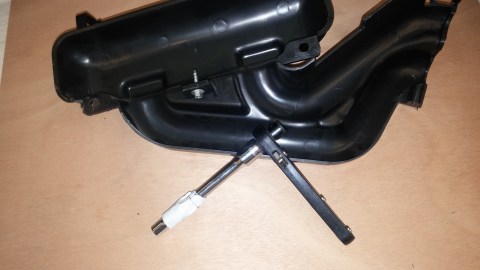
Notice the screw in the photo above. Any idea what’s wrong with that picture? Today I wasted a day trying to cope with that bit of engineering stupidity.
“Germans would over-engineer butter!”
My long-time insurance broker grew up with a German father who was a Mercedes mechanic before he immigrated to Canada. I thought of Cordelia a few times today as I tried to make sense of the puzzle of five AC actuators crammed into adequate space for…none.
And anybody who would put a screw in the middle of the BACK of a cover in a space as confined as it is under the dash of a first-generation Cayenne, that engineer is either incompetent or a sadist.
For all I know my Lexus has a similar arrangement of actuators for its AC, but I’ll probably never find out: Lexus parts don’t break from a lack of lubrication after 125,000 km.
It’s easy to see why there are so many nused Cayennes on the market. Not everybody wants to make a hobby of his car, and when the absurdity of a broken air conditioner goes past a certain point, out of the garage it goes to where enthusiasts like my son lie waiting.
UPDATE: 22 January, 2017
At the time I wrote the passage above I was quite distraught as the fingers of my left hand were gradually losing the ability to type. I’m now pleased to report that my fingers have regained enough dexterity to outpace the spell-checking software.
I realize there’s a glaring gap in the narrative at this point, so I should try to fill it in somewhat. I did post to Renntech.com an account of the repair, I but I’ll offer a quick summary here.
The problem with the non-functioning heater and air conditioning controls related entirely to the failure to operate of a series of servos known online as A.C. actuators. They’re famous for their great expense (up to 189 USD each), so most DIY owners buy the Volkswagen equivalents for the Tuareg at about half the cost.
Only one of the original servos which I removed was broken. The others were paralyzed by old grease and poor design. The 2008 servos I found on eBay.com came from a San Francisco wrecking yard. For $100 I had a new set of servos and they worked when I installed them. The Renntech article involved disassembly and repair methods for these servos.
For a claustrophobe any under-dash repair on a Cayenne is a hellish experience. There’s no space up in there. Distances are awkward. I bought extra-long Torqz screwdrivers to help.
The manual I downloaded eventually proved to have information essential to the task, but Porsche technical documents are annoyingly obtuse. After all, I grew up on Volkswagen Maintenance For The Complete Idiot. The Whole Earth Catalogue and Pirsig’s Zen and the Art of Motorcycle Maintenance completed the trifecta. I expect information with a solid measure of empathy for the reader.
The one thing the manual failed to warn me about forced me to remove a “plate” of three servos because I couldn’t connect the wiring harness to one servo once the plate was installed. It took a full day of agonizing work to re-install the plate. That’s how tight it is in there. The KESSY (some little computer controlled by the ignition key) never did make it back up to its rack. It now hangs out beside the accelerator pedal.)
In any case, some bits haven’t been replaced under the dash yet, but the car’s now warm and comfortable in winter. Before my ordeal the AC had two settings: full on and off. There was no heat. On the other hand, my wife has forbidden me to crawl under the dash ever again to replace bits still sitting on the bench or around the gas pedal. It took eleven treatments at the local physiotherapist’s establishment to return my left arm to service.
https://www.renntech.org/forums/topic/44460-ac-flap-actuator/#comment-281193
 the Walnut Diary