The Chong Show
May 31, 2015
Michael Chong appeared on CTV’s Question Period recently in conjunction with his private member’s bill which appears stuck in Senate until it dies on the order paper with the election call.
I’d never seen this fellow interviewed before. It immediately became obvious why he was a first-round cabinet pick for Stephen Harper, and as I watched him in debate it became even more obvious why he quit the job out of principle.
Somebody should do a pre-election poll which tracks the relative positions of the three main parties if Michael Chong were to replace Stephen Harper as the leader of the Conservative Party of Canada. Chong, an apparently idealistic, moderate conservative, might well draw a lot of voters back to the blue tent after Mike Harris and Stephen Harper stole their party from them.
UPDATE, 24 June, 2015
The Senate passed Chong’s bill into law. Good.
Frost
May 24, 2015
Friday night (May 22nd, 2015) the temperature dropped below freezing for several hours. The next day was cold and very windy. The frost, or the frost combined with cold, dry winds, did considerable damage to the foliage and flowers of various trees and seedlings scattered about the property.
The most obvious victims were young green ash saplings. By Saturday afternoon the five-year-old ashes beside the brook had turned completely black, stems and all. The damage in a stand of green ash and silver maple planted in 2006 was entirely restricted to the ash. They showed moderate defoliation on some lower branches. All maples seemed to hold up well to frost.
White birch seedlings planted two years ago (2013) showed little frost damage despite rapid growth this season. Their escape might have to do with their height. Seedlings under a foot of height were hardest hit.
Shagbark hickory leaves on 2010 seedlings showed extensive damage. Pin oaks varied: the more verdant the recent growth, the more leaf damage. Slightly older red oaks showed red leaves, but no shriveling.
Black cherry saplings transplanted to the front lawn showed no damage.
Mulberries on the lawn have shriveled leaves, but the undeveloped seeds seem intact, if slightly discoloured. This applies to both the red mulberry trees and the hybrid which produces freakishly sweet, mauve mulberries.
2012 black walnut seedlings were whacked by the frost. That’s no surprise, for I looked at 7 acres of 2005 walnuts and only the most sheltered have the bulk of their leaves intact. One relatively exposed plot of 2006 butternuts will have to grow new leaves, a trick these trees do anyway in response to insect attacks. The adjoining black walnuts planted in the fall of 2005 have heavily damaged foliage, as well.
The real question remains whether the apples, pears, and the producing black walnut tree which lie in the shelter of the house will bear fruit this year. I suspect that the presence of two furnaces running nearby on the night of the frost may have created a micro-clime to allow their flowers to survive. Time will tell.
A note about weeds might be in order. Buckhorn seems impervious to frost. I detected no frost damage to the dreaded wild parsnip which I spent Friday and Saturday spraying. Wild cucumbers and the more verdant climbing vines suffered greatly in the frost, but the robust climbing vines soldier on.
Apart from the green ash, the showiest sufferers were 2013 Norway Spruce seedlings. They had been having a great spring, but the new growth is now brown and dessicated. White spruce and white pines, like maples, seem to have suffered not at all.
About those debates, Steve…
May 23, 2015
To: Hon. Stephen Harper, Prime Minister of Canada
O.K., Steve, here’s the deal. You don’t want May, Trudeau and Mulcair to spend a couple of hours shooting at an empty chair in the main debate on CBC. This can do you no end of hurt.
So send Paul Calandra to fill the chair. He’s been willing to play whipping boy for the last year, and if his recent performance on Power and Politics is any indicator, viewers will find watching him so painful that they’ll turn off in droves and forget about the debates.
BTW: if this modest little tactic helps you get re-elected, I’m eligible for a senate seat representing Ontario, and because I live in the Ottawa area, there wouldn’t be any need for a housing allowance.
Rod Croskery
The rumoured rock barrier at the Marina Road failed to materialize, so we cruised in comfort across the side-roads and beaver ponds which make up the landscape on the stretch between Little Lake and Chaffey’s Locks.
When we came to the bridge over the canal with its planked deck and chain link sides, I regaled the crew with a long and windy account of trying to follow my 15 year-old son across the railway ties while he took advantage of his new, suspended mountain bike. He’d torn across the bridge at full speed while I was reduced to hopping over one tie after another while gazing at the Rideau through the wide gaps below my wheels.
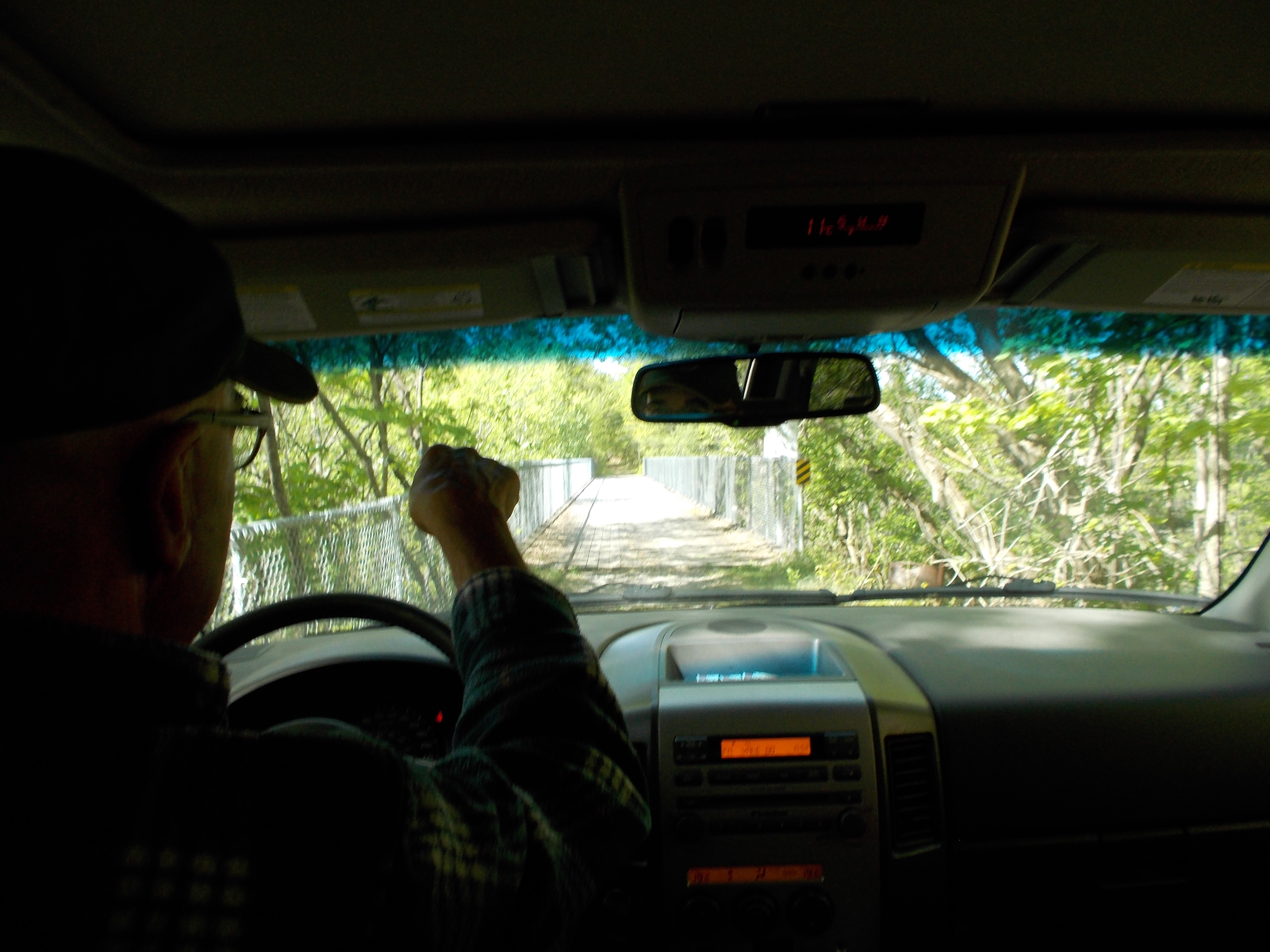

Then it was Doug’s turn to tell us about the livestock culvert through the railway bed and how it had become impossible to maintain due to shifts in the rock and gravel above.
When we came to the gate at the road which leads in to The Two Doctors, a black SUV pulled in quickly behind us while Doug puzzled with the key. The Queen’s Biology Station prof showed Doug how to fit the key, and then asked if he could go ahead because he had a student with a broken ankle a mile and three-quarters down the trail. Away he went.
I had built up the bird watchers’ expectations with wide-eyed accounts of the great blue heron rookery just off this section of the Trail. I should have remembered that dead trees don’t stand indefinitely in a beaver pond. When we finally got to the large marsh which stretched out far below our vehicle, it was treeless, and thus the heron nests had to be somewhere else. Undaunted, Lloyd and Dwayne kept up their search for songbird nesting sites.
This stretch of the railway line runs through very rugged territory, so we saw quite a few isolated lakes, the most impressive Garter Lake (or Carter Lake; Doug’s map wasn’t clear on the first letter). It’s a deep lake a couple of miles long which fills the gap between opposing ridges.

I called a halt at one point to photograph a huge mud beaver dam which maintained a pond at least four feet above the height of the road bed. If it ever broke, the trail would be inundated with silt cascading down to another pond about 30′ below on the other side of the road. Rough country.
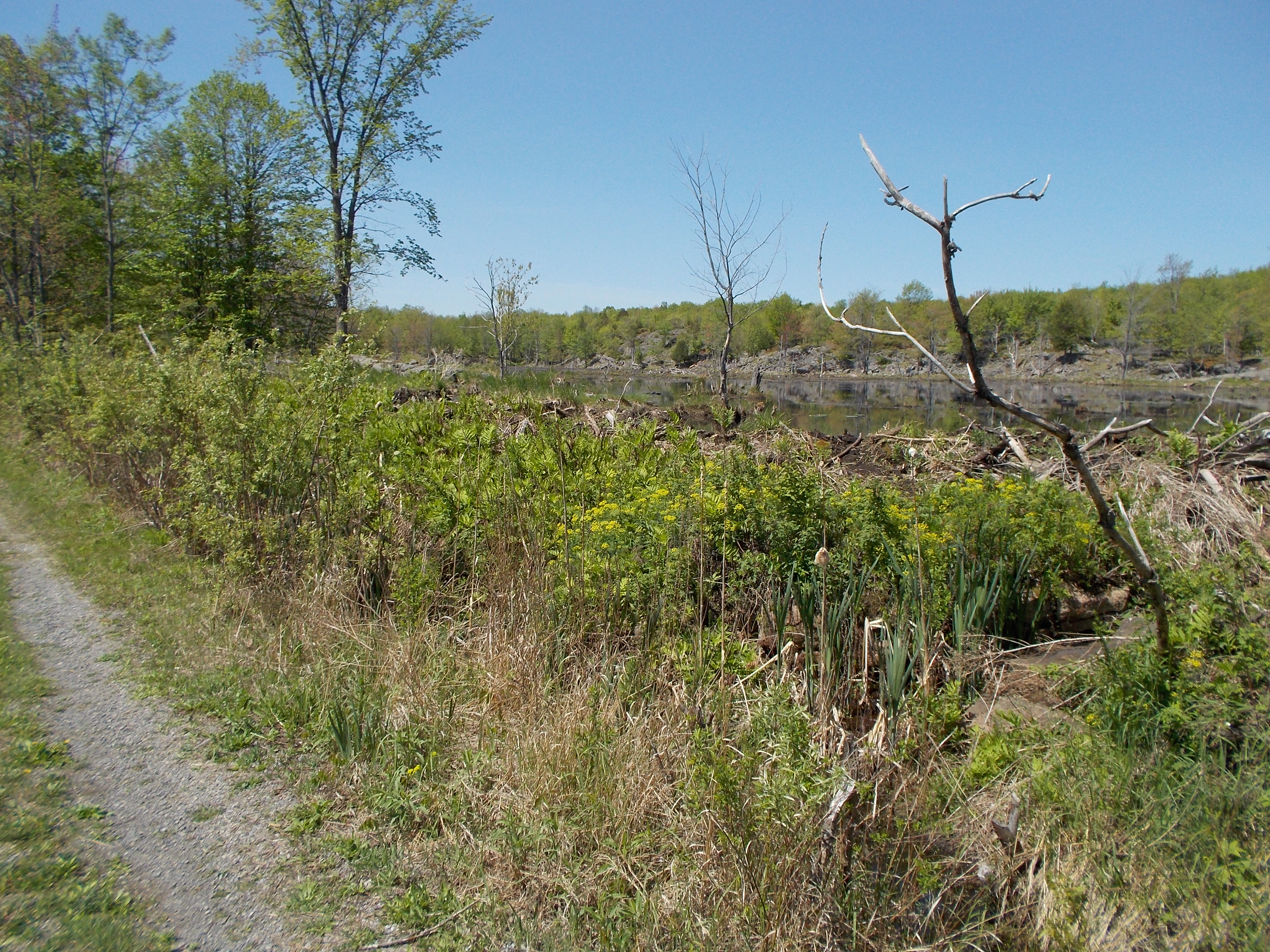
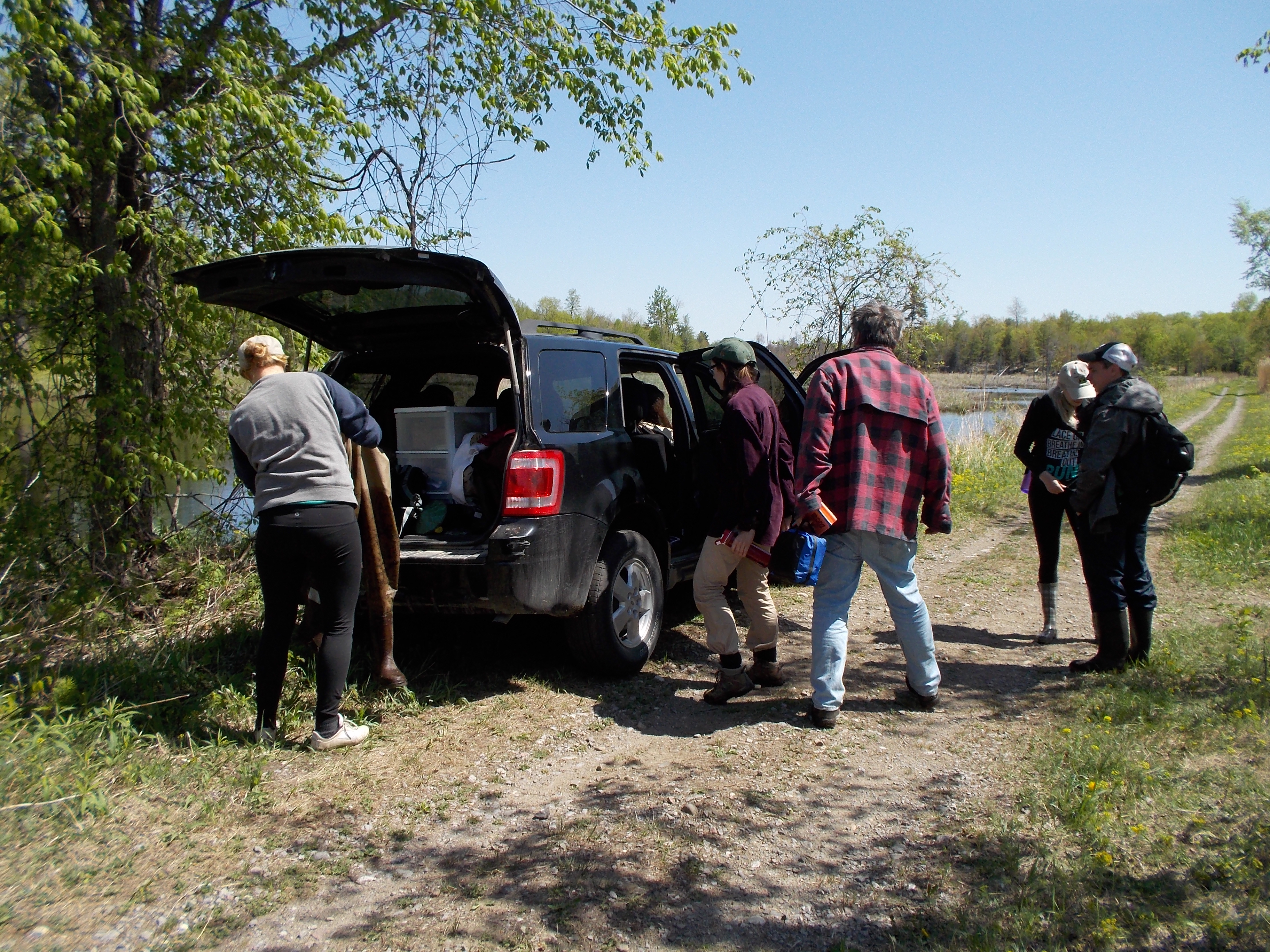
Eventually we came upon the band of Queen’s biology students and the guys helped carry the injured woman out a boggy trail to the prof’s SUV. They loaded her across the rear seat. She had slipped while stepping over a log on her way to the beaver pond to work on the water snake project. The rest of the crew dumped waders and other extra equipment into the back of the car, then cheerfully began the hike back to “QUBS,” their pet name for the Biology Station.
As the landscape began to level out Doug called a sudden halt and asked Lloyd to back up about a hundred feet to a trail marker dangling from a sapling. Then he bailed out and scuttled down the bank to the entrance of what looked like a large cave. “Take a look at this!”

As we assembled at “The Grotto” Doug explained that the builders of the railroad faced a unique drainage problem here. They needed to provide a route for a lot of overflow from a swamp above, so they drilled a tunnel through the granite ridge. The makeshift culvert looked to be about fifty feet to the light at the other end. A placid stream bubbled through the ridge and joined a smaller stream at a conventional concrete culvert under the railway bed.

Soon we came out at another gate a couple of miles short of Perth Road village. We opted to return by road from there while Doug told us about Opinicon Village, though we were unclear about the location of Postal Gate, which apparently guards the trail to the mythical town site.
Time will tell what the impact of the trip will be on bird house placements, DSV containment strategies, or local history tours, but the ride through the Cataraqui trail before the bugs of summer was well worth the effort for its scenic value alone.
There’s a fascination with forbidden spaces which strikes deep to the heart of every owner of an off-road vehicle, so as soon as my neighbour Lloyd Stone bought a used Polaris Ranger, I was eager for an expedition. Actually, there was a bit more to it than that. Lloyd volunteers maintenance services to his section of the Cataraqui Trail, clearing fallen trees and occasionally making a pass or two with his rotary mower. Such work’s not hard for a retired farmer with an embarrassment of tractors and related equipment still on hand.
Lloyd wants me to take over the section which runs past Portland, but I’m still holding out for the Chaffey’s Locks end. My argument throughout the winter remained that we need to make a thorough inspection tour so as to understand the challenges of the western half of the trail before firming up the maintenance schedule.
The list of objectives grew as the landscape turned from snow to mud, to wildflowers. Then it became a matter of recruitment and scheduling.
Doug Good, Chairman of the Cataraqui Trail Management Board, has a key to the gates and his group funds the building of boxes for trail newsletters in my shop, so he became a natural member of the tour group.
Dwayne Struthers is a member of the Leeds County Stewardship Council with a particular expertise in bird habitat, so Lloyd wanted him along to plan the placement of new nesting boxes along the old railway bed. I got to come along because the trip was my idea, and because of my obsession with the invading Dog Strangling Vine (DSV).
So in best bureaucratese, our objectives:
1. to identify what type(s) of bird houses should/could be installed on the different types of terrain along the trail;
2. to determine the extent of DSV infestation along the Trail, and consider remedial measures, including spraying with Arsenal on the shoulders of the trail;
3. to examine lines of accountability and finance to facilitate objective #2 (above) before the seeds take to the air like milkweed fluff in September;
4. to allow Doug to show other participants points of interest and historical significance along the Cataraqui Trail.
Enthusiasm for the use of UTVs for the trip wilted quickly. Lloyd said, “We’ll take my truck,” and that was that. I didn’t quibble because I had recently broken my gas-pedal toe, and was pleased to be a passenger.
Equipment for the safari consisted of Lloyd’s four-door Nissan Titan, an assortment of birdhouses, a few fence posts, a driver for the posts, and three Dewalt cordless drills and a jar of Robertson screws. Lloyd produced one 5/8″ wrench to tighten u-bolts.
Precisely on time we joined the Trail through Lloyd’s private entrance and proceeded to the site of the old Forfar rail terminal where the crew leaped into action to install a bluebird box. Then we crossed Hwy. 15 and encountered the first gate.
Doug managed to unlock the gate, but had to tie the heavy barrier shut with baler twine because the needed sledge hammer or 1″ wrench to adjust the barrier’s alignment with its post had not made the trip.
Off we went to gawk at the surprising beauty of Little Lake and gaze with growing consternation at local DSV infestations.

-More later-
Why you always need to get the x-ray
May 12, 2015
My GP figured it was gout, as did everyone who looked at my ailing toe. Wrong joint, though. The Internet was a bit vague on the subject as gout is almost always on the main joint of the big toe, not the one out by the toe nail. But two weeks after the initial diagnosis of gout the bloodwork came back negative and the swelling wasn’t going away on its own, so Bet insisted upon an x-ray.
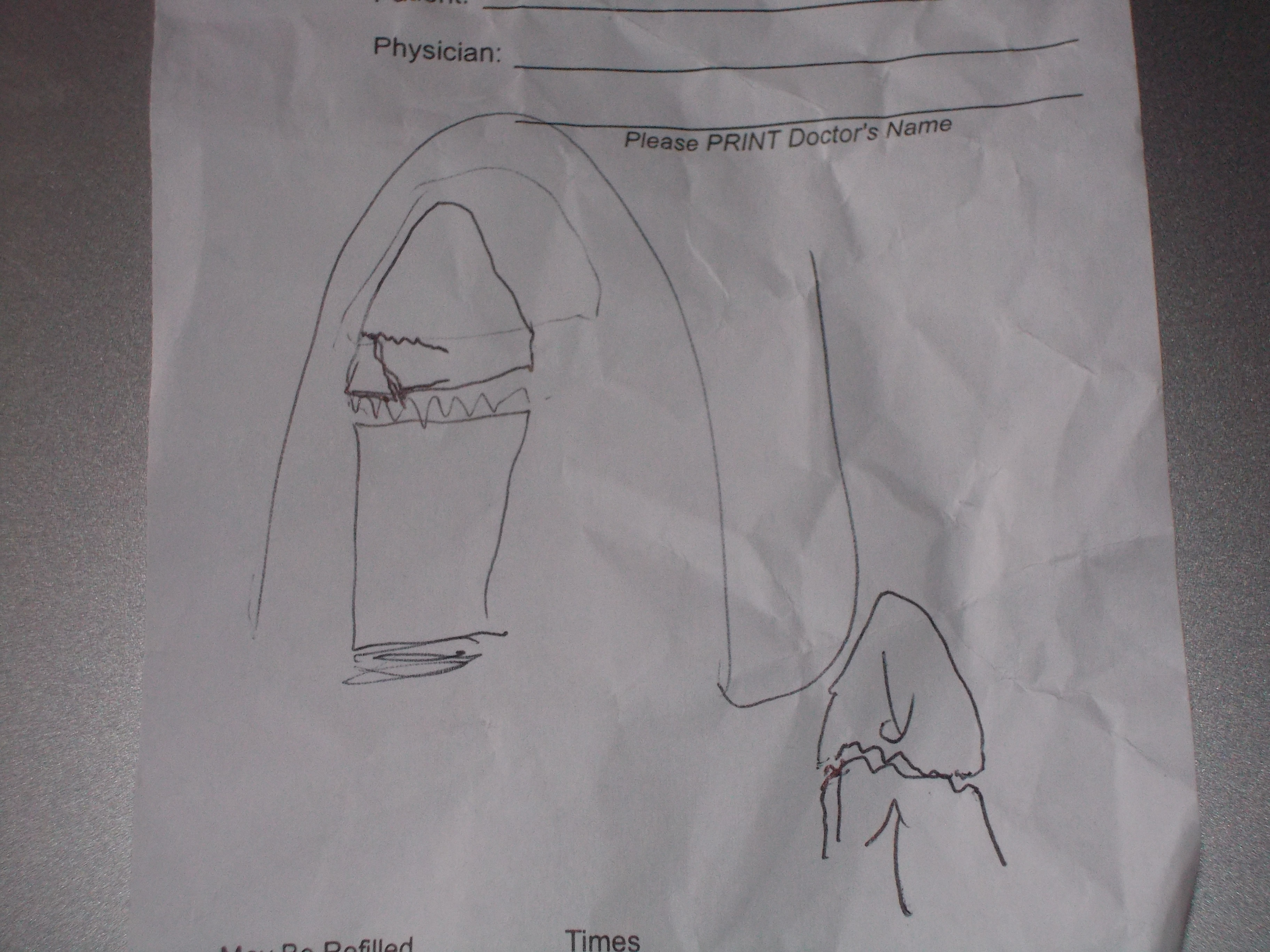
We ran into Bet’s GP working Emergency at Smiths Falls, Dr. Raphael Shew. Shew has a reputation as a fine diagnostician. He said it looked like gout all right, but he’d see after the x-ray. A half-hour later he came into the room beaming. “Well that’s interesting. There’s a fracture there, all right.” He drew me a sketch to illustrate it.
It should be good as new in six to eight weeks of confinement in a firm-soled shoe. That’s a lot easier to take: a fracture (a young man’s injury, the result of haste or stupidity) over gout, the affliction of some old guy nearing the end of the tunnel.
No wonder the damned thing kept hurting and even getting worse. Off to recovery…
I dug Dr. Shew’s sketch out of the wastebasket.
And then the Opinicon dinner bell began to ring…
April 25, 2015
My old classmate Don Goodfellow called it crowdfunding. He was impressed that this many people would come out on a Saturday morning in April to heave several years’ accumulation of oak leaves onto large tarps, then drag the sodden loads a hundred yards to the edge of the lawn, dump them, and climb the hill for another go. But lots of us were there with rakes and gloves, happy to help out, equally grateful that the black flies had not yet arrived, and that someone had had the foresight to lay in no fewer than six portable toilets for the crew. For 200 people, that’s luxury.
Further foresight had banned the leaf blowing crew to the far end of the property, so we could hear ourselves think.
So we went to work with a will, as long as wind and muscles lasted. Then we found things to lean against and chatted. One woman and her son come from a farm just outside Elgin. The family business is a grain elevator. Another couple own a lovely property on Newboro Lake. We had corresponded extensively over the years as part of the Annual Ice Out Contest. Specifically, I had named the winner two years ago only to have Pete comment that he had pulled a log off the “non-existent” ice with his Rhino that morning. From that point on I announced no winner until I had first toured the lake looking for ice.
Turned out they were head-hunting, and before long they had found an energetic member of the raking crew, a teenager willing to add more hours of wood splitting and raking to his busy week.
My friends Tony and Anne Izatt arrived from their new home in Newboro. Tony grumbled when I dragged him away from a conversation to help with a tarp, but when he finally got to work he pulled with a will, and seems to have great wind and stamina. But he’s been working on their house every weekend since fall, so he’s in much better shape than I. Don Goodfellow is ancient — two full years older than I, but he told me he’s already been doing a lot of raking this year, so he as well seemed in great shape. But at least I had had the sense to suggest the tarps to Fiona.
You see, there’s no way I would work this hard at home. I have too many toys for lawn care, and there are all sorts of tricks one can use to get out of heavy lifting if there are four diesel engines at one’s beck and call.
As it approached 11:30, Don kept talking about food. We raked bits of remaining leaf patches, but the bulk of the day’s problem had turned into a pile of compost over behind the dock shed. Then to everyone’s delight the dinner bell began to ring. If anybody wants to go all poetic about the bell pealing out a song of hope or continuity, or any such, please pen away and add it to the comment section below. Suffice it that I was very glad to hear that bell, and it wasn’t because I like hot dogs. The Opinicon is part of what I call Home.
Up the hill we trooped to avoid the slow stampede of rakers descending from around the cottages on the opposing hill. How many buildings are there up there?
A country rock band played quietly on the veranda as we moved into the short lineup for hotdogs, cake and cookies (effortless food delivery noted). The green relish looked unusual, so I tried it. Good. Over at the t-shirt booth people signed in and the woman before me commented beside her signature: “I loved the home-made relish.”
Hands full of food, I led Don toward The Liar’s Bench, but diverted onto the veranda of a nearby cottage, well-supplied with old chairs, painted red. The first one I tried had a cane seat. I sat down gingerly. Nope, too much crackling. I switched it for one with a piece of plywood screwed on ages ago. It took the weight and felt surprisingly comfortable.
People passed. Lots of chats with well liked, if seldom-remembered acquaintances. People seemed in an excellent mood at this event. Maybe in its own way perspiration is as good a social lubricant as alcohol.
Godwin’s Law, Justin Bieber variant
April 14, 2015
A time-honoured principle of Internet discourse is Godwin’s Law, which declares an argument lost the instant that the opponent resorts to a comparison to Hitler and/or the Holocaust.
Last week at the trial of Canadian Senator Mike Duffy the prosecuting attorney Mark Holmes attempted to badger his witness, former Senate Clerk Mark Audcent, on the topic of Duffy’s highly questionable claim of residence in Prince Edward Island.
Holmes suggested that becoming a senator doesn’t suddenly make you a resident of that province, you need to have already been a resident. To further his point, he raised the Senate requirement that a senatorial candidate must be at least 30 years old to be a senator. And this is when he brought up Bieber.
“(Justin) Bieber,” Holmes said, “is 21 years old. If the Governor General (were) to appoint the Canadian singer to the Senate tomorrow, would he become 30?”
“Of course not,” Audcent replied.
Our language cries out for a word for this fatuous use of the beguiling Bieber’s name. Bieber’s Law sounds more like a TMZ headline, followed by photos of police lines and luxury cars in seedy places. Bieblaw won’t stand the test of time. Perhaps it should be deliberately obscure, like Godwin’s. We’ll have to name it after the prosecutor, or maybe even Duffy’s Law.
No, it has to be Holmes. But the apostrophe’s placement (Holmes, Holmes’, or Holmes’s) would use up all of the air in the discussion, lessening the term’s value. How about The Law of Holmes? The Holmes Law? Reductio ad Bieberium?
Feel free to offer alternate suggestions as comments below.
My friend Tom lives in Southern Pennsylvania on a large wooded lot. He sent along the following account of his attempt to live-trap a groundhog whose digging imperils the earthen dam which holds his pond in place above a creek.
On Mon, Apr 6, 2015 at 11:38 AM, Tom Stutzman wrote:
The groundhog that last year took up residence under our barn came out of hibernation last week and has been foraging on the lawn regularly. Having excavated a den under the 2 foot thick stone bearing wall of the 300 year-old building, and having piled mounds of dirt on both sides of same, I resigned myself to evicting him. As a “live and let live” guy, I figured the large “Hav-a-Hart” live trap would be the solution. I could simply load him into the bed of the truck and release him on the other side of Nolde Forest. This, even though his attempt to find a new home could very well have him run over on State Road 625, along which many a mammal meets its maker.
A few days ago, I scattered half of an apple on the lawn below the barn and near his den. The dozen thin slices didn’t get a chance to turn brown in the sun before he had eaten every one.
This morning I repeated the offering, but introduced the baited trap. Friggin’ groundhog ate the trail of sliced apple all the way to the trap door as I watched from the kitchen with binocs and mumbled my best Bill Murray commentary (see Caddyshack, the movie). He stuck his head just inside to get a piece, then returned to the den for a short nap. Now addicted, temptation had him return for a more thorough inspection of the strange box which included a walk-around. He seemed to take careful note of the large cache of fruit on the trigger amidship.
After yet another retreat he couldn’t help himself any more and lost his fear. He entered the trap and tripped the doors, but because he is a rather large fellow, the entry door hit him on the rump, thereby not allowing the lock to engage. The rascal grabbed a final section of apple, backed out, and in total defiance of the gods, ate it right there at the door. Then he stood on his hind legs and flashed a middle claw towards the house.
Where’s my ammo?
You learn that a TV series viewed on a laptop without commercials is a highly enjoyable form of entertainment/addiction which rather reminds me of the scifi image of brain implants connected to an electric charge leading to isolated individuals plugging in and wasting away until death.
 the Walnut Diary