A final look around the apartment
May 8, 2014
It’s been a great place to relax and enjoy the view. I haven’t walked this much since my teenage days on a paving crew, but Kitsalano is a terrific neighbourhood if you can get up to climbing hills.
Last night’s dinner was a hoot. Vij’s, the Indian restaurant the kids chose, doesn’t take reservations. They open at 5:30 and require that clients arrive at five and line up in their little garden, sitting around elevated koi ponds on stools. At 5:30 they let us in in the order we arrived. Lots of waiters swarmed the many tables, doing whatever needed doing. Various tasteless samples came around during meal preparation, ranging from strange, sweet tea to french fried strange potato substitutes to other deep fried potato substitutes.
Then came the appetizer, something tasty and hot, meat based. Then came our four entres, which we shared. All were tasty and hotly spiced, based upon one of the popular meats, and floating in a sauce which we eagerly lapped up out of the platters with superb nan bread. So we had pot roast, pork tenderloin, rubberized chicken and tiny lamb chops along with mystery vegetables and lots of spices, washed down with many glasses of water.
Everybody seemed to love it. Desert was rice pudding for Charlie, two Timbits floating in sugar syrup for me, and excellent home-made mango ice cream for the girls. We all ended up spooning away at the ice cream.
Thus ended our rather fine dinner at one of Vancouver’s trendiest restaurants.
Rumour has it that Vikram Vij, whom we met at our table, is to become one of the personalities on the CBC program Dragon’s Den next year.
The Vandusen Botanical Garden
May 7, 2014
Today we walked to the only used book store we could find in the area where I happened to mention Farley Mowatt’s recent death to Charlie and found myself in a conversation with a Mowatt fan from Cape Breton of about my age who had not heard the news. She was astounded when I mentioned that he’d been just shy of his 93rd birthday. She’d lost track of time, and had him perpetually at 68.
Then we rode buses to the Vandusen Botanical Garden and lost ourselves in its carefully nurtured and fully labelled wilderness.
On a walk the other night we had seen a mystery tree towering over a Grey Point Road mansion. It had looked like a Norway spruce with dreadlocks, and the online guides to trees in Kitsalano provided little help.
But we found a couple of the strange trees at the end of our tour of the Gardens and I was lucky enough to buttonhole the man who had planted the Peruvian monkey puzzle tree ten years ago. He explained that the Patagonian tree grows well in Vancouver, and that in the ten years this tree had doubled its height.
Mission accomplished, but Bet is now smitten with rhodedendrons. Enjoy Charlie Croskery’s photos.
https://www.flickr.com/photos/112002166@N06/with/14135022014/
A walk in the woods, BC style
May 5, 2014
Yesterday morning we set out on a sightseeing tour, BC style: rented Prius, pouring rain, someone else driving, the only real destinations a park bench and a restaurant.
Deep Cove makes all of the lists as one of the most beautiful spots in Canada. It wasn’t at its best yesterday, with a cold wind blowing the rain in our faces. The camera didn’t seem to mind the weather all that much, though. We checked out the memorial benches, let Bet hug a tree on video, strolled the downtown scene in the hamlet, and ducked back into the car to escape a shower.
Then Charlie made a wrong turn. It looked as though he was counting expensive sports cars as he nosed through this residential community on the side of the mountain until he reached a gate which clearly wasn’t his destination. So he turned around, then drove back a couple of hundred yards and parked on a bridge over a little stream.
Apparently we were to get out here and walk. A disembodied voice coming from a front cup holder in the Prius had been dispensing the directions. Charlie lifted his phone out, checked a photograph of a private driveway, and then marched confidently across it and up a concealed set of stairs and into the darkness beyond.
Up we went into the heart of darkness. In twenty yards on the Quarry Rock Trail we were in the thick of the BC rainforest, and quite an experience it was. First, the rain and wind no longer bothered us. It was quiet, though this was temporary because a lot of people were going our way. The steep trail consisted of roots and rocks, interspersed with crude stair risers held by rebar to control erosion.
But the trees were magnificent. The colours run to rich shades of green and ocre, but the overwhelming impression I formed was that this would be a great place to shoot an action movie. Rambo was filmed near here.
Periodically we heard heavy breathing behind us as another large dog ran up the trail, followed by its owners. Dogs love the trail, easily outdistancing their masters, interacting with other mutts, running back down to check on things. The presence of the many dogs, coupled with a human traffic level which would put Hwy 42 to shame on a week day, ensured that we would not be bear bait today. But I did notice a suspicious burrow under the end of a fallen log.
Honest, I couldn’t believe the number of people running up the side of this mountain. A whole kid’s soccer team chugged by us, none over five feet high. One tall geezer blew past us on his way down, leaping from rock to rock. How do they get someone out of here when he breaks a leg on a slippery root?
We passed a couple letting their kids bathe in a pool at the edge of a pretty long drop-off. That water must have been cold, but it was very clear. By this point most of the climbers had stripped down to t-shirts, despite the cold.
Because this was an old-growth forest in the purest sense, plenty of fallen and decaying matter provided variety on the forest floor. Is a 45 degree slope a floor? Lines of sight were longer than I expected, and the light level was higher. I asked Roz if tropical rain forests are like this. She suggested that it might be a little darker in the tropics, though sight lines would be similar.
Roz was eager to get to the top of the mountain, so we split up, with Charlie and Bet returning to the base while I further tested my new hiking boots on the roots and rocks. Excellent performance here, BTW. What they lack in pavement comfort they more than make up in climbing ability.
She loped and I puffed along for another fifteen minutes or so until we came to a steep section of trail going down, down, down, and then up again to the same level on the other side of the ravine. I stopped and thought: You know, this rain forest all looks pretty much the same. Apart from a rainy, windy view at the top, is there any reason to walk down that hill and up again, then to turn around and repeat the process on the way back? I gasped a halt.
Roz made her way back up the hill, thought for a second, and then suggested there might be a way to reach the top, anyway. She pulled out her phone and called up a photo from the trail’s website. “Now take a picture of the image on the phone,” she grinned. I snapped away, but took care to include the lettering above and below the photo. Academic honesty is an illness, eh? Turned out the photo was so badly out of focus that it wouldn’t have mattered, though Charlie later did remark that the sun appeared to have broken through a cloud about the time we hit the summit.
Back down we went. At the halfway point we had to decide between two identical forks in the trail. It’s quite possible to get lost on a nearly vertical mountain trail. No kidding. We guessed, and soon after I recognized a muddy track of Kangaroo Man, so we found the bridge and the car without mishap. Bet and Charlie responded to Roz’s text and strolled in a few minutes later after a visit to a convenience store up the road.
Soaking wet, covered with mud (well, me, anyway) we headed off to Troll’s in Horseshoe Bay for perhaps the best fish and chips lunch we’ve ever eaten, followed by Baskin-Robbins ice cream for desert.
As I understand it, this is a leisurely walk in the woods, BC style.
The truly curious can find illustrations of this yarn at
https://www.flickr.com/photos/112002166@N06/
The Vancouver Aquarium
May 4, 2014
What to do when you are the only species of fish in the lake? This is the problem the arctic char has faced for thousands of years in the far north of Canada. So the char has diversified: there are midgets the size of a herring which specialize in plankton, there are large, deep-water char which feed exclusively on fish, and there the medium-sized char which do the usual trout things. Before long, biologists suggest, the three will have evolved into distinct speces.
I had fun with an interactive board detailing the dietary history of a captured Greenland shark. This not-yet-published research showed that the subject eats a mix of seal, halibut, crustaceans and mullosks, with an emphasis upon the invertebrates.
The Vancouver Aquarium is a biologist’s playground. Our resident ornithologist took a kid’s delight in the displays of living fish, reptiles, and an occasional parrot in the Amazon display. The true star of the show was likely the large anaconda just finishing the shedding of its skin, but it’s hard to warm up to a large, slow-moving, mud-coloured reptile without much of a face.
More amusing were the large caymans (S. American crocodiles) on display. They would occasionally open an eye, but otherwise remained motionless. Charlie speculated that they were from Disney Studios, robots. The mouths looked fake, but we really couldn’t tell. Of course he tried the same thing on Roz about the parakeets a couple of minutes later, but one reprimanded him for the impertinence with piercing gaze.
The dolphins rescued from nets off the coast of Japan were the most engaging characters to perform. Those two females showed amazing comic timing with their trainer. Our perch was a bit back from the small, informal pool where they did their shows, actually over “the green room”, where they hung out between performances. The hilarious thing was the way they would vanish, tear around the perimeter of the pool in response to a line in the trainer’s lecture, then resume what they were doing without a ripple.
If this pair were the starlets of the show, a beluga whale was the mermaid. She was large, white, and everywhere the trainer touched her, she jiggled. A little dim in comparison to the dolphins, she nevertheless swam with effortless grace and great power. In her endless, hypnotic laps of the pool, she always made her return trip on her back, along the bottom. We watched though the glass side of the pool. Though in her show she showed little intelligence or personality, the beluga was soothing to watch and it was easy to see the human form in her rippling flanks, though sometimes in surprising places, rather like a large, rubbery, fast-moving Henry Moore statue.
Apart from traffic jams (outside one women’s washroom and anywhere more than six strollers congregated), the flow through the many tanks of the aquarium allowed a large crowd to enjoy the rainy day with their toddlers.
The Vancouver Aquarium is definitely worth seeing.
Kitsilano II: definitely not in Forfar any more
May 3, 2014
Gorgeous weather here yesterday. We went for a morning stroll, checking out flowering trees, gawking at tree-lined streets, staring in our best bemused manner at occasional palm trees in decorative front gardens. Eventually we made it down to the beach, a wide stretch of shell-flecked sand which goes pretty well everywhere from our view in Kitsilano. We were surprised at how clean the sand is, though there’s no evidence of grooming.
Yesterday little kids and their mothers played on the beach in the morning sun. Four guys were competitively digging holes for beach volleyball posts. Joggers trotted by in summer apparel. A bunch of dogs and their owners sociably lined up at the doggy drink fountain on beach property.
We found a bench in a bit of shade, not far from the bustle. A slightly dishevelled guy about my age with a plastic bag containing a number of cans of beer selected a bench for his day. Bet decided a young crow was getting too pushy and so she shooed it away with a stamp of her foot.
More joggers huffed and puffed their way past our bench. It was time for the climb. We took deep breaths and set off.
You see, the problem in Kitsilano is that everything is on a slope. Our borrowed apartment has a great view, peeking over the roofs of rows of buildings below. That means a climb. After some gasping on my part we made it back to base, only to find an email suggesting we meet Charlie for lunch. Five blocks doesn’t sound too far, but two of those blocks are nearly vertical! All right, I exaggerate, but I have slid off roofs flatter than this street.
And the food outlets are all at the top of this Matterhorn! Four times we struggled up the thing. Once, just once, we passed someone: a young mother pushing a newborn in a large stroller. But then two 4’6″ raging grannies in Lululemon attire (local industry) blew by us and up over the hill without breaking their conversation.
We ended up driving to East Vancouver to an Italian sandwich shop Charlie likes. We ate on little wire chairs on the sidewalk in front, next to a dog hitched to a post. The food was pretty great, but why did he park a half-mile from the shop? Then he headed another quarter-mile downhill to a coffee shop where we spent almost as much on coffee as the sandwiches. Then back up the hill to the car.
Of course a day wouldn’t be complete without a trip to a food store, so up we went again in mid-afternoon, only to emerge into a gentle drizzle (what passes for a downpour in Vancouver).
And then dinner. You can’t believe Charlie on distances. “Just two more blocks to Trattoria, an Italian restaurant I haven’t tried yet …” We walked downhill until we must have hit the International Date Line, then eventually he ducked into a hole in the wall with a few chairs and tables out front. We had arrived.
Roz texted from a city bus. Charlie gave her the location and she arrived in time to join us. The food was spicy, the patio seating cramped and noisy, but the meal was quite enjoyable on this beautiful Friday evening.
I complained outright about climbing that insufferable hill again, so Charlie relented and we circled it, coincidentally passing the huge vending machine which is the local Ferrari dealership. The cars are on display in a six-story window with more glass along the length of the building in the attic. The dealership’s stock of new models is thus arrayed like sandwiches in a Brown’s Vending machine for easy selection. Impressive, and no doubt tempting for the impulse-buying billionaire.
Charlie did mention that there’s a new, very wide Lamborgini in the neighbourhood with a student-driver sticker. The owner is a small, very young fellow who can hardly see over the steering wheel. “With the power and width of it, he can’t be having a very good time,” Charlie quipped.
Today we plan an expedition by bus to the Aquarium at Stanley Park. Public transit is cheap and ubiquitous in Vancouver, and on a city bus we likely won’t run afoul of the kid in the Lambo.
Kitsilano: We’re not in Forfar any more.
May 2, 2014
Bet looked for weeks on airbnb to find the perfect place for us to stay for a week while visiting Roz and Charlie in Vancouver. She found one four blocks from their small apartment in Kitsilano.
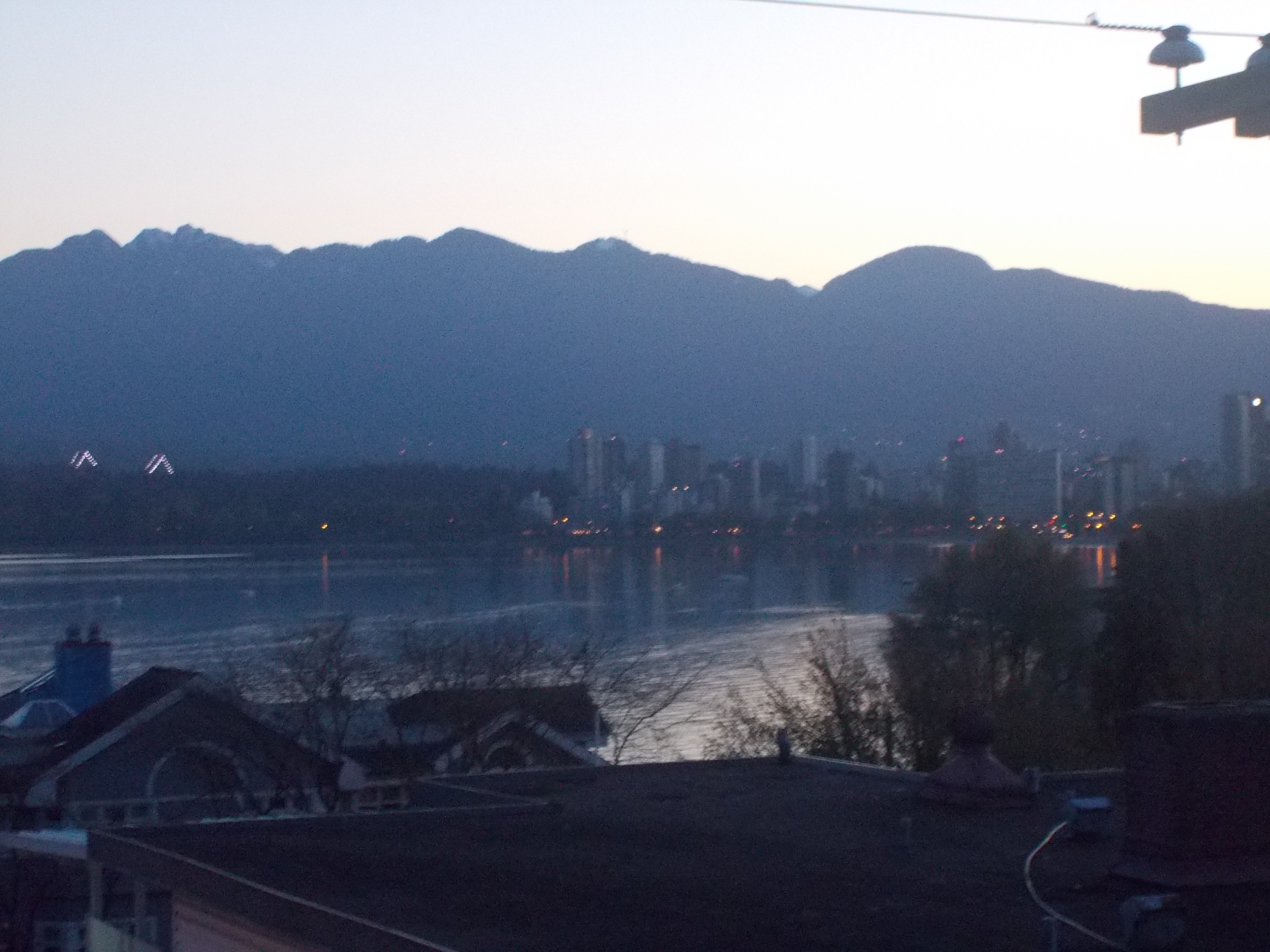
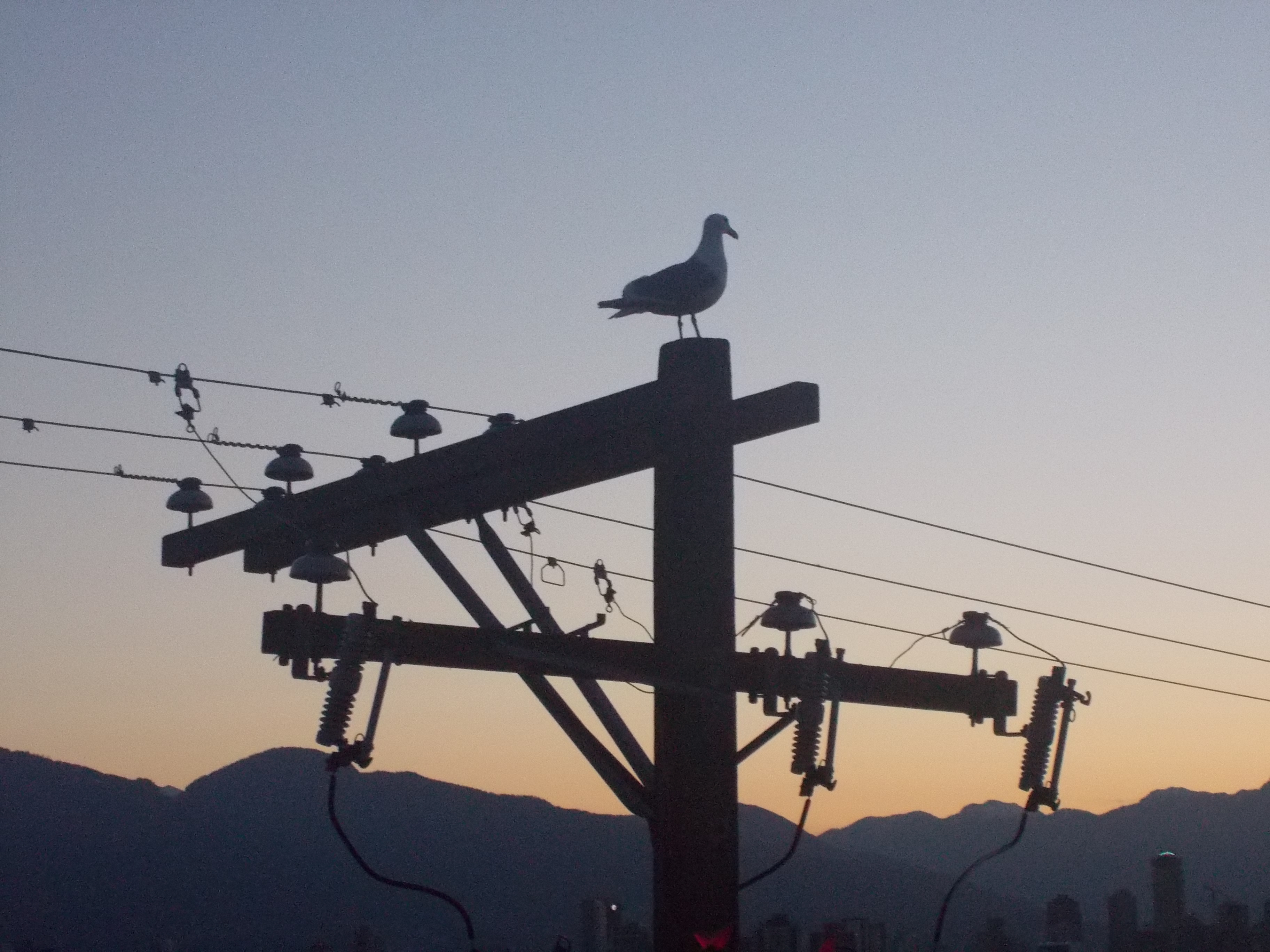
Turns out this one overlooks English Bay, the downtown skyline, and North Vancouver and the ski hills above it. The large balcony is equipped as an outdoor living room, so we plan to spend a good deal of time there, though I may need to negotiate with this one large sea gull who seems to own the post adjoining the balcony.
Charlie and Roz picked us up at the airport in a Zip Car, a Korean SUV well suited to hauling luggage. When the business opened up he bought a $100 card which, combined with an app on his phone, gives him the location of an available vehicle (Prius, Kia SUV, or van) and allows him to book it. Then he walks the two blocks to the supermarket parking lot where three spaces are designated for these vehicles. Stroking the card across the windshield unlocks the vehicle and its keys inside. There’s also a credit card for fuel if it needs it.
Charlie had booked the Kia for three hours at a total cost of $36.00. A Prius costs $7.00 per hour. This seems like a terrific way to haul parents around and leave the Porsche with its non-adjustable racing seats in its underground parking space.
The Whole Foods store we visited at 9:00 last night reminded me of Gordanier’s in Elgin, though with a much richer customer base. I grabbed a chunk of superb French bread and a piece of what looked like Johnny cake but turned out to have hot peppers and corn in it. Good, but not what I expected.
But the surprise was the people. They’re young, fit, and apparently well-to-do, to judge from the clothes and the shining, late-model cars which line every street.
Perhaps this is a pocket of endangered yuppies which has survived the cataclysmic extinctions of the tech and Wall Street melt-downs on this isolated northern shore.
Last night on the trip from the airport Roz mentioned that the University of British Columbia campus is actually larger than downtown Vancouver. I wonder if UBC drives the economy of this enclave.
No doubt there’ll be more hick-goes-to-Vancouver observations as we explore the upper middle-class jungle of Kitsilano over the course of the week.
Shipwrecked in Rideau Ferry
April 27, 2014
We stopped in Rideau Ferry Sunday at lunch time and ventured into the dining room The Shipwreck built on the site of the old Rideau Ferry Inn. Given the early season and our arrival on the stroke of noon as it opened, it came as no surprise that we were so far the only diners.
The timber-frame hall shows evidence of a good deal of thought and care in construction. Wide pine plank floors survive because of an expanse of harder flooring separating the dining room from the entrance. Queen Anne chairs provide comfort and contrast nicely with the post-and-beam ceiling and exposed stone hearth and box stove. Many windows offer a panoramic view of the Bridge and the waterway.
An elaborate patio enclosure and complex landscaping under the outstretched limbs of a massive shade tree complete the summer decor.
Our pleasant, articulate server directed us to the special, a single-dish rigatoni concoction with a bolongnese sauce, served in a large pasta bowl at $14.00. My wife explained to me that a bolongnese sauce starts with a blend of veal, pork and beef, to which is added a tomato-and-onion sauce, spiced quite mildly, then smoothed with a bit of milk.
I had never tasted a dish like this. As it cooled and I grew accustomed to the flavours, I liked it quite a lot.
If we had received this dish at our favourite Kingston restaurant, Casa, I’d think the chef was having a particularly good day.
With the closing of The Opinicon we’ve been without a good dining room within easy driving distance of Forfar. It looks as though The Shipwreck may well come to fill that void.
Worth noting as well was our stroll on the new municipal docks directly under the Bridge. They should hold eight to ten cruisers in addition to the docking space on the Shipwreck property.
Things my hairdresser tells me
April 25, 2014
Danielle comes to the house and snips my few locks amid a torrent of interesting conversation.
Last time she described driving a Can Am Commander UTV on tracks around a snow-covered go kart track at a cottage she and her husband visit regularly by snowmobile. She said it was fast and lively in deep snow, though hard to turn on dry pavement.
Today she told me that her grandfather-in-law taught her not to eat bananas during black fly season because they make you irresistible to the little devils.
DIY brake job(s) on a 2008 Scion xB UPDATED
April 19, 2014
When her beloved Honda CRV became too old to drive safely on the highway my mother needed another car with easy access. The best we could find at the Honda dealership was a 2008 Scion xB from Florida which offered height-adjustable front seats and wide doors.
The Toyota controls on the air conditioning and lights were a chore for Mom to learn in her mid-eighties, but the rest of the car was just fine. Two years later the brakes had begun to grind, so I put it up on the hoist and took it apart.
After the wheels were off I realized that nothing looked familiar in there, so I took to You Tube for instructions. Disk brakes have come a long way since my all-too-frequent encounters with them on my 1979 Rabbit, but now there are lots of guys who demonstrate simple procedures on their websites.
On the Scion xB the caliper is separate from the part that holds the brake pads. On the fronts the holder hinges up for convenient maintenance if you remove the lower bolt.
The big problem with the rear calipers was that no amount of clamping pressure would make them retract, though the pins holding the brake pads were fine. Online I discovered that the emergency brake linkage holds the pads in position, so the piston of the caliper must be rotated clockwise under compression to get it into position for new pads. Charlie emailed me that Princess Auto had a tool for that on sale this week, a dice-shaped, hollow metal box with pins sticking out of it. After much fussing with C-clamp, hammer and screw driver, I learned to fit a 3/8″ socket extension into the appropriate slot on the new gadget and twist away.
I looked online for brake parts. None of the usual Canadian suppliers carry Scion brake parts. I phoned a Toronto-based eBay brake parts vendor. She firmly told me that 2008 Scion xB’s have drum rear brakes. Oh. Another told me the same thing. So much for the $200 brake job.
Toyota brake parts are usually pretty reasonable at the dealer, so I called Kingston Toyota and asked. The parts guy wanted a VIN number. I recovered 16 of the 17 digits from a liability slip in the glove box and his computer provided the rest. “Is it black?” he asked, by way of confirmation.
Another reason I was willing to pay four times the lowest Internet price for pads and rotors for this car was that the pads when I took them out seemed to have been jammed into the holders, unable to move. I suspected either a fit issue or crummy workmanship at some point. There was no need for Toyota brakes to fail in two years of light driving.
John had to order the rear rotors from Toronto, but assured me they would be in the following morning, so we planned a trip to Kingston to pick them up. For the $601 (including tax) John threw in two tubes of grease and a session with a technician who explained to me how to lubricate the pads in their slots so that they would work smoothly. Then he carried the rotors out to the car for me, and away we went.
By email I asked Charlie if the pins really needed to be re-lubricated if they were flexible under their rubber seals. He assured me that they did, but after I greased one with the special lubricant the dealer gave me I had trouble getting the rubber thing to seal again, so I left off for fear my clumsy fingers would do more harm than good to the other pins. Charlie’s done a lot of brake jobs on his track cars, but they were Porsches, and Porsche brakes go together very easily. Scion brakes don’t.
All in all the reassembly went pretty well. I had to figure out how to wiggle the pads into the holders so that they could move. Otherwise they’d jam. The lubricant and a goodly amount of elbow grease freed them up, but I still don’t understand why these little clips fit onto the bottom of the front pads. There weren’t enough to go around, so I put two on the left side and left the right ready for clip installation if they squeal or thump.
Apart from the pad-fitting the front brakes went together well, but the rears required that I remove the calipers in order to mount them on the rotors. No problem: Charlie’s tool box has two sets of vice grips for pinching brake lines, and banjo bolts are no big deal if you don’t lose the washers when you remove them. “Gravity bleeding” was mentioned on one of the videos, and it seemed to work. I added a few ounces of brake fluid at the top and wiped up the mess on the floor.
The car stops well now and the ABS works properly. With the summer tires installed (tire pressure sensors) no indicator lights complain on the dash. The parking brake works properly. The car shows no evidence of brake drag, but when I took the temperature of the rotors after a test drive, the right rear was a bit hotter than the others. That caliper had felt a bit tight when I put it together. It may need replacement.
I’ll try a couple of test drives and see if it loosens up with wear. Now that I know how to reassemble a set of modern disk brakes, the prospect of another session on the hoist isn’t bad at all.
BTW: I see this article is already getting some hits, so I should mention a trick I learned from a mechanic some years ago. Toyota brake rotors don’t flop loose from the hubs when the wheel comes off. There is, however, a pair of tapped holes drilled into the rotors which take a regular bolt, metric thread, a bit bigger than 1/4″. The correct bolt takes a 12 mm wrench, if I recall correctly. To remove the rotor, all you need do is locate a suitable bolt and twist it in against the hub. Pop. Works every time. Paint the bolt and keep it in your toolbox.
UPDATE: 20 April, 2014
After considerable thought, a downloaded service manual and email chats with Charlie, I went looking for the source of the friction on that right rear caliper.
There didn’t seem to be a lot of run-out on the rotor, though the pads had worn themselves looser than when I had forced them into place before.
Before long I found myself removing the piston from the caliper by turning it counter-clockwise with my little caliper tool and a 3/8″ ratchet. It felt as though some lube could help. When the piston came free I discovered a few bits of broken thread on the stud inside the caliper. I cleaned things up as well as I could, tried air to blow any remaining moving parts out onto the bench (there weren’t any), then buttered things up with the synthetic grease the dealer gave me and put them back together. The rubber “foreskin” of the piston was hard to get back in, though with persistence and the back of a dental pick I think I prevailed. Several trips in and out (with ratchet and tool) and the piston seemed freer than before. On a dry fit I noticed that it’s fairly easy to extend the piston in the caliper by judicious manipulation of the emergency brake lever (where it joins the cable at the wheel), though it’s wise to avoid pinching the web between one’s thumb and first finger during this exploratory exercise.
Little then remained but to torque the lug nuts and try a gentle test drive. My laser thermometer read 120F on the right rear rotor vs 100 or so on the others after the drive. But the gas mileage is back up on the digital display and there’s no puddle of brake fluid under the car, so I hope that the caliper has somehow become third-time-lucky.
UPDATE: 24 April, 2014
After several local expeditions to check local ice conditions, I have concluded that the brakes on the Scion are now considerably better than those of the other vehicles in the fleet, so this missive ends.
UPDATE, 30 June, 2017
After what seemed a short interval since the last brake job, but much time sitting idle combined with intermittent winter driving, the Scion xB’s rear callipers were seized and noisy. Braking performance had deteriorated significantly, so it was time for a session on the hoist. This time I would replace all components and hope for a better fit on the components.
The Toyota guy told me he would have to order new rear callipers from California at $445 each. No rebuilds were available. Rockauto.com still had them listed, so I ordered callipers, upgraded rotors, and bargain pads from the online vendor. But they cancelled one rotor as they were out of stock of that model. Then the trouble began. Rockauto has such an efficient website that I had never tried to ask a question before on many orders. It hit its limit when I tried to cancel the second rotor in order to get both from a single warehouse and reduce shipping costs. The cancelations, additional charges, refunds and delays made me wonder if cross-border online auto parts purchases may have had their day. To their credit, the faceless workers at Rockauto ended up shipping me all of the correct parts, and they all made it through to the bemused clerk at the Kinek outlet in the back of the Wellesley Island Building Supply, but at Canadian Customs all I could do was hand the agent the stack of invoices and declare that I had paid $631 US for the pile of boxes in the back seat.
If you are cross border shopping online, always get the invoices in U.S. funds to avoid hassles at Customs. Agents assume prices are U.S. and automatically calculate the exchange rate to Canadian funds before adding the 13% H.S.T. On a previous trip I had a clerk become quite annoyed at having to re-calculate the sales tax when I pointed out the obvious disparity in the numbers because the major item had been invoiced in CAD.
The new components went onto the Scion quite easily in comparison to the battles I had had with the old rear callipers. The rears still proved difficult to adjust, though. Then I couldn’t get the pedal to firm up, despite repeated bleedings. After a test drive the right rear had brake fluid on it when I took it off for a final inspection: a leak! New washers on the banjo bolt, a wipe-off of the tire and wheel, and the Scion was finally ready for return to duty in the motor pool.
During their short market run, Canadian Scion xB’s had rear drum brakes. Thus equipped they gained a reputation as highly reliable and economical cars. Drums last almost forever.
Behind the headline
April 14, 2014
Government buying 1,600 pieces of custom wood furniture for 70 MPs new offices
By Don Butler, Ottawa Citizen April 13, 2014
I sent an email to Don Butler and asked if he could give me access to the PDFs containing the sketches of the furniture in the order. He immediately sent the following link:
https://buyandsell.gc.ca/procurement-data/tender-notice/PW-PPS-007-24427
Once the graphics blew up enough that I could see them, I realized that the pieces of furniture in the illustrations are well designed and should be lasting and durable, but they are more utilitarian than extravagant.
A government spokesperson comments in Butler’s article: “Furnishings should be made of good quality materials so they are durable and they should make the most of the heritage spaces for which they are designed.”
From what I could see in the plans, the bookshelves, tables, desks and coat racks are well proportioned according to classical standards. The predominant motif on the pieces is a simple, ¼” bead cut into the bottoms of legs and added to trim to prevent splintering and resist wear. The ogees on the table edges fulfill a similar function. There is very little ornamentation on the furniture.
From the headline of the article I expected when I looked at a sketch of a large table to see a plan for a 10’ by 4’ slab of 3” black walnut cut from a single log in the manner of a corporate boardroom table, priced at about $50,000. What I found was something more like a nice ping pong table – two sections of walnut-veneer plywood sitting on three boxes underneath to hold A.V. equipment. Mind you, with good veneers, solid walnut for the edge trim and a good finish, the result could look very good. Moreover these pieces would likely remain in service for a long time. There’s no sense in buying something of poor materials and shoddy design which will need replacement when the next occupant of the office comes along. That’s where the waste comes in.
My wife looked at the illustration of the larger bookshelf in the “catalogue” and commented: “That’s just like the cherry one in our upstairs hall.” But I used solid wood throughout. The government plan calls for veneer, and rightly so: good veneer over plywood will outlast solid wood in wide, relatively thin panels where changes of humidity are to be expected, such as in Ottawa in winter.
Butler comments: “When the MPs settle into their new offices in 2016, they will be surrounded by furniture of the highest quality.” Based upon the tender requirements which Mr. Butler forwarded to me, I would disagree. The tender simply calls for an office-full of decently-designed plywood furniture covered in walnut veneer, with solid walnut used for the edge trim. There’s a lot of it in the order, but that is hardly the fault of the designers.
There remain a lot of myths about black walnut after the inflated prices of the 1970’s. In fact in 2007 Eastern Ontario hard maple was worth more than black walnut on the wholesale market. Home decorating guru Martha Stewart had declared that she preferred lighter woods, and that was the end of the demand for black walnut lumber. Even today black cherry, to my mind a much inferior furniture wood, is worth more than black walnut.
“The contract is conditionally limited to companies that can supply at least 80 per cent of the goods and services from Canadian sources. Other bids will only be considered if fewer than three bidders meet the Canadian content requirement.” It’s hard to see a bad side to this.
It’s interesting that prices for black walnut veneer logs recently shot up in Ontario. A veneer buyer told me a couple of months ago that 10,000 board feet of logs sold for $100,000 at an auction. This is a solid price in a chronically depressed market. It may not be enough to turn the hardwood market around in Ontario, but for this black walnut producer, it’s a whole lot better than nothing.
I am no admirer of the Harper Government and I am not at all sure Canada needs 70 more MP’s, but I can’t see anything wrong with this furniture order.
 the Walnut Diary