How do you pump a solid?
November 14, 2013
In 1980 I spent an entertaining evening at a bed and breakfast in Stratford listening to my host describe pumps. He was an engineer for a company which manufactures pipeline equipment and the things he told me stuck in my mind.
The most interesting one had to be their use of regular jet engines to drive natural gas pipelines: as an experiment they put one into a shed beside the pipeline, burned natural gas from the stream in it, vented the exhaust through grates to the air above, and sat back to see how long the thing would last. The trick with a jet is that the flow of air through the turbine actually cools it, so a jet runs very well in a shed without a fancy cooling system. When the prototype didn’t wear out they put more and more turbine engines in place. They found over time that the service life for a gas turbine in a pumping station is much, much longer than for the same engine in a 737. My host told me that they hadn’t had one fail yet.
So this made sense: it’s easy to pump a gas/fluid which readily provides fuel to the engines which drive it. The gas logically would move easily through the pipe without high pressures or frequent pumping stations. So that’s the design for the west-to-east natural gas pipeline.
A pipeline is a magical metaphor for politicians to use: things go in one end and come out the other and nobody needs to understand how or why. But the image I see is a jet engine choking on tar and the 1/4″ pipe wall gradually sanded away to nothing by the flowing bitumen.
Bitumen starts out as a substance hard enough that it takes huge shovels to chisel it out of the ground. It’s abrasive. It certainly is going to be harder to pump than natural gas.
So, you say, they dilute the bitumen with natural gas in liquified form? So they mix the bitumen and the LNG together and pump like crazy and when it gets to the other end they refine the whole mess into petroleum products.
Trouble is, everything I could read on Wikipedia about liquifying natural gas products emphasizes how critical temperature and pressure are. What happens if something upsets this delicate suspension? Do we get the pipeline plugged with tar from Windsor to Cornwall?
I don’t have a dog in this particular fight, but I’d be very interested to know how Enbridge proposes to pull off this feat with a 1/4″ thick pipe stretched across the country.
I’d really like to know some answers here.
Trudeau the heretic
November 11, 2013
SUN news is all abuzz about Justin Trudeau’s evening speech to a group of highbrow women in Toronto last week where he uttered a heretical statement about admiring China.
I first ran into the “admire China” meme in 1979 in grad school. The dean of the Queen’s Faculty of Education had spent a month in China and showed us his photographs in one class. As an educator he was deeply impressed by the rows and rows of young men and women out for morning calisthenics. He told us that the average height of a male recruit into the army was then 6′, evidence of the vast improvement in nutrition China had achieved in a single generation.
We were somewhat taken aback by Dean Ready’s attitude, but eventually we came to realize that the Chinese have worked very, very hard, first to feed their people, and then to grow their economy.
This is what a visitor sees on a trip to China.
Justin’s comment suited his sophisticated audience (likely former grad students all) but it played a bit too well to the Sun News camera. David Akin extracted a measure of revenge for JT’s drubbing of their Great Conservative Hope last spring in the celebrity boxing match — the media event which came as close to humiliating Ezra Levant as anything ever has, and launched Trudeau’s run to 24 Sussex.
This week some cartoonist will likely cast Trudeau as the Road Runner with Akin or Levant as Wiley E. Coyote in a scenario where it looks as if the anvil is at last about to fall on JT’s head…
Splitting a tractor Part II: 7 Rules for the Compleat Idiot
November 3, 2013
Today has provided a series of lessons:
1. When you’ve bolted everything back together and you’re all ready to do the triumphant drive around the yard in your recently-repaired tractor, the battery will be dead.
2. If the hydraulic pump makes a horrible noise when the engine starts up, don’t panic. It’s air in the system. If it continues to make an unpleasant noise while running, check the auxiliary levers in case one is stuck.
3. Splined shafts are connected to universal joints with spring pins driven through carefully-alligned holes in both. They require a wire run through the hollow pins with the ends brought back and twisted together outside the shaft. If you do not have any wire, stop the project at this point until you have some.
4. In the drive tunnel of a Bolens compact tractor there isn’t enough space for a pair of pliers to twist two strands of wire together if the front drive shaft is in the way. It must be removed again to complete the job. See rule #3.
5. Count the items left over in the parts tray. If there is a remaining spring pin, it came from somewhere. Find the universal joint with the missing pin before driving the tractor a mile into the woods on a test run.
6. A loud clunking noise doesn’t necessarily mean disaster. If the front drive shaft universal has a missing pin, it will eventually come loose when the tractor is running in 4WD. The same rig seemed willing enough to idle along in 2WD on the limp back to the garage, though.
7. Rod’s rule of 30: if you think you have made all of the mistakes possible in the installation of spring pins, you’ll discover one more. In this case I carefully pinned the errant universal joint just past the end of the drive shaft, allowing the shaft to fall out as soon as I had finished wiring the pin into place. Hey, it was dark in there. From now on I’ll look at the inside of the universal joint for the end of the drive shaft before pinning it.
8. Replacing a spline boss on a Bolens G174 is a lot like setting your hair on fire and putting it out with a hammer. If feels so good when you’ve finished.
UPDATE: 4 November, 2013
I used the Bolens all afternoon to move firewood into the shop. It’s good to have it back in service.
UPDATE: 26 October, 2014
The Bolens has seldom sat for long over the last year as there is usually something around the farm which needs to be moved.
With the dump trailer it has seen duty hauling firewood and prunings from the walnut and butternut plots.
It mowed under overhanging walnut trees with the 48″ bush hog this summer.
It jockeyed trailers.
The heaviest work it faced came on two construction projects of friends: it dragged a 5′ box blade to strip away clay and replace it with gravel under a large deck in Newboro, getting buried in wet clay in the process.
With the dump box it hauled about 35 yards of gravel around the footings of a new house near Chaffey’s Locks until the “Big O” pipe was properly bedded. Most recently I have put a tank of diesel through it while raking the leaves off the two acres surrounding the house with a Brinley 48″ lawn sweeper.
It was certainly worthwhile making the repair to the spline boss on this excellent and useful little tractor.
UPDATE: 14 July, 2014
The Bolens is still going strong, seeing action just about daily around the property. It is particularly useful in conjunction with the dump trailer.
Splitting a tractor
November 2, 2013
My trusty old Bolens G174 stripped a few cogs on its output shaft boss the other day, and sat there sounding like an annoyed pencil sharpener instead of pulling my trailer. A session in the garage revealed that it had stripped a spline boss on the shaft which transfers power from the engine and clutch to the transaxle at the rear of the tractor.
I found the part at Sony’s Bolens on the Internet. Then the problem arose: how do I split the tractor in half to make the repair? The shop has lots of tools and lifting equipment but I was loathe to tie it up for an extended period with a tractor hanging in sections from the hoist.
I asked my neighbour Peter Myers to supervise the first couple of hours of the project. He looked at the situation (the shaft and spline boss are visible from beneath the tractor, but blocked by the front drive shaft) and suggested we might not have to do the 10-hour take-apart prescribed in my service manual for clutch replacement.
He started with the front drive shaft as it was in the way. The manual directed him to the lower end after he removed the pin holding the rear (upper) end and found it would not slide forward enough to come off. The lower end is inside a heavy boot with a strong “O” ring and a bolt which looks like a drain plug. Peter removed these and found another universal joint which was easier to disassemble. As nearly as I can tell, one half of the front universal joint doesn’t take a pin, allowing it to slide on the splined drive shaft just enough to allow the rear universal to come clear of the transaxle.
We decided to split the tractor at the rear end of the drive shaft tunnel, where it joins the transaxle. Peter suggested a wooden block to support the rear half, so I cut two blocks off a 15″ walnut log, one 13″ and one 12″ in length. The 12″ piece worked with two 1 7/8″ pieces of plank on top and a 3/8″ shim to fill the space. A logging chain encircled the bell housing behind the engine and hooked to chain blocks attached to the bar across the top of the car hoist.
Before he left Peter warned me to wedge the engine and front axle together to prevent the engine tipping out of alignment when I split the tractor. (It still tipped a bit, but I corrected it easily by tapping judiciously on the wedges.)
First I had to disconnect the hydraulic lines from the pump and wiggle things around to allow the tractor to separate about 1 5/8″ to allow the spline boss switch. To free the brake rods, the rear pins came out. I also removed a pin on the differential lock. Then I removed four bolts from the front of the foot plates to allow the split.
All of the eight transmission bolts proved to be loose. I guess they had had lots of time to move around since 1980. The two bolts around the foot plates were hard to remove, but a 19 mm stubby wrench did the job.
It turned out that the output shaft will slide forward into the clutch a bit to make the job of removing the spline boss easier.
The old boss which dropped off the shaft (and onto my head) was worn quite smooth on the rear set of splines, so buying the replacement was a good idea. The rear shaft was far from perfect, but Peter suggested that with the new spline boss and pins it would likely run for a long time. A little oil and a few grunts and the shafts lined up for me to tap the spring pins into place.
Then I bolted the split halves of the tractor back together, ending phase 1 of the project.


John Robson on Stephen Harper and the Senate Scandal
October 31, 2013
He wasn’t lying to fool his supporters but to implicate them in the deception, to force them to put loyalty ahead of truth.
Duffy’s encore in the Senate today
October 28, 2013
You know the one nice thing about this whole imbroglio? Mike Duffy was able to walk into the Senate today and unload upon his opponents without the need to watch out for snipers or a sudden vacation in Syria. How would he have fared in the other countries in the Americas?
I may occasionally paint the Harper crew as a biker gang or fascist wannabes, but in this case of extreme provocation they have not yet resorted to assassination or rendition. There is still hope.
After a week of scandal
October 25, 2013
The inner workings of the Conservative regime are gradually coming into view as the pond of public trust is drained. What the media are showing us is the opposite of what the propaganda has led us to believe: instead of an honest, accountable government in the interests of taxpayers, we see a gaggle of scavengers picking at the bones of the Canadian State, and turning on each other without scruple.
In this context it is little wonder that the large military acquisitions contracts have fallen apart: these guys don’t have a vision beyond their own immediate wants. We’re seeing what Michael Ignatieff termed a “biker gang government” in operation as the Senate scandal unfolds.
If the comments posted in online newspaper articles on the subject are any indicator, Canadians still care about the greater good, human rights, and due process of justice. We are disappointed that Stephen Harper has emerged as a charmless, self-centred despot, and are rapidly concluding that the truth is not in him.
Amid this hubbub all Justin Trudeau has to do to appear statesmanlike is stand still in a corridor and directly answer a few questions from reporters. And that’s what he does.
Upon reading the transcript of Mike Duffy’s speech
October 23, 2013
.
.
Dalton McGuinty had the grace to resign when his credibility tanked. Will Stephen Harper?
.
.
The Bolens hydraulic remote project
October 18, 2013
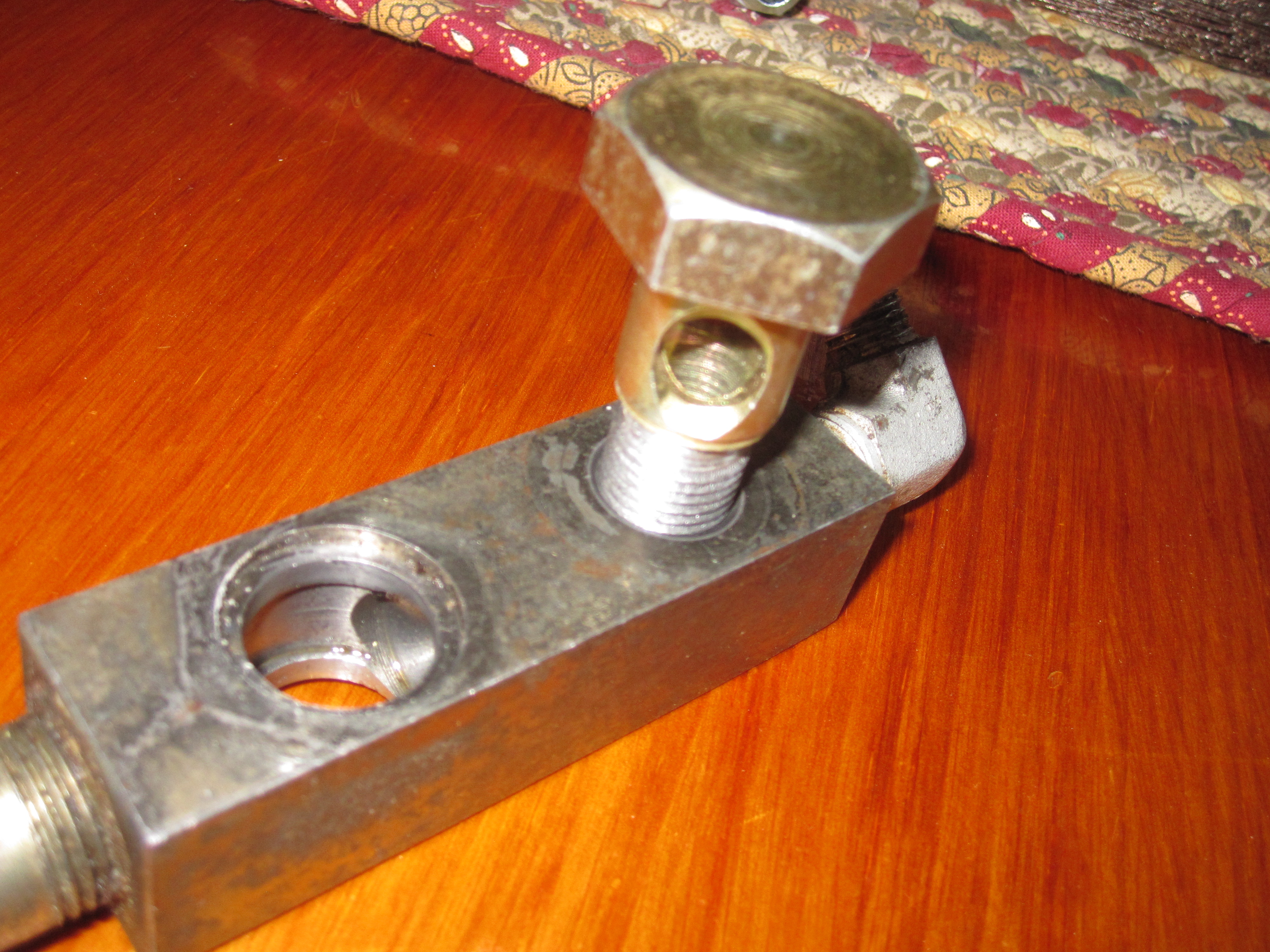
I now have the Bolens G174 tractor set up to tip the new dump trailer, and therein lies a tale. As I may have mentioned I lost one critical bolt from the remote hydraulic rig which I had Peter Myers remove from the tractor three years ago. Actually I lost the whole thing, but I found most of it a month ago and tried to re-install it.
Over a couple of weeks I stared across a number of parts counters at bemused clerks leafing through catalogues. Most didn’t even know what a banjo bolt is. (It’s a hollow bolt with cutouts to allow the passage of high-pressure oil, as at the end of a solid oil line.)
One guy on Tractorbynet found a supplier of the part he thought I needed, a Massey Ferguson dealer in New Jersey. The parts guy was hard to get on the phone, but when we talked he agreed to order the part number the Tractorbynet contributor had suggested. Five days later it turned up at Wellesley Island, N.Y. for pickup.
The bolt was about the right size, but the threaded end was way off. For example, it had 19 threads per inch. A guy at Baxter’s in Kingston informed me only BCS bolts have 19 threads per inch. That’s British Cycle Standard. Not metric. He pulled a BCS nut off a shelf and it fitted. But I needed the bolt to thread into a 3/8 pipe thread. That’s an 18 thread-per-inch about 5/8″ in diameter overall.
I took the whole thing over to Peter and asked him if he could cut the bolt down and thread it to fit. He said he didn’t have a die of that size, but he could cut the threads on his lathe.
An hour later he turned up looking pleased with himself. He showed me the modified bolt, and after lunch he wrenched it into place without drama. The Bolens produces 1250 psi at the remote, and that’s enough to raise the dump trailer when empty. Who knows how much load it will lift? The Kubota produces about double that pressure, and it had to work hard to dump a yard of gravel. Of course firewood’s a lot lighter than gravel.
Anyway, this toy project seems to be back on track. It would have had a very different outcome without the help of Peter Myers and his metal lathe.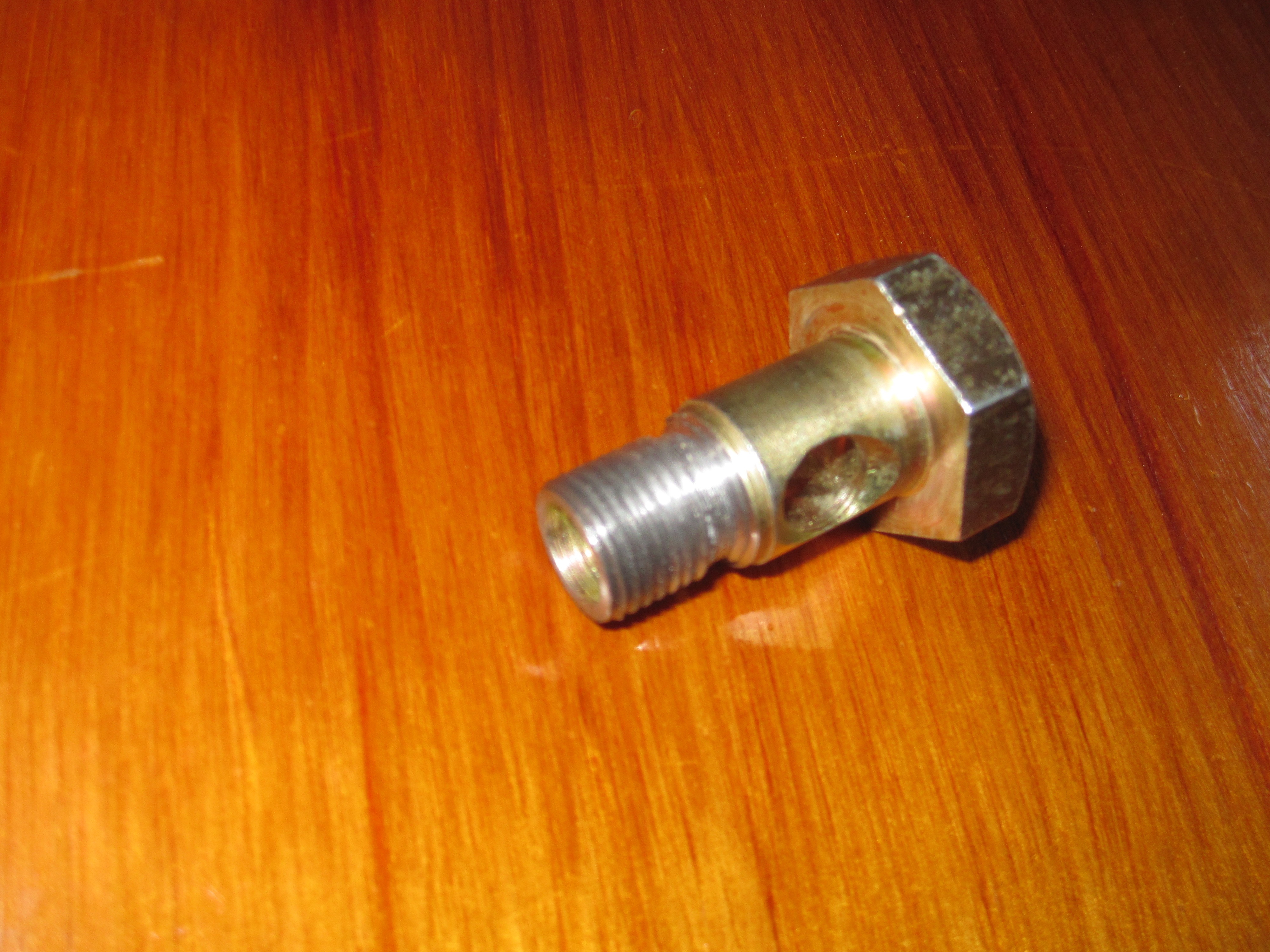
UPDATE: OOPS!
Maybe I overworked the Bolens’s elderly drive line, but after a day of hauling firewood out to the splitter, something broke and I heard a loud scratching sound as it came to a stop. Much probing with a lighted camera eventually led to a stripped spline boss on the shaft that links the clutch to the transmission. It’s a shaft about the diameter of my finger, yet it and this spline boss have had to take all of the torque this machine has ever produced.
The good news is that the part is available, if expensive. The bad news is that I have to learn how to split the tractor in half in order to effect the repair.
Oh well, I was looking for a project for the auto shop this winter. This should do the trick nicely.
Meanwhile, my 1947 Massey Ferguson 30 is making short work of firewood hauls that strained the G174. All is far from lost in the hydraulic project: its purpose was to free up the Kubota B7510 for use on the block splitter throughout firewood season. The ‘Bota’s pump is much more powerful than the TAFE 35DI’s and it runs the spitter quickly and well.
Stephen Harper castigated in a New York Times editorial
September 22, 2013
This is too good not to pass along (with proper references to its source).
Rod
I’d be remiss if I didn’t credit Canada.com journalist Michael Woods with the idea to track down the NYT article. http://o.canada.com/2013/09/22/new-york-times-criticizes-harper-governments-alleged-muzzling-of-scientists/
———————————————————————-
The New York Times Sunday Review
Editorial | Notebook
Silencing Scientists
By: Verlyn Klinkenborg
Published: September 21, 2013
http://www.nytimes.com/2013/09/22/opinion/sunday/silencing-scientists.html?_r=0
Over the last few years, the government of Canada — led by Stephen Harper — has made it harder and harder for publicly financed scientists to communicate with the public and with other scientists.
It began badly enough in 2008 when scientists working for Environment Canada, the federal agency, were told to refer all queries to departmental communications officers. Now the government is doing all it can to monitor and restrict the flow of scientific information, especially concerning research into climate change, fisheries and anything to do with the Alberta tar sands — source of the diluted bitumen that would flow through the controversial Keystone XL pipeline. Journalists find themselves unable to reach government scientists; the scientists themselves have organized public protests.
There was trouble of this kind here in the George W. Bush years, when scientists were asked to toe the party line on climate policy and endangered species. But nothing came close to what is being done in Canada.
Science is the gathering of hypotheses and the endless testing of them. It involves checking and double-checking, self-criticism and a willingness to overturn even fundamental assumptions if they prove to be wrong. But none of this can happen without open communication among scientists. This is more than an attack on academic freedom. It is an attempt to guarantee public ignorance.
It is also designed to make sure that nothing gets in the way of the northern resource rush — the feverish effort to mine the earth and the ocean with little regard for environmental consequences. The Harper policy seems designed to make sure that the tar sands project proceeds quietly, with no surprises, no bad news, no alarms from government scientists. To all the other kinds of pollution the tar sands will yield, we must now add another: the degradation of vital streams of research and information.
 the Walnut Diary