Quora discussion of red vs Grey squirrels
January 6, 2022
Is it true that a grey squirrel is more territorial and will run red squirrels out of their area even to the point of chewing their nuts off?Rod Croskery, Rod has owned a lifetime of English springer spaniels.Answered Oct 22, 2020
Quite the opposite, from my observation over a few decades: in Eastern Ontario the red squirrels are so fast and aggressive that the greys avoid them, even allowing their smaller rivals possession of choice walnut trees, rather than confronting them.
Because the reds do not plant walnuts (broadcast hoarding) the way the greys do, and because the reds insist upon turning our attic into a larder for walnuts, I kill them off with my shotgun until the greys can resume their scatter-hoarding around our farm.75 viewsView 2 upvotesAnswer requested by Randy Steele22
Add CommentRod Croskery · June 12, 2021
Over the last year during a bumper nut crop I learned to raid the red squirrels’ caches of walnuts — substantial piles of green nuts heaped on the forest floor — overflowing from their usual log or den caches. My neighbour and I simply shovelled the nuts into the back of my Kioti Mechron and hauled them out to distribute to other land owners for planting to replace ash trees lost to the borers. Two hauls of four five-gallon pails full went to other woodlots, but I also enlisted the grays in other parts of the woodlot to plant some of the surplus nuts. I just left the pails of nuts on the ground and returned for the empty pails the next day.
Another update is in order. 6 January, 2022
Over a two-week period last fall I wanted the squirrels to plant walnuts over a ten-acre section of our woodlot after an improvement cut to remove diseased American beech trees which made up 40% of the tree population. My first effort involved dumping a five gallon pail of nuts next to a game camera to report the activity. A single red squirrel carried every nut fifty feet to a large maple, and up the same track to a hole halfway up the trunk. This went on from an hour before daylight until every nut was gone. The red tried to kill a Grey squirrel who ventured in for a nut.
Plan B: Kill the red squirrel. I went into Elmer Fudd mode and made a fool of myself for an hour before realizing that the vanished squirrel had been lying on a branch, silently watching me for the whole time I scanned the large tree.
Plan C: Spread nuts where that squirrel isn’t. I put the game camera to work again along our driveway. The first day a cache of nuts was ignored by three Greys, a gray and two blacks, which lived in an adjacent tree. On the second day the camera recorded many feints and quick runs by the nuts with much nervous tail twitching. Eventually the gray mother squirrel picked one up, examined it, but then dropped it and ran away. One of the black daughters was a little braver, and dashed in, grabbed a nut and retreated to a limb of the tree above. Eventually all three began to steal nuts from “the trap” and retreat to the tree with the nuts with hulls still intact. This was no better than the red squirrel’s headlong effort. I reset the camera to watch the trunk of the tree. The following day I have film of one of the black squirrels descending the tree with a hulled nut in her mouth. Then she tentatively made her way down a trail away from the tree. She went out of the camera view after a couple of hundred feet, but I observed her planting a nut (not necessarily the same one) near a fence row at the far end of our lawn 500 feet from the tree.I set up a feeding station for these three Greys where I could watch them from the breakfast table in the house. The gray lady is my favourite. She overthinks everything. A nut planted is not necessarily going to stay there. One day I watched her replant a nut two more times in different locations until she was apparently satisfied with its location.My take-away from the distribution of at least a dozen pails of nuts over a two week period: Grey squirrels will plant nuts. They work slowly, but with great deliberation and dedication. Red squirrels and chipmunks destroy walnuts by burying them too deeply in dens or packing them together in places where they can’t grow.
Plan D: I started distributing nuts in piles of about a dozen at a time, in many locations around the road in the woodlot. I drove my UTV on the route several times a day as I checked the many caches, looking for partial depletion as an indicator that the Greys were at work. If the nuts were all gone, I eliminated that site as a candidate for more nuts, assuming that a red or a chipmunk had found it. This seemed to work, but the Greys get tired easily. In some cases a couple of dozen nuts moved out right away, but then the cache was ignored for weeks.
My sources for the abundant walnuts were unharvested sections of road through the woodlot where no squirrels visited, for some reason. I used a nut wizard to roll the nuts into five gallon pails with amazing efficiency. Alternatively I raided a red squirrel nut cache where I filled five pails with a shovel in just a couple of minutes. This left a hole about the size of a bathtub in a gap between two rotting elm logs. There were still lots of nuts in the cache.
If you Google Rod Croskery on YouTube, the video For The Love of Black Walnuts will likely pop up. With over 800 hits so far, it is doing a lot better than my film on motorizing the rotation of the chute on my snow blower which has 32.
Update, 8:01 a.m., 6 Jan, ’22
Over my granola this morning I watched the Grey Lady deal with a cache of walnuts I had left in the feeding station four days ago. They have sat untouched through a balmy day yesterday, but today in 25 degrees F she decided to visit. While the red squirrel mentioned in this lengthy tome repeated the same activity at least fifty times in plundering a pailful of nuts on camera, this Grey is a true lateral thinker. I watched while she buried a nut in the snow on the other side of the pump, then returned rapidly for another, which she buried in the snow behind a parked truck. Next candidate went up to the very top of a small sugar maple, where she found a crotch where she jammed it securely. Next nut went out of sight into a tall cedar tree, but then I saw her coming down from the top of another young sugar maple, without a nut. And so it goes. From what I know of this lady, these initial placements will be revised over the coming days. Some may be fed to her nest mates, the two black-mutation offspring who nest with her. The Grey lady’s urgency makes sense to me now. I just looked out to see a red squirrel bouncing around all over the place. The walnuts have already been put away safely. In this case, the early Grey got the nuts.
Review of N-95 mask under lockdown conditions
January 2, 2022
The latest protocol for infection control at Rosebridge Manor required enhanced mask protection and eye shields for essential visitors, most likely to protect patients and staff from outside contamination. After my rapid test, the guy at the door gave me a pair of vinyl goggles without vents. I discovered there are two layers of film which must be removed if one wishes to see, even badly. How do nurses and PSWs read while wearing these things? He did warn me not to run into anything.
The other component was a version of the treasured N-95 mask. It is unimpressive at first view: just a little strip of material and a couple of elastic bands. On closer examination one finds it surprisingly solid and heavy, with a substantial metal nose frame, but also a membrane between the eyes and the metal clasp, as well as contouring for a tight fit over the chin aided by the two elastic bands, one over the back of the head and the other around the neck. The fit and general quality of the mask are impressive, notwithstanding the two rows of ordinary staples pegging the elastic bands in place.
Breathing through the N-95 is an entirely different matter than wearing a blue surgical mask. I couldn’t stand the air deprivation for more than an hour. It would take much better lungs than mine to deliver a lecture — or even take part in a conversation — while wearing one of these barriers.
Trying to read a book or computer screen while wearing goggles, bifocals and an N-95 just boggles the mind.
Is the N-95 an effective barrier against airborne virus threats? It is certainly better at sealing off extraneous air supplies than a blue surgical mask, which remains a reasonable protection for others if one is prone to sudden sneezes. For a short time in an environment where the risk of viral infection is high and one must enter, the N-95 seems a good idea, though avoiding the situation entirely remains by far the better plan.
I promised the guy on the door that I would take good care of the mask and goggles, and bring them along for my next visit so as not to waste any PPE kit.
Ranked ballots revisited by The Star
December 20, 2021
In today’s Toronto Star there’s a debate among contributors about whether Ontario voters would benefit from the next provincial vote run according to the principles of ranked ballots. I tried to post the following comment but they were no longer accepting input.
So here it is:
Did ranked ballots make the Ontario Progressive Conservative Party any better? Had Tania Granic Allen not switched her social conservative votes to support Doug Ford, Christine Elliot would be the Premier today. Nobody can reasonably state that Ford’s immediate dumping of Granic Allen was a legitimate move, even though the rules of ranked ballots allowed it. This deprived Ontario of the services of a reasonable, intelligent leader going into the pandemic. Instead we got Homer Simpson.
For the Love of Black Walnuts
December 10, 2021
In November our woodlot underwent an audit to requalify for the FSC rating. Glen Prevost at that time suggested that I contact the Ontario Woodlot Association. They asked me to do a film about the managed woodlot over the years. My son Charlie ran the cameras and I talked. The film dropped on December 3rd, though it is still hard to find in You-Tube’s archives.
Here is a link:
The film finally dropped on YouTube on December 12, and since then has accrued 500 views.
What have I learned from this squirrel over two weeks?
October 20, 2021

Nut drop was more important this year than others. I needed to seed a few clearings in the woodlot created by the logger last winter who removed the dead and diseased American beech trees from the property. The prescription called for reseeding the clearings with pine, red oak and such, but I wanted to try black walnuts. In 1964 the previous owner of our property allowed a selective cut of hard maple logs for use as veneer. This left a legacy of towering, over-aged maples and clearings.
Three black walnut trees grew at a junction of the fence lines near the sugar bush. The squirrels got to work to the point that middle-aged black walnuts now dominate the southern half of the woodlot. I had assumed that the upper half of the woods created a mini-climate which allowed them to withstand the winter cold and the late spring frosts which kill their flowers. But the climate is changing, and for years I have gathered nuts from an exceptionally cold-hardy walnut right at the northwest corner of the woodlot.
Last year in anticipation of the cut, I had planted about ten gallons of walnuts. No sprouts appeared this year, though I have found the odd walnut seedling amid the logging debris which a squirrel must have planted, along with a few little oaks.
In 2005 when I started the walnut orchard, the Grey squirrels (black squirrels named after a biologist) took an inordinate interest in my work, perversely digging them up only to replant them, usually six to ten feet from their original positions on my 20 foot grid. Because I had planted two per hill, I was forced to compare the squirrels’ planting efficiency to mine. Suffice it to say that it is hard to mow two, 4 acre fields with the best seedlings stuck in the middle of the rows. At the time this was a real annoyance, but over the years when it has become harder to stomp around over fallen limbs, I decided to see if I could put the Greys to work on my project.
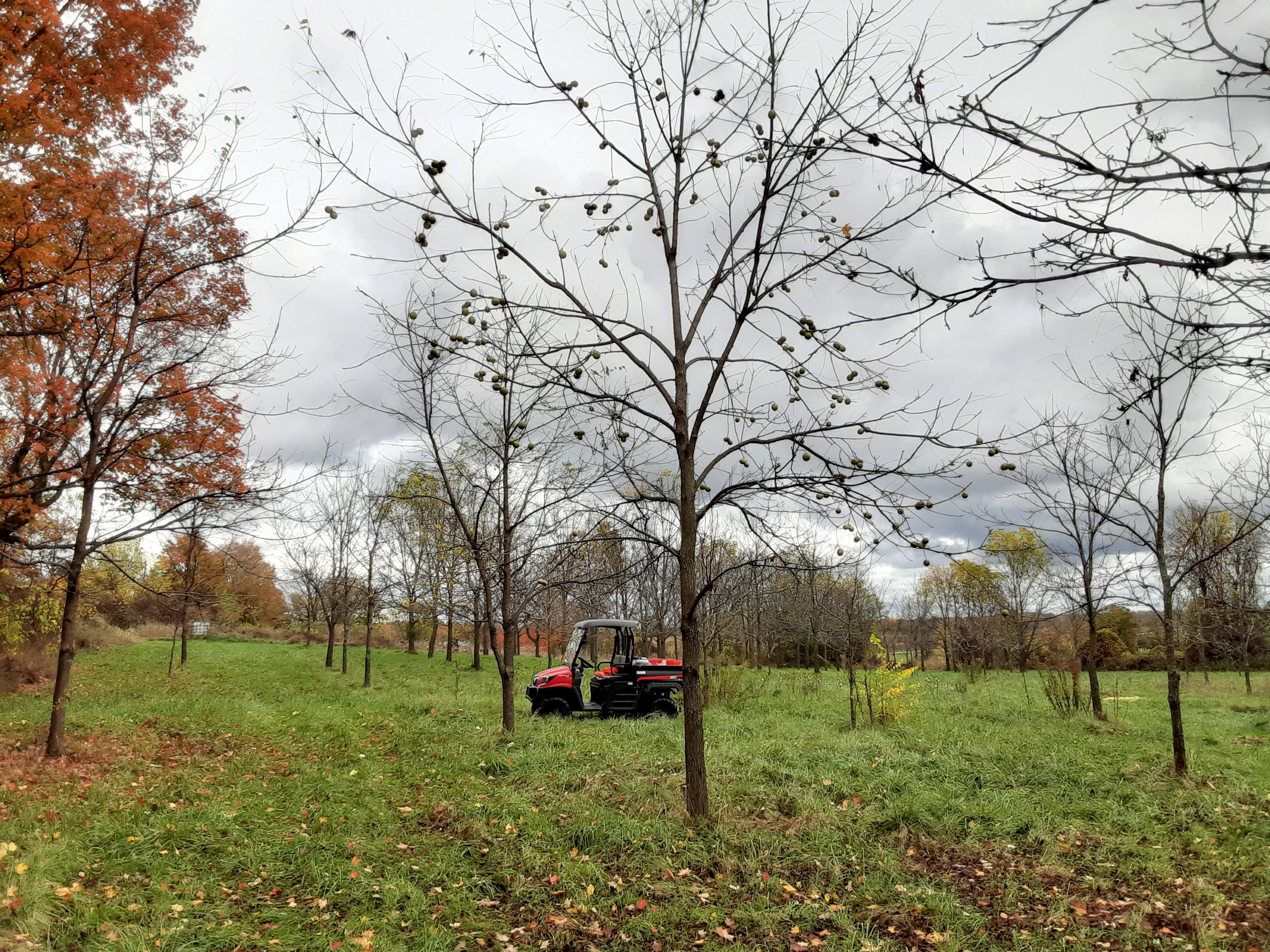
One of the truisms of forest management is that if you want to plant nut trees, take two pails of nuts to the woods: one for the squirrels to eat, and the other one for them to plant. Whoever dreamed that up had never watched a chipmunk stow the contents of a five gallon pail of nuts in his burrow between dusk and dawn. Red squirrels also work notoriously long hours. With my game camera on my first cache, I recorded a single red squirrel working its way through a pail of nuts, pausing only to attempt to kill a Grey who dropped in to pilfer one. The red started an hour before dawn and worked quite late in the evening, with every scene showing it tracing the same route up the side of a large maple tree with a walnut. The red also outwitted me when I attempted an assassination with my shotgun, so I gave up and moved elsewhere for my seeding efforts.
Later efforts with camera and pails of nuts showed that a Grey squirrel takes a long time with much tail-shaking before she touches the first nut. Before long, though, the whole family gets involved, hulling the nuts and burying them in shallow holes in a widening radius from the initial pile. One camera setting suggested that the three Greys might be running up a maple tree behind the camera, so I reversed it and shot down a long lane. The following day every Grey which descended the tree had a hulled nut in her mouth, and often travelled as far as 400′ down the driveway before the film clip ended. They certainly appeared to be planting walnuts in the area.
The gray squirrel was easy to identify as the matriarch of the nest. She also has a habit of planting things around the flower bed outside my breakfast window, so she was an ideal test subject. One day she worked extremely hard to plant a nut at the edge of the driveway where the fuel truck stops. It took her a long time and she put great effort into getting the nut into the hard earth, thencombing the grass to make the planting disappear. The next time I looked, the nut was gone and she was planting one on softer ground next to a cherry tree fifty feet away. I have begun to wonder how many times a walnut gets planted before the Grey decides to leave it.
In the woodlot I decided to locate my baiting sites where I had observed Grey squirrels fleeing at the approach of my UTV. This seems to work, according to the camera.
A typical nut cache

From what I have seen, here are some guidelines for getting squirrels to do your work for you:
-Avoid chipmunks and red squirrels, unless you are looking for an easy supply of nuts. If so, shovel pails-full of them from red squirrel caches which they seem to forget. Yesterday with a little aluminum shovel I filled three, five-gallon pails from a gap between rotting logs in a pile beside the trail (see photo above). Last year I shovelled twenty gallon loads from two separate open-air caches around the walnut trees.
If your bait pile disappears overnight, it’s not a good spot for Greys.
If the bait sits for a day or two, and then starts disappearing sporadically until about half of it is gone, that’s a Grey. They seem to loose interest in a cache after a while. Perhaps they are motivated by a sense of scarcity, or perhaps it is the novelty of a new discovery which intrigues them.
Red squirrels ignore overly large walnuts. A Grey tried valiantly on camera to carry one of these, but gave up after a couple of half-dozen I had left him. I decided that the likelihood of successful planting greatly increases if the nuts are more like golf balls than tennis.
Greys learn very quickly. At first I put caches near tree trunks for safety, but gradually I started advertising the baits on stumps. They seem happy with this arrangement. It may be that the hawk has finally left.
Walnuts don’t always sprout the first May after planting. They can take two or three years to grow, according to Ed Patchell of the Kemptville Forest Centre.
I wish I could take credit for planting this seedling.

Fighting back against those damned moths
July 8, 2021
In The Review Mirror this week I ran onto a mention of the Wesport Lions’ giveaway of rubber bands impregnated with gypsy moth pheromones at their recycling depot on Salem Road, beginning today. They opened up at the shop at 10:00 a.m. Parking was an issue, and the line-up had the air but none of the solemnity of a vaccination program. A guy named Maynard (not a cousin of mine, it turns out) explained that a Waterloo professor discovered a way to make an ordinary rubber band utterly irresistible to a male gypsy moth. A hand-out showed a variety of extremely low-tech traps, all of which were well filled with dead brown moths.
Please consider the device in the photo below my contribution to the growing literature on the subject. The original paint in the tray was a shade of green for my grand-daughter’s bed entitled “Lazy Caterpillar.” She suggests that this decorator touch may have enhanced the trap’s effectiveness.
To build the trap I tried an old paint tray with a twig and an elastic band tangled on it over a pool of diluted doggie shampoo. Within the hour it had drowned a dozen moths. The tray sits on a shelf in an open shed next to my UTV. It is out of the weather, but readily available to the moths. I believe that the infestation of the adjacent tree stemmed from a series of egg sacs along the ridgepole of this outbuilding.

As of press time there were sixteen casualties in the pan, with no evidence of other swains in the offing. On a hunch I turned off one outdoor security light for tonight and left the overhead light in the shed on to attract moths. The local cohort may be a little late to mature, so I shall remain vigilant.
UPDATE: 9 July, 2021. 7:30 a.m. Four more moths entered the trap overnight, including one brown specimen which may be of another species. The thorax is fatter than the others. All four bodies are larger than the earlier crop. There are no other moths which I could see in the area this morning.
UPDATE: 9 July, evening. When I turned on the light in the Kioti house this evening, I noticed the rafters of the shed. They were loaded with pupating gypsy moths. I had at them with half a tank of water from the Koti’s pump, but then I started scraping the insect clusters down with the back of a garden rake. It became rather mushy underfoot on the gravel floor of the shed.
UPDATE: 10 July, 2021, 9:37 p.m. In early afternoon my sister called to report that, despite the success of the moth traps, she discovered huge gobs of pupating moths in the red ornamental maple at her house. I Googled an idea and the screen which came up suggested that yes, a pressure washer works well for blasting moth pupae off trees, though you still must track them down and step on them to be effective.
A tank of gas and a litre of dish soap, along with a lot of water, made an appreciable improvement on the appearance of the tree. We’ll see better in daylight.
UPDATE: 13 July, 2021. The hatch is now on and abundant male moths are filling the trap to where they are walking on the bodies to get to the elastic lure. I dump and replenish the trap twice a day. There is no question that the trap works, though it may have the effectiveness of a child’s plastic shovel in a blizzard. The pressure washer works quite well at my sister’s house to clean up trees. My red maple is taller than hers and not nearly as encrusted with pupae because of the convenience of the shed roof where I had at them with a rake.
Of personal importance, the caterpillar attacks upon my little apple trees and the row of ten young cherry, red oak and basswood trees along the edge of our front lawn have ceased. The twenty Saskatoon berry bushes are finished bearing for the year and I haven’t seen a caterpillar on one in a week. For low vegetation if you have the time, the best approach is to locate and squish individual raiders.
It will all come out in the wash.
July 4, 2021
This old truism took on a new and unwelcome meaning today when my wife was removing sheets from the dryer and shaking each, as is her habit. When snapped, one discharged a black-legged tick, fully alive and ready to wander off to other adventures. Bet decided that a tour of the septic system would be a fitting next destination, and away it went.
If laundry won’t work to rid clothes of ticks, perhaps the only remaining tactic would be to hang them on the clothesline and let the birds pick them clean.
Edna P. Croskery will turn 95 this month.
Allison, the nurse-in-charge at Rosebridge, called me today in early afternoon, July 1st. “Edna is fine, but her hearing aid’s battery door is stuck.”
I promised to pick the implement up but suggested that, as this was my first fully-immunized day (2nd jab two weeks ago) I wondered if I could meet with Mom while there….in the back garden. “She likes it back there, under the tree.”
Allison bounced me to another department where voice mail marooned me, but an hour later Life Enrichment Director Kathy Barr called me: “Can you be here for 3:30 today?” I was there on time for pre-screening and then Gary the maintenance guy undid a padlock and let me into the back garden. Nurse Susan wheeled Mom out into the shaded bower around a stately maple. d
The rules permitted brief touching, and when I produced from my wallet a vaguely-remembered certificate from the second vaccination, Susan ran it in to the administrator for registration, and then came back beaming and allowed me to be alone with Mom as long as I kept my mask on.
I had fixed Mom’s hearing aid while sitting on the fender of an electrician’s trailer outside the gate, so it wasn’t hard to get things going again. Mom could hear me well enough to nod in response to obvious questions. It was clear that she enjoyed the garden visit, though, and the photos of Ada on my phone. I plopped my hat onto her head in case of deer flies, as was my habit before Covid. She had no objection.
The four long-term residents of Rosebridge whom I saw today all seemed relaxed and in good condition. It was good to renew acquaintances, albeit from a ten-foot distance. The staff at Rosebridge have clearly risen to the challenge of the last eighteen months. They deserve our commendation and our appreciation.
And my tomatoes and cucumbers are doing better than the ones in their garden.
Toronto’s pet Leafs
June 1, 2021
Toronto takes a perverse pride in its losing Leafs. Like a beloved but useless pet, it lavishes hope and attention upon this organization only to share in the catharsis of yet another playoff loss.
It’s as if, with the Leafs as the worst thing that can happen to them in a given year, Toronto fans can feel no guilt about their growing hegemony over the rest of Canada and the world. They take one for the team, and away they go.
Archimedes and me
May 17, 2021
It’s hard to retain one’s belief that he is the smartest guy in the room when he can’t remember right from left on some occasions. One of these happened last night when I decided to turn on the outside water supply after three days of work with Les on my sister’s bathroom ceiling. We had tired each other out.
A walk around the garden had determined that the newly-transplanted raspberries would soon need water. That involves emptying the Kioti of chain saw, chains, oil, gas, and the winter clutter, washing it out, and installing the 25 gallon tank and 12v pump for watering. First step is to turn on the water supply to the taps out the lane.
I’d had it on once this spring, but then the tap froze up during a heavy frost, so I had shut it off and drained back the water. I thought. Today I tried to turn the tap on. Stuck.
Now this is where the problem is for me. Over the years I have accumulated a lot of force multipliers for my diminishing wrist strength. At hand was a strap wrench, so I grabbed it and used it to ease the tap open. It didn’t ease. More force. Still more. Eventually the top broke off the tap. No leaks. Frantic searches through online listings of local hardware stores provided no leads as to how to replace that part of that 3/4″ threaded brass check valve. Replacing this key component involves a total shutdown of the house water supply.
At 5:00 a.m. I woke up thinking that the tap might already have been open. This proved to be the case. We now have outside water, though I’ll need to do some plumbing before it can be shut off for winter.
Back to the force multipliers. The worst of them is the 1″ pneumatic impact wrench in the shop. This tool definitely should not be operated by someone who is iffy on left vs right, especially when removing a stuck wheel stud from a Porsche. On the other hand I get a grudging respect from Porsche acolytes when I admit to twisting off one of the studs in the left front hub of my Cayenne. Nobody has ever done that before.
Archimedes and his screw principle provided the foundation for modern machines, and his right-on left-off precepts have served me faithfully until these few lapses over the last couple of years, but I must remember not to use available wrenches to reinforce a wrong assumption when in a hurry.

