The Broken Tap
September 18, 2013
Roz starts a post-doc at the University of British Columbia in a couple of weeks, so they’re moving to Vancouver.
I’ve been driving for three days: hauling Charlie and Roz’s stuff “home” from Kingston for storage (2 trips) and running in to Stittsville yesterday after a tap extractor.
Therein lies a tale.
A Porsche 996 will accept roof racks. They cost $350 US and they bolt into specific fittings in the roof which are hidden below tiny doors which fold open to accommodate them. The threads are kept fresh by the insertion of soft metal plugs in the holes, which of course corrode in place, and are so soft that three in four had to be drilled out on our son’s 1999 model.
So Charlie drilled away, tapping new threads in as he went. This is a fussy job because the headliner is right below the mechanism and tight to it. This eliminates the use of penetrating oil or any other lubricant as a strategy when the headliner is made of light brown leather.
Things went well until I came out to the shop to see how it was going. Charlie was talking to me at the time, and thus a bit distracted while removing the tap from the last hole. It bound a bit. He twisted and POP! The tap broke off in the hole.
Nothing worked. He took the car to a machinist in Kingston on the assumption they would have a tap extractor. They didn’t. The idiot made a mess of it until Charlie took the car away from him.
I googled until I found a firm in Stittsville, Newman Tools Inc., which keeps them in stock. 3 hours later I was back and Charlie had the broken tap out. Then he drilled and tapped the hole oversized for an insert left over from the thread-repair kit for the engine job on the 968 he sold to buy this one.
Order restored. Now Charlie can install the racks, load up the bikes, and drive to Vancouver with a carload of cutlery and bedding. The rest he’ll buy at Ikea in time for Roz’s arrival by airplane.
But first, a last weekend at Mosport with the new car (without racks).

UPDATE, 2 October, 2012:
The bikes rode well on the new racks and Charlie arrived in Vancouver on schedule, quite pleased with the 996’s performance and the respect other drivers give it on the road. We’re still mailing boxes of essentials which wouldn’t fit into the car, but the epic journey across the northwestern states went well.
Friday the 13th
September 13, 2013
At this point it’s almost ten a.m., and I have retreated to my bed to hide for the remainder of the day. Any reasonable man would do the same. Terrible things happen to me on Friday the 13th and they usually travel in threes.
First, I should have suspected something was up when a wasp dropped from the plastic roof of my shed onto my shirt collar at 4:00 a.m. and stung me while I was walking the dog.
This morning a guy came for a second look at a piece of machinery I have advertised. His father approved; the mechanism worked perfectly. It should have been a sale, but just before he had left to come to our appointment someone had offered him (free of charge) another machine which would also move his sawdust and he felt he should look at that one first. He’d get back to me. Fine, no problem. Needless to say, he soon called back to tell me that he had chosen the free one.
So I decided I should oil the mechanism on the manure spreader. Its apron is a pair of chains driven by cogged wheels which roll above and below the wooden bed of the trailer. Cross pieces join the chains and enable the mechanism to unload its cargo. To oil the chain I planned to extract a couple of litres of used engine oil from the collector in the garage, an 18 gallon tank on wheels with a large funnel on top which wheels under a car on a hoist for oil changes. It also boasts a connection and a series of valves to allow the use of an air compressor to force the oil out of the tank and presumably into a waiting container.
Twice I have performed this function involving adding air to the tank while directing the resulting stream of oil into a five-gallon pail via a siphon hose which otherwise sits draped over the edge of the funnel. Today I discovered how big a mess ten gallons of old oil hooked to an air compressor can make in a garage if anything goes wrong.
I blamed myself and cleaned the mess up as well as I could.
The third disaster occurred when I returned to the spreader, started the tractor and the PTO, and carefully dripped oil from a gallon container onto the chains, taking great care to avoid the dangerous turning shafts. The track broke.
A cotter pin holding a cogged idler on the right front corner had failed, allowing the gear to slide off, causing the chain to …. I shut the tractor off before things got worse, leaving me with a bent bolt to repair and a complex apron mechanism to readjust.
This should not have happened.
Then I thought of the date. Damn! Friday the 13th.
So instead of fixing the mechanism I retreated to my computer, hoping against hope that the third disaster of the day wouldn’t involve something indispensable like my laptop. (I’d been too sleepy at 4:00 a.m. to attach any significance to a random wasp sting, so I cowered around all morning until I realized that this Friday the 13th had probably completed its mischief for the day.)
The Hydraulic Dump Trailer (Part II)
September 3, 2013

No buyer’s remorse yet.
Yesterday’s task involved the collection of a couple of loads of scattered walnut branches from the pruning of a three-acre patch of seedlings. I liked the combination of the HSD Kubota and the narrow trailer. When working alone one appreciates the ability to leave a machine simply by stepping off. The last time we did this task I pressed my wife into driving the Bolens G174 on a 4X6 utility trailer. The trailer was a tough fit through some areas of the nursery, and of course the geared Bolens is hard to get on and off, so a driver was needed.
Unloading branches packed into the box of a utility trailer is a drag. In anticipation I had removed the tailgate from the new dump trailer. I just backed each load up to the compost pile, tipped, moved ahead a bit, lowered and drove away. Beautiful.
But today was the real test. An excavation contractor sells gravel, fill and topsoil from his yard two miles along the county road in Crosby. Our driveway needed some work, so I resolved to walk the Kubota up to Crosby for a yard or two of gravel. I had inflated the tires to 30 lb for the project. The loader operators were careful sprinkling gravel into the apparently-fragile trailer box. I made two round trips. Each took 54 minutes, including unloading. The turf tires warmed up, but the bearings remained cool.
To unload the gravel I removed the bottom pins of the tailgate to make a little dump truck. This allowed the load to spill out while supporting top corners of the side panels against the rush of aggregate. The second load was considerably heavier than the first, nearly filling the box.
The hoist wouldn’t lift the slightly forward-biased load when it came time to dump.
When I first bought the tractor I discovered that the auxiliary outlet tested at 2600 p.s.i. and the book said 1900, so with my neighbour Peter’s help I turned it down to 2000 p.s.i. Today I reversed the procedure, tightening the screw first a quarter turn, and then another quarter turn, until the hoist could lift the heavy load. My neighbour had told me that that relief valve has no effect upon the rest of the tractor, and at worst a hose might spring a leak from the extra pressure.
With the corrected pressure setting on the tipping lever, the dump went well. I see no reason why this little hydraulic trailer shouldn’t see a lot of (admittedly careful) use over the next few years.
The Hydraulic Dump Trailer (Part I)
September 2, 2013
It looked too fragile to work, even in the Kijiji ad. I kept looking. But tipping trailers in North America are for the highway, to be towed by huge pickup trucks, cost a great deal of money, and take up too much space.
I needed a replacement for my trusty red 4X6 trailer which had served since 1995 as a mobile workshop, tool hauler, crushed stone and sand hauler, and so on. More times than I can count I took it through the scales at the quarry with upwards of 3400 pounds of payload. It was also narrow enough to back in the long alley at Martin’s house in Kingston, so it had the honour of emptying his backyard on several occasions after his year-long renovation.
Speaking of renovations, that’s why I wanted a trailer this time which could dump. Clotted shingles are a royal pain to unload from a trailer. There must be a better way (this side of hiring a contractor) than forking them out of a metal box.
It was a load of shingles which did Little Red in. The counter guy at Rideau Lumber turned out to be a fine salesman, and before I knew what had happened I had agreed to the purchase of 28 bundles of shingles, which the fork lift operator cheerfully plumped onto the trailer and slid the pallet neatly into position for the trip to Forfar. My tires were fine, but the axle broke on the first corner, plumb rusted through. Determined to prevent a traffic jam, I dragged the disabled trailer to a quiet spot, and then tried to get back to the Rideau Lumber yard with the right tire rubbing against the box to support the weight of the shingles. The tire and wheel gave up with a loud bang a block short of refuge. The Rideau Lumber boom truck responded to my call for help and loaded the shingles onto its commodious bed, and almost as an afterthought, my wounded trailer as well. Little Red made what turned out to be its first final trip home.
I couldn’t find a replacement for a heavy duty 4X6 trailer. They don’t seem to make them any more. So it sat there in the yard, scrap metal, until Princess Auto had a sale on axles, wheels and tires. $400 and a morning of work and Little Red was back from trailer heaven.
But all was not well. Red’s fenders were rusted through. The tail gate required a sledge hammer to open and close. A winter of neglect with a load of salted sand pretty well did the poor old trailer in. After a trip to the quarry last week I had to use a bar clamp to pull the sides together to enable the sledge hammer to do its work. Little Red was past its useful service life, suitable now only for lending to friends who didn’t check for running lights, or for storing scaffold.
So I revisited the dump-trailer ads. A beauty turned up on Kijiji for $3200., everything I could want in a dump trailer, and more. It was the “more” which gave me pause. My old Tacoma can only tow 3500 pounds, and this new trailer could easily haul twice that with its brakes. But a precious implement like this new one would need indoor storage, and that would mean seven feet of width in a 20′ wide building. I could put a boat or a sports car in that space. And the 4X6 is already too wide for some of the trails in the woodlot and the aisles among my 15,000 little trees. So the Hamilton hydraulic trailer would end up a highway vehicle, used about ten days per year.
Truth? I shuddered at the thought of two trips across Toronto in my stiffly-clutched truck. My last trip took an hour and 56 minutes in bumper-to-bumper traffic and I spent the last half terrified my clutch leg would give out before I could find a gravel shoulder. It’s possible to feel claustrophobia on an eight-lane freeway and I had no desire to repeat the experience.
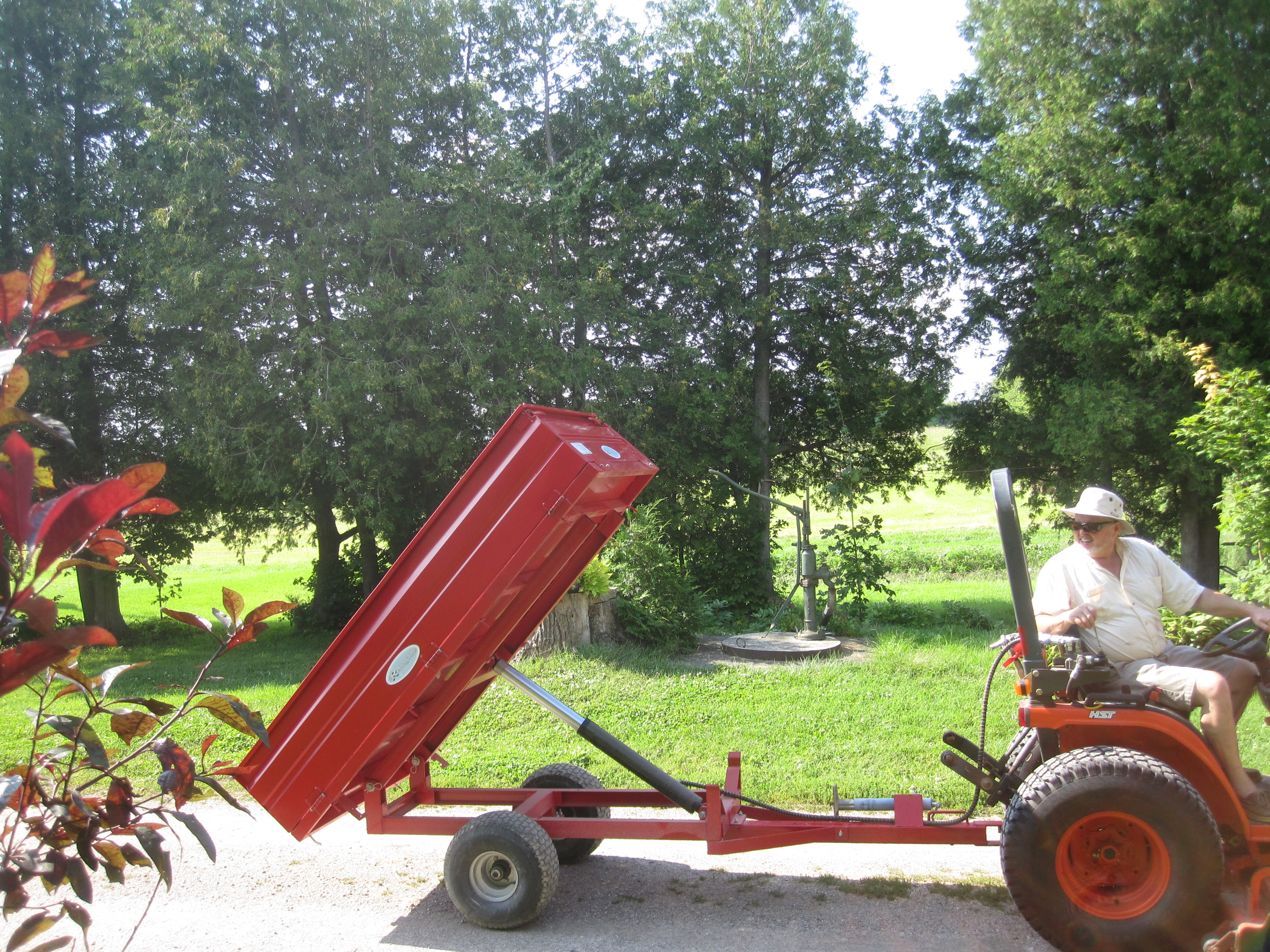
Perhaps “Almost everything you always wanted in a trailer (in the Ottawa area)” would be a better approach. I called the flimsy trailer dealer again. He seemed confident in the product because he had sold a lot of them and his mechanic has one on his hobby farm. I asked him to explain why the hoist uses one hose only: where does the oil go on the return trip? His answer was basically, “It works. Come and look.” So I drove two hours north with the trailer we built for the Ranger attached.
The sides looked light and flimsy, but as the-mechanic-who-owns-one explained, “Look at the underside. It’s very strong.” He ran the hoist up to reveal the heavy metal underneath. Without trepidation I stepped onto the again-horizontal bed. “I haul 10′ logs out of the woods on it. I just take off the sides and the front and tie the logs on. It works fine behind my 60 hp tractor. I have also heaped it with sand and gravel. To dump gravel I disconnect the bottom of the tailgate so it works like a little dump truck and still supports the sides.”
Perhaps because I didn’t know how I would use the thing, I asked them to load it up, and home we went. Buyer’s remorse could come later.
Prince Edward County Revisited
August 19, 2013
At the age of five I climbed to the top of a huge sand dune on the edge of Lake Ontario and then attempted to run down it. As I recall I spent the remainder of the trip to the Picton Sandbanks trying to flush sand out of my eyes, nose and ears.
Some years later on August 20, 1972, my bride and I drove from Kingston to the Sandbanks on a one-day honeymoon before we returned to our summer jobs in Ottawa. Students, eh?
It seemed fitting this year that we attempt to recreate that journey. Bet admitted that she remembered very little of our brief honeymoon. I was sure that we drove our red VW Beetle, found the Picton beach, if not the sand banks, and made it back to Ottawa in time for work on Monday.
I wished I had that Beetle to drive on a road trip one more time, but our gray Lexus would have to do for now. Bet insisted upon taking our spaniel along for the ride.
My bride of 41 years had prepared a fine picnic lunch the day before, so we drained the dog and loaded up the Lexus on a glorious August day. Our son Charlie knew not what he asked when he borrowed my portable navigation system to aid his drive from Seattle to Victoria for a wedding on the weekend. At Bet’s insistence I asked my computer for directions to the Sandbanks. Google Maps commented: “Go to Trenton and turn left.” I tried for a more sophisticated itinerary, but when it offered a path that cut through Battersea and Inverary I decided to rely upon my own (unused of late) navigation skills.
We found the park after a spectacular drive across the island from Deseronto. Things went pretty well until we had finished a delicious picnic lunch well away from the beach. Dogs are not permitted on the sand or in the water. But lunch went well, once we found a picnic table without discarded rib bones on the ground below. Taffy’s quite the scrounger.
By the way, the beach looks to be flat-out beautiful. I peeked over the hill for a few photos, then headed off in search of wine country.
Near the park exit I cornered a woman on a recumbent bike and asked her whether I should turn right or left to find a winery. She rose to the challenge and actually produced a cycling map combined with a blizzard of instructions, so off we went, driving the charming back roads in the vicinity of the Sandbanks Provincial Park. Somehow we doubled back. Twice. Fine. I recognized our mistake. Off we went again, this time branching off into farming country.
We happened upon a number of vineyards. To my surprise they seemed to be situated on some of the less arable farmland in the area. Much of the vegetation we saw I didn’t recognize. Oh yes, goldenrod and sumacs were everywhere, but I didn’t see any dreaded wild parsnip or buckhorn, and Bet commented that she only saw purple loosestrife as we drew near to Belleville. One very common stunted evergreen is a mystery to me, though it grows in profusion on poor soil to the west of Kingston. I couldn’t identify the tree under which we ate lunch. Some kind of ash? Ash crossed with Manitoba Maple? The trees are different there.
To judge from the height and girth of some well-established lawn specimens, black walnuts do well in this area. They’re heavy stems with straight, muscular branches, like the ones on our property in Forfar, not the spindly trunks and willowy branches which surprised me in the wine country south of Lake Erie.
My purpose in visiting the wine district was to get an idea of growing conditions in the area. I suspected from the placement of the vineyards near the lake that they depend upon the unfrozen lake’s moderating influence throughout the winter.
At one well-financed vineyard we saw a pair of huge propellers erected on towers above the vines, no doubt to help fend off the frost on chilly spring nights.
The vineyards show conspicuous effort and investment on the part of their growers and we must have driven past a dozen separate operations in the area south of Belleville.
But I wanted ice cream and we were in the middle of nowhere. Driven my sweet tooth I tried to find our way out to civilization – Belleville and the 401 in this case.
My navigation instincts had completely broken down from sugar deprivation by the time we tried to make our way through Belleville. Without my trusty Tom Tom I found myself lost more than I liked. Finally I sidled the car up to a stopped pickup truck and two embarrassed guys sent us back two miles to a Tim Horton’s to make the turn to the 401.
Not having the Tom Tom cost us at least an additional hour of driving and disturbed those guys talking in that Chevy pickup. When we stopped at a popular takeout in Barriefield for Greek food for supper, we discovered it had been replaced by a pet food vendor. More backtracking. But I guess we can’t blame the Tom Tom for a restaurant closing.
In all (counting getting lost in wine country as a positive), it was a pleasant drive. I commented to Bet: “If you want to sell a couple a Lexus, give them the keys and send them to tour Prince Edward County. The car is made for days like this.”
“No walnut twig-boring beetles yet,” MNR.
August 6, 2013
For two summers MNR technicians have maintained an insect trap amid the black walnut trees on our property. The task was to locate examples of the walnut twig-boring beetle, a known vector for the thousand cankers disease which is currently devastating black walnut stands in the American South.
I just spoke to the technician. She told me that they soon plan to remove the trap because they haven’t found any of the dreaded critter. There are lots of butternut twig-boring beetles, but no walnut.
Needless to say I liked this news.
As a retired secondary school teacher and vice principal, while I detest marijuana for the damaging effect it has on the learning of young people, I support legalizing it with one important caveat: take strong steps to keep the stuff away from kids under the age of 18.
In particular I would suggest that the type of electronic surveillance which has proven effective at rounding up child pornography rings should be directed toward the use of cell phones in secondary schools.
The grade 12 drug dealer sitting in the back of an English class will be a lot less likely to take orders by text from grade nine kids if Signals Intelligence has made a copy of his morning text traffic available to the local police before his lunch-hour delivery time.
Kids, especially boys with ADHD, are badly damaged by early cannabis use. I have seen too many bright kids ruined by the drug to have any use for it in or around the school yard.
If we treat marijuana dealers who sell to kids as the child molesters they are, let the rest of society pay their taxes and buy their grass at the LCBO.
UPDATE:
I fell into a discussion online in which a guy challenged me to put up proof that grass is bad for kids with ADHD. So I’ll add a few links here as I find them.
Rod
http://www.patient.co.uk/doctor/cannabis-use-and-abuse
http://www3.imperial.ac.uk/newsandeventspggrp/imperialcollege/newssummary/news_1-7-2013-11-49-21
These were the first three Google listed.
With five tractors and three cars in the motor pool at the farm, I have grown concerned about aging anti-freeze in aluminum engine blocks and radiators. As coolant grows old it becomes acidic and can eat its way though unprotected aluminum on a modern engine. Protecting against corrosion is as much coolant’s role as protecting against frost.
But a couple of looks at the Prestone wall at Canadian Tire have sent me on my way in despair, afraid that I might select a product which would do more harm than good. The various fluids are all in opaque containers and so I can’t even go by colour.
For anti-freeze is not a simple subject. I used to believe that there were two types: green and red. But that’s not true. There’s green ethylene glycol, the standard stuff, which the books suggest changing every two years. Then there’s the GM stuff, dex-something, which according to the Internet is Kryptonite to a lot of silicone-based head gaskets and other engine parts, especially on Cummins diesels. There’s been a class action lawsuit about Dex-Cool sludging up and destroying GM engines for which it was a warranty requirement.
And then there’s long-life coolant, and even extra-long life coolant for diesel tractor engines. And none of them are compatible. In fact a service manager told me that if I mix red and green coolant, the resulting liquid will coagulate and fail.
And the coolant in the Lexus, Scion, and Toyota in our motor pool is pink, not red. The Lexus service lady I called explained that the Toyota product is not the green-stuff-dyed-red, as one otherwise fairly well-informed Internet chemist suggested. “It’s a gell formulated to bubble and harden wherever there is a leak, so that the technicians can track the fault quickly.” She told me (correctly) that it’s very hard to find the source of a leak of the green glycol.
She further told me that the technicians use a float to measure how dense the coolant is, and hence how much cold it will protect against, but she knows of no chemical testing for PH at the dealership. If it’s not pink, though, they replace it. “If a water pump has failed, they replace the coolant,” her opposite number at Kingston Toyota told me.
No one I spoke to seemed to put much credence in the replace-every-two-years rule printed on the plastic jugs.
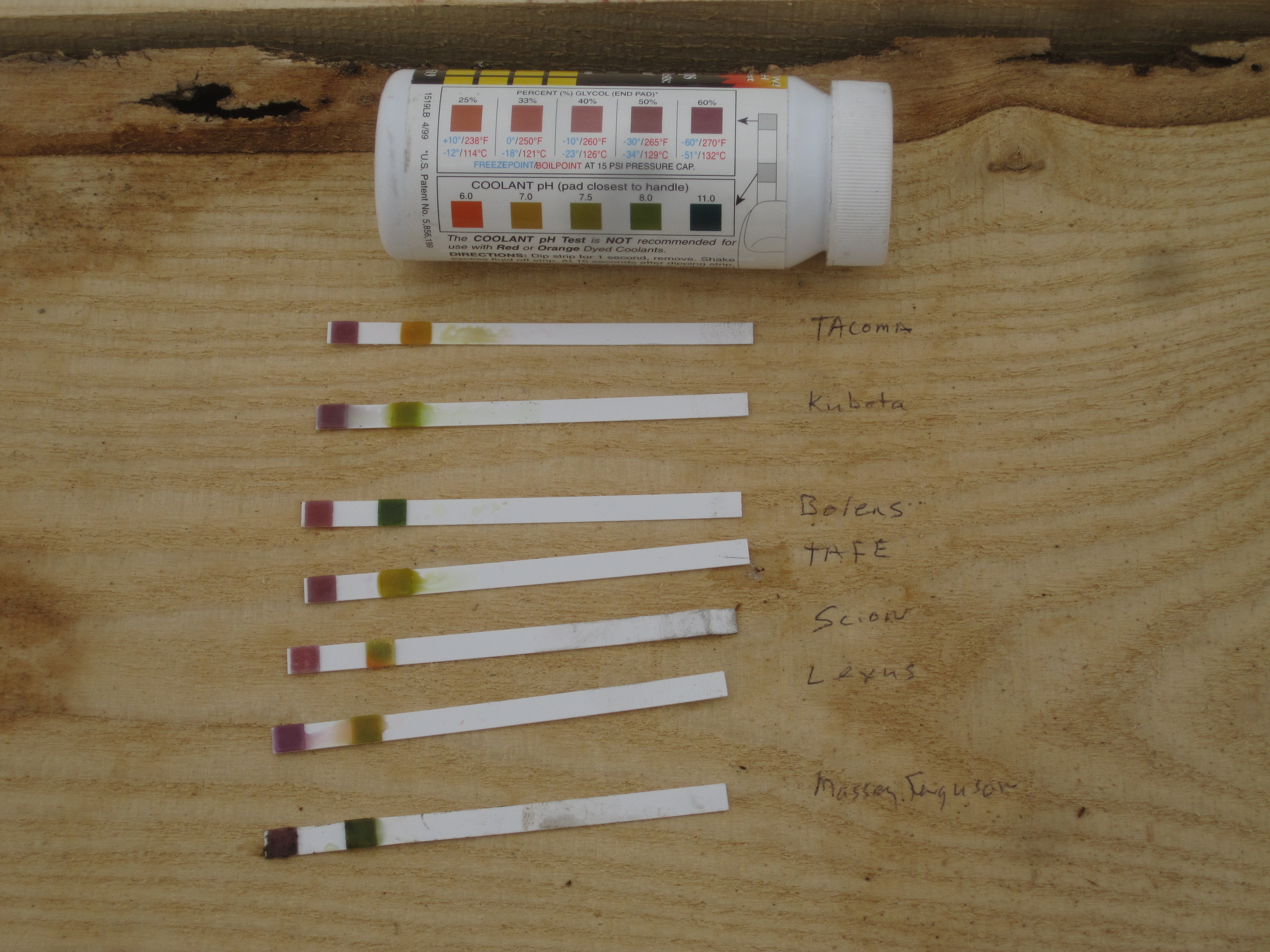
Today for the price of two-and-a-half gallons of Prestone I bought a bottle of 50 CoolTrak coolant test strips from the local UAP dealer. The bottle states clearly that the strips are not recommended for pink or red coolant. Great. I tried them anyway. The 2006 Kubota tractor needs its green coolant replaced. It tested a PH of about 7.25 and the ideal is 10 for my B7510, so it’s too acidic for that expensive little diesel engine and aluminum radiator which I want to keep for a long time. The 1981 Bolens has the best coolant of the fleet because I replaced it earlier in the summer after a heat-light malfunction. The 1995 TAFE’s green stuff also isn’t as bad as I expected because it’s a leaker and requires top-ups from time to time. The 1960 Massey-Ferguson, according to the test strip, is in a similar situation, though I don’t remember renewing its coolant.
So the Kubota needs Prestone. With the Bolens I just drained and refilled it with a 50:50 mix, but according to the Internet that may only remove half of the liquid. A backflush is more appropriate, but there’s the problem of vapour locks in the engine blocking the flow of coolant, and what do I do with the toxic waste? One sip of coolant from a spill or an open container will kill a bird.
The other problem is that I can usually rely upon Internet information, but on this subject everybody who has ever twisted a radiator cap feels compelled to offer advice, and some of it is dangerously inaccurate, even to my naive view. And one Internet wag suggested that the parts guy at the dealership inevitably has strong opinions about coolant, and most of the time they are unfounded and wrong.
What’s more, an Internet source informed me that coolant now comes in yellow and blue to suit warranty requirements of Korean cars. Something tells me that mixing yellow and blue to get green in my Kubota would boil that expensive little engine like an egg, so I’d better not try that.
More on this later — the test strips expire in a year.
How to blackmail a mulberry tree
July 4, 2013
It was just a little shrub growing at the side of the garden, a bit in the way but not too bad. All summer I had avoided it, then one day the mower reached out and flattened it. Oops. Oh well, there are lots of mulberries, both red and white, growing wild at the farm.
But it popped back up, looking horrid. So I backed over it to put it out of its misery. Further mangled, it doggedly resisted the diesel mower’s three spinning blades and rose tentatively from the sod again. I left it for a forthcoming session with the hand-held brush cutter, but then forgot the thing.
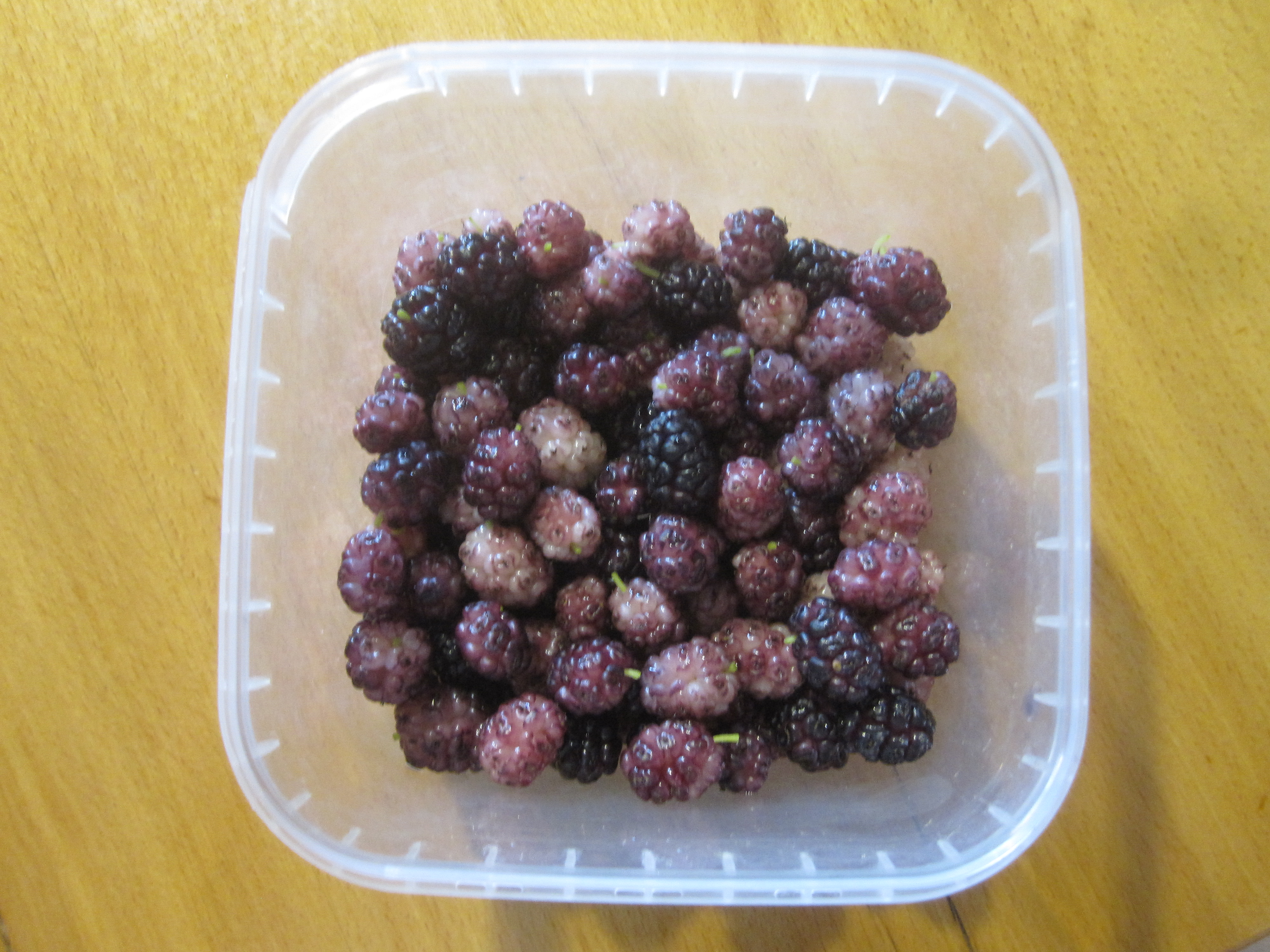
A year later it surprised me with a handful of extremely sweet mulberries which were a pale mauve colour.
I’d never seen mulberries of that mauve colour, ripe or unripe.
There’d been a large white mulberry near the house until I cut it up and burned it as firewood. It blocked my mother’s view of the road and it confused me because there was no way to tell visually if the abundant fruit was green, ripe, or spoiled: all were a pale greenish white. Of course the more common red mulberries are white when formed, progressing to bright red and then to shiny black when ready to eat. Simple. Birds, dogs, raccoons and humans love them.
This year the little tree in the upper garden is loaded with berries ranging from white to black, but the pale mauve fruit are already sweet enough to eat, and actually taste better than the fully ripe deep purple ones. The tree seems to be going all-out to prevent another visit from the mower.
Perhaps stress motivates a fruit tree.
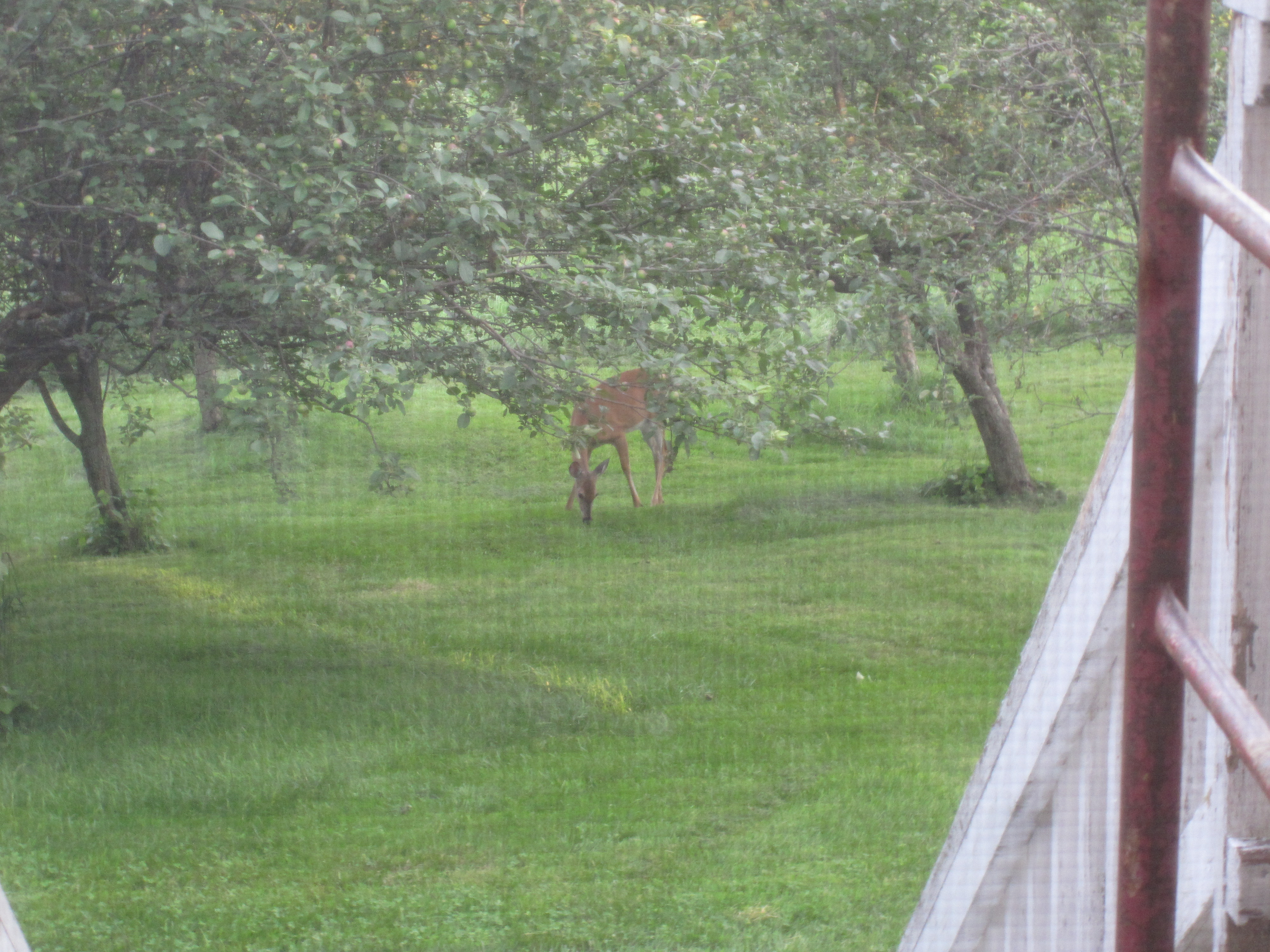
With Emily-the-Wolf absent, this yearling fawn has decided she likes our orchard for twice-daily feeding sessions. She let Bet take a few shots yesterday.

Why so quiet at The Walnut Diary?
July 3, 2013
No reason in particular, I guess. Things are fine at the farm, though the grass is growing at a ridiculous rate and I’ve put a lot of hours on the mower over the last two months. Having almost finished the painting left over from last summer’s window replacement project on the brick house, I lept into roof repairs on the stone house preparatory to the back verandah project.
Still haven’t figured out a design for that one, which might have something to do with the lack of blog activity. But likely not.
Fishing has been slow this spring. Everyone is confused by the early season for bass. They haven’t been where I expect them to be. Things are picking up now, but it’s been slow. Last night I released a 4 1/2 pound largemouth which was unsuitable for the table. Too big.
I just haven’t felt like ranting about politics. Sick of it.
Before long, if history is any indicator, I’ll round up a new hobby horse and get back to blogging.
Rod
 the Walnut Diary