Stephen Maher. Deadline. 2013: A first look
February 11, 2013
I’ve followed Stephen Maher’s career since I discovered his columns and news stories from the Halifax Chronicle-Herald online at National Newswatch four or five years ago. He has since moved to Ottawa as a columnist for Postmedia News and become half of the team who broke the Robocalls scandal. This morning when Newswatch carried a teaser about Deadline, his new novel, I downloaded it to Kindle and had a look.
………………..
The initial buzz will undoubtedly come from Parliament Hill, CBC, CTV, Signals Intelligence and Ottawa Police types looking to see how they are portrayed in the book. I’m most impressed by his bang-on impersonation of Peter Mansbridge. Stephen Harper is played without affect. Another character might reflect a grudge on former CBC broadcaster Krista Erickson. But there is a large cast of others and the game of the week will no doubt be the jotting of well-known names above the generic monikers Maher uses in the novel.
That’s the inside baseball interest. For general readers, the tome is an interesting and amusing spy novel set in Ottawa. I’ve read straight through the Kindle edition today. Most mysteries don’t carry me past the first chapter.
First chapters are important to me. My rule of thumb is that as soon as I come upon a dead body, I return the book to the pile. Very few mysteries pass this hurdle. But Maher’s jogging nurse makes an early-morning leap into the shallow water of a drained lock to rescue a drowned man. This impressed me as one of the best initial chapters I have read.
The plot advances with the usual intrigue surrounding the retirement of the prime minister and the subsequent leadership race. Maher is in his element in recounting misinformation schemes of the staffs of competing cabinet ministers. His hard-boiled main character, journalist Jack Macdonald, nurses a hangover through the back alleys, bars and bedrooms of downtown Ottawa.
Macdonald follows a lead to Fort McMurray where he encounters a subculture of fellow Newfoundlanders. Maher describes what the massive oil sands project looks and smells like before he returns to the narrative and a city of lonely men from the Rock with too much money in their pockets while Chinese oil interests lurk.
One of my objections to most of the mysteries my wife brings home from the library is that the characters are cutouts and the resolution of the plot is as predictable as the body in the first chapter. Not so with Maher. In fact, the most memorable Maher catch phrase is the unique: “A transition period is the period between two transition periods.”
Perhaps the only truly corny part of the novel is the gratuitous chase scene on the frozen canal, but what Ottawa writer can resist its appeal?
No, Maher’s plot doesn’t follow the expected arc, and I’ll leave it at that. Suffice it that if you have kept up with Canadian newspapers for the last four or five years, you’ll enjoy quite a few AHAH! moments in the dark irony of the last quarter of the book. Maher is clearly not a fan of the Senate.
Radio Canada International ran an interview in which Stephen Maher spoke about the writing of Deadline:
http://www.rcinet.ca/english/daily/interviews-2012/11-58_2013-02-08-ottawa-political-investigative-journalist-stephen-maher-writes-a-seamy-political-thriller-called-deadline/
Vancouver lands TED, the holy grail of conferences
February 4, 2013
If you aren’t familiar with TED and you are getting tired of the usual YouTube fare, Google the acronym and settle back to be amazed and amused. The TED format places an expert in front of an alert audience for a fifteen minute talk. Remember the best lecturer you had at school? Imagine that TED has the clout to pull the best of these speakers from all over the world. Bill Gates and Stephen Hawking were just two of the guys in this crowd.
TED has been running for a long time: its top 100 speeches have had over 1 billion hits.
And now the organization is picking up and moving from California to B.C. This is a big deal. Read the attached news article:
The Good Ice Tour, 2013
January 27, 2013

The full moon made it inevitable: no fish bit for an hour this morning, the air was clear, cold and still, and the thin crust of white on Newboro Lake over 13″ of ice made for perfect driving conditions for Tony’s Polaris Ranger.
We resolved to find the winter route to Chaffey’s Locks. Open water or at least weak ice at the Elbow and the Isthmus meant a trip across Scott Island if we wanted to look for splake on Indian Lake.
Yesterday we’d noticed a pack of wolf hunters coming out of the upper reaches of Stout’s Lower Bay, so we followed their tracks to a rugged trail off the ice. Tony had never faced driving conditions like these. On the other hand the Ranger 500 gave evidence that it has had lots of practice over rugged terrain, idling over breathtaking moguls, ducking its windshield under overhanging pines, and ploughing fearlessly through frozen muskeg until we reached a better trail.
We were pretty lost until Tony noticed that this looked like our friend Tom’s cottage road, so we oriented ourselves from there. I must emphasize that it is very easy — in any season — to become lost on Scott Island.
The township road is little more than a snowmobile track at this time of year, but the Ranger had no trouble on the hard, rutted, snow. Just short of the ferry dock we turned off onto a short trail and drove out onto Indian Lake.
Clusters of vehicles indicated the splake fishermen at work. We drove up to veteran Chaffey’s Locks fishing guide Lennie Pyne, comfortably ensconced in a mobile shelter above a shoal in the middle of the lake. Lennie told us that he had lost a good fish this morning, but that otherwise fishing was slow with the full moon.
Lennie showed us where he had driven on with his pickup truck, so we followed a minivan off the lake and out to the township road which runs around the south end of the lake, took our bearings, and headed back across to Scott Island. Tony decided it was time for a change of drivers.
The 2003 Ranger 500 4X4 has just over 1700 hours on it, but the engine is fresh and the rest of the UTV works well. I noticed immediately that the 500 is more softly sprung than my 2004 Ranger TM. On the open ice at 30 mph the steering feels light, yet stable. It didn’t offer to break the back end loose, though I was careful, mindful of the rig’s high centre of gravity. On the island trails the suspension worked its way over bumps and obstructions so that the passengers and equipment enjoyed a comfortable ride at a reasonably brisk speed. The optional cab and windshield enabled riders to retain at least some body heat on the cold day, and an improvised rear windshield kept snow and exhaust back there where they belonged.
According to the owner’s manual the AWD only engages a front drive wheel if one of the rear wheels slips, but I found the system distributes power very effectively without input from the driver. To cover the same terrain with my 2WD TM I’d be shifting the differential lock in and out at every obstruction. We didn’t use the diff lock on the 500 at all during today’s fairly demanding outing on the Island.
A wrong turn led us down a narrow and steep cottage road. Tony dismounted to move an oak branch out of the way and nearly slid down the hill when he picked up the limb. He climbed happily back into the Ranger and we sure-footedly made our way on to the point that further progress was unlikely. Then we made a 3-point turn on the narrow trail and regained our proper route.
The drive from Indian Lake to Newboro by Scott Island is quite scenic, but too long for a convenient fisherman’s commute. Tony timed our island transit at 30 minutes, though that included the time lost on the dead end. Add fifteen more minutes for lake travel and it would make more sense to drive a 4X4 out on the lake at the Chaffey’s end, if the ice permits.
On the way back we stopped to photograph a remarkable beaver project: an enterprising rodent has half cut down a 30″ pin oak overlooking the bay.
So it was a great day to explore. The ice was hard and strong and the crusted snow felt like concrete beneath the tires of the Ranger. Conditions don’t get better than this for cross-country winter travel.
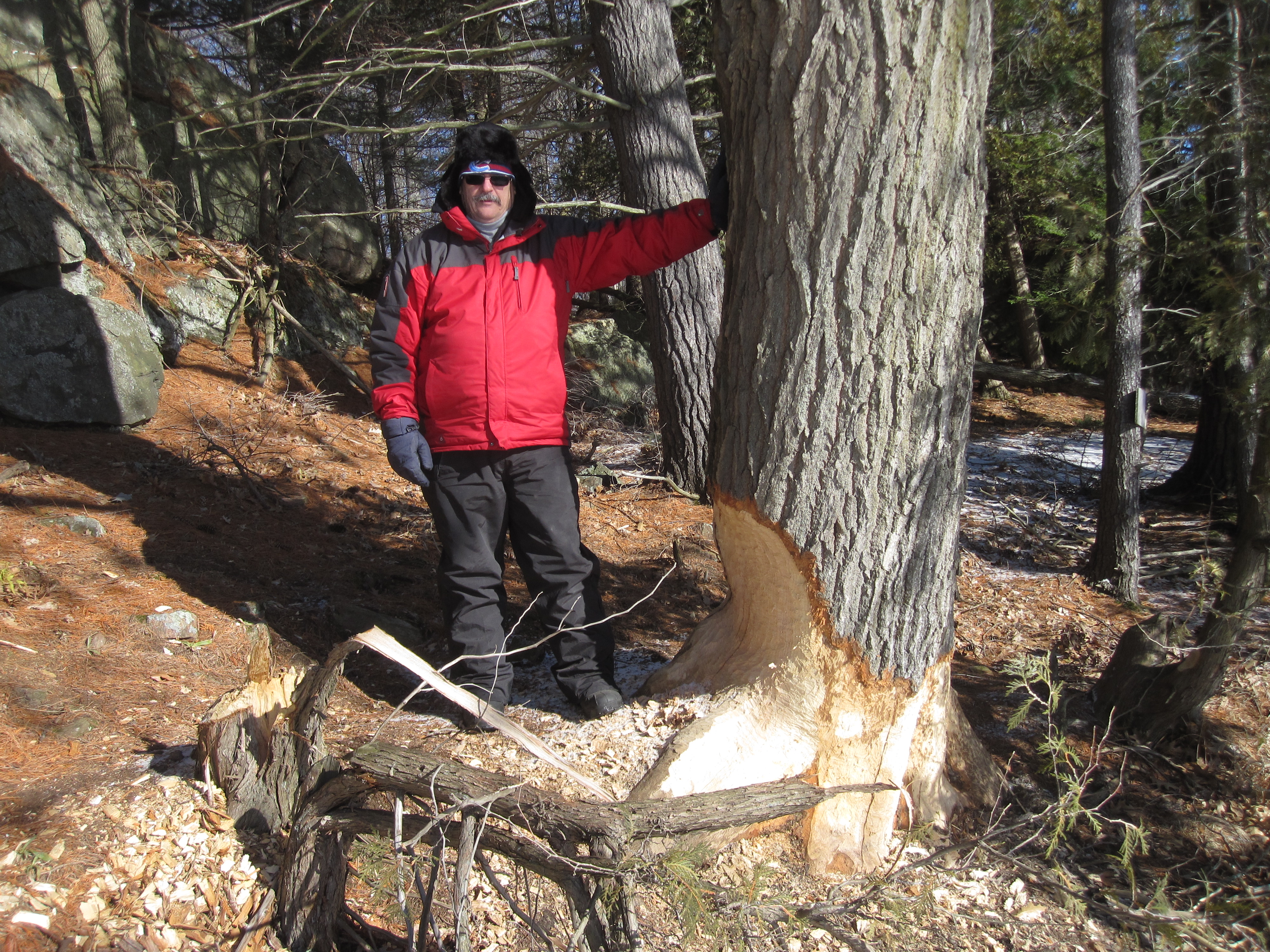
We grow our rodents big in Leeds County.
Protests work: revised fee schedule for Locks
January 22, 2013
Parks Canada has responded to the flood of invective from boaters and shoreline residents with a more moderate proposal. For the good stuff look at the end of the web page.
http://www.pc.gc.ca/eng/agen/tarifs-fees/consultation/ann-app3.aspx#canal
Comments?
Thanks to Marjory Loveys for the link.
Parks Canada Fees to go way up.
January 14, 2013
This is just out.
http://www.pc.gc.ca/eng/agen/tarifs-fees/consultation/ann-app3.aspx#mooring
Speaking as a boater, I think that this fee schedule will reduce the amount boaters use their vessels on the Rideau. Westport Harbour can’t fail to suffer from a system which punishes the boater financially every time he even ties up at a lock, let alone passes through it. The 100% surcharge will ruin tour boat operators. I guess fishing guides will also qualify as commercial vessels, so each return lockage will cost the guide about $28.00.
These fees will substantially reduce traffic and dock occupancy on the Canal. I’d say it’s effectively a lockout by Parks Canada in response to draconian cuts to the Trent-Severn and Rideau budgets to fund new parks in the north and west. Only if the public makes enough trouble to threaten the Harper Government politically will they raise the Rideau Canal budget back to a reasonable level.
Review-Mirror reporter Margaret Brand sent along the revised Parks Canada FAQ page:
http://www.pc.gc.ca/eng/agen/tarifs-fees/consultation/ann-app4.aspx
Eskimo Stingray 33 cc Ice Auger Review
January 8, 2013
This nearly turned into one of those pieces where the author vents his frustrations about the worthless product. You know, the kind with the one star out of five rating at the bottom, and the word “junk” in the last sentence. But then I read the instructions.
The auger was an impulse buy at Canadian Tire during the Christmas blitz. Its sale price of $300. was the same as the best I could find on Amazon.com, only without the additional costs of delivery and a border crossing. So I bought it, torn package and all, at the risk of a scowl from my wife. After all I was supposed to be shopping for Christmas presents for family members at the time.
When an ice fishing buddy stopped by the workshop I decided it was time to fire up the new toy, so I grabbed the open can of chain saw gas, dumped a bit in, and let fly. The engine started only after I splashed fuel around the vicinity of the spark plug hole and re-inserted the plug, but then settled into a smooth idle, smoking enough to set off the alarm in my woodworking shop almost immediately. My pal suggested that the gas smelled a bit old, but you know how guys can be: “That gas was fine when I cut up those logs last spring, and it worked fine in the brush cutter all summer.”
The next trial was to start it in the cold at the lake. That required another drink through the spark plug hole to get it warmed up enough to drill. Once started, it cut a series of holes through soggy ice ranging from 12″ to 16″ with no difficulty. Clearly the auger works very well; it was just a matter of getting the Viper engine to start.
I was impressed with the design of the protective cover over the blades. It seems to allow you to stand the auger up for starting without damage to the blades or the surface below. The auger also has a point to centre the hole. No doubt this is good for starting cuts on hard, glare ice.
On Monday morning I tried to start the Viper under conditions I could expect to find on the lake. Zero degrees F, a wind, bright sunlight. No way would it start. Removed plug. Numb fingers. Dropped plug in snowbank. How do you get ice out of a spark plug? Place it in an interior pocket (the more interior the better) and wait for it to warm up. Pulled cowl off air cleaner with Philips screwdriver. Dropped screw into protective plate at bottom of auger. Mindful of razor-sharp blades, tried to get it out with pliers. No room. Tipped auger over. Lost screw in snow. Located with shop magnet. Lit fire in shop stove to thaw hands. Continued.
Failure syndrome beginning now. Narrowly avoided damaging prongs which hold cover for air cleaner. They looked fragile enough that I held back a bit. Reassembled. Cover loose under there, but recovered screw went in O.K.
No hint of life from motor.
In desperation I re-read starting instructions. Nope. They hadn’t changed. Checked Internet for tales of woe about Eskimo ice augers. Not much. Most people love them. Dug more deeply. Found a discussion group devoted to owners very much like me. One learned contributor posted a 500 word essay in which he explained that the Viper engine will start well if the fuel vapourizes properly. It needs winter gasoline, and 87 octane, not high test, as regular unleaded has more aromatic ingredients for winter starting.
I looked again at the instructions. No way was I going to buy a new can when the other one is only a year or two old, but I’d give it new fuel and oil. So off I went for five litres of regular, carefully mixed in the 50:1 synthetic I use in my chain saw, and dumped some into the newly-drained tank.
Halfway through the first tug the thing began to purr smoothly with little smoke. Oh.
Just to be sure I have left the motor unit (auger stowed away) in a snowbank in the shade for a series of cold-start trials over the next week. So far it has lit up on cue every time. It needs a bit of prime at each start and the choke set. But then it starts easily and idles without hesitation. Unlike some Chinese engines which won’t start without the choke, this one will start when warm with just a tug on the cord.
That old summer gas just wouldn’t vapourize, or maybe there were ice crystals in it. After all, it had sat in an open shed without a cap on the spout for several months.
Had I written the review at the spark-plug-in-the-snowbank stage I would have made a fool of myself, slagged the product, and contributed nothing useful to the discussion.
If all else fails, find somebody on the Internet to tell you what the instructions which came with the motor actually mean.
AFTERWORD, 9 January, 2013:
After a couple of days of cold starts I believe I have figured out the drill:
1. Turn switch to “on”.
2. Ensure choke lever is set to “run”. I don’t know why, but everybody says to do it, and it works.
3. Give primer a light squeeze, about 50% of maximum effort.
4. Turn lever to “choke”.
5. Tug cord lightly.
6. When it starts, gradually raise choke lever to “run”.
How do I like the auger? It’s too heavy to lug around on foot, but it starts and runs very well with fresh gas. With sharp blades it has abundant power to cut 8″ holes in ice. Overall I’d say it’s a pretty good machine and an excellent value. Just stay away from stale gas with this engine.
UPDATE, 12 January, 2013:
The auger worked very well on an exploratory fishing trip this morning. I drilled several holes to mark a route out to the fishing area, and then many more in an attempt to find a weed bed. No fish were forthcoming, but it wasn’t the auger’s fault. Over three hours and many starts I gave the cord a second tug only once when I miscalculated the choke.
On glare ice in deeper holes I found my inertia wasn’t quite enough to overcome the auger’s torque by the bottom of the hole, and I found myself beginning to slide. For even deeper cuts in soggy ice I might need another person (or better footing) to steady the auger, but the little engine produces plenty of torque. After lugging the thing over questionable ice for a half-mile on the way out, I was happy to load it into the box of the Ranger for the return trip. It’s heavy.
UPDATE: 1 February, 2013
So far this season we haven’t caught many good fish, but it’s not the equipment’s fault. The auger has drilled dozens of holes, trouble-free. We couldn’t ask more of it. It starts well in all weathers, and it’s not hard on fuel. The 33 cc engine is well matched to the 8″ auger size.
UPDATE: March 25, 2018
My friend asked me in an email to install a sump pump on his dock to begin to prepare for spring break-up. I got out the ice auger, only to discover that the fuel line had dissolved. Without a practical way to clean the gorp out of the fuel tank, I rinsed it as well as I could, cleaned up the carburetor, fitted the requisite new parts, and couldn’t get the thing to run with any consistency. After several hours of work spread over a week and too much expense, I scrapped the thing and used my friend’s cordless drill with a 5″ auger attachment.
A fuel system should not dissolve over time.
Firewood handled only twice
December 23, 2012
Ironwood (hornbeam) is an inconspicuous weed tree which grows beneath the maples, walnuts, and towering beeches of the forest crown. It fills in sunlit spaces if it can, and if not will stretch up forty feet until it eventually dies from root disease and falls over. Its cadavers litter the forest floor, often suspended a foot or so above the ground, dried like bones.
My dad built fences with them. He claimed ironwood rails would last twenty years, and a horse couldn’t break them. But now that there’s no more livestock on the farm, the dead ironwoods have become a mess of pick-up sticks.
I decided it was time to launch a small campaign to clean up the view from the trails.
My new Husqvarna 346 is light and fast. The 20” bar reaches the ground with little back strain.
At 44” in width and with excellent ground clearance, the Bolens G174 can get to any part of the woodlot to pick up cut blocks.
Last winter I discovered that the Walco 3 pt hitch dump box on the Bolens holds as much firewood as the 5’ bucket on the larger tractor. What’s more, it can back directly into my workshop and unload at the woodpile beside the stove.
Think of it: firewood handled only twice.
But a run back with the Ranger to cut a couple of ironwoods and then returning with the tractor to haul it out seemed wasteful to me, so on a wet day I built a scabbard from two 6” boards rabbetted to create a slot for the saw’s blade.
First I bolted it vertically to the bumper of the tractor. That worked fine until I tried to change the oil. Oops. Couldn’t open the hood. Off it came. Internet searches offered no real suggestions apart from the odd bit of butchery of the tractor’s sheet metal. The scabbard wouldn’t mount behind the seat. There wasn’t room on the little tractor.
Then I looked at the right fender. If I could hold it in place there, it wouldn’t interfere with much of anything. A leftover fitting from a plastic tractor canopy spanned the handrail and bolted the scabbard in place. A loop of string slipped over the starter cord to keep the saw from working its way out while underway if I forgot to set the chain brake.
It takes an hour on a fine day to cut enough ironwood to fill the box, bring it to the shop and add it to the woodpile. No block is larger than 6”, so the splitter isn’t needed. The surprise is how well the forest-dried wood lasts overnight. Ironwood, it turns out, makes excellent firewood.
There’ll still be lots of use for the logging winch, the hydraulic splitter, the loader on the tractor with a cab, even the manure spreader with beaters removed, but firewood handled with all of this equipment requires many stages of production and quite a bit of diesel.
The little tractor-with-saw-attached uses less than a litre of diesel per hour of operation and requires little strength of its operator. It looks like a system which could work for me well into my seventies.


Newboro Lake Ice Report: 2012-2013
December 11, 2012
It’s time to move this post to a page accessible from the index at the side of your page. You should find it there identified as
-
A New Ice Report, December, 2012 to April, 2013
.
DON’T MISS THE SAFETY ALERT I POSTED ON THE “PAGE” TO YOUR LEFT. (THIS IS A “POST”, IN BLOG TERMINOLOGY).
ROD
23 December, 2012
Today I drilled a couple of holes out slightly from the launch ramp at the foot of Bay Street in Newboro. The rather soggy ice in this location measured 4″ in thickness. I wouldn’t walk any distance on it yet.
15 December, 2012
The Newboro end of Newboro Lake had about an inch of ice at the shore today, with coverage as far as we could see. The Little Rideau was frozen at the canal entrance to Newboro, but showed plenty of ripples a bit past the buoys.
Yesterday a trip across the bridge to Wellesley Island on the St. Lawrence showed a bit of ice in the usual bays, but nothing substantial yet.
13 December, 2012
While walking the dog in early evening last night I was struck by two very bright patches of light on the horizon in the general direction of Newboro. The intensity of the light put one in mind of Spielberg’s Close Encounters of the Third Kind. One was nearly in line with a communications tower, the other maybe five degrees to the east of it. Nothing else on the horizon (we can see a lot of it from Young’s Hill) showed strong illumination. This morning at 5:00 the one light was gone, and the other was back to the normal glow from Westport.
A look at Google Earth revealed that two solar fields currently under construction lie in the directions I noted. Maybe they’re working overtime to get things closed in before winter sets in.
UPDATE: After a few more night-time looks, I think the lights I saw were indeed those of Newboro and Westport, seen in freakishly clear air. What struck me was how obscure the lights of Elgin, Phillipsville, and Athens had been on the same night, so it must have been a localized thing.
12 December, 2012
A drive north this morning revealed that Mississippi Lake appears to be covered with ice, as is Clayton Lake. On the return trip I noticed that at Rideau Ferry the Lower Rideau is covered, but the Upper Rideau is frozen only about a quarter mile west of the bridge, and there are cracks all over the sheet. This ice may break up again with a breeze. At Portland on the Big Rideau the bay is frozen, but only out to the first island.
Please feel free to report ice conditions when and where you observe them. Just post a comment and I’ll do the rest. You may send photos to me for possible inclusion at rodcros@gmail.com . Rod
11 December, 2012
The Weather Network often displays contributions from viewers. This morning I ran across a shot of Bedford Mills which from a quick look appeared to be an image painted during the Romantic era. On closer examination it turned out to be a remarkable shot posted by R Couper on November 10, 2012. (I asked my son Charlie, a professional photographer, to comment on the photo. He suggested it had been altered through aggressive use of Photoshop.)
My attachment to the Mill goes back several generations. My grandfather Charlie Croskery walked across the hills from his farm on MacAndrews Road to work at the Mill in winter. Much later in life he laid out the Cataraqui Trail through this area. You see the triangular marker on the tree in the foreground of the attached photo. For a couple of years my mother hiked across the hills to her students at Bedford Mills Public School. When I came along, Marjorie Bedore babysat me in their apartment on the second floor of the Mill. I dimly remember the night Ken and Marjorie’s firstborn arrived. Mom was first on the scene and had Clay pretty well delivered before Dr. Goodfellow arrived from Westport. It was on February 9th, my birthday (and Ken’s as well), though I do not recall the year. Most likely it was about 1954.

More about that photo shoot for Slate Magazine
December 5, 2012
A couple of weeks ago I posted a rambling blog stealing from the title of Emma Marris’s Rambunctious Garden: Saving Nature in a Post-Wild World. Since that time I’ve been digesting what has turned out to be quite an interesting read. Marris basically tosses the old paradigm of conservation onto the scrap heap: no longer is it all right simply to return the environment to the way it was before Europeans saw it. As Marris correctly points out, the great herds of buffalo and flocks of passenger pigeons may well have been sudden spikes in the population because of the elimination through smallpox of vast numbers of their main predator, Man.
Instead Marris provides a series of examples from all around the world of how ingenuity and effort have produced a new ecology which, while a bit heretical, may offer greater benefits than the back-to-Eden approach. For example there is a dry-land “wilderness” preserve in the Netherlands which lies 14′ below sea level. Feral versions of domestic animals have been enlisted to fill certain ecological niches.
I’ll get back to Marris once I have had time to think the book over. In the meantime, Charlie rather excitedly emailed me that the Slate Magazine article by Marris, Hipster Hunters, has finally appeared online. Vanya Rohwer is Emma Marris’s brother-in-law, and he responded to her request for photos to illustrate her article with the full-blown Charlie Croskery photo shoot mentioned on this page.
Old Eights Story Exchange
November 28, 2012
Does anyone remember his/her parents talking about their youth? One good story each…
My classmate from Westport Public School Jim Forrester started this email thread this morning, and because my mother has just completed her third driver’s requalification I suppose parents and cars would be a likely theme for the Croskery contribution.
My dad’s stories of his youth generally centred around his riding horse, Prince. That’s because his father, Charlie, never drove. Well, not quite. When his sons Alden and Glen grew old enough to drive, Charlie invested in a Model A Ford, but his one attempt to drive the thing left it nose-up against a small ironwood when it failed to respond to the usual commands. For the next sixty years if he couldn’t walk to his destination Grandpa relied upon friends and family for transportation. My dad preferred Prince for courting visits, as mounted he could travel cross-country and cut many miles off the trip to the Bresee household which ran rich to daughters.
As the eldest child in a growing family my mother’s summer duty from the age of ten involved driving the family 1929 Plymouth along behind the horses and hay wagon to and from the hay field with the younger siblings aboard. When Mom had reached the age of fifteen* Grandpa Bill asked the Westport police chief for a permit to allow Edna to haul the children who lived on the Noonan Sideroad up Hwy 42 to school in a 1939 Ford. So Mom has driven legally since 1941*, a claim which astonished the test administrator of the day last October and left her counting up the years on her fingers.
*Fact-checking required a few modifications to the story.
 the Walnut Diary