The second annual Possum Lodge bass tournament
September 11, 2011
As Sir Paul McCartney once famously said, “Merely to succeed is not enough. Others must fail.” Hosts Tony Izatt and Anne DesLauriers must have had this in mind when holding the event during a full moon. They couldn’t have foreseen the stiff northerly wind, though.
Tony had scheduled the thing to begin at 7:00 a.m. What fish is awake at such a ghastly hour?
So there we were around the gas dock at Indian Lake Marina at the crack of dawn, waiting for the only sane members of the crew, Jeff and Greg, who had apparently slept in. Eventually they came slumping down the dock. We were a motley crew, but the fishing tackle was good.
As the designated “ringer” for this event I realized that my duty was to bring my particular skill to the tournament: the ability to make the fish stop biting whenever there is any pressure of any kind for the anglers to perform on cue.
So I dialed up CONSERVATION mode as Les Parrott, unsuspecting, joined me in the boat. The others apparently decided their best bet was to get as far from me and my jinx as possible, for at the start they all blasted off to various points of the compass. I moved over to A-dock on the trolling motor and began to cast. Fishing in the morning is best off A-dock.
Surely enough, a chunky largemouth waited for my worm, immune to my jinx. I stored him in the live well for his own protection.
Then we fished our way around Indian Lake. Lovely body of water. Perfectly fishless this morning, as well, until Les found another largemouth just off the Pagoda which had apparently missed the memo.
Hiding from the wind, we worked our way up Indian, across Mosquito (fish very well protected there by the jinx) and into Pollywog Lake. Pollywog bass are notoriously independent and a bit suicidal, if provoked. Most of the belligerent ones tore our bait off the hook and tangled us in weeds, but a couple of the unlucky ones ended up in the well.
Then we moved through Bedore’s Creek onto Newboro Lake and the jinx cut in with full force. We cruised around more exquisitely clear water, cast a variety of choice weed patches, and had a few strikes best characterized by their inaccuracy. Some occurred as much as 3′ from the actual bait. According to Les these strikes say: “Get out of here and leave me alone!”
But no Newboro Lake bass were unfortunate enough to land in the live well. My jinx seemed to work well enough on the north side of Scott Island.
To put it to the test we moved over to the bay known as “The Boathouse”. Tony and Jeff were already there, straining the weeds frantically with long, looping casts. Tony tried to wave me out of there, but I lobbed a cast under a tree on the outskirts of the bay. A solid largemouth took the worm, fought valiantly for a while, then tossed the hook back past my ear.
“I’ll bet that just cost us some money,” I muttered to Les. The jinx continued. An inaccurate cast under another tree led to a missed strike and a lost worm, then I took into a run of tangles in trees which led to the exploration of a lot of overhanging limbs while I removed a series of hooks from branches.
Back at the dock Tony conducted weigh-ins with a large plastic pail and digital scale. Things proceeded normally until a protest from the group forced the host to drain the water out of the pail in which he was weighing his team’s catch, reducing the weight from 22 pounds to seven.
Turns out my jinx had been pretty effective after all. The five bass we had put into the well for safekeeping weighed a total of 9.9 pounds and turned out to be the catch of the day, beating the entry of Morgan Pickering and Brad Wilson by a half-pound. The fat laggard from under A-dock at 2.8 pounds won the largest fish by a couple of ounces, as well.
So Les and I faced some baleful glares, but we got to hold the Bob Steele Memorial Trophy for photos and have the right to display it in our homes for the winter.
Maybe I’d better ease up on the jinx next year because a passing cottager complained that the mouth of every bass on Newboro Lake seemed to be sealed up Saturday morning.

Host Tony Izatt presents Bob Steele Memorial Trophy
The Legacy of Edmund Zavitz
September 6, 2011
It’s hard to believe as one drives through the lush Ontario landscape that it was not always this way. That’s why the photos in John Bacher’s Two Billion Trees and Counting: The Legacy of Edmund Zavitz (Dundurn, 2011) come as such a shock to the reader.
I looked in amazement at pine stumps standing on skeletal roots high above the drifting sand below. In another photo a sand bank gradually engulfs an apple tree. In 1885 a main road near Picton was buried under 30 metres of sand. A brick factory had to be abandoned due to the sand invasion.
In other photos the Oak Ridges Moraine appears as a vast, sand wasteland, fissured with deeply eroded gullies. The photos show the gritty reality of what happens to a rich landscape when it is plundered without care.
At the turn of the twentieth century, unfettered logging driven by the railroad led to the destruction of much of the forest which covered Ontario. Slash from the timber cutters was left where it fell, turning to tinder in hot weather. Sparks from steam locomotives caused fires of such frequency that the topsoil burned or blew away along the railway lines. In the Canadian Shield the land was burned right down to the rock. In Southern Ontario the underlying sand became a desert over large tracts.
But the loggers and the locomotives were not entirely to blame. The myth of the Ontario pioneer shows the immigrant struggling with his axe to fell the tall trees, then burn them for potash to provide income prior to planting a first crop of wheat in the few acres of the homestead tract the family was able to clear each year. According to Dr. Bacher, over vast tracts of Southern Ontario and on into the Canadian shield, the reality was one of reckless burns of the forest for the ashes left in the wake of the fires. There was more money in supplying the soap factories with potash than in subsistence farming on marginal land, so the squatters would often move on to another patch of virgin forest and try again.
It was a war against the landscape. Railroads, logging companies, prospectors and squatters raced to gobble it up. Politicians looked upon the receding forest as an impediment to progress, and the market in its products as a patronage opportunity.
Catastrophic floods, droughts and fires followed. The history of pre-1925 Ontario is one of devastation.
In his book Bacher traces how a single man, Professor Edmund Zavitz, convinced Ontario that there was a better way. Zavitz was a bureaucrat who used the technology of the time to convince landowners and legislators alike that the future lay in controlling the waste caused by degradation of the environment.
His friend J.H. White’s photographs documented the “railside burning of forests down to bare rock (108)” which led to federal regulations on railways in 1912. “In 1915 Zavitz’s inspectors found 36 fires which were caused by settlers starting fires in dangerous seasons and not controlling them… Such dangers, they believed, had to be accepted as the price for living in Northern Ontario (109).”
The Matheson Fire on 1916 burned twenty townships across Northern Ontario with 243 deaths. Cochrane burned out for the third time. 89 died in a sudden firestorm in Matheson. In all, 6% of Ontario burned. The Haileybury fire of October 4, 1922 caused 40 deaths and destroyed 6000 homes.
Through the use of air power, tougher laws, and changed public attitudes, Edmund Zavitz pioneered the control of loss from forest fire in the Canadian north. Working with Premier Drury and later Premier Ferguson, he ended the threat of uncontrolled forest fires in the north.
Zavitz brought similar stability to Southern Ontario with reforestation programs which eventually ended the threats of drought, flooding and spreading deserts as the consequence of deforestation (144).
Fire protection and reforestation programs pioneered by Edmund Zavitz over his life have largely shaped Ontario’s landscape and climate. Bacher’s book details the stages by which this Ontario Agricultural College professor and visionary public servant created and preserved this rich legacy of tree planting on private lands.
After it had been severed by the lack of understanding and subsequent cutbacks of the Rae and Harris governments, the link to Zavitz’s tradition was reestablished in 2007 by the McGuinty government. With minimal funding and support from a wide variety of organizations and individuals, the 50 Million Trees Program has quietly restored the link to this proud tradition in Ontario.
UPDATE: October 29, 2011, The Globe and Mail offered the following concise review by William Bryant Logan:
Two Billion Trees and Counting: The Legacy of Edmund Zavitz
By John Bacher
Dundurn, 274 pages, $26.99
John Bacher, an environmentalist and historian living in St. Catharines, Ont., has rescued Edmund Zavitz (1875-1968) from undeserved obscurity. Zavitz was appointed Ontario’s chief forester in 1905, when vast stretches of Ontario were deforested to the point of desertification. Beginning with the Oak Ridges Moraine, which was rapidly becoming a dust bowl, he instituted reforestation projects all across to province, establishing tree nurseries and bylaws and educating politicians and the public about the dire consequences – flooding, erosion, sandstorms – of over-cutting. He went on to become Ontario’s deputy minister of forests and director of reforestation. One month before Zavitz’s death, Ontario premier John Robarts planted the billionth tree on Zavitz’s watch, and more than a billion have been planted since.
Two years’ teacher training in Ontario?
September 1, 2011
Premier Dalton McGuinty recently announced that a re-elected Liberal Government will extend teacher training to two years, effective immediately. My initial reaction to this announcement was one of satisfaction. When I graduated with a B.Ed I was so clueless that I didn’t even know it. It wasn’t until after a master’s that I came to understand what education is. It took that extra year.
But then I thought a little more.
In the summer of ‘72 Bet and I were a week away from our wedding when a pair of telephone calls turned things upside down. The first was from the University of Windsor, offering me admission to first year law. The other call the same evening came from the registrar of the Faculty of Education at Queen’s, asking me when I would be arriving to complete my registration.
While obsessing about law school all spring, I had clean forgotten about the application to education at my alma mater. A corporation had recruited me out of my B.A. class, moved me to Ottawa, and was grooming me for management, promising the earth. But they had lied to me three times in the last three weeks, and their string was running out.
So it came down to a question of logistics: could we handle a move to Windsor? could we manage a trip back to Kingston for another year?
At that pivotal point in our lives, one extra year sounded manageable and three or four did not. After years of construction jobs to pay my way through school I very much wanted a paycheck, but married students qualified for student loans, so we could swing another year.
Life is great for newly-weds in Kingston. Towards the end of the spring term the principal of a new school in Smiths Falls found me a spot, and Bet landed a job at the Medical Centre opening in Newboro. We moved home to Forfar.
In the fall I started with a grade eight class and discovered that I loved kids. I liked my colleagues, the work, even the parents, and they seemed to like me. It was an honour and a privilege to be a teacher.
But the salary schedule sent me a clear message: I held minimal qualifications for the job. With effort, though, I could improve my pay. For the next twelve years, winter and summer, I took courses.
In the process of thickening my wallet I developed a more thorough understanding of English literature, then education, and later educational administration. Before long I moved to the secondary school across town, then became head of English at another, and later vice-principal for a while. By all reports it was a pretty good career.
But if, on that pivotal evening, the Queen’s registrar had told me I would have had to remain a student for two more years before earning a salary, I probably would have picked law or stayed in business.
My suggestion to Mr. McGuinty: kids need the very best young teachers, not just the ones whose parents can afford an extra year of university. Keep the one-year full-time course for teacher qualification, but adjust the salary grid to make the second year, full- or part-time, the only logical step for the young professional. That way the penniless-but-eager candidate won’t be lost to the school system because of finances.
Score one for the Ranger
August 29, 2011
I heard the calls from up on the hill. A dog was on the loose. Calls continued. Good lungs on that woman. Then I saw Joe hiking across the north end of the property, headed for Crosby. I hopped into the Ranger and ran across the field to him. My neighbour happily accepted the offer of the UTV because last time he had used it he scoured the countryside for a half hour and eventually found the bearded collie behind Baker’s Tires in Forfar.
Away he went down the paved road, covering fields on the way, until he disappeared into Forfar. His wife walked down across the field to our driveway, covered in burrs. We picked them off and dropped them in the burn barrel on the way by. Elaine looks as though her new lifestyle is sitting well with her. Both the she and Joe retired last year from Rideau Distict High School in Elgin.
“We were just back from a reading, sitting in the sunroom which is cut off from the rest of the house. Just as we thought about making dinner, I realized it was a bit quiet in the house. The wind had blown the door open. Two dogs were missing, and we had no idea for how long.”
Elaine and I chatted for a while as we strolled out the driveway to the road, then she perked up and took off in mid-sentence on a sprint up the road: she had heard one of her dogs. The lady was making pretty good time up that long, steep hill. Then I saw her throw up her arms in celebration. One dog found. She was still doing her victory dance when I saw the roll bar of the Ranger appear over the crest of the hill from the Hwy. 15 side. Joe had the other dog.
A couple of minutes later they brought the Ranger back. Joe explained, “She was walking down the centre line of Highway 15, so I went after her with the Ranger, stopped traffic, and got her. The new pup was waiting in the driveway when I got home.”
Joe’s rapid 4-mile circuit down concession roads and along the highway quite possibly saved the life of one of their prized bearded collies. Score one for the Ranger.
How to make your own cove siding
August 21, 2011
Over the last year Charlie, Martin and I have put up a fine workshop where the horse stable once stood. Apart from sheetrock taping and interior trim, the only remaining task is the exterior siding. Building inspector Anpalahan Kandasamy told me that the final approval requires permanent siding, so I couldn’t leave the fading gray fabric on the outside for another winter.
The problem was that while I like the trim appearance of vinyl from a distance, up close I hate it. The double joints on long runs ruin a pretty good effect. So I decided to design and build my own horizontal siding.
The tool drawer contained a good set of tongue-and-groove knives for the shaper and a convex cutter designed for raised panels. I went to work on samples. To fit the tooling I would have to plane each board down to just below an inch, then cut the cove on top of the tongue so that the tongue and groove would fit together normally, but with a recess on the top edge of the board to give the traditional appearance. I hoped to be able to blind-nail the interlocked boards to the stud wall.
If this worked the project would give the old Poitras shaper and its power feeder a good workout.
Two years ago when I remarked at how well his fiberglass building dried a stack of wide ash boards he sold me, band-mill owner George Sheffield suggested that I should have my own solar kiln.
Over the winter I had ordered a couple of thousand feet of pine for spring delivery. I decided to follow George’s advice and try kiln drying this stuff in the “plastic palace” to speed the project up. Twenty-five hundred board feet of pine made for impressive piles in the low shed.
Even with large openings in the ends, a greenhouse-type building gets very hot in summer. Lumber apparently likes this as a drying environment. So do wasps. When it came time to take out a trailer-load I discovered that the wasps had colonized the electrical boxes and the rolled-tarp door. They didn’t leave gracefully, either. They like the dry heat.
The first batch of 12” boards I cut up to make siding had been piled outside over the winter, and did not take kindly to ripping on a table saw. The ends had dried a lot and the middle stayed green, so there were huge tensions in most boards. Some actually exploded from the stress during cutting. The 6” siding-candidates came out so crooked I re-piled them in the palace for a couple of months of further drying.
The stuff I cut up this week had gone into the palace in early May, and seemed very nice to work after three months in the “kiln”. The terrific tensions of the outdoor boards just weren’t there.
At the planing stage a new problem cropped up. Normally I run lumber through a trailer-load at a time, let the shavings land on the floor and then shovel them into an old spreader for mechanized unloading elsewhere.
But this dry pine planed off in light, fluffy shavings which plugged the machine. I was forced to hook up the heavy vacuum system I had earlier installed for the sander. That worked nicely until I had finished the third board. Then the planer plugged again, this time because the chip barrel was full. This would take some learning.
I gradually figured out the timing on the barrel and discovered the planer in fact works better with the chip collector installed.
The first batch of siding came out at 5” in width, and I was able to cover the front and half of one side of the 24 X 24 shop. The next batch is almost finished, and I can’t decide whether to try to hit the 5” mark again, or leave these at 5 ½” and reduce waste. This stock was a little wider than the previous lot.
In any case, the 1” cove siding nails onto ¼” strapping quite nicely with galvanized siding nails. Anpalahan insisted upon the strapping to provide an air space so that the siding can adjust to humidity changes and water infiltration. Turns out these little straps enabled me to locate the studs in advance, preventing chaos later.
Making cove siding is nice, mindless work. If you don’t count labour, tools, and the paint yet to come, it’s cheap, too.
https://picasaweb.google.com/106258965296428632652/MakingCoveSiding
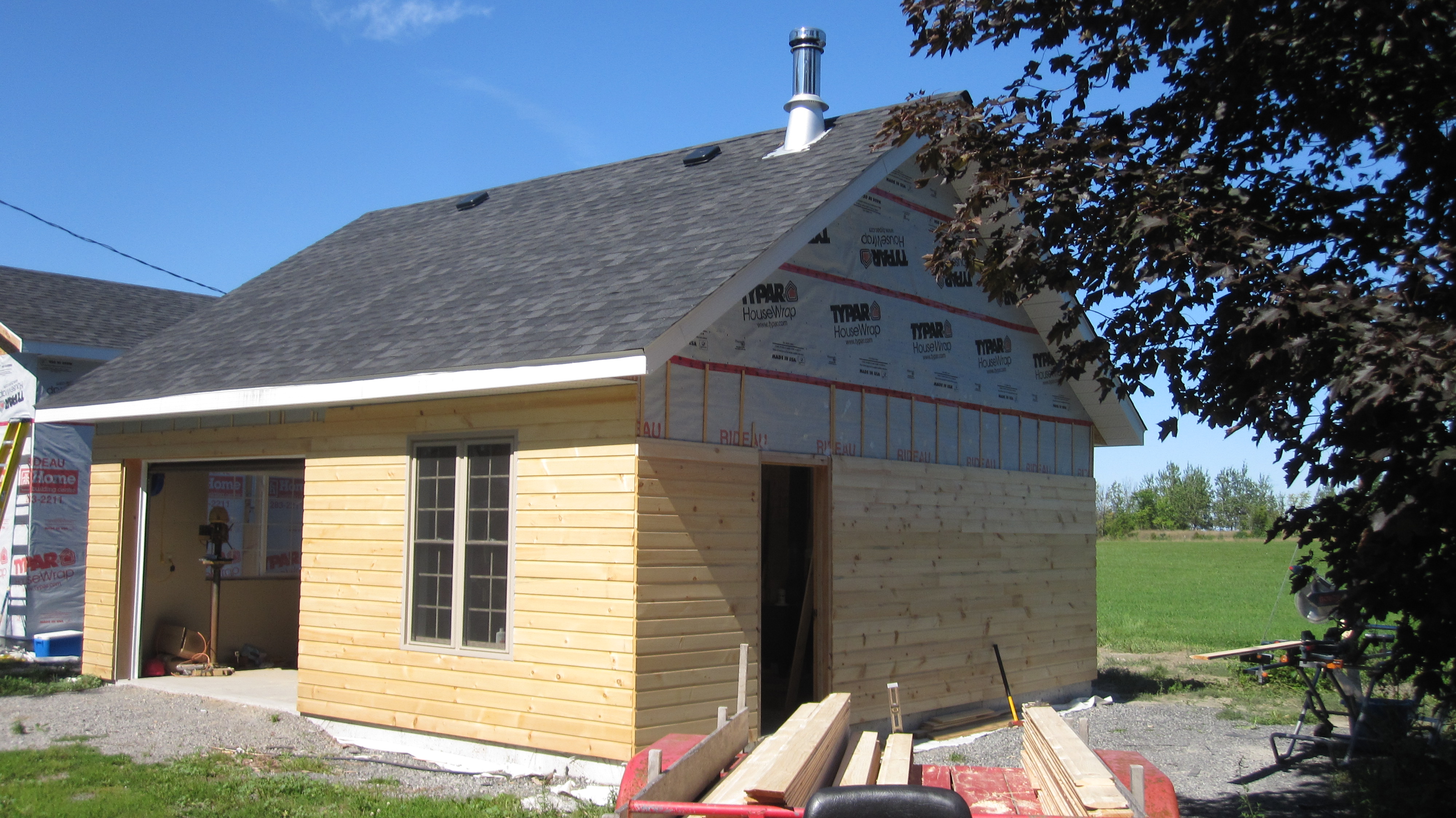
That’s all before the scaffold goes up.
Memories of Bob Steele
August 15, 2011
Last week the Indian Lake Marina community at Chaffey’s Locks mourned the passing of one of its members, Bob Steele. With his loving and supportive wife Mary and their son John, the Steeles have been a presence in the boating community on the Rideau since the early 1980’s.
Like many other successful couples from the Ottawa Valley, the Steeles acquired a place in Florida to which they retreated for the winter months. Visits to the Steeles became the route by which other Marina members found their way to Florida, and the social whirl continued – some would say intensified – during the winter months.
For Bob Steele liked his fun. For a large man Bob had amazing energy. Kids at the Marina couldn’t match his fondness for bounding around in an inflatable with a ten horsepower motor. Then the motor became a twenty-five and the rides grew even more thrilling. The rule on the dock was that if you got into the Zodiac with Bob, hang on, and make sure the gas tank didn’t fall on you.
When the dream of taking Good Times to Florida for the winter reached the planning stage, Bob decided she needed better engines for the trip, so he located two fine diesels. Then it was just a matter of getting someone to install them. This process turned out to be a lengthy one while Bob regaled us with tales of his mechanic’s latest evasions and missteps. After two years of frustration the engines ran well, the signal for Bob to put the boat into the shop at Ayling’s Boatworks in Merrickville for a winter rebuild.
The trip south went well for the Steeles, though rumour has it the weather drove them ashore from time to time. It was on one of these dry-land escapes that they found a winter residence which did not move.
At the Marina Bob had noticed some of us spending more and more time in our dinghies chasing splake and bass, so he put his 25 hp Johnson onto a 16’ aluminum hull and moored it next to Good Times.
Tony sold him a trolling motor. Bob set it up on a plywood platform, and then continued the decking throughout the boat, right over the seats. He ended up with a sturdy and efficient fishing machine. I soon noticed spots which usually yielded a fish were empty. Bob was learning the tactics of the tree fisherman and I had to raise my game to keep up.
He loved gadgets. After an expensive rod bounced out of his boat on a choppy ride across Indian Lake, its replacement was a kevlar experimental model without eyelets. The line went through the centre of the hollow rod. The level wind reel boasted a braking system guaranteed never to backlash. Bob was proud of that rod and it didn’t seem to hinder his fishing success.
Life at the Marina changed when I discovered a battered Yamaha G1 golf cart near Ottawa. The thing was a wreck, but it ran. I built a very fine box for it and discovered the sport of carting around the many trails and roads of the area. Before long more golf carts turned up. The hill to the washrooms is steep, Chaffey’s Locks is two miles by trail, and Scott Island is only a ferry ride away.
The Steeles were at the dealership in Edwards the day we took possession of an almost-new Ez-Go. Bob and Mary opted for a green Club Car, and were trying to figure out how to load it into the back of John’s tall 4WD pickup truck.
Next time I talked to Bob he was having trouble with the fuel pump on the Club Car. He kept plugging the thing with mud while driving off-road.
Next year I heard Bob had replaced the nine horsepower Kawasaki with a 29 hp Briggs and Stratton. Huge tires and a lift kit accompanied the modification, and Bob’s golf cart was gaining a fearsome reputation around the community.
The problem is that a golf cart, regardless of its augmented size and horsepower, only has cable brakes to its back wheels. The thing looked to me like a death trap, though I had to admit it sounded very much like a Harley Davidson when he fired it up at the store for a run up the ramp to his trailer.
Tony and I figured the thing would be the end of him, but Bob was a good driver and he had the sense not to lend the overpowered craft.
In later years Bob and Mary passed Good Times on to a younger family at the Marina and placed a trailer on a shaded site in the middle of the park above the water. Bob took to the golf cart as his outlet for the energy which had carried him through long days as a bus driver and stayed with him into retirement.
An air ambulance ride home from Florida last winter began the cycle which ended last week. Our thoughts go out to Mary and John and the other members of the Indian Lake community as they try to fill a large space in their lives.
Bolens G174/Iseki 1500 Review
August 10, 2011
Mike
Northeast Connecticut
——————————————————————————–
Mike:
Yes, the 17 hp diesel has lots of power to run 48″ mowers through whatever I face. Its radiator sheds seeds well and doesn’t plug in tall hay or weeds. It bulls through spruce boughs without damage. In 4 low it’s a mountain goat, even with turf tires. The diff lock is occasionally useful.
The smooth tires aren’t so great in mud pulling a trailer, but that’s to be expected. On the other hand the Bolens will mow over soft ground that I can’t touch with my heavier tractors until much later in the year.
It doesn’t have enough lift to skid logs with my mid-sized winch, but the pto will pull them out to the road and it will carry the 500 pound implement around for me.
It needs the three weights on the front. Beware rearing with a load on the 3 pt hitch on a hill unless you have the weights. It has no overrunning clutch, so you MUST buy and attach one to the pto shaft before running a rotary mower. A finish mower is fine without.
Without live pto the Bolens would make a lousy snowblower tractor. Beware leaving the key on. It kills the battery on mine. Parts are available.
The thing gets way more hours than I anticipated.
Buy one of those triangles for trailer hitches. It’s very handy for jockeying trailers around the lawn between mowing sessions.
—————–
UPDATE, 14 MARCH, 2013
For the winter I have fitted the tractor with a pair of tire chains off my dad’s old military surplus jeep. I extended the chains about 2 to 3″ with extra links for the fit. The increase in traction meant that the Bolens could work all winter if I kept it out of the cold. It doesn’t like to start without plugging in if it’s much below freezing. The simple solution was to appoint it Garage Queen for the winter. That way there was always a clear path among the woodworking tools to the woodpile, and its primary function was to haul wood to the pile on its 10 cu. ft. 3 pt hitch dump box, anyway.
BTW: that dump box is an excellent implement for this tractor, if you can find one. Mine was marketed by Walco and I found it used at a farm equipment dealer. Several searches of the Internet haven’t turned up another example of the type, though.
In early winter while my 35 hp loader tractor was broken down I pressed the Bolens into service on a 7′ 3 pt hitch blade. It lifted and dragged the blade well enough, but as snow volume increased it had nowhere nearly enough weight to shift the drifts away from the centre of the long driveway. If you want to use the blade to clear a rink, the Bolens would likely do a good job, but it’s outgunned in heavy snow unless it has a front blower. The front pto operates independently of the 1 stage clutch, so it likely works well in this application.
———————
The Bolens uses about 1 litre of diesel per hour, and it’s a pleasant thing to run.
UPDATE, 29 December, 2014
The Bolens originally had a pair of hydraulic auxiliary fittings installed, so I reconnected them.
I have used the Bolens a great deal over the last year on a small hydraulic tipping trailer I bought new. The single axle Chinese import is 44″ wide and about 7′ long with sides about 15″ high. A pair of off-road tires sit beneath the box. The sides and/or the tailgate fold down for loading, and of course it can be configured as a little dump truck. It holds about 3500 pounds of gravel without distress.
It’s very handy for pruning trees. The rig fits down narrow alleys and turns easily.
For firewood I find the best feature of the trailer is the folding sides. I can slide substantial blocks onto the bed, then shift them to the block splitter with only the single lift from the ground.
The rig is also small enough I can back it into my workshop for easy stacking of firewood right from the trailer bed.
While the Bolens doesn’t have the hydraulic pressure (1600 lb/sq. in.)to dump a trailer load of gravel (neither does my TAFE), my 21 hp Kubota B7510 with its system tuned to 2600 lb. tows and dumps gravel quite well.
Hope this helps,
Rod
Update 13 September, 2015
The following article contains an accident report of some significance. Short version: don’t tow a trailer much wider than your tractor.
UPDATE: 18 MARCH, 2019
The Bolens is still working around the farm. I should mention a session it had at the local tractor dealer, though. The clutch began to misbehave in early 2017, working only intermittently. Eventually it quit clutching, so I loaded the tractor onto a trailer and dropped it at Feenstra’s Farm Equipment in Athens.
A few days later they called and I picked it up only to face a bill of a bit over $900. It was all for labour.
Turned out the clutch was full of mud, and it took twelve hours with a toothbrush (metaphor) to clean up the bell housing, the clutch plate and the rest, and re-assemble the tractor. The tech also cleaned the glow plugs.
The only time the tractor had been stuck in mud was when I buried it in clay at my friend’s house while we were landscaping under his deck posts with a box scraper. It spent the night in the springy bog, and the clutch-contaminant must have leaked back into the bell housing through the drain. That was four or five years before the clutch actually quit working.
It starts better in winter now since I went with Shell Rotella 0W50 synthetic oil. The tractor hauls the trailer when the Kubota is on the wood chipper. Around the lawns it’s handy to get rid of the chips without having to rake them up. For extended runs on the 7.5 kw pto generator, I use the Bolens because it uses so much less diesel than the 21 hp Kubota, as well. But its primary use is to jockey trailers around the yard. Its 3 pt hitch will lower the hitch bar right down to the ground. The Kubota’s is held up pretty high by the design of the tractor and the mid-mount mower.
Spring and fall involve lawn cleanup. I run both small tractors at this, the Kubota on an estate rake, one of those things with a series of four rotating, vertical rakes suspended over a little triangular trailer, producing a windrow. I follow it with the Bolens on a ground-driven sweeper to gather up the munge in spring and the leaves in fall. I can get over the two acres of lawns in a few hours, spread over about a week, as things dry out in spring or leaves fall in October.
I should mention as well that I had to order new front tires for the Bolens from the local tire dealer. They cost a bit over $400 installed for the pair, but they are identical to the original tires. I don’t know if they make rear tires for the tractor any more, but there are still years of life left in them yet.
What are the odds?
August 5, 2011
This week our son located a large pile of used, good quality fluorescent lights taken from a drugstore undergoing renovations. Desiring an ample supply of lighting for his new garage, he bought the contents of the large pallet which turned out to contain seventy lights of the eight-foot size, each with four thin, energy efficient bulbs, and three shorter units.
To our astonishment the poor Tacoma could barely carry the load. The reflectors stacked together densely and Charlie and I discovered we could lift only small piles of them. And there were a lot. Similarly, there were a great many bulbs to load onto the top of the pile in my sagging pickup. Everything rode well on the road home after the vendor added air to my tires, though.
In anticipation of the weekend rush I picked a few lights out of the back of the truck, cleaned and assembled them. The first two lit up like champions. Out of the first bundle of bulbs I had two rejects: one was burned, I guess (no way to tell), and one had a prong bent at one end, so I disposed of it.
Bet and I hung the two completed prototypes from the ceiling of my new workshop, “as an experiment.” Yeah, right. I like the even light.
Flushed with success, I assembled another for Charlie to put up in his garage. All went well until I added power. Nothing. Now what?
I dutifully took the thing apart and checked each connection. No dice. Ballast? I pulled one out of another light from the pile and spent twenty minutes wiring it in. Still nothing.
Time for the burnt fingers method. In I went with the multi-meter with the current on. Power to one end was fine. Voltage was a little variable at the other end. Re-jigged things until the flow was steady. Still no lights.
What does a ballast do, anyway? On my way to the house to ask Google, I thought, “What are the odds of having two bad ballasts from a collection of working lights? About four times the odds of having four bad bulbs from a similar collection. Come on, now. Four bad bulbs in a row? No way.”
I pulled an unwashed bulb from the centre of a bundle and put it in. It lit up. Three more, same story.
Do you apologize to a ballast you have wronged?
So what are the odds of hitting four bad bulbs in a row out of 286 which were working when they took them apart?
Could their failure have anything to do with my amusing discovery that they make a high- pitched hamonic sound when polished with a wet towel? It didn’t hurt the others, though.
An experiment the following morning with damp cloth produced the expected (and hilarious) high-pitched screech on the first one I cleaned. Then the cloth grew drier or gummier from the dust and didn’t sing any more as I worked through the four new (dusty) bulbs. It looks as though I had just hit a phenomenal run of bad bulbs last evening, and the harmonic effect doesn’t destroy fluorescent bulbs.
You know what? There’s a huge gap in the world of knowledge here. Google doesn’t know about this phenomenon! I typed in “Why does a fluorescent bulb squeal when rubbed with a damp cloth?” and Google served up stern lectures by talking heads about the dangers of compact fluorescent bulbs. YouTube offered a how-to lecture on repairing Apple mouse balls and some dude with a wash cloth on his bald head.
Clearly this is an area for further research, or at least an amusing YouTube clip. Tip: not the whole tube sings. On 48″ bulbs, the harmonic point is about 7″ in from the ends. I used a dirty blue terrycloth towel, fairly wet. As the towel dried, the tube performed less energetically. Enjoy. Get back to us on this one with your results.
For American readers I’ll add the expected caveat: Rubbing glass rods with towels is a dangerous activity and may produce broken glass, spilled toxic chemicals, or annoyed family members. Do not do this at home! The owner of this website, the Review-Mirror and Google accept no responsibility whatever for injury or property damage which results from foolish experiments in this area.
The Grindstone Cowboys play in Portland
July 31, 2011
For film of Saturday’s Sail-past and Salute, check
http://www.youtube.com/watch?v=1PpShfEo6zQ
——————————————————————
Saturday I sat at a picnic table in Hanna Park in Portland while a group of us listened to a very laid-back concert by a group of musicians who call themselves The Grindstone Cowboys. To say these guys and ladies are good is like saying Buzz Boles’s honey is sweet. The event was the second annual Portland on the Rideau Historical Society Sail-past and Salute in celebration of the life of Admiral Kingsmill.
One fellow didn’t seem to be playing an instrument or singing, so I drew him aside for a word. He introduced himself as David Bearman, summer resident of Grindstone Island. “The Cowboys are an eclectic collection of musicians who turn up at the Island on long weekends to make music.” I asked about his role as patron of this obviously talented group.
“It’s a very extended family, though not one is a blood relative of mine. I provide wine and cheese.” He pointed to the inscription on his T-shirt: “Three things that age well: cheese, scotch, and ‘King’ David.”
The group slipped from “Hallelujah” to “Folsom Prison Blues,” and the kid playing violin by ear didn’t miss a note. Somebody behind the tree worked some mellow riffs out of a harmonica.
What struck me about this group of musicians was the ease with which they and younger family members contributed to the songs from their small circle of chairs under a tree. There is way too much talent and technique here for a garage band. “King” David admitted that several of the members are professional musicians on their way to the Canadian Guitar Festival this weekend in Kingston.
Bearman supports the Historical Society’s work, partly because his summer residence was the home of Admiral Kingsmill, so he has brought the band in each year to provide music for the tribute.
He told me the group’s next gig is at the Corn Festival on Sunday at Wendy’s Market, near Lyndhurst. Bearman warmed to the subject. “Wendy’s Market has a special event on the last Sunday of each month during market season, with musicians, artisans, farmers and chefs invited along for a party at a farm on a dirt road between Morton and Lyndhurst.” He encouraged me to find out more and write a column about Wendy and her operation.
By now they were doing a sing-along version of “I’ll Fly Away” and we stopped to listen to the remarkably clear alto of one of the seated group members. Then the lead guitarist finished off with a squeaky rendition of “I’m So Lonesome I Could Cry.”
There’s certainly no predicting the songs the Grindstone Cowboys will perform. On their website they offer a number of original cuts like “Sam McGee,” as well as spirited covers of “Thunder Road” and “A Whiter Shade of Pale.” I hadn’t realized how much all of these songs rely upon their instrumental interludes.
The Grindstone Cowboys are highly competent musicians with a penchant for anonymity through corny pseudonyms. If you get a chance to catch them in concert, they’re well worth a listen. You can also find samples of their work online, especially on CBC3.
It’s an open secret that noted guitarist David Barrett plays steel guitar for the group.
Then Buzz Boles took me aside to show off a treasure the Portland on the Rideau Historial Society has just unearthed. Sim Scovil, grandfather of the recently departed Tom Scovil, revived his grandfather’s store on the waterfront in 1924, serving the Portland community and summer residents until his retirement due to ill health in 1967. Sim made a practice of mailing out to his customers spring and fall greetings consisting of poems he had written and a few personal notes.
Buzz told me they were delighted this week to receive a scrapbook containing a dozen or so of these poems from Frances Quattrochi in Smiths Falls. By interpolation they believe there should be between sixty and eighty titles out there, and they would very much appreciate access to any that readers might have. They want to put together a book of Sims’s work.
If you have or can get access to any of Mr. Scovil’s poems, please contact Doug Good or Buzz Boles, or email prhs@live.ca. Have a look also at http://portlandontario.com.
FALL, 1942 by Sim Scovil
DON’T FORGET THE SOLDIERS’ MAIL
When the troops are busy training,
And perhaps it has been raining,
When discomfort seems the order of the day;
Then a parcel or a letter
Makes a soldier somewhat better,
For he knows he’s not forgotten, though away.
It’s a joyful, gladsome feeling
O’er his senses quickly stealing
As he’ll recognize the old familiar hand;
Like a miser with his treasure,
He’ll gloat o’er it at his leisure,
With a simple joy not hard to understand.
This link never should be broken,
For to him it’s just a token
Of a loving friend who’s ever in his mind;
And he’ll do his duty gaily
For his heart’s uplifted daily
By the thoughtfulness of those he’s left behind.
To you who were able to come to the Lake this summer, thanks for everything. For you who missed the Rideau this season, well, better luck in 1943.
SIM SCOVIL
 the Walnut Diary