Canine encounters
October 3, 2010
September 10, 2010:
The young coyote visited the orchard at suppertime today, sampling the fruit of every tree, but returning to pick up fallen pears several times. I moved out on the elevated deck to try for a photo and to my surprise she co-operated, then began a game of peek-a-boo with me. She stepped behind a trunk. I moved for a better angle. She looked me in the eye and stepped behind another tree, but she kept picking up windfalls throughout the game. Coyotes really like apples, but the one I’ve named Erin seems fond of pears as well. She must have a sweet tooth.
I’ve watched Erin and her two siblings play tag and hide-and-seek quite often during the summer as they grew up in the field just below the orchard. They love to dodge around the bales of hay and climb on them.
The best episode of the summer had to be the day four turkeys decided to forage in their field. I looked out to see two adult turkeys flying and two half-grown chicks running behind, chased by a young coyote. The birds could easily outdistance their foe, but there were large windrows in the field and traffic became a bit confused. At one point the coyote got ahead of one of the young turkeys, but by the time the bizarre chase passed out of sight of my window, the bird was doing its best to catch up.
Only later did Dr. Bill Barrett explain to me that this family of coyotes have decided defend their field. “Near Forfar I had sea gulls all over the place when I was raking and baling, but the in next field the coyotes came out and wouldn’t let one land. The mice in the windrows were theirs, and they weren’t going to share them. When I moved up to the field above the barn they didn’t follow, but that big gray hawk kept me company all day.”
Construction on the garage is an ordeal for the coyotes. The nail guns must be too loud for their sensitive ears because they disappear until they are sure no more loud bangs will come from the human’s den.
October 2:
Coyotes certainly can adapt. After I devoutly claimed that the nail guns had scared the coyotes away, on Friday Erin resumed her afternoon visits to the orchard while I banged away on the roof of the garage. Bet watched her languidly select each apple, return to her temporary nest, lie down and chew it up with great enjoyment.
But today took the cake for coyote sightings. As I drove out the lane on the Ranger this morning I spotted two little heads peeking out of a bush in Laxton’s fence row, 400 feet to the north. The two heads were very close together, as though the pups had lain down shoulder-to-shoulder to enjoy the show. I shut off the UV to watch. One pair of ears tracked every sound. The other was so still I became convinced it was a bunch of leaves. Eventually the still creature stood up and walked away, leaving Mobile-ears to keep watch on the noisy human.
In the afternoon I was mowing the orchard when my peripheral vision picked up Erin, seated just out of the way, clearly impatient for me to leave so that she could have her afternoon meal. I explained to her that I needed to cut the grass and she retreated a bit, but returned.
“You want an apple? Here!” And I fired an empire I had picked off a passing tree at her. She fielded it like a shortstop and wolfed it down. Next apple, same thing. Erin seemed to like this game. Over the space of five laps of the orchard she snagged the five apples I threw her way, and also four mice she found in the grass. Then she disappeared.
This evening behind the garage I was explaining to Martin the habits of the coyote family when the large male raised his head from the foliage to the west of Laxton’s bush, yawned, and resumed his nap. He seems curious to identify new voices, but very calm in his demeanour. He looks and acts very much like a middle-aged German shepherd.
October 3:
This morning produced a canine encounter which proved much more frenetic than the coyote visits. Towards the end of her walk, Bet came around the end of the barn and spotted “two beige bullets blasting down the lane from the woods. One jumped up on me and then collapsed on the ground, wiggling in excitement.”
She rolled me out of bed to deal with the crisis. I nabbed the male, Georgy, and Bet located his sister, Gillie, who was raiding the cat’s food dish. Keen on a Ranger-ride, the west highland terriers nodded eagerly at the scenery as we drove up the hill to their home.
With a population of at least four coyotes in the neighbourhood, these little bait dogs (and four turkeys) seem to be able to share the territory without ill effects. The resident coyotes don’t behave at all like the pack of four furtive strangers I saw in the quarry last fall. They were scary, but didn’t stick around.
October 12:
My mother spent the afternoon in and around the orchard, so Erin’s schedule was off today. At suppertime I noticed a larger and furrier coyote in her usual haunts, but with Erin’s characteristic markings around the muzzle. Apparently she’s experimenting with her new body after the growth spurt, because windfall apples no longer appeal to her. Now she stands up on her hind legs to pick fresh apples off the trees, often settling down on her haunches to leap straight up to snap fruit from higher branches. She seems curious to see how high she can jump, an adolescent testing her limits.
Harper’s hubris
September 26, 2010
Following his party’s defeat in the House of Commons this week, the certainty with which Stephen Harper vowed to hunt down and destroy the Long Gun Registry put me in mind of a quote from Bertrand Russell I saw once on a tractor site: “The problem with the world is that fools and fanatics are always so certain of themselves, and wiser people so full of doubts.”
In the ongoing soap opera on Parliament Hill, no one could accuse Stephen Harper of a comic role. He’s the stuff of tragedy: larger than life, towering above his peers, neither predominantly good nor evil, imbued with a personal vision quite apart from the conventional moral code. It is of this vision I wish to speak.
Over the last year Stephen Harper and his government have declared war on statistics and the more rational forms of record-keeping. Lump sum payments to wounded soldiers suddenly took the place of a rational system of disability pensions for life. So much for supporting our troops, up until then the mantra of the Harper Government, but the system was simple.
The census is the bastion of all rational public administration in Canada. This summer it had its foundation cracked on the laughable premise that no one should go to jail for the failure to fill out a form. No one has ever gone to jail for not filling out a census form. But without believable, objective data, one can only govern by one’s beliefs and impulses, and that seems just fine for Harper and his inner circle.
And the latest battle to destroy the Long Gun Registry took on the context of a rebellion against an oppressive law which criminalized honest gun owners. What madness is this? The strength of the LGR is the set of rules for the possession and storage of firearms it carries with it. Every time I handle ammunition I remember the rule which requires that the shells be locked up in a separate room. This legislated requirement for the careful storage of firearms and ammunition in Canada undoubtedly saves lives because it makes Canadians careful.
Even Jim Flaherty caught the mania. To the annoyance of his audience at the Canadian Club, last week Flaherty read a rip-roaring speech accusing the opposition parties of a lust for power so that they can destroy Canada. It ended with an extended pirate metaphor so corny that it would have had my grade nine students of a decade ago jamming fingers down their necks in protest. This is hardly fit behaviour for a Minister of Finance of a G8 country, but like Tony Clement, Flaherty does what his boss tells him to do.
So what’s going on in Stephen Harper’s head?
Remember two years ago when Harper and Flaherty devoutly promised Canadians that there would be no recession in Canada? Harper even denied the stock market crash, suggesting it would be a good time to pick up some bargains. Yet these same two plan to run on their economic record and expect a good number of Canadians to believe them.
Stockwell Day disregarded statistics which show Canada’s crime rate steadily declining over the last two decades, and justified billions of dollars in prison expenditures with his claim of “unreported crimes.” How do you know there have been crimes if they’re not reported? I guess Stock just believes there must be some, so we need more prisons.
“This madness erects therefore its own foundation, owing nothing to reason. While holding itself high above reason, it makes itself reason’s counterpart. It is through this madness that subjectivity becomes absolutely sovereign, and the ultimate truth of folly is revealed.” Marina Van Zuylen, Monomania: the flight from everyday life in literature and art. Ch. 5
This mania for the subjective over objective evidence is the downfall of Harper and his government. Certainly a world closed in around a few strongly-held beliefs is more comfortable than one where the viewer is exposed to all of the banal, often hopeless confusion which makes up the normal world with its lack of a coherent narrative. If one can subscribe strongly enough to one’s mania, the world can be a comfortable, rewarding place. One can create meaning within the fantasy world, and appear frighteningly confident to an outside observer. But faced with the statistics of a nature “Which is but an inert mass that does not depend in the least upon one’s creative powers when all it does is remind us of our limits, of our fallen condition, of our imminent return to dust,” the fantasy crumbles and the created ego shatters (Van Zuylen).
Look at the sudden departure of former Harper spokesman Kory Teneycke from Sun Media two weeks ago. In combat with author Margaret Atwood, he pushed the delusion to a point beyond which the fantasy could not go, and he cracked.
I can accept a certain fragility in Canada’s prime minister and his or her government, but not at the cost of ignoring the real issues for which we need a parliament to provide leadership. Columnist David Olive offered the following list of critical issues in October of 2008. Have we made any progress?
-
healthcare
-
the Canadian mission in Afghanistan
-
foreign policy generally (Do we have one? What should it be?)
-
squalid conditions in Native Canadian communities
-
education reform
-
immigration reform
-
conventional pollution, specifically the proliferating toxic lakes in the Athabasca tar sands, and the continuing disgrace of the Sydney tar ponds
-
the infrastructure deficit
-
the widening gap between rich and poor
-
the flat-lining of middle-class incomes
Notes from the nut fall, 2010
September 20, 2010
It looked as though the three nights of frost in late May had done in this year’s walnut crop, but after supper tonight Bet and I gathered about 40 gallons of walnuts from five trees growing together in the woodlot and one in the garden.
The young garden tree yielded 530 nuts (4 white oil-pails full) before I ran out of space and desisted for the evening. That was about 2/3 of the nuts on the ground. The tree still has a lot of nuts on it. I’d call that a best fruiting ever for that young tree. Perhaps it’s because I pruned a large extraneous limb off it last year. Stress seems to encourage walnuts to bear.
Update: 22 September. From the garden tree I gathered another 560 nuts from the ground and low-hanging branches. There are still perhaps 500 nuts on the upper branches of the tree, but they don’t seem ready to fall yet. About fifty nuts lay under the small tree in the shade of the barn, with a few on the upper branches. Competition from the nearby red mulberrry tree and vines crawling over the upper limbs have limited this tree’s productivity. In the woods again there are nuts not yet ready to fall, but I gathered only about 60 more from beneath the clump of frost-evading trees there. A search of the remainder of the woods turned up no more bearing trees, so it looks like a short nutting season in 2010.
You can’t get there from here.
September 19, 2010
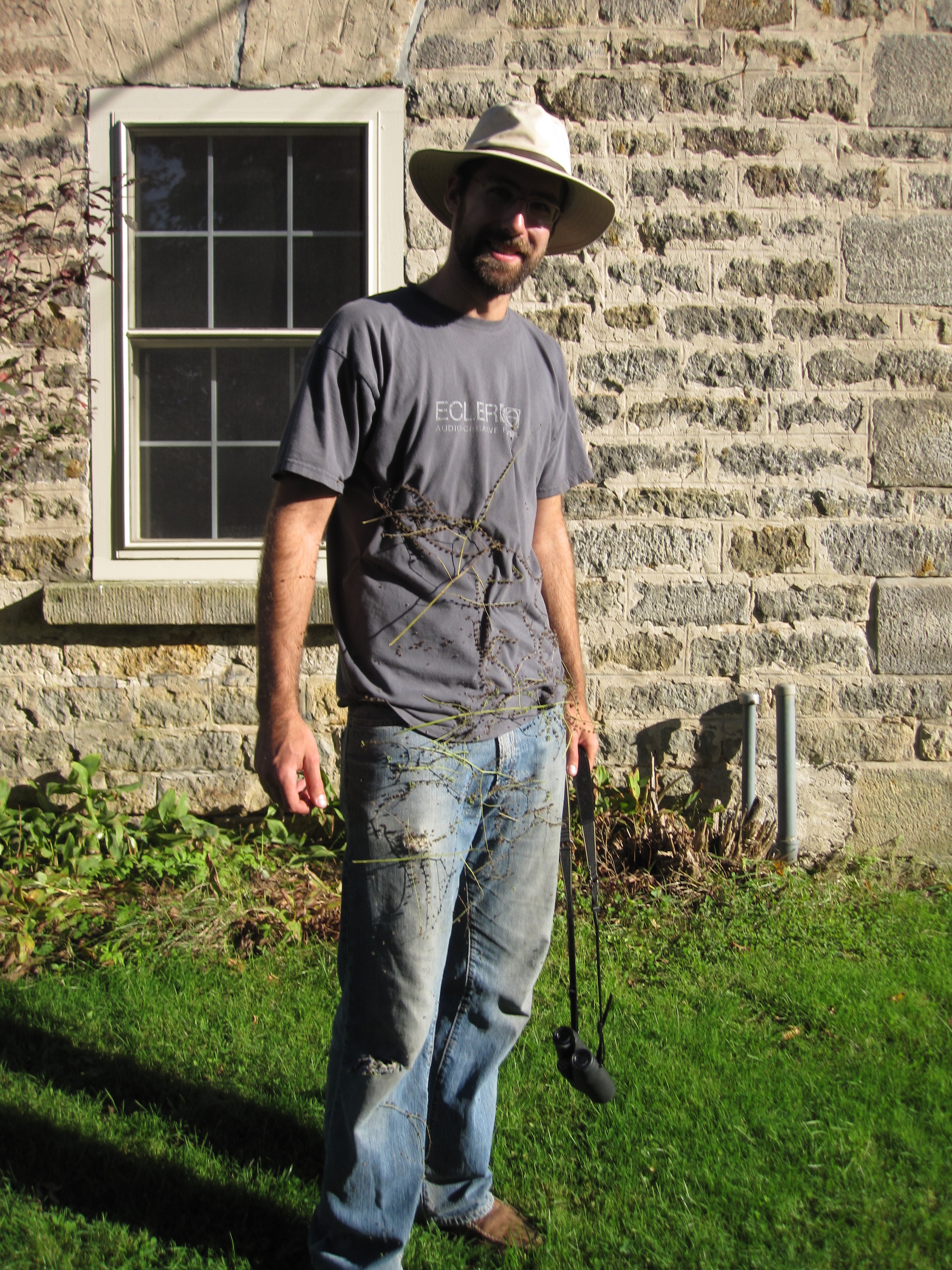
We finished a bit early after a day of shingling on the garage, so Martin grabbed the .22 and went looking for a squirrel for the pot. Eventually Charlie went to round him up for supper with the Ranger. Martin heard the UV and took a shortcut across a brush pile to intercept him. Unfortunately the brush turned out to be old fence wire and poor Martin found himself entwined, losing a shoe. But that wasn’t the bad part. On the way out he pushed through a clump of sheep burrs.
Bet compared his antics to those of the springer spaniels whose lives were made miserable by sheep burr season.
The Roofer’s Dictionary
September 19, 2010
Shingle-surfing: a giddy sensation of movement one experiences when the shingle on which one is standing detaches from the nails holding it and begins a descent of the roof, necessitating rapid instinctive movements to restore balance and control before collision with the scaffold or the ground below. The adrenaline rush is palpable, though because this activity fits the definition of an extreme sport, participation by persons older than forty years should be discouraged.
Chalk line: container for string which can be unwound and stretched from time to time to 1) illustrate by the depth of the gaps below the string how uneven the rafters are 2) demonstrate how leaving tools out in the rain turns blue chalk into an interesting paste.
Magnet: efficient device for the salvage of used shingle nails when the calculated allotment of “1000 nails” runs out.
Ice spud: useful device for the scraping of old shingles from the roof (see also shovel, kitchen knife, bread board).
Roll-up: what occurs when an energetic newbie discovers that the soft, bonded-together shingles can be rolled up (nails and all) like a piece of old carpet and dumped over the edge of the roof into the backyard (see beginner’s luck).
Hammer: common construction tool available in a variety of weights and configurations in student households, marginally suitable for the pulling of bent nails but remarkably efficient at mutilating aluminum trim and fingernails. Straight-claw variants of this common tool can actually be used in construction, though the pulling of nails turns this common type into a catapult for the projection of bent nails in all directions.
Tin snips: reinforced scissors for the cutting of sheet metal until pressed into service to cut shingles when the knife blades run out.
Utility knife: oft-maligned disposable cutting device invaluable for the trimming of shingles, thin aluminum trim and roofing membrane. When used freehand, occasionally allows the user to produce artistic shapes in shingles, which earn negative reviews from gallery viewers. Used in conjunction with a straight-edge, has the effect of slowing the entire project down, enabling volunteers to concentrate upon consolidating the shingles into a solid mass by aimless rambling around the roof waiting for something to do.
Mazda 3: modern hatchback automobile, utterly unsuited to the transport of shingles, even though the internal capacity of the vehicle with seats folded down is about right.
2 X 4: common softwood product which can be cut, shaped and adapted to any number of applications in roof repair, limited only by the supply of such products, a saw which has not yet cut any shingles, and a supply of 4” Robertson screws.
Robertson screw: ubiquitous fastening device in Canadian workshops, banned by patent law from American building sites. In conjunction with the cordless drill and screwdriver bit, produces the characteristic loud “churrrrl” sound of the handyman at work.
Roofing membrane: delivered to the jobsite in ridiculously heavy rolls, a new wonder product for use as an ice dam on low-slope roofs. Two broad plastic strips protect the adhesive side. In some cases these can be removed by pulling after the product is in position on the roof. Other attempts produce lumps of mangled plastic under the adhesive, imparting an interesting architectural contour to the otherwise bland plane of the roof. If freed from their adhesive, the white plastic strips can then blow about the building site, imparting a festive air to the project.
Flashing: sheet metal product configured to exploit principles of differential expansion and solar heat to lever fastening devices out of brick walls, utilizing hardened tar as a fulcrum; traditional behaviour of high steel workers to commemorate the completion of a project.
Rules for volunteers on the roof: 1) bring the shingles 2) lay the shingles 3) get out of the way.
Ladder: portable grounding device for the testing of the current-carrying status of overhead wires; wind gauge indicating unsatisfactory weather conditions for roofing when it blows over; justification for the wearing of hard hats on construction sites (see above).
Stepladder: useful device for climbing if set up on a flat, horizontal surface; unstable platform for balancing and contortion acts for the entertainment of spectators when installed anywhere else (see extreme sports).
Backyard: landing area for used shingles, scrap, tools, wrappers, flashing, so that the roof can appear neat and tidy in photographs. Cleaning up the backyard is never figured into calculations of cost or labour allotments.
Volunteerism: strange psychological disorder compounded of empathy and testosterone imbalance leading friends or the curious to pitch in and help. Generally one work session is sufficient to cure sufferers of this strange malady, but some will keep coming back until the shingling is complete. Even these few rare individuals will never, however, show up when it’s time to gather up the shingles and other junk in the back yard.
Used asphalt shingles: hazardous waste to the budget of the homeowner, accepted reluctantly at landfill sites after payment approaching the cost of the replacement shingles. Profit source for removal contractors.
Pickup truck: highly desirable possession of a friend, suitable for the hauling of shingles, brush, old appliances and other debris piled high in the backyard of the recently-purchased house.
Newbies: new owners of older home, prone to embarking upon major projects without knowledge or experience, relying upon energy, the Internet, and considerable intelligence to make their way through. When asked if she would do this again, this one responded: “Sure. Now we’ve done it I would never pay someone to do a roof.”
The little project that could
September 12, 2010
You can’t predict how people will use something new. The Internet began as a way for scientists to exchange information, but its early growth was driven by pornography. Broadband Internet has brought tremendous communications technology into virtually every home. Facebook and a few other social media take credit for the election of U.S. President Barrack Obama by mobilizing an otherwise-fragmented base and pulling in millions of small donations. Surveys and online polls have sprung up to take advantage of new marketing opportunities in the medium. One of these promotions is a summertime poll by the World Fishing Network to select the Ultimate Fishing Town in Canada.
I encountered Seeley’s Bay Newsletter publisher Liz Huff at a picnic this summer where she told me about the Seeley’s Bay bid for the WFN title. She took the time this week to bring Review-Mirror readers up to date:
“Liz Rudd, co-owner of Seeley’s Bay Retirement Home, first noticed the contest. She and local crafter Edwina McMaster told me about it and I submitted the first nomination for our town on the World Fishing Network site. We thought it was a great idea. We ARE a great fishing town, we need the $25K prize for fishing improvements, and hey, it’s way more fun than writing grant applications.
“Roger White of Rideau Breeze Marina got on board quickly and started filing supporting nominations on-line at the WFN site. Dale Moore, owner of The Nest Egg, a popular ice cream shop in our village, got very excited about it. She made a big sign for her bulletin board and prodded us all to put up posters around town.
“The WFN TV site encouraged people to load up videos as well as photos to support their nominations, so we made a little video featuring Shane White, son of Roger and Tracey White. With Shane’s words, ‘I want to help the fish,’ we realized that we had found our goal – and our spokesman.
“By the time the nominations phase ended, Seeley’s Bay had more supporting nominations than any other place in Canada: 147 different online submissions. Next came a public voting round in which of all the towns that had received a nomination competed. WFN announced that they would put the top two towns from the each of the West, Ontario, and the Maritimes, plus four wild-card towns, onto the final ballot of 10.
“During the second round we had hopes that we might be able to charm our way into a wild-card spot. We didn’t think we had much of a chance of landing in the top two in Ontario, given that big places like Ottawa, Kingston, Windsor and Thunder Bay were all in the running.
“But our local fishing fans were mobilizing (Postmistress Karen Simpson, Councillor Kellington, Mayor Kinsella, the Legion, the Lions Club, First Impressions Committee, etc.). More and more people were giving us permission to vote on their behalf, and before long many of us were staying up late, entering long lists of email votes on behalf of family, friends and other fans of Seeley’s Bay.
“And lo and behold, we actually ended round two in the #2 spot in all of Ontario. Only Nestor Falls beat us, from way up in the north-west corner of the province near the Manitoba border. Nestor Falls is the base camp for over 20 fly-in fishing lodges. We figure they were able to mobilize a lot of votes because all of the lodges have long contact lists of clients, and they really are dependent on fishing – totally.
“Over the next week while we waited to see for sure we were in the top ten, we tried to work on planning a campaign. We know that without the support of neighbouring towns in eastern Ontario we don’t have a chance. In fact we really need support from the Greater Toronto area. The towns across Canada that had piled up the most votes by the end of round two were Port Alberni BC, and Dauphin, Manitoba. We could see from online research that they both had great local support from their papers and TV stations. So we have been madly trying to figure out how to get people in eastern Ontario to log on and vote for us.
“Now we are indeed in the final ten. It’s a big fight. We have had great support from CTV Ottawa, CBC Ottawa, CKWS Kingston and the Review Mirror, but we need MORE.
“If Eastern Ontario residents would log on and vote for us as often as every 12 hours between now and Sept 28, we could beat the West and show fishing fans across North America that Eastern Ontario has some of the finest fishing in the country. The winning town will win $25,000 for a project of their choice and be the subject of a half-hour show on the World Fishing Network, which claims 42 million viewers across North America.”
To vote just log onto
Putting up the trusses
September 6, 2010
Instead of a tale of foible and error, I offer this week one of sore muscles and fatigue. Putting up trusses is strenuous work for an old guy who thinks twice about a trip up the stairs, let alone an excursion across wobbling trusses at the top of a roof. But Martin and Charlie were available, and it was the best chance we would have to get the trusses installed and keep the project moving.
The last time I hauled trusses along a top plate was in the summer of 1974, and I was flat-out terrified. We were building the house on the hill now owned by Joe and Elaine Laxton, and all I can remember is that the huge trusses were on a tractor-trailer bed at one end of the house, and I had to pull one end of these thirty-foot monsters along this narrow, wobbly top plate, the full length of the house while staring down sixteen feet to rocks and concrete below. I hadn’t figured out how to backfill at the rear of the house, so things were a bit ragged down there. Falling was not an option.
The worst of it was that my dad was fearless around heights. My nephew Jonathan picked up the same gene, but it skipped a generation with me. But it wouldn’t be manly to show fear. The house wouldn’t get built, either. Better to risk a fall. So off I went, dragging this truss across the tops of the interior partitions of the house, my dad on the other side, cheerfully picking his way along. Then came the the living room/dining room with no central partition, and the top of the truss dropped into the gap. Yikes! Turned out it was easier to carry in this position, so on we went, tiptoeing down our parallel tightropes.
I was very pleased to complete that day’s work with all my limbs and some of my dignity intact.
But that was then. Today’s trusses seem a bit lighter in construction. And there are no partitions inside a garage, so we were able to bring them in through the opening for the wide door, push one end up onto the far wall, then combine our efforts to gain the other wall. Then it got tricky. The guy on the bottom, usually Charlie, hooked a 2X4 into the top of the truss and pushed while Martin and I reached down and grabbed.
It looked risky but it worked. Nobody had to walk the top plate. Martin was even able to lounge on a rolling scaffold unit. Equipment has improved since the seventies.
Unfortunately the nail gun didn’t seem all that good at driving spikes through the plates holding the ends of trusses together. The hammers came out. Charlie started a strong, steady routine with the spikes, but Martin’s taps showed great effort, reasonable accuracy, but little skill or effect. Charlie explained what his grandpa had taught him, and Martin immediately improved his swing.
My job was to crawl around in the middle with the nail gun, installing braces as needed to keep the whole thing from falling down. Hurricane Earl had sent a few tentacles northwest, and we found it wasn’t hard to tip the trusses up — just let the wind get under them — but bracing needed to be quick and sure.
Gradually we ran out of space inside the garage for the nine-foot-high trusses. This meant hauling them up over the end of the building, but that went pretty well until the final truss, #13. Have I mentioned how the number thirteen seems to have it in for me? I could hardly wait to see what was in store.
Just to play it safe I lifted the heavy end-truss onto the top plate with the tractor. No disaster, despite Charlie’s worry and Martin’s objection to the slowness of the machine. Everyone’s back was still intact. We slid it into place and tacked the ends. And then the air strike hit. A sudden downpour of water and hail pummeled us as we struggled to brace the truss, but one shot from the nail gun connected with a 2X4 in the right place and we dashed for cover. They were up.
The following day Charlie and I faced the sobering challenge of the package of “ladders” which had come with the trusses. The end units are smaller than the others by the thickness of these ladders which fit over the ends and nail to the side of the next truss in. The 16″ of the ladder which hangs over then becomes the overhang for the roof.
I had no idea how to put these things up. Charlie suggested a scaffold, so we set up three lifts at the west end of the building. Some of my climbing planks are a bit old, so I grabbed a 10 inch oak plank off a pile of new lumber in the yard. My goodness, a chunk of green oak is heavy to place up 15′ on a scaffold. On the other hand, once it’s there it doesn’t move.
By the fourth section of ladder we had the system figured out and the only question remained, “How will we get the scaffold down now that we have built the eaves of the garage over it?”
http://picasaweb.google.com/rodcros/BuildingAGarageWorkshop#
Anyone can do basic carpentry. All you have to know is how to read and which way is up.
August 29, 2010
Turns out each of these is a tall order. My usual crew members have departed for B.C., one on vacation and the other to a conference, but the trusses for the garage arrived a week early. With thoughts of the pristine trusses turning to pretzels in the August sun, I made a quick call to former student Dale Edwards at Rideau Lumber and soon had materials for the walls to hold the trusses up.
Years ago when I worked in the shop at Rothwell-Perrin someone else did the layout on the panels we banged together all day. The houses seemed to assemble at a fairly quick pace. It’s another matter entirely when there’s just one old guy, a pile of new, straight 2X4’s starting to curl in the heat, and the Ranger to serve as cart and workbench.
The first task on the first panel was to fit the treated-pine 2X4 which sits on the concrete pad. The anchor bolts looked a little snaggle-toothed when I approached them with a drill. How would I get all of those angles correctly copied into the bottom of the wood?
I placed the green scantling on top of the row of bolts and gave each a firm tap with a hammer to mark the spot. Then I guessed. I drilled the holes out and the 2X4 fitted over the bolts neatly, so it was on to the layout stage.
I pressed the Massey-Ferguson into service to lift the panels with the loader. I’d left off the last foot of sheeting to create space for a chain. This worked.
But then it got tricky. Do you know how many ways there are to foul up the arrangement of two 2X4’s lying beside each other on a bench? On that third panel I think I discovered all of them. Two attempts at a very simple wall were abandoned to confusion on the first day. The following morning I laid it out again, this time with a black magic marker. I’d reached the point of no return.
The tractor lifted the panel onto the anchor bolts, two in this case. They went on fine, but one end of the panel now hung over the yard and the other was dangerously close to the centre of the garage. What?
It’s all about knowing which way is up. I had figured out how to nail up the panel without having to turn it over or reverse it, but in the process I lost track of which surface of the bottom plate had to be UP to fit over the bolts. It cost a few frenetic minutes with a hammer drill and what had been a pretty good woodworking bit to set this error right. Bet’s confidence in my abilities as a carpenter did not increase that morning.
What’s worse, I wasn’t sure the same thing wouldn’t happen on the next wall.
Then comes the second half of the woodworking prescription: the ability to read. An email from a truss manufacturer which promises delivery before September 3rd may mean the truck will arrive without warning on August 25, so it would be wise to have the space ready well in advance. I had to make the guy wait while I leveled 18 yards of gravel to make a semi-flat surface for his load.
But that’s not the only kind of reading required of a framing carpenter. My dad always put great faith in his square, but I’ve never trusted the thing. Unless you’re an expert it’s too easy to build a cumulative error into layout with one.
I remember in the mid-seventies when a group of us put up the trusses on colleague Robin Fraser’s garage. Paul Smith went down one wall with a square and I shinnied down the other. Nobody thought to check if we ended up with the same number of spaces at the end. Brimming with testosterone, the gang of young teachers on a Saturday morning had the things up and braced before anyone could look. Robin told us later that Paul and I did, in fact, end up with the same number of trusses by the end of the garage, but he had to cut every sheet of plywood they installed on that roof because of the errors accumulated over 30 feet with coarse marking crayons.
The same thing happened when I tried to transfer the marks around to the other side of 2X4’s after laying them out upside down. Factory-machined dimensional lumber has rounded edges and every line requires guesswork to transfer from one surface to the next. Things just didn’t line up right on the panels. Window frames were a little crooked. I compensated by making the openings a little larger and soldiered on. There’s always foam, and for really big gaps I can cut shims with my band saw.
What I had thought would be an easy woodworking job has turned into a real challenge because I keep losing track of which way is up. But this is the easy part. Wait until those trusses go up.
Pouring a garage floor
August 20, 2010
You Tube offers a variety of film clips on just about any subject, but when I looked for instructions on how to finish concrete, the supply of information suddenly dried up. After yesterday’s pour of a garage slab at the farm I now understood the reason. With four compulsive photographers on the job, not one thought to pick up a camera. There was just too much grit, too much to do, and too little time to spare for non-essentials.
None of us had poured a floor before. Derek offered to help before heading off to MIT for post-doctoral work. That physics background helped: he turned out to be a smart and willing concrete worker. I suspect Martin, the biologist, had never set foot on a construction site before, but he learned quickly and showed amazing strength and stamina. A veteran of projects with Dad, Charlie brought an eye for detail and a dose of caution to the mix, determined to head off his father’s sometimes-reckless excesses.
The family book on me is that I’m good at measuring and cutting but hopeless with anything sticky. Charlie’s never quite gotten over the time I varnished the transom of the boat with a mop. Concrete was an unknown, the transition from liquid to solid fraught with mystery and conflicting opinion, but all sources agreed that timing is critical.
Building inspector Alahan Kabdasamy insisted that I couldn’t pour a floor by myself, nor with one helper: I would need a full crew. So Charlie rounded up Derek and Martin and the plan came together. It’s one thing to plug away by yourself on a project. It’s quite another to schedule an inspection, a volunteer crew with little time-flexibility, and a truckload of highly-perishable concrete on a day with good weather for a pour.
It worked. The truck pulled in two minutes early, and Charlie and Martin were on time. Derek followed them in the lane. The sky was clear.
The driver quickly sized us up and took charge. He knew what to do. I had straightened a sixteen-foot 2X4 that morning on my jointer. That would be our screed. A small beam laminated up out of 4″ pine boards divided the floor in half and set the grade. We would be able to support the screed on the outside forms and the pine beam to level the concrete, then hopefully remove it at the end of the pour and fill in the gap.
The rebar at the perimeter of the slab sat neatly wired to the little plastic “chairs” I had located in Kingston the day before. For the mesh which covered the bulk of the floor the supports were just a hindrance, though. Pulling the mesh up with a hay hook or garden rake worked much better. I hadn’t anticipated quite how chaotic screeding ten cubic yards of concrete – that’s 40,000 pounds – can be. Alahan was right: we definitely needed all four guys on the crew for this part.
To push across the floor with a bull float, you hold the handle low to plane the large trowel fastened rigidly to a 12′ pole over the rough surface; for the return trip you pull from above your head to plane the other edge of the trowel on the way back. Yikes! Much taller Martin took over and quickly became proficient with the thing. He even had enough energy in reserve to shake the float to work the moisture to the surface as the LaFarge guy recommended.
I placed the anchor bolts and Charlie shaped the edges of the slab. Derek went around the bolts with a hand trowel.
Much debate ensued about when was the right time to start the power trowel: the concrete at the southwest corner was almost two hours wetter than the stuff at the northeast, so when and where do you begin?
Charlie looked horrified as I stepped up onto the slab. Oops. Sank too much. Hasty repairs. Twenty minutes later, though, I only sank about a quarter-inch, and that’s when the Internet advice suggested we start to trowel.
None of us had run one of these things. There are no useful sets of instructions available, either. We put the coarse paddles on it, started it up, and the lads lowered it onto the pad.
A power trowel has to be the most right-brained tool I have ever operated. I couldn’t tell you now how to control it. The more I troweled the less I had to rely on strength, but I don’t know what I did differently. The coarse paddles took a serious toll on the anchor bolts, though. Derek and Martin stayed busy with repairs.
But the machine reduced the sticky concrete to a workable substance I could measure and cut, so I soon had the grade where I wanted it. Internet advice said to continue to trowel until you don’t care any more. That point came quite quickly because we were bushed. The slab was smooth and slightly grainy. Any smoother could be a safety hazard. Into the trailer and back to Elgin the strange inverted helicopter went.
Fortunately by 3:30 a thunderstorm took over and gave me a break from spraying the slab. After supper I rolled on a coat of preservative and the day’s work was done. Whew!
TED
August 15, 2010
Charlie and Roz showed up on Saturday and the new iPad soon made an appearance. It’s a neat device for Internet browsing with very good picture resolution, but without the versatility or sheer power of my laptop. As Roz said, “It’s a good computer for reading the newspaper in bed.” Charlie loaded up a file from TED.com and handed the iPad to me. I didn’t know what to expect.
On a small stage stood a young woman who looked funny. O.k., I thought, a standup comedienne. I settled in to listen to her pitch. Well spoken for a comic, I thought. And bright. Laurie Santos talked about how our brains are wired to make the same stupid mistakes, time and again. Pretty standard stuff.
Then she wheeled out photos of a distant relative, a Columbian monkey, and explained how in her lab her staff taught a group of them how to use money, seeking to prove that the kind of errors which produced the financial collapse were no accident nor the result of the work of a few bad apples: the collapse was a result of errors genetically built into our species. Hmmm.
To prove her point she taught a group of monkeys to use money, then in experiments observed them making the same mistakes their human cousins make. For example, if the subject had some money and had a choice of taking a risk or not to gain more, the primate would often stand pat rather than risk a loss.
She suggested her audience members should not immediately fire their financial advisors and hire the monkey, though, because it turned out the chimp would likely make the same mistakes as the first guy.
In the other half of the experiment, when the same subjects had money and faced the prospect of losing it, they would often take risks out of proportion to the benefit to preserve their current level of wealth, much in the manner of Wall Street investors over the last two years.
She concluded, however, that Man is very smart, and armed with this observation should be able to learn from it.
I felt a bit like a laboratory subject myself as I experimented with the iPad. Charlie bought it to develop applications for use by elderly patients in doctor’s offices, and I think he let me loose with it to see how a clumsy and myopic senior would handle the touch-sensitive pad. Right off he decided that any sensors toward the outer perimeter of the pad are too touchy to use in an application for inexperienced users.
But actually I liked the little thing. It’s light and relatively easy to operate, with very good resolution, especially when Charlie configured it for HD. But the real surprise was the content of the film I watched.
TED.com offers a tremendous variety of short, illustrated presentations on topics of general interest. Call it an on-line Popular Science magazine. Many articles deal with global warming, the oil spill, finding life on other planets, but there is also humour.
For example comedian Poet Rives runs through a routine on 4:00 a.m. If you loved the Da Vinci Code (or maybe if you love to laugh at Da Vinci Code fans), you’ll get a big kick out of Rives’s satire.
I could rant on here about how wonderful this site is, but a quote from one of the programs should do the job. Elif Shafak is a writer. Her twenty-minute lecture, The Politics of Fiction, is one of the best I have seen. Here are two paragraphs from it:
Many people visited my grandmother, people with severe acne on their faces or warts on their hands. Each time, my grandmother would utter some words in Arabic, take a red apple and stab it with as many rose thorns as the number of warts she wanted to remove. Then one by one, she would encircle these thorns with dark ink. A week later, the patient would come back for a follow-up examination. Now, I’m aware that I should not be saying such things in front of an audience of scholars and scientists, but the truth is, of all the people who visited my grandmother for their skin conditions, I did not see anyone go back unhappy or unhealed. I asked her how she did this. Was it the power of praying? In response she said, ‘Yes, praying is effective. But also beware of the power of circles.’
From her, I learned, among many other things, one very precious lesson. That if you want to destroy something in this life, be it an acne, a blemish or the human soul, all you need to do is to surround it with thick walls. It will dry up inside. Now we all live in some kind of a social and cultural circle. We all do. We’re born into a certain family, nation, class. But if we have no connection whatsoever with the worlds beyond the one we take for granted, then we too run the risk of drying up inside. Our imagination might shrink. Our hearts might dwindle. And our humanness might wither if we stay for too long inside our cultural cocoons. Our friends, neighbors, colleagues, family — if all the people in our inner circle resemble us, it means we are surrounded with our mirror image.
Catch the rest of Shafak’s presentation at http://www.ted.com Don’t be surprised if this site quickly becomes your timewaster of choice.
 the Walnut Diary