In a delicious bit of irony apparently lost on the Ottawa press corps, Opposition Leader Michael Ignatieff inferred Monday that Prime Minister Stephen Harper may have to make up the time lost when he prorogued the House last winter before the Liberals allow summer recess. He didn’t say it in exactly that way, of course.
Instead he showed his disappointment with the wayward Stephen’s most recent economic report, but he chose to return the assignment for revisions before flunking it. Stephen must realize, however, that if he doesn’t do some major work before Friday, he and his party will spend the rest of June in the House until he upgrades his work to a level acceptable to the professor and the Canadians he represents as Leader of the Opposition.
“If the PM has something good to help the jobless, I will support it. I’m prepared to make compromises which will help the unemployed. I’m looking for co-operation, not confrontation, but I’m ready to vote against the estimates on Friday, and yes, the full Liberal Caucus will be present in the House for the vote.”
As well as criticizing the E.I. gap, Ignatieff noted that the current estimate has dropped any mention of a plan to get the Canadian economy out of deficit, and this shows a significant lack of leadership. Further, the spending statements and projections contained in the report failed to provide specific information Canadians need to know.
Ignatieff seems particularly concerned with the current medical isotope crisis. He mentioned that he has spoken to the supplier in Australia. “I asked, ‘O.K., can you scale up here?’ He responded that we can’t guarantee our supply will reach Canada.” “This is a big deal. Tell us honestly what the situation is. This is a very serious failure of leadership by this government and I can’t let this go on longer. This is a public health matter, not partisan politics.”
A journalist asked if Ignatieff would advocate taking funds from infrastructure spending to boost E.I. payments. He responded by saying that on the subject of infrastructure spending, the Harper government leaves the impression of an adolescent with a garden hose spraying a backyard. On the other hand, the numbers in Harper’s own report make it clear that the most effective stimulus spending during the recession has been E.I. payments: they provide immediate and effective help. “If Harper can convince me a large rise in E.I. would cause a big problem of public finance, I’ll listen. But I want to help the unemployed. I’d like to discuss this with the P.M. He knows my phone number. I’d like to work with him on this.”
“I don’t seek an election, but we need accountability and I want some answers. He promised changes in three months in his last report. Now he mentions some plans to look at E.I. in the fall. What counts is getting action to help the unemployed. If he’s got something good to help the unemployed, let’s get it out now, not later, after the seasonal workers have missed the benefits.”
“Any sensible person understands that Canadians want to work. There are 58 regional variations across Canada on E.I. The P.M. won’t get away with saying that in three months he may come back to it.”
Accused of giving Mr. Harper a way out, Ignatieff responded: “We just had an election. I’m just trying to work with the government to make Parliament work. I don’t want him to give in to me, I want solutions that are good for Canadians.
Tory cabinet minister John Baird had spent the quarter hour before Ignatieff’s speech today in front of a CTV camera attempting a pre-emptive strike on the Leader of the Opposition’s credibility by using the word “games” a lot. Ignatieff came back with, “I won’t put a grade on this economic statement. The stakes for Canadians are way too high for that. This is not a game. What Opposition is for is to ask real questions and seek real answers on behalf of Canadians. The big prize here is to make Canadians feel we have a pretty good system of government here which can work for them.”
A CBC commentator concluded, however, with another games metaphor: “The ball’s in Harper’s court.”
Canadians are unlikely to share the pain of parliamentarians if Ignatieff makes them sit through the month of June and even longer while they finish the work of a session cut short by last winter’s prorogation. Serves them right.
Something is eating my butternut trees!
June 7, 2009
A couple of weeks ago I was driving Leeds County Stewardship Coordinator Martin Streit around the property as I explained our needs for next spring’s tree planting project. I showed him various groups of saplings which we had planted in the spring of 2006, and I commented that the butternuts donated by the Rideau Valley Conservation Authority were doing very well, even though they were not the later, blight-resistant variety he sent along last year. Then we came to the actual plot, and half of the trees had lost their leaves!
This had to have happened within a couple of days, because I had been back there checking on them recently, and they were fine, except for a few black beetles crawling around some leaves. The bugs had seemed harmless. Now half the 116 trees looked dead.
What’s more, when we checked the mature butternut in the woodlot whose photograph Martin had included in his annual report, it had been defoliated, as well. Because the lowest branch is about 60 feet up, collecting leaf samples from this tree was out of the question.
Martin told me he would contact Susan McGowan, the MNR Forest Health Technical Specialist based in Kemptville. Sue arrived two days later and examined the saplings in the butternut plantation. By this time many were beginning to sprout new vegetation, so they didn’t look quite as devastated as they had when Martin and I first encountered them. They were still in big trouble, though.
This was my first chance to watch a forest detective in action. My biggest problem was to stifle the questions and let her work, but Sue was very tolerant of my curiosity.
She immediately examined the tip of a branch where the compound leaves had been sheared off. “A deer did that?” I argued that we don’t have deer here; the coyote has always kept them away. She just pointed to the tracks next to the tree. Oops. Then I remembered: the coyote was killed on the highway a couple of months ago.
“But that’s not all. Look at this.” She broke off the tip of a branch and extracted a fat grub. “That’s a twig borer.” She took pictures and dumped it and a few others she collected into a brown paper sack.
When I later tried to produce a grub to show Martin, I just kept breaking off healthy branches. I still don’t know how she knew where to find the twig borers, but she never missed.
Sue pointed to a crumpled, dying leaf. “That’s a gypsy moth. And here’s a forest tent caterpillar. Notice how it doesn’t have a solid stripe on its back like a regular tent caterpillar? If you look closely you’ll see a series of little keyholes down its back. This one does not spin a web.”
Sue went on to find more of the little black beetles I had earlier captured, some exotic insect with vivid orange legs, and a few tent caterpillars, as well. Everything went into the large bag for the lab in Sioux St. Marie. “They hate it when I send more than one thing in a bag, but what can you do? We’re in the middle of a perfect storm of things eating your trees. It must just be a really good day for insects.”
“And deer,” I mused ruefully. Sue departed with the evidence for the lab, and promised a report with suggestions as to how I can prevent such an infestation in another year.
The large doe who chose my walnut field as a nursery last week? That’s another matter. I need a good coyote, right away. That thing is munching her way through my walnut seedlings at a great rate! She even came out for a feast today while I was mowing the field. The doe is a beauty, though, and I think it was a maple she was eating this time, not a little nut tree.
We haven’t seen the fawn yet. Maybe we should hold off for a couple of weeks on the coyote.
Landing craft/utility trailer?
June 7, 2009
No kidding, this morning in Portland I examined a 15′ aluminum landing craft/trailer. It was hitched to a full-size Mitsubishi SUV and had a 25 hp Merc mounted on the transom, which faced forward, surrounded by the trailer’s A-frame. The frame decoupled with pins, then a handy little hydraulic pump raised it to provide a radar arch, I guess, above the motor. Two seats at the stern protected fuel tanks and allowed for tiller steering. Amidships, wells allowed the wheels to rise into compartments which were then shielded, if not sealed, by sliding panels to improve the hydrodynamics of the hull. But the clincher came at the bow of the craft (back of the trailer). A wide, boiler plate aluminum ramp unclips and drops for beach landings. It’s all carefully sealed, but you can drive your lawn mower ashore and up onto hostile crabgrass in one easy motion if you haven’t been hit by artillery fire on the way in.
I stopped and gaped at this thing for quite a while. It’s Ontario-registered, and I think it might be Ontario-built. It’s an amazing bit of misplaced ingenuity, to my view.
The Attack Ad
May 31, 2009
I hate attack ads. There I was, settled in for a Saturday evening of Hockey Night In Canada. The tempo of the game riveted me to my seat. At the end of the period I didn ’t dash away, perhaps because of the quality of the game, or perhaps because of fatigue after a day of gardening. I sat there, willing even to listen to Don Cherry’s rants. And on it came, the “Just Visiting” ad. It doesn’t say much, just that Michael Ignatieff spent an entire career outside Canada and now wants to be Prime Minister out of personal ambition. My first reaction when I saw the ad on You Tube was to ridicule it as a feeble attempt to weaken the powerhouse that is Michael Grant Ignatieff.
I remembered that Ignatieff’s uncle, George Grant, wrote Lament for a Nation. Since its publication in 1960 this book has defined what it is to be Canadian. I further remembered that among Michael’s ancestors lie two principals of Upper Canada College, one principal of Queen’s University, and Vincent Massey, perhaps Canada’s greatest Governor General.
“Just in it for himself?” No. That’s Stephen Harper using Flaherty’s fall economic update to attack personal enemies: women, the public service, opposition parties. That’s Stephen Harper proroguing parliament to save his own political career. That’s Stephen Harper’s attack on Quebec during question period because they refused to give him the seats he needed for a majority.
I know these things, but when I’m watching Hockey Night In Canada I’m not in the mood for political debate. I’m watching two romantic groups of men competing with all their hearts for the holy grail of sport. My mind is far from the rational, pragmatic attitude which protects me from the demagoguery of an election campaign.
This is the genius of the attack ad long before an election call: it hits the viewer in a deep, emotional place, far from the intellect which can tell fact from fiction, and it repeats the attack many times per night at the one time of the year when the Canadian male is at his most vulnerable, the Stanley Cup final.
So I know in my mind that Michael Ignatieff has one ancestor who was the first Canadian-born Governor General. Another family member wrote the book on what it is to be Canadian. His father was a diplomat, and Michael is following a strong family tradition of public service. But that’s another part of my brain. The television says that he’s just in it for himself, and as the song goes, so does my heart: “I know it’s true, oh so true, ‘cause I saw it on T.V.”
Revolutionary in a gray suit and parka
May 30, 2009
Some of the dumber American bloggers have had a field day this week with comparisons between Michaelle Jean and Sarah Palin.
Animal rights activists are furious, Europeans are shocked and dismayed, and Canadians in the north now afford our Governor General the kind of adoration normally reserved for rock stars. So what happened, and why is the holder of a staid, ceremonial role in a dull country suddenly such a polarizing force in world opinion?
Michaelle Jean attended an Innu banquet on Baffin Island as part of her official duties. The main course consisted of several freshly killed seals lying on the floor on tarps. Jean participated in the feast. Using a traditional knife she sliced up a bit of the seal carcass, then ate a small piece of heart when it was passed to her. With great fortitude she joined her husband and a red-haired woman in tasting the samples, then commented on the quality of the food. She looked a little pale, but she held the food down and kept a coherent flow of polite words running for the camera. This was clearly no thrill ride for her, but she toughed it out because she had a point to make and she was determined to do so. She still managed to keep her outfit clean throughout the process.
What the film clip reminded me of was the scene in Ghandi where Ben Kingsley made salt from sea water in defiance of English rules, and it is to the life of Ghandi we must look for perspective on the decisive act of Michaelle Jean. Ghandi jolted the British public with acts of polite defiance in which he showed that the vaunted principles of the British Empire did not match their practices in the treatment of Indian citizens of South Africa and India.
Ghandi’s well-publicized acts of civil disobedience directly led to Indian independence, because he correctly reasoned that the Western people had no stomach for their own hypocrisy, and would do what they needed to get these disturbing images and stories off the pages of their newspapers.
Jean’s very public act of respect for the Canadian Innu community undoubtedly shocked “civilized” Europeans and even some Canadians, but when this act is placed in context alongside fellow French citizen Brigitte Bardot’s visit to the seal hunt (when she fled to find a bathroom) or even the McCartney’s more recent photo-op, it should stand out as a defining moment in the consciousness of the environmental movement.
Up until now the anti-seal hunt movement has been about pictures of famous and glamorous people on ice floes with baby seals, and disgusting images of blood on the snow. Michaelle Jean changed the game. It’s now about the taste and smell of a mouthful of seal heart, and about the feel of blubber, bone and skin, and the humility of kneeling on a tarp on a floor to participate in an ancient, life-sustaining ritual. Jean has announced to the world: “This is Canada. The seal hunt is a part of us. If you want to play in our league, you’d better get serious.”
Halfway through the construction of a basement door my chop saw quit this morning, an obvious burned wire somewhere. So I took the thing apart and located the culprit, shorted another wire on the re-assembly, took it apart again and generally familiarized myself with the machine and its construction on the next three or four disassemblies. Then it went back together and worked fine until I tried to cut a board. Damned thing was turning backwards. Tried reversing the polarity on the plug. Nope. Put that back.
The only thing that wasn’t the same as before was that the motor housing had gone on upside down. Off it all came and apart it went. The red wire gave me fits again as I re-routed it for the fifth time, and then the thing worked, as normal, but more smoothly than it has run in years. Nothing like a thorough cleaning to spark a motor up. Turning it backwards really lets go with a lot of dust.
Almost four hours lost, but it was fun.
Props and rocks
May 24, 2009
The ice on Newboro Lake took out more than docks this year. It also removed two shoal markers from Miller’s Bay. In my defense I must state that this was my first expedition out from the new slip at Newboro. The boat’s been used to coming from Chaffey’s Locks, and it can be forgiven for not quite knowing its way, yet.
Navigation on Newboro Lake is mainly a matter of perspective. Everyone knows the hidden rocks of the lake will reach up and bite you if you stray off certain rigid lines of travel, but I had given up my line of sight when I approached Miller’s Bay from the wrong direction.
I remember thinking, “Odd, I seem to recall a floating marker buoy in this bay, right about here”…CRUNCH—zzziiiiinnnnnggggggg—clunk. The engine flipped up after the impact, then dropped back into place and slowed to an idle as I shut the throttle down.
Hoping for the best, I reapplied the throttle and the boat climbed back up on to plane without much vibration, so I continued on my course, though at reduced speed.
This was nothing. A prop on a Merc 35? No problem. Dave Brown probably has a dozen of them.
Things used to be a lot different when I was skipper of the old wooden yacht, WYBMADIITY II. WYB could only be lifted out of the water on a travel lift, and the nearest one to Chaffey’s Locks is in Portland. That’s two or three locks away, a long, expensive tow. The prospect of a summer lost to delays and huge costs made me stick to the channel.
Sailors can afford to run aground just for the adventure, or to get a new perspective on the world in tidal regions. Their hulls and propellers are protected by a deep lead keel.
Actually, Wyb has a full keel, too, but it didn’t do much of a job in protecting the prop on two occasions during the twenty-five years we cruised on her.
The worst was during the first month we owned the boat. Bet and I had just brought her down Lake Ontario from Port Credit when I received a phone call inviting me to a summer course in Peterborough.
I had four days after school ended to get the boat from Smiths Falls to Peterborough. Brock Fraser, one of my students, volunteered to crew for the trip. After university Brock went on to a career with Parks Canada in British Columbia.
The cruise down the Rideau and west on Lake Ontario had gone well. We found the entrance to the Bay of Quinte and cruised merrily up the Long Reach as darkness fell. Then came the fateful decision: do we stay on the marked channel with its illuminated buoys, or pull into that well-lighted harbour off to the left and moor for the night? We stayed on the channel, found a wide spot and dropped anchor. In the morning we discovered the “harbour” was actually a large barnyard with no docking facilities. Good call, Brock. Proud of our navigation success, we headed on into Belleville for breakfast.
The problem came when, full of bacon and confidence, we pulled out of Belleville. Here was the Moira. There was the bridge across the bay. What we didn’t notice was a little green marker way out in the middle. No, we came out of Belleville and turned right. Before long we heard the juddering thump, thump, thump, bump. WYB has a long oak keel, and that rock ground about a half-inch off the bottom of it before she eventually floated free.
I’ve heard it said that powerboat skippers are limited to two emotions: fear and anger. For the rest of that morning I certainly had the fear part down. The boat still ran, though with a little vibration. I couldn’t tell how much damage I had done, but the scraping of the keel over that rock certainly hadn’t done WYB any good.
When we pulled in to Trenton I put on a mask and had a look underneath. The beautiful, 3” oak keel’s bottom was no longer pristine. I had run the old girl aground for the first time in her long career. The prop, protected by the keel, had only had the tips crushed, and I hoped it would get me to Peterborough and back.
At the end of the season, Ross Ayling sent the prop to be recast. The next time I crumpled it, on a log in the Mud Cut on the Lower Rideau, he pounded it back into shape with two large hammers. It turned that way without further accident for another twenty years. I had gained the essential attribute of the successful skipper: fear.
I hauled the fishing boat home on its trailer, unbolted the crumpled prop and took it in to Brown’s Marina in Chaffey’s for an exchange. Dave trotted off with it, leaving me time to gaze into the crystal clear water. Two beautiful splake darted into view. This had to be an omen!
Surely enough, Dave had a prop, and at a reasonable price. I was back in business after my navigation lesson.
When the oak leaves are the size of a squirrel’s ear
May 14, 2009
It’s time to hunt for morels, according to one Internet article I read this week. In Leeds that was the interval from May 5th to May 13th, and yes, there were some to be had in local forests at that time.
Another blog quoted an unnamed newspaper reporter on the subject of finding the tasty fungi. The article suggested that the season begins in mid-April in central U.S.A. and moves north at a rate of 100 miles per week. Apparently it continues until three consecutive 80-degree days occur. I love the author’s certainty, but when he suggested there was little point in hunting for morels anywhere except around the stumps of recently-dead elm trees, I decided to see if this was hot air or not. Off I went to check out elm stumps. To my surprise, I had to conclude the guy is right. I came up with three new picking sites in a morning’s search.
Many bloggers this year are gushing about huge hauls of morels. Around Forfar the harvest so far has been sparse, though steady, with quite a few small blacks, but not many of the larger commons. One heavy rain and strong southern wind encouraged quite a few commons to peek out of their leaf and grass cover, though, and that evening Bet and I found a hatful where I hadn’t seen any a few hours before. Maybe it was the diffuse evening light which made spotting easier. Common morels are very well concealed at the best of times, and the temptation after you find one is to peel away layers of leaves and grass in case there are more which have not quite emerged, but therein lies madness. Morels only grow where they want.
Because pickings have been too slim to justify the effort as food-production, I’ve decided to separate the sport of morel hunting from the enjoyment of processing food for the table. The challenge of picking the pattern of the sponge-like fungus out of the other cover on the forest floor is fun in itself. It’s like those eye-twister games they run in The Citizen, or those Where’s Waldo? books.
It’s funny how the mind gets trained to find them. It’s often one’s peripheral vision that gives the first indication of the presence of a prize. Then it takes some methodical searching to track down the culprit. It’s quite like bass fishing, actually, and I think I’m getting better at it.
A cautionary note from a woman in Burbank, California appeared in a blog. She commented that she almost died after eating a skillet-full of sautéed morels and washing them down with beer. According to her, excessive consumption of morels and alcohol can create a compound which dissolves a membrane which protects the central nervous system. She claimed that her neurologist found the antidote (saline drip with B vitamins) in an old mushroom book.
The vast majority of blog posts, however, celebrate the great meals to be had from fresh and dried morels, so I suspect their benefits outweigh the risks. It might be a good idea not to drink alcohol during the meal, though, and of course one must never eat morels raw, or allow pets to consume them.
Last year we discovered the new gas range does a great job drying halved fruits even though it does not have a pilot flame. The convection fan and the light are perfect to dry tray after tray of the fungi.
From last year’s bumper harvest Bet froze some of the dried morels in paper bags, and stored the others in similar bags in a basket on the bookshelves. The room-temperature packages preserved considerably more flavour than the frozen, dried product.
We’re still hoping for a major morel hatch, but the oak leaves are now much larger than a squirrel’s ear, so time may be running out for this year. Keep an eye on the ground around dead elms, though.
The Common Loon
May 10, 2009
In an English text a few years ago I came across Margaret Laurence’s Loons, which traces the loss of innocence of two Canadian girls. The title draws the reader into the story, but all the loons get to do is sit at the end of a lake and hoot. Nevertheless, Laurence uses the birds to evoke a vague bond with nature. Their extinction in the story she uses to show the girls’ loss of innocence and youth.
The author of the text fawns all over these mythical loons. The spectre of their impending doom works achingly into every note. From this prompt a student can hardly fail to generate even more fatuous hand‑wringing over the fate of the loon.
Instead of the fine art and variety of Lampman, Johnson, and Mowat, our renewed awareness of nature has left us stuck with the silhouette of a Loon plastered onto a million sweat shirts, coffee mugs and coins. The loon has become the inflatable doll of ecological guilt.
I would suggest that the real loon is a creature quite different from the popular symbol. The real loon doesn’t choke on the acidified air of Algonquin Park. He thrives on the Rideau Lakes with his brood, and screams the night away to the delighted anguish of caffeine‑soaked cottagers.
The real loon is no ecological wimp doomed to extinction from boat wakes. Newboro Lake loons bob merrily among the tidal waves thrown up by passing Sea Rays, Bayliners, and Dorals as the annual spawning run of Quebec boaters arrives. Biologists quake in horror, but the loon families calmly nest on sides of islands away from raucous boat traffic. Loons didn’t get this far without the ability to adapt.
Real loons can be a bit of a nuisance. What fisherman can tend his line when a dozen or so loons are conducting a Sunday morning church service, swimming in a large circle in that eerie dipping ritual?
I’m not so sure about their mythical fish‑finding abilities either, because if the boats out trolling start to cluster in one location, the loons are soon on the scene. I’m waiting for one to ask to use my depth sounder.
On the water they are good company, if they’d only stay there. You’d think that with all that water, and fish everywhere, loons would be content to stay wherever they happened to be. But no: about quitting time they start yakking back and forth to each other, sometimes from a mile or more away. Try talking to anyone while this is going on. Worse, they decide to switch lakes, or get together for a drink. This involves several minutes of confusion for everyone, as they taxi, take off, yell at each other, land again, and finally depart. They’re a little awkward when entering and leaving the water, and they tend to distract boaters from more appropriate activities such as crunching ice cubes and polishing Tupperware.
Then comes morning. Loons love to sneak up on anchored yachts. I think they like the smell of coffee and bacon. (No morning skinny dips allowed in Loon Country.) Anxious dogs must be rowed ashore, or else lost to a morning of loon‑tag.
Honest. Loons try their best to separate dogs from their boats. I have photos of three of them trying to entice my spaniel off our swim platform. Once Patch joined them in the water, they’d see how far from the boat they could get him to swim. They’d take turns. They’d let him get dangerously close, only to speed up, just out of reach. If I’d call him back, they’d come too.
Loon mug in hand, the reader will insist that loons are only protecting their nests when they do this. Since when do loons nest a half‑mile from shore? I think they came to our anchorage because they’re bored.
The only good thing which I can say about loons is that they don’t beg handouts. Unlike the mallards and sea gulls of the area, the loons ask nothing but an occasional bushel of splake or bass fingerlings from the Ministry of the Environment stocking program. Apart from that they are sufficient unto themselves.
Perhaps loons are good symbols for the writer. They do have an other‑worldly aura. They don’t bunch up and litter docks and beaches the way Canada geese do in cities. Loons stay wild without the help of birdshot.
Perhaps loonies are useful coins. Northern Reflections shirts and Algonquin Park promotional materials could contain less pleasing logos.
Perhaps I should join the trend, rather than laugh at it. For Christmas gifts, what would be better than loon slippers? Just think. You wake up at night. You want to raid the fridge, but must not click that light switch and wake the family. You shuffle into your new loon slippers and begin the trek to the kitchen. You get there without mishap, because last night the sleeping spaniel found himself on the receiving end of a loon slipper, and he’ll never lie at the top of the stairs again. He now sleeps on his back, snoring in disgust, between the magazine rack and the fireplace. No more loon slippers for him.
Morels! (updated)
May 5, 2009
May 14th, 2009: They’re still popping up through grass and leaves. A heavy rain and a warm, south wind seems to have encouraged quite a few common morels to make themselves evident. They’re very hard to see in the grass, but Bet and I have been finding them peeking out from under cover. Of course it is tempting to move leaves and grass to find the others, but therein lies madness. Morels only grow where they want.
I read an American newspaper article one guy had on his website. It suggested confining hunting activities to newly-dead elm trees. This produced results for me today. Another point the unidentified author made was that the season continues until three consecutive 80 degree days occur. I don’t know how well that knowledge travels north. He further suggested that the season starts in mid-April in his area and moves north at a rate of 100 miles per week. http://outdoorsportsman.wordpress.com/2008/05/12/how-to-stalk-morels/
Good luck with the hunt. I think it’s at its peak now in the Eastern Ontario area.
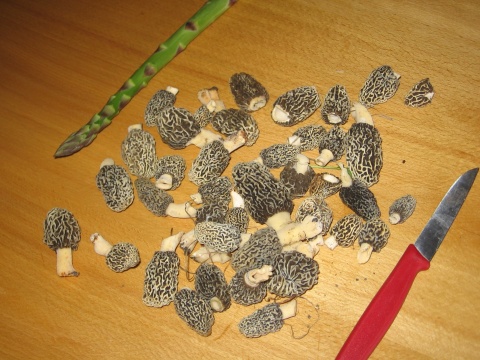
May 5th, 2009: They’re starting! This morning I found a few tiny black morels in my favourite spot, and by late afternoon I was able to collect the group in the photo. They’re still quite small, but rain is forecast for the next three days, so they may last until the weekend in Leeds County, Eastern Ontario, Canada.
This is good.
The first pick of the year
 the Walnut Diary