On Democracy
January 18, 2009
In The Voyage to Lilliput Jonathan Swift portrayed a class of men whose fortunes depended upon their skill at balancing on a tightrope. Another group analyzed such performances and predicted who would fall and when. Swift’s light satire of the British Parliament takes an ugly turn, however, when Gulliver realizes that these beautiful miniature humans routinely use their laws to justify savage acts of aggression and greed, and there is no virtue in them.
I fear Swift’s words apply as well to democracy in the 21st Century as they did in the 18th. The signature moment of the last quarter of the 20th Century had to be the death of communism and the fall of the Berlin Wall. The first quarter of the 21st may well mark the death of democracy.
Let’s look at the last two years in Canada as an example. The Liberal leadership convention was manipulated by Gerard Kennedy, a clever rope-balancer who would not have appeared out of place in Gulliver’s Travels. In hopes of personal benefit he formed an alliance with Stephane Dion to leapfrog the two leading contenders. Delegates with an eye on little but victory went along with the plan, and almost by luck of the draw Stephane Dion ended up the deeply-flawed leader of the Liberal Party of Canada.
This left the door open for Stephen Harper, a man of unsteady balance, to take power and keep it by a ruthless campaign of partisan attacks upon any and all opponents.
I am disgusted at the gleeful way that Harper and his minions pick over the bones of what was once the great institution of Parliament, but I recall what has happened to leaders in Canada who have attempted to act unselfishly. At his retirement Bill Davis extended full funding to Catholic schools. John Tory promoted equitable funding for the schools of all religious denominations. Voters rejected the plans resoundingly. An election campaign is no place for ideals.
Stephane Dion’s carbon tax was the right approach to lead Canada into a new century, but citizens voted their wallets, their prejudices, and the images created for them on television. All Harper had to do was claim loudly that the plan was “crazy” and “would screw everybody” – even when his own studies proved the opposite to be true – and voters gleefully torpedoed the Liberal Party.
Then we come to Count Ignatieff, a man who shows little interest in democracy, but seems willing to listen to Canadians. His reluctant philosopher-king persona harkens back to a time when wisdom, vision, and commitment to the greater good were what mattered in a leader, not fund-raising ability or the willingness to savage opponents. Perhaps it is appropriate that he took office by coronation. Democracy hasn’t exactly distinguished itself lately.
Then we look below the border to the Obama inauguration. I like Obama and I love his oratory. The doubt in the back of my mind has to do with the nature of his democratic mandate. Admittedly, the Republican Party was so bankrupt after eight years of George Bush that they had lost the will to govern. They selected the most liberal of all their candidates and then wondered why few Republicans supported him. They cheered when McCain brought in the Palin soap opera to energize the most conservative Republican voters. Neither of these tactical errors ensured the victory of Obama, but one blooper killed the McCain campaign: they failed to raise enough money.
Obama may come to be known as the Internet president. While McCain made the fatal error of admitting that he couldn’t use email, Obama’s political machine used social networking sites to raise millions of small contributions from individuals. It is here that his “democratic” mandate lies. The flow of cash left no doubt that many, many people bought into Obama’s vision of a better world.
These funds enabled his campaign to blanket the culture with advertising, even to the point of buying space for billboards in video games. The U.S. Presidential Election was won not on the debating podium, but in the battle of the budgets. Obama had four times the money to spend that McCain had. That’s democratic in some sense, but I still have my doubts.
So what’s wrong with selecting leaders by vote? It should work fine in a village to hire a dog catcher. It might conceivably work to elect a president in the U.S. system. But Canada is a vast mosaic of cultural, regional, and economic groups. To cram all of their needs and aspirations into a single ballot is to enable the tyranny of the winner over the vast majority.
All it took to form the government of Canada the last time was 37.6% of the vote, with a turnout of 59.1%. But Stephen Harper took the choices of the 22% of Canadian citizens who voted for his party as a personal mandate to bludgeon the 78% who did not support him. Thus in his first economic statement Jim Flaherty went after the opposition parties, public servants and women, and Harper showed his spite after a failed courtship with bridge-blowing tactics designed to cut Quebec off from the rest of Canada.
So now comes the new budget. That pall over Ottawa these days is the smell of Stephen Harper’s Hush Puppies smouldering as Iggie holds the PM’s feet to the Parliamentary furnace. This undignified Anglo Saxon method of encouraging a man to keep his word might very well work. Be ready for plenty of squeals from Harper and his minions this week, though.
So much for Carfax.
January 16, 2009
CBC’s Marketplace, January 16, 2009:
The lead article this evening effectively drove a stake through the heart of the Internet auto shopper’s standby. Marketplace staff examined four late model Vancouver vehicles for sale or recently sold at dealerships, all with clean Carfax reports. Their forensic mechanic had no trouble identifying that each had been in a major collision, despite the dealers’ claims to the contrary.
Competing automotive history services had some of the collisions on record, and each of the vehicles had sold at auction as “frame damaged.”
At the time that I bought my truck on eBay Carfax promised to buy back any vehicle that proved to have unreported damage. No mention was made of this promise in the Marketplace piece. In fact the Carfax spokesman could do little but grimmace and try to evade the blame the interviewer relentlessly plastered all over him. The best he could do was to blame the agencies who had failed to report the accidents to Carfax. Reporting damage, apparently, is voluntary.
To my mind this piece of journalism destroys the credibility of Carfax as an instrument for car purchasers, but I invite readers to have a look and decide for themselves.
http://www.cbc.ca/consumer/story/2009/01/15/marketplace-carfax.html#socialcomments
Coyotes I Have Known
January 12, 2009
Margaret Brand’s “Coyote population still on the rise” in the January 8 edition of The Review-Mirror quotes Scott Smithers of the Ministry of Natural Resources: “People need to take the best measures to protect their property.” Unfortunately the second half of the article was lost in my edition of the paper, so I don’t know how it ends. I hope the conclusion will appear in the next issue as a correction, because a balanced approach to coyote management is very important.
My parents raised sheep on Young’s Hill for fifteen years and the only ewe they ever lost they blamed on Sally, the border collie. She had a temper. Mind you, Dad kept the sheep in the barn at night, and he was careful. During that time he shot two coyotes which looked as though they might cause trouble, but that was it.
All through my childhood my dad kept Walker foxhounds and hunted wolves and foxes for sport and furs. In later years, though, Mom admitted that he used to sneak out to watch the young foxes playing outside their den under the back barn.
A few years later I came under the spell of the resident bush wolf who owned our woodlot. She was a beautiful animal. While he reviled the old coyote near Elgin who was stealing his ducks, Dr. Bill Barrett became quite fond of the one on Young’s Hill while taking the hay off our fields. “The Coyote” seemed to enjoy the company of large machines, and would come out each day, take up a secure vantage point, and watch the show. Bill speculated, “She must have some dog in her, because she likes humans too much to be all coyote.”
She lived for six years in our woodlot, occasionally raised a pup as a single mother (strong evidence that she was a hybrid: coyotes raise their young as a couple), and defended her territory as well as she could against intruders. I watched from the back field one day as she dashed from one side of the barn to the other to peek at the strangers who had descended from a car at the house.
Logger Ken Carson and his assistant also became very fond of The Coyote as she kept their skidder company during his work in the woodlot in 2006. Then to their dismay, one night she died under their logging truck.
Always troubled by mange, she had lost a lot of hair off her right hip, and a January cold snap was too much. Her tracks led from a patch of thick cover across an open field and directly to the truck.
We missed her presence in the woodlot. During her life she eliminated groundhogs from the property and kept other rodents and deer honest, as well.
Since her passing we’ve had a series of critters try to fill her role. The most impressive was a large pup I first encountered one day when driving across a field on a lawn mower. Sound sleeper, that guy. I nearly drove over him before he abruptly sprang up in my path, staggered a few steps to one side, yawned mightily, then scuttled off to the woods and cover. When I eventually came upon his bed smack in the middle, I could see why he kept trying to return as I mowed: he had all his toys around the spot of matted grass he called his own. There was a large leg bone from a cow, a few other chunks of bone, and a plastic chew toy which could only have been purloined from some dog’s play area.
By fall he had grown huge. When our neighbour Paul Hargreaves saw him one day he exclaimed, “That’s no coyote, that’s a bush wolf. He’s plenty large enough to bring down a deer by himself. That’s why there are no deer on the property.”
Last winter while snowshoeing we came upon a large trench where he and his mate had obviously spent some time buried in a snowbank. Next circuit of the woods we saw two sets of fresh tracks heading east along the field, and that was the last we saw of him. This year in his absence a buck tore some of my prized butternut saplings limb for limb.
The current occupant of the post of top predator at the farm is definitely a coyote, and a particularly scraggly one, at that. I wrote at Thanksgiving about her antics in our orchard, so I won’t go into that here. I must emphasize, though, that I often follow her tracks around the property, and she seldom goes far without stopping to dig out a vole or two.
If there were more coyotes in the woodlot the situation would be very different, and Dad’s rifle would come off the rack. But I see only benefit in a single animal who shows restraint in her dealings with my mother’s cat and the humans on the property.
I hope nobody decides to eradicate the coyote population in the area. Well-established coyotes know the rules and contribute mightily to rodent control. Harmful individuals need to be identified and shot, but I heard a rumour last year of an underground bounty program sponsored by deer hunters, and that can’t be good.
Planning to build a porch?
January 5, 2009
The stone house badly needs a veranda on the south side of the house to protect the doors and windows from the elements and reduce the amount of snow I must shovel each day throughout the winter. The issue delaying plans has been the uncertainty as to how much a roof would reduce the light level in the house: we have designed the entire interior around an effort to maximize natural light.
In a book on porch design I found the address of a website operated by the U.S. Navy which charts sun and moon elevation and azimuth for any American city at any time of day and year.
Minneapolis is at about the same latitude as Forfar. On December 21st, the highest the sun will rise in the sky is 21.6 degrees above the horizon. On June 21st, it will blaze down from 69 degrees. Of course at that time it might be nice to have some shade, instead of all of that light.
As usual, the devil is in the details. A closer look will determine the precise direction of the sun at that time of day, and we should be able to to mock up a computer sketch which will provide optimum light and shade for the new veranda.
You can find the website at http://aa.usno.navy.mil/cgi-bin/aa_altazw.pl
The Heroic Winter Assault on Schooner Island
January 4, 2009
The photo shows four people stuffed into snowmobile suits, mitts and helmets, standing along the edge of a frozen lake and leaning on a pair of old snowmobiles. The shot could have been taken anytime, but in fact it is only a couple of years old. It marked the final winter expedition to the cottage on Schooner Island. That’s right. Never again. Both our wives insisted.
But the trip had gone well; it’s just that the weather changed a bit.
Tom and Kate get homesick for their cottage on the Island during the winter, and I can tell by the frequency of emails and phone calls about when the pressure will become unbearable for Tom, and up they will come. Much planning is required: ice reports are filtered through runoff records to determine if the ice is strong enough for a passage across Newboro Lake to the Island.
A few years ago in a fit of optimism I asked a snowmobile collector to locate me a serviceable Ski Doo Alpine, the two track, single ski behemoth which crowned the Bombardier line for many years. From the first time I drove it the thing intimidated me: I could barely pull the starter cord on the monstrous engine. It refused to turn without running into something. Its suspension ignored my considerable weight, and only rode smoothly if I had a full oil drum on the back. But it would float over any depth of snow, and could it ever pull!
Not to be outdone, Tom found a 1970 Evinrude Skeeter, also with reverse, which had been kept in its owner’s living room in Ohio since it was new.
Tom and I decided to run out to the island without wives or luggage to make sure the ice was strong enough to support us. Tom’s machine made a ghastly racket at its maximum speed of 25 miles per hour. The Alpine is actually a lot faster than that, so I had to idle along to let him keep up. Then Tom spun out on the ice. This looked pretty funny, but the third time the machine flipped, tossing Tom clear and rolling until it had divested itself of its windshield. Chastened, Tom made the rest of the trip at a more modest pace.
Back at the SUVs we discovered far too much luggage to load onto the little sled I had brought, so Tom took it and I hitched the 5 X 8 trailer to the Alpine. Down the ramp we went with everything but the kitchen sink in the trailer.
As long as the shore was nearby, our wives’ morale was high. As we pulled out into the open lake, though, and the only reference points became the large bubbles of air just beneath the black, transparent ice, I began to notice a persistent vibration coming from the rear of the Alpine. It didn’t vary with engine revolutions or speed. In fact the shaking continued when we’d stopped. Bet was shivering. This did not bode well, but we were over half-way there, so on we went.
The cold-weather camping was good fun at the cottage, and then the morning dawned to a five-inch drop of slushy snow, with clouds and wind which indicated more on the way. Yikes! The trailer!
The retreat from Schooner Island occurred more quickly than our hosts would have liked, but we had to get off the ice. With the wide track of the trailer I would have to maintain a steady speed until we hit dry land, or we’d be stuck.
We tossed the luggage into the snow-filled trailer, Bet clamped her arms around my waist, and I gingerly urged the rig along the shoreline until we had gained enough momentum to brave the deeper snow.
With a roar the Alpine hit cruising speed, and the next three miles was quite a ride. The open lake alternated between hard portions of frozen snow and liquid puddles of goo. We plunged straight through them. I didn’t dare look back.
Down the lake we went and up the ramp. Newboro had never looked so good. The Alpine shut down with a grateful sigh; I pried Bet’s arms free and staggered off the machine. She still sat there. When I knocked on her helmet, an eye opened through the frosted visor and she gradually became aware that we had arrived.
She pawed at the visor a couple of times with her mitt. I helped her open it and remove her helmet. “I … will … never … do … that … AGAIN!”
I’d sorta expected that, so I checked the load behind. Nope, nothing there but a snowbank which had somehow slid up the ramp and into the parking lot behind us.
Tom couldn’t get over the remarkable turn of speed the Alpine had shown on the trip across the lake. “We were following in your track, but your machine was just a dwindling yellow dot, with a great big snowball forming behind it!”
Perhaps the governor on the huge Rotax engine responded to the weight it was pulling, or maybe the beast just sensed its master’s panic and ran for it, but the Alpine has never gone that fast since, and perhaps it’s just as well.
Good Neighbours
December 27, 2008
We moved back to Forfar after graduation, and Bet and I soon decided to build a house. Dad severed the orchard on the top of the hill for our use, and banker Greg MacNamee agreed to finance the project on no more than a signature until I could arrange a mortgage in the fall. It was an exciting summer for a couple in their very early twenties, but by October 15th we had the building up and were ready to move in to meet a deadline for the grant the province offered that year to new home buyers.
The only problem was the tile bed. Young’s Hill is a drumlin. That’s a pile of very coarse gravel, so coarse, in fact, that I could never get a machine operator to return to the site for a second day. Mixed in with the boulders is a layer of clay. My dad’s tractor had a good loader, but it lacked the traction to do any meaningful work among the rocks in the clay.
Our neighbour Ross Stone got wind of this, and before long a brand new, four wheel drive Fiat tractor turned up on the site. Ross didn’t say much beyond a few encouraging words, but that Fiat made all of the difference. The thing was just wonderful with its four driving wheels, differential lock, power steering and large bucket. Over the three or four days that I hogged the Stone Family’s best tractor, I carried several truckloads of weeping stone into an impossible location and built a perfect substrate for the tile. Then I laid the pipes and carefully straddled them with the tractor as I put the covering stone on to complete the aggregate work.
When the inspector looked at the job he complimented me on the accuracy of the grades, if not the site’s neatness.
Ross seemed a bit embarrassed by my gratitude when I returned the Fiat, but he made it clear that if we needed help in any other way, we should just let him know. Over the years when we met occasionally Ross was always friendly, but what struck me was how carefully he listened when others talked to him. From what I could see Ross never interfered or offered unsolicited advice, but he proved quick to help, if needed.
Ross passed away this year, but in the community his wife Marion and sons Lloyd, Grant and David carry on the gentle tradition of the Stone Family.
A little while after we built the house on Young’s Hill, Johnny Chant gave me permission to hunt grouse in his woodlot which adjoined Myles Young’s gravel pit. At the time I was an ardent collector of lumber for furniture, and I discovered this outstanding cherry tree in the northwest corner of John’s property. At 24″ in diameter at the stump, tall and straight, it was easily the largest black cherry I had ever seen, and I wanted it.
I ran into John at an event in Forfar Hall and began negotiations with an offer of $100 for the tree. John responded, “Get permission from Mylie to take the log out across his property, then cut the tree and let the fence down where you can. We’ll talk later about how much the log is worth.”
Myles and my dad were agreeable, so one hot August day I dropped the tree and then faced the task of pulling a 20′ log up a very steep slope to the top of the hill. Dad’s draught horses had plenty of power for the task, but the harness wasn’t as strong as they were. Several whiffle trees shattered, an evener, even a tug needed repairs before the sweating Belgians made it up over the summit and out to the flat land in Young’s pit. Four smaller logs came easily. It hadn’t crossed my mind to cut the large one up into shorter pieces.
I worked a day repairing the fence and loading the logs onto the hay wagon with Dad’s tractor. Then off I went to Lyndhurst and Don McGregor’s mill with my load. The tree produced four hundred board feet of fine, wide boards. I was ecstatic.
I went to see John, prepared to double my offer for the log. “I’ll take twenty dollars,” he said.
I gaped, “But that tree gave me 400 board feet of choice lumber. When it’s dry it will be worth a small fortune!”
John smiled knowingly. “That cherry was dying. If it wasn’t cut it wouldn’t be worth anything in a year. What’s more, it was growing on the steepest hill in this country. How much harness did your dad’s horses break pulling the logs up that slope? Then you had to cut and mend the fence, load the logs, haul them down to Don’s, pay for the sawing and haul them home. That took time and fuel, as well. Those boards will be worth some money, but they won’t be ready to use for five years, so until then they’re just an expense to you for storage and piling. Now if you do the arithmetic, you’ll realize that my price of twenty dollars is exactly what that tree was worth.”
I handed him the twenty and shook his hand. I’d been bested by an expert in the art of neighbouring.
Forfar is the less for the loss this year of these two excellent men.
The Reverse Domino Effect
December 27, 2008
I’ve seen the results of this effect from time to time in news photographs, and I don’t know what else you would call it. I think there was one on Hwy 400 early this winter, and another in Belgium last summer. Both involved tightly packed traffic traveling at speed, suddenly reduced visibility leading to sharp braking, then a collision which produced a reverse domino effect, leaving the rear tires of a number of cars neatly planted on the hoods of the cars which undertook them during the event.
Interestingly, Wikipedia does not have an article describing this self-evident phenomenon.
Ranger Pix
December 27, 2008
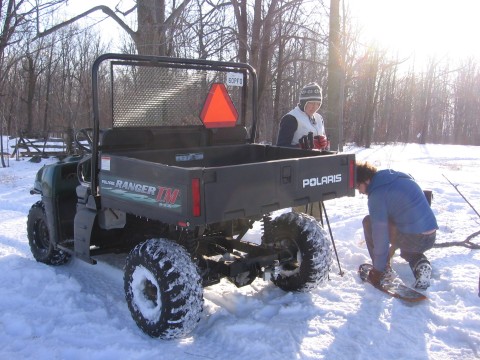
Christmas Eve
December 24, 2008
Bet’s in full elf-mode. The back of the pickup was full for the morning run to the farm. Last I saw of her she had commandeered my bench and was decorating a little fir tree which has been struggling along in a window as a house plant. I noticed a few problems of hue and scale in the project, but she continues undaunted.
The snow is due for a coating of rain, which may make for interesting navigation up this way, but the big story is the refugee situation. According to the T.V. news, airports are full of the poor lost souls, each pining to join relatives on the other side of the continent. I guess swaps are out of the question.
Two-day delays in Vancouver, Toronto and Montreal have piled up the feeder flights and produced a new definition of hell, airline style. Forget firey crashes: hell is a slow death of hard chairs, interminable waits, lineups to nowhere, and confusion — with no real prospect of a solution, at least in the short time frame which passes for historical context among Christmas travelers.
Hope things are going well down your way.
Rod
 the Walnut Diary