Weekend with a 45′ Bil-Jax man hoist
August 25, 2019

After painting the steel roof beneath the bucket, I had to repaint some areas splintered by the roofers’ nails, and get rid of two old wasp nests at the very highest point of the cornice.

A mysterious, splintered hole appeared in the coping above where I am applying a tidy patch secured by many small brass screws to bend the plywood to the contour of the moulding.
I had a host of little jobs to do around the 1896 brick house which would have been at the upper end of my 40′ ladder. But it is too heavy for me to put up by myself any more, and I can rent a really cool tool, an electrically-powered cage with which I can climb in comfort while taking along my power tools, paint, and mortar, all in the same trip. Cash in some ways can be a substitute for youthful vigour. Bet appreciated having our friend Les around to operate the hoist and easing the pressure on the spousal unit.

This is a shot from the May, 2016 session where over three days we scraped and painted whatever was white, wherever we could reach it from the bucket.
The only catch is the rig’s weight. At 4200 pounds it’s a bit too much for my 4 cylinder Tacoma with its elderly and much-maligned frame. Even the rated 3500 pounds towing capacity seems heavy for the venerable old truck.
Of course Ruby, my 04 Cayenne S, is rated for 7400 pounds, even if it has been sitting in disgrace since I concluded that her replacement, a 2014 Lexus es300h hybrid, costs 2.7 times less per mile to drive. But I needed a relatively heavy duty vehicle to pick up the hoist an hour away in Kingston, and prices are down again on premium gas, so Ruby got the nod and a chance to redeem herself.
Ruby’s build sheet lists a factory trailer hitch for $2000 and change, yet it has given me fits to get trailer lights to work on the thing. I finally used an adaptor for digital bulbs into which I drilled an additional 12V lead, the other end plugged in like a cigarette lighter to the rear-hatch 12V feed. I connected the constant 12v feed to the running lights for the trailer. Then the signal lights would work. Brake lights? Gee, Officer, they don’t work? Are you sure? I just have to remember to shut off the lights.
My son’s Cayenne has an after-market hitch and his lights work brilliantly. My inability to solve this signal light mystery was not for a lack of trying, though it has removed Ruby from contention as a tug for my son’s 20X8.5 enclosed car trailer.
Anyhow, at the rental place Ruby of course refused to fire the Bil-Jax’s signal lights. A bit of contact spray the rental agent had got them going. Once under way, Ruby handled the long, unwieldy device quite well on the road, and we soon arrived at the farm.
It was when I had to take the Bil-Jax up and down a steep slope and along a terraced driveway that I gave Ruby’s low range and centre differential lock a chance to work. Both functioned flawlessly on an off-camber path which unweighted one wheel after another. The diff lock and low range shifted out as easily as they had engaged. An ’04 Cayenne is a serious tow vehicle at 1 km/hr. I wonder how many Cayenne owners have really tested the low-speed pulling abilities of their pigs?

Les operated the Bil-Jax for all sessions, leaving me to juggle masonry, woodworking, and painting equipment in the bucket.
The Bil-Jax has a series of three hydraulic cylinders controlling booms. The topmost boom had a fault whereby it started off with a vicious outward whack, regardless of whether it was asked to raise or lower the cage. The instrument panel in the cage was ideally situated to injure a vertebrae on an unwarned passenger who was standing with his back to it, holding a pitcher of paint, for example. Paint falls down through the expanded mesh of the cage without a problem, though it wreaks the usual havoc on brick and stone 40′ below.
Apart from the spilled-paint debacle, the rig allowed us to get a lot of brick repair, painting, tin roof painting, bee’s nest removal and the repair of a hole chewed by a squirrel into a chestnut fascia board 40′ above the ground. Go figure.

Here I am at the height of an extended 40′ ladder, repairing the hole a squirrel carved in the fascia board of the house. A family of greys climbed the brick wall all winter to use their penthouse den.
The 110v feed in the Bil-Jax cage proved quite handy to run a reciprocating saw while I fitted a plug for this hole. There’s also an air hose installed on each machine, though on the last one it was easier just to run a 100′ hose straight from the compressor to my nail gun.
At just under $300 CDN per day for rental or for a two-day weekend, I find the World of Rentals product a good value.
It turns out that Ruby still has considerable fun potential at the farm, even if Cayenne ownership seems rather fraught in comparison to the mindless ease of a Lexus hybrid’s.
Another smug, annoying post
August 6, 2019
The hybrid encourages a whole new attitude toward driving. I have gone from “that jerk in the Porsche passing everything in sight” to “that damned old geezer in the Lexus holding up traffic.”
It’s fun getting to know what uses up the fuel. I have gotten good at making the round trip to Rosebridge at a fuel burn rate of 5.1 L/100 km. That’s with the windows and sunroof open, and the a.c. shut off on the dash.
Today because it was raining I needed the fan for ventilation, but I didn’t want to run the a.c. because of the fuel penalty, so I went into the climate settings and shut the compressor off. The computer showed 4.6 L/100 km. That’s 61 miles per Imperial gallon on the return leg from Rosebridge. Not bad for a 3800 pound car. Almost up to diesel standards.
Has the Toyota Prius become a status symbol?
August 4, 2019
This question turned up in my Quora feed, so I felt obliged to respond:
The Prius is a very recognizable automobile, but to the extent that the bulk of them end up as battered and grubby urban taxis, it’s hard to attribute the glamour to them that the term status symbol suggests. That is not to say that “Prius” does not have some important connotations. The car’s frugality and long life put it at one end of a choice-continuum which is balanced at the other by a short-life gas-hog like my Porsche Cayenne S.
Would a buyer gravitate logically from one to the other? Perhaps, if the buyer is of a certain elemental nature, determined to avoid the bewilderment of choices in the mushy middle.
If I’d had my druthers I would have bought a new Prius a couple of months ago to replace my Cayenne, but my less radical wife would have none of it. She did find a used Lexus hybrid acceptable, though, so that is what we bought.
But when I am alone in the car it’s a Prius to me, and like Walter Mitty I poke along down country lanes, happy in my own internal dialogue, eyeing the battery graphic and whispering “Pocketta-pocketta-pocketta.”
Real world fuel consumption calculation
July 13, 2019
According to Google Earth it’s 40.2 km from our home to the parking lot of Rosebridge Manor where my mother is a resident. For most of the route there is little traffic, though there are a number of small, restricted-speed hamlets and stop signs.
Tonight with the 2014 Lexus es300h I got 5.2 L/100 km on the drive. That’s 4.1808 litres of regular fuel for the round trip, or $5.35 at the current price at the service station in Toledo of $1.279 per litre.
Fuel consumption rates vary from 5.1 to 5.4 for the trip. This is with air conditioning and headlights off, seat cooler on, windows and sunroof open, fine weather on a summer evening, 80 to 85 km/hr, and using electric power while passing through the hamlets.
On the same route under the same conditions, my 2004 Porsche Cayenne S had a fuel consumption rate of 10.1 L/100 km on premium fuel. The last time I filled this car the rate was $1.399 but that was a couple of months ago.
Marshall challenged me to repeat this test with the Lexus es300h “while driving it like a Porsche.” I obliged on a 33C afternoon, glorying in the air conditioning, even leaving the car for fifteen minutes with the air conditioner (though not the engine) running. I set the cruise control for 100 km/hr instead of 80 and passed on the two-lane roads whenever the opportunity arose. Fuel consumption was 6.4 L/100 km.
Easy Pickin’s in my Saskatoon berry patch
July 12, 2019

Four years ago I ordered 20 Saskatoon berry bushes from Calgary and planted them in a disused garden plot at the farm. Nothing much has happened until this year when there were oodles of blossoms and my neighbour lent me a roll of netting to protect the fruit from the flocks of birds which follow two pairs of cedar waxwings around to the choicest eats.
Perhaps it was the soaking rains, but this week we have had a bumper crop of large, juicy Saskatoons. So far Bet has bagged and frozen seventy cups of the fruit for winter.
I am torn between wanting to believe that this wonder berry is the latest crop miracle, and/or rationalizing that it’s just the effect of too much rain which has caused the bushes to produce freakish amounts of berries, a one-year-in-a-hundred phenomenon.
I enjoy picking berries, and these grow on little trees. No uncomfortable bending is involved in the harvest. The shrubs bear exceptionally well, and the fruit can be picked in bunches if you hold a flat pan underneath to catch everything.
Saskatoons are reputed to be the best berries for pies, bar none. We’ll see. Raw, the ripe berries taste a little bland, but they are pleasantly chewy and more substantial than blueberries. Cooked, they have a more nuanced flavour and are quite nice.


UPDATE 22 JULY, 2019: I have just completed the final picking of the patch. It netted 2.25 pounds of berries after a heat wave which I expected to destroy the fruit. Unlike mulberry trees which shed ripe fruit at the first breeze, Saskatoon bushes hold onto their mature product quite well through heat and high winds.
This will put our winter cache to about 120 cups, a reasonable number if they are used each day for cereal topping, as well as other baking projects. I plan to keep a couple of pounds in the refrigerator for use fresh until late fall. They keep well.
Lexus es300h update
June 11, 2019
As I drive the car repeatedly over routine round trips, I am gradually forming some conclusions about its mileage performance.
1. Mileage is lousy when it is cold. Until it gets three miles from home, it uses from a bit over 9.0 L/100 km to as high as 12.0. A trip to Newboro to bail out the fishing boat, for example, starts at 9.1 and over the 14 mile round trip gradually reduces to an average while coming in the driveway of 5.8 L/100 km. That’s 48.7 Imperial miles per gallon, 41 U.S.
2. Starting while warm, the car maintained that same 5.8 L/100 km average throughout a trip to Kingston for shopping and back today, about 100 miles of heavily travelled two lane and a bit of four-lane highway and assorted city streets and parking lots.
3. From a cold start the trip to Rosebridge Manor in Easton’s Corners, a sixty-eight mile expedition over little-travelled roads and frequent hamlets with speed limits and stop signs, the average steadily decreases from a bit over 9 to a final average as I use battery power through Forfar, up Young’s Hill Road, and in our long driveway, of 5.1 L/100 km. Usually traffic allows me to poke along at 80 km/hr on this stretch, again with frequent coasts through villages on electric. That’s 55 miles per Imperial gallon, 46 U.S.
Driving to Mosport
May 31, 2019
Our son decided that today would be the day to take his parents for rides around the track at the Canadian Tire Motorsports Park near Bowmanville. Members of the Porsche Club of Canada annually participate in a Drives for Smiles event where they invite the parents of children suffering from Down’s syndrome to the track for rides in racing cars, complete with pit crews and safety harness, but not helmets. This year PCC considered the seven-year history of the event, but ruled that there would be no passing, so the tours went in parade formation, but the cars still moved quickly around the tight track. Occasional family members and guests of the volunteer drivers did find their way into the cars along with the six hundred kids who attended.
I had only worked on Charlie’s BMW at the shop, and had never encountered it at speed. It’s the real deal on a track like Mosport. The engine is strong and the car is very light. It turns in eagerly, slides the tail out in a very controllable manner, and chases down much more powerful cars in tight corners.
Charlie responded to my comment about plotting a line through a corner before you can actually see it. “It’s more a trajectory you plan.”

We had left the dog with a sitter in Westport and hit the road in the 2014 Lexus es300h. Earlier in the week on a round trip to Westport the car’s computer recorded 4.8 L/100 km. That’s 58 miles per Imperial gallon, but on a limited sample size.
Today’s run up the 401 for four hours at 120 km was likely to show much higher fuel consumption than the slow wander on County Road 42. The readout hovered at 6.0, but slowly dropped to 5.9L/100 km for the duration of the trip. 5.9 is 48 miles per imperial gallon of regular gasoline. I think it’s 39 miles per U.S. gal. My new VW Beetle gave us excellent gas mileage in 1973. It got up as high as 32 miles per gallon.
They’re not making cars the way they used to. This Lexus hybrid weighs twice what the Beetle weighed, offers climate control and luxurious seating for five, yet uses substantially less fuel than the ’70s mileage icon.
Jody Wilson-Baybould and Jane Phillpot announce their plan to run as independents in the federal election.
May 28, 2019
These dissident Liberals should have paid attention to the historical origins of democracy before blasting their powder half-cocked. The idea of democracy emerged in the 18th century concurrently with the development of science and the invention of the pocket watch.
The opposing-spring principle was the revolutionary idea that an object could be held in place indefinitely by opposing forces such as a pair of springs. It was not a difficult jump to the assumption that an idea could find balance between a number of conflicting points of view.
Jody, Jane, this is what politics in a liberal democracy is. That partisanship which we all dislike is the concrete on which our society is built. It’s not pretty, but without it, structures lose their durability. Why do you think JT put an end to democratic reform? He wanted to end the honeymoon with voters? No. He realized that the way things were going, Canada would end up atomized politically by extreme fragmentation until the only ones able to exercise political will would be the theocrats, anti-abortionists, and animal rights groups, or a dictator emerged.
Government must attract idealists for their ideas and energy, but it is essential that it govern. Trudeau has said that no society would leave billions of dollars worth of oil in the ground, and an issue involving 9000 jobs in a province is a big deal to politicians, regardless of the messy reputation of the corporation.
Jody Wilson-Raybould had a fine run at her portrayal of Antigone, but it’s Justin Trudeau’s Creon who is still obliged to restore order for the good of society following the disruption. Jane Philpott seems to have fallen into the role of Haemon, Creon’s son and Antigone’s fiancee, who insists upon entombing himself with Antigone when Creon is forced by his role to execute her for her repeated threats to his rule.
And now the tragedy has played itself out. Canadians have been morally uplifted and edified. We are better than we were before this spectacle of wasted greatness. But now it’s time that they leave the stage, not end up a burlesque footnote to one of Canada’s most striking political dramas.
Morels are up.
May 27, 2019
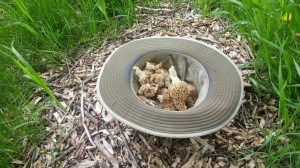
The last time I walked the property I came home with three small dog ticks, so my wife suggested pointedly that I cut down on the bringing home of arachnid pets if I wished to continue to eat as well as exercise.
To that end, today I mowed a one-mile path, 5′ wide, on a route which by and large avoided overhanging pine trees. Then I walked same route, only to discover a location where I had run over an entire patch of white morels.
 the Walnut Diary