With five tractors and three cars in the motor pool at the farm, I have grown concerned about aging anti-freeze in aluminum engine blocks and radiators. As coolant grows old it becomes acidic and can eat its way though unprotected aluminum on a modern engine. Protecting against corrosion is as much coolant’s role as protecting against frost.
But a couple of looks at the Prestone wall at Canadian Tire have sent me on my way in despair, afraid that I might select a product which would do more harm than good. The various fluids are all in opaque containers and so I can’t even go by colour.
For anti-freeze is not a simple subject. I used to believe that there were two types: green and red. But that’s not true. There’s green ethylene glycol, the standard stuff, which the books suggest changing every two years. Then there’s the GM stuff, dex-something, which according to the Internet is Kryptonite to a lot of silicone-based head gaskets and other engine parts, especially on Cummins diesels. There’s been a class action lawsuit about Dex-Cool sludging up and destroying GM engines for which it was a warranty requirement.
And then there’s long-life coolant, and even extra-long life coolant for diesel tractor engines. And none of them are compatible. In fact a service manager told me that if I mix red and green coolant, the resulting liquid will coagulate and fail.
And the coolant in the Lexus, Scion, and Toyota in our motor pool is pink, not red. The Lexus service lady I called explained that the Toyota product is not the green-stuff-dyed-red, as one otherwise fairly well-informed Internet chemist suggested. “It’s a gell formulated to bubble and harden wherever there is a leak, so that the technicians can track the fault quickly.” She told me (correctly) that it’s very hard to find the source of a leak of the green glycol.
She further told me that the technicians use a float to measure how dense the coolant is, and hence how much cold it will protect against, but she knows of no chemical testing for PH at the dealership. If it’s not pink, though, they replace it. “If a water pump has failed, they replace the coolant,” her opposite number at Kingston Toyota told me.
No one I spoke to seemed to put much credence in the replace-every-two-years rule printed on the plastic jugs.
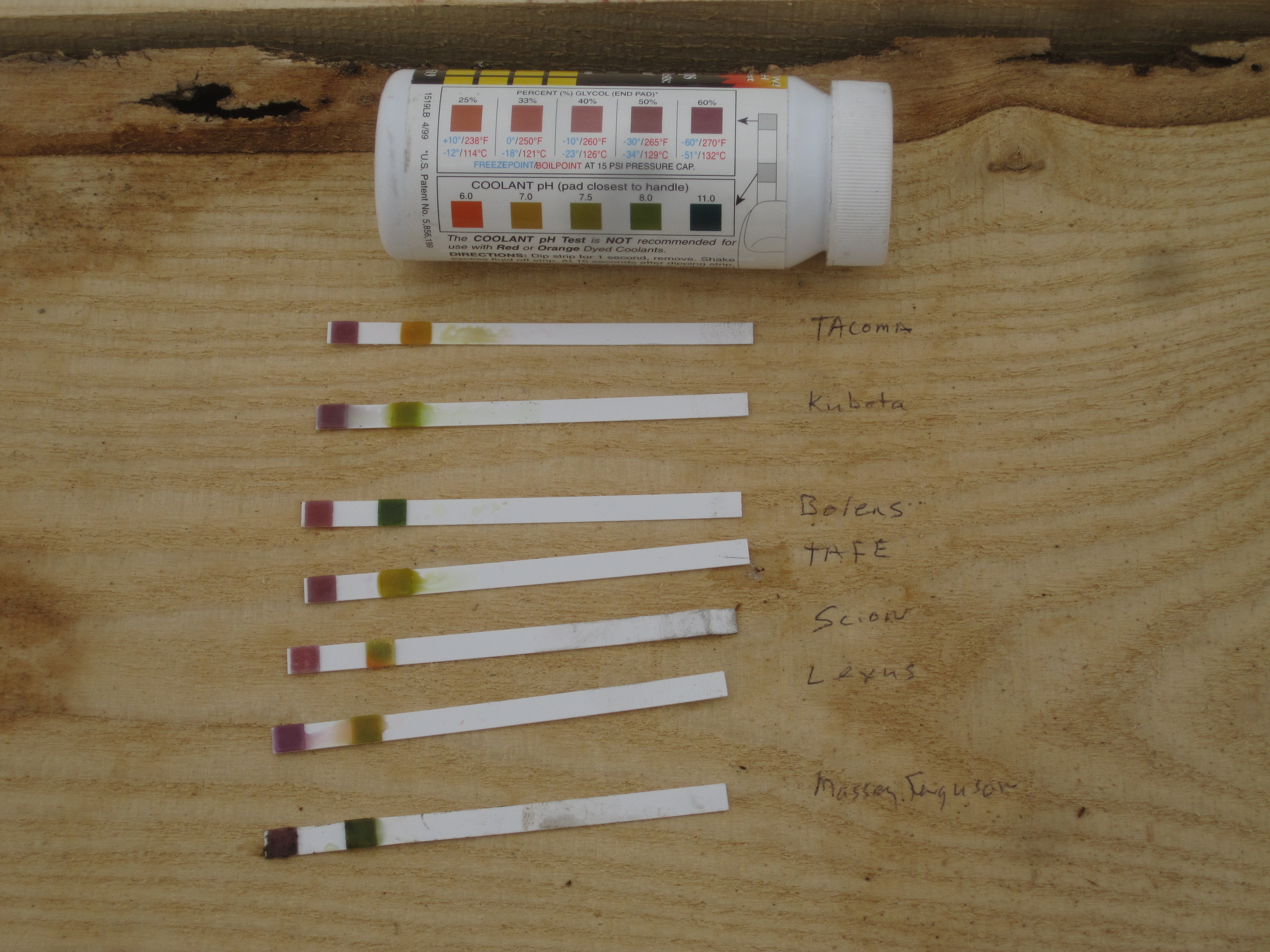
Today for the price of two-and-a-half gallons of Prestone I bought a bottle of 50 CoolTrak coolant test strips from the local UAP dealer. The bottle states clearly that the strips are not recommended for pink or red coolant. Great. I tried them anyway. The 2006 Kubota tractor needs its green coolant replaced. It tested a PH of about 7.25 and the ideal is 10 for my B7510, so it’s too acidic for that expensive little diesel engine and aluminum radiator which I want to keep for a long time. The 1981 Bolens has the best coolant of the fleet because I replaced it earlier in the summer after a heat-light malfunction. The 1995 TAFE’s green stuff also isn’t as bad as I expected because it’s a leaker and requires top-ups from time to time. The 1960 Massey-Ferguson, according to the test strip, is in a similar situation, though I don’t remember renewing its coolant.
So the Kubota needs Prestone. With the Bolens I just drained and refilled it with a 50:50 mix, but according to the Internet that may only remove half of the liquid. A backflush is more appropriate, but there’s the problem of vapour locks in the engine blocking the flow of coolant, and what do I do with the toxic waste? One sip of coolant from a spill or an open container will kill a bird.
The other problem is that I can usually rely upon Internet information, but on this subject everybody who has ever twisted a radiator cap feels compelled to offer advice, and some of it is dangerously inaccurate, even to my naive view. And one Internet wag suggested that the parts guy at the dealership inevitably has strong opinions about coolant, and most of the time they are unfounded and wrong.
What’s more, an Internet source informed me that coolant now comes in yellow and blue to suit warranty requirements of Korean cars. Something tells me that mixing yellow and blue to get green in my Kubota would boil that expensive little engine like an egg, so I’d better not try that.
More on this later — the test strips expire in a year.
 the Walnut Diary