Normally I keep the black walnut fields carefully trimmed, but this year I have a lot of younger seedlings and so I decided to let the two four-acre fields fend for themselves. Some are now bearing, so they’re hardly tender shoots any more.
But my wife complained that her favourite dog walk had become “spooky” with the dense hay growing between the trees. This new worry might have something to do with the large black bear we saw on the property earlier in the spring.
Anyway, I made good progress with the TAFE on the 5′ Rhino, but only down the centre of the aisles. With its ROPS, sun cover and loader, the 35 hp field tractor is now too cumbersome to work around the rapidly growing and brittle branches.
I had already put a couple of tanks through the Kubota trimming around 15,000 younger seedlings with the 48″ Braber rotary cutter. As long as the grass wasn’t too long it did a good job. When I tackled a one-acre plot of hay running rich to wild parsnip, however, it did a lousy job. The wide turf tires flattened about a quarter of the hay and the blades tore up the rest. At the time it didn’t look too bad, but five days later I couldn’t stand the mess any more and re-did the job with the Rhino on the TAFE.
Up until now I have blamed the crappy, off-brand 48″ bush hog. The blades seem shaped improperly on it, pushing the grass (and rocks, I suppose) down, rather than drawing up. (See update below).
With its ROPS the Kubota is too high for work under trees, so today was the turn of the Bolens. Normally I use 1st gear HI for mowing, but the hay was too heavy. We crawled around under the trees in 3rd LO with the PTO in 2nd gear. The “crummy” mower did a surprisingly good job.
If the increase in pto revolutions from 540 to 750 produces a major improvement in cut, could it be that 48″ mowers turn too slowly with a standard, 540 rpm shaft? Simple geometry would suggest that the same gearbox used on a 4′ and on a 5′ will only deliver 80% of the tip speed on the smaller chassis.
The 5′ mower produces an effortless cut. Until now I have attributed it to the high-priced components in the Rhino. But if I were to buy a 48″ Rhino, would it still produce only 80% of the tip speed of the 60″? (Again, see update below).
UPDATE: 29 July, 2014
I looked up gearboxes for Rural King rotary mowers. They list two 40 hp gearboxes, one geared to produce a final drive speed of about 750 rpm for 5 and 6′ mowers, and the one for the 48″ mower geared to spin at 1000 rpm. So a good 48″ rotary mower won’t have the same gear ratio as a good 60″. (Turned out the Braber mower has the correct 1:1.9 gear ratio. The label on the gearbox makes that plain.)
UPDATE: 14 August, 2014
I found that TSC in its American stores stocks replacement blades for the Chinese rotary mower under their proprietary brand name, so I replaced my broken blades. The contour of the new blades looked great, though they still looked as if they had been shaped and sharpened by a blacksmith. Initially they did a very good job, causing me to rethink my complaints about the mower. It was even somewhat quieter with the new blades. Perhaps that grinding sound from the gearbox was blades out of balance?
Today I discovered a 3/4″ nut and washer in the chaff I cleared off the deck of the mower. The shear pin was about to give up. A new one installed, I checked the blades. They’d had a couple of hard days mowing the worst three acres on the farm, and I discovered the problem with these blacksmith-sharpened blades:
A normal rotary cutter blade is very dull. It has a steep angle and blunt edge. The Chinese blade has quite a sharp angle. An impact on the cutting edge of the blade seems to bend it upwards. Repeated impacts produce a blade that looks like a snaggle-toothed propeller designed to push the grass downward. Perhaps they use soft steel so that the blades don’t shatter when they hit a rock.
That was why this morning I had noticed the cut on short grass was no longer very good. The other revelation was that my theory about tip speed was out to lunch. The gearbox is clearly labelled a 1:1.9 ratio. The 48″ mower has the same tip speed as a 60″ mower with a 1:1.4 gear ratio.
So I pulled the back end of the cutter up and went at the blades with an angle grinder. There’s no way to restore the contour of the blades by grinding. The best solution will be to replace the $54.00 US blades with a new set. That’s not such a bad idea.
Changing the hydraulic oil on a Kubota B7510 HST
June 15, 2014
I just finished changing the hydraulic oil in the Kubota B7510. It’s quite a job. I’m told HST machines live or die on the condition of their oil, so it needs doing every 300 hours. The previous owner told me he had changed it just before I bought the tractor at 210 hours, but he apparently went by the manual and only changed the single filter mentioned there. That filter handles the lifting hydraulics. The other one (which the manual seems to have forgotten) handles the hydrostatic drive (HSD) It’s the one which gets all of the use on my machine, and it still had a factory black filter at 370 hours.
To judge from a lack of particulates in the oil and no evidence of metal filings anywhere, everything turned out to be in top condition, but to determine that I had to drain 11 litres of oil from the transmission case (from 6 different orfices: 6 potential leaks) and then pour new oil back in until it was full. The parts guy said its capacity is 13.4 litres, so he sold me 15. The manual said 13.4 litres for a B7510DT, but this one (HST or HSD, depending upon context) needs 15.3. It took 11.
The tough part was the strainer everyone warned me about. It’s a 26mm nut, factory-tightened very tight. Very few garage socket sets contain a 26mm socket, and none of the wrench sets do. I almost rounded the nut with a 27 mm socket when I removed it. Out the long, skinny cylindrical screen came, attached to the nut. I washed it, but it wasn’t dirty. I couldn’t find any metal fragments in the strainer, but the learning curve was a bit steep when I set out to replace the strainer. Eventually it went in easily if I lay directly beneath the assembly at the bottom of the transmission. This was not a bolt I could put in by feel alone.
I plan to check this strainer regularly from now on — about every 1000 hours.
The new, higher-quality oil from the Kubota dealer seemed to make the tractor quieter, and likely smoother. I’ll know better after a few hours of work. Update, 15 June: It’s certainly no quieter with the lighter premium oil, though everything seems to work well.
In retrospect, changing the HST oil was a messy job made tedious by the risk of a leak, but things went together quite well once I’d figured out how to do it.
A commenter on the Kubota page on Tractorbynet just told me that I missed one drain. That would account for the 11 litre drain and refill.
Next up is the front axle lube change. The same guy said that his machine weeped oil at the seals with the lighter oil, though it’s fine since he went to 90W gear oil, so I’ll try that.
Update: 19 December, 2016 When last fall I eventually drained the front axle lube, it was dark and burned-looking. I felt quite contrite about the oversight. The axle’s fine now, and properly filled.
Bush hogging with the Kubota B7510
June 2, 2013
23 May, 2013
Today I prepared the B7510 for mowing around some of the 15,000 little trees on the farm. That involved removing the five-foot mid-mount mower and hooking on the 48″ rotary mower. The off-brand “bush hog” normally mounts on my Bolens G174 where height control is achieved by means of a pair of chains to the upper bolt on the 3 pt hitch. The fittings came with the 4′ Woods finish mower and it seemed reasonable to add the chains when I bought the rotary mower new.
Removing the MMM turned out to be a handful because I have it set for a 3 1/2″ cut and didn’t want to change it. That reduced clearance underneath, so I lifted the front with a floor jack. The little plates which hold the trailing arms for the mower had been mangled by frequent lifts and hydraulic force. I had to remove one and blacksmith it back into shape. Apart from that the dis-assembly went well.
Hitching the Kubota up to a 3 pt hitch implement was a pleasant surprise. The arms of the hitch arch together and above the implement, making it easy to centre things. When I lowered the hoist, I watched the arms spread out to about where they needed to be. Minor adjustments to position can be done from the ground by discreet pressure on the forward and reverse pedals. This was real bonus. Hitching up the idling tractor was surprisingly easy.
The 7510 doesn’t seem to need suitcase weights to balance the 405 pounds of the mower on the 3 pt. hitch. The chains were extraneous to this application so I taped them securely out of the way. The lift height control seems quite precise and it holds its position well. While I always used 4WD with the Bolens to allow it enough traction to turn the awkward implement, with its greater weight, longer wheelbase and larger tires, the ‘Bota gets along well in 2Wd on the rough field.
Mowing long rows of seedlings goes much more quickly on the Kubota than on the Bolens.
From two hours of field work, the B7510 seems poised to boot the Bolens out of the garage. At the moment I can’t think of anything the 1980 G174 can do which the ’05 Bota can’t do better, and with insolent ease.
24 May, 2013
Today I finished that 5 acre field of seedlings. It took another 2.3 hours to compete the job, so with a 48″ bush hog the Kubota covers a bit more than one acre per hour of mowing. That’s about what my TAFE 35 hp gear driven tractor does with a 5′ bush hog. There’s no doubt the HSD* is a time saver when cutting around trees. The Bolens was much slower at this job.
HSD: Hydro-static Drive
HST: Hydro-static Transmission
HST: 13% consumption tax in most Canadian provinces
UPDATE: 4 July, 2014
The attached photos show a safer method of lifting the front of the tractor for mower installation.

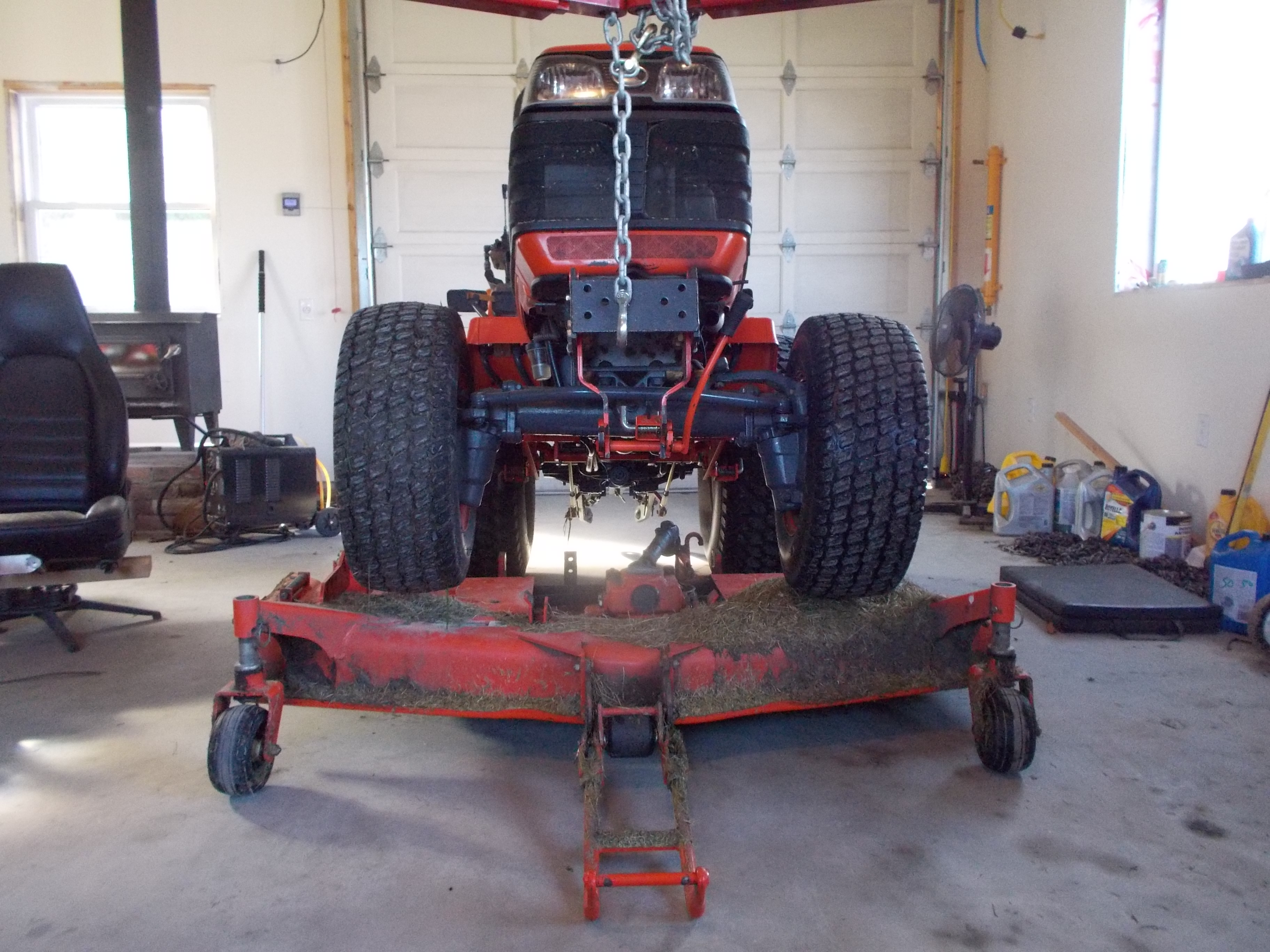

2 January, 2016
For two mowing seasons the chaining method illustrated above has worked without a hitch for weekly installations. Most weeks the B7510 runs other implements on the property between sessions on the 2 acre lawn.
UPDATE ends here.
____________________________________
Original article begins here:

As long as I used the Bolens compact tractor to mow the lawns I could sharpen the blades by the simple expedient of raising the mower on the 3 pt hitch and diving underneath with my trusty angle grinder.
The rocks haven’t changed, and though I am using the newly-acquired Kubota mower at its maximum height, occasional trolls have still lept out of the sod to engage the new knives in combat. Things came to a head yesterday when a suddenly-emerging rock caught the middle knife a good one. Things sounded rough, recovered, and I made another circuit of the plot where I park utility trailers before I realized that the grass was getting a Mohawk cut with the centre blade out of action. This wouldn’t do.
A check underneath indicated that the blade had come loose, so I moved into the auto shop to effect a repair. 30 mm sockets are not common in shops. My tractor wrenches wouldn’t fit, either. Fortunately I found a specialty wrench in one of Charlie’s tool drawers and it allowed me to tighten the thing up to where it would run again.
But the cut wasn’t very good. I had to accept that the blades were dull, and that this would be a regular problem. Standard procedure involves removing the mower deck each time to sharpen the blades. The B7510 is designed to drive its front wheels over the hulking pressed-steel deck, but everything has to be set to a 1″ cut for this to work well, and I need the 4″ height.
I needed a quick and efficient method to access the blades for maintenance.
The tractor is all-tires-no-frame from the point of view of a car hoist. After not very much thought this morning I grabbed a couple of hardwood boards off a lumber pile and set them across the arms of the car hoist to provide a wooden path for the tractor wheels. I added a collection of walnut blocks to allow the tractor to climb up onto this improvised cradle on the hoist. In low range, 4WD the tractor eased into position and I set the parking brake. No problem so far.

The standard shake of the vehicle when just off the floor proved that this was definitely not a car on the hoist. Cars lift by their frames and the metal-to-metal contact feels very solid. The tractor wobbled about far more than I liked. The tires are big and soft. They flex.
I kept my distance and ran the Kubota up for photos. I noticed that the left blade had a noticeable bend and would need to be replaced. The others were far from new.
Off I went to the local Kubota dealer, Weagant’s Farm Supply in Brockville. I showed a photo of the tractor on the hoist to the parts guy and he took all of the time he needed to convince me that I shouldn’t work on the tractor on the hoist. His line was that it would do a great deal of damage to the tractor if it fell off. He told me in the shop they always keep the wheels on the floor, and if they need serious lifting power, they bring over a portable chain lift. Big floppy tires don’t go well on car lifts, and the kind of yoke necessary to reach the frame past huge tires would be cumbersome indeed.
He suggested I hang the front of the tractor only from the hoist with a chain. This made sense, so I stole a choker chain from the timber winch and hooked it up.
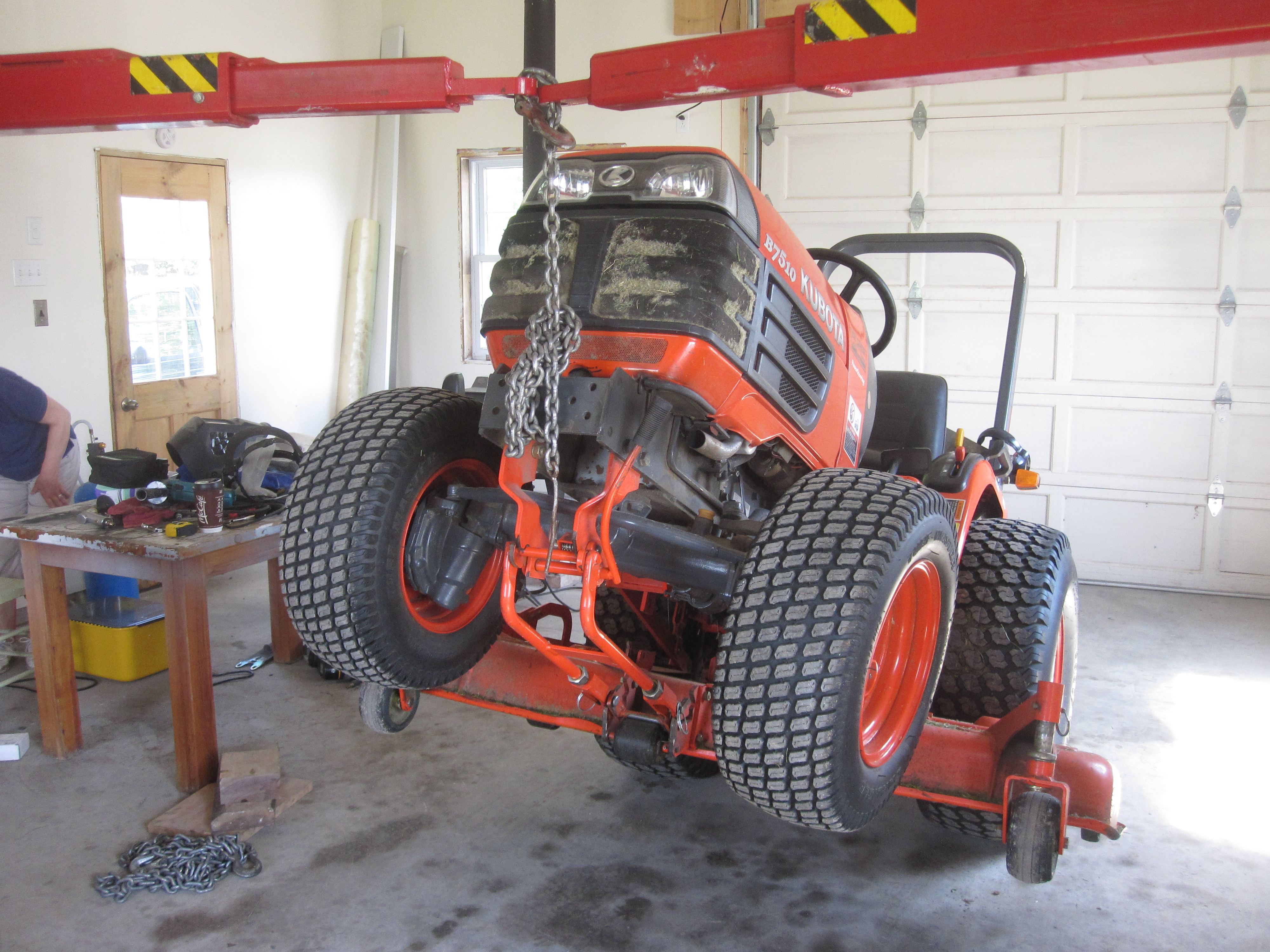
That worked fine. I crawled in and used the 1/2″ impact wrench on the 30 mm socket he sold me. The blades were changed in about fifteen minutes of work, so I may well have found my efficient method of attending to the service needs of this mower.
Comments from TractorByNet.com suggest that axle stands would be a good idea in case the chain fails. But the ones we have are much too short. I’ll improvise a pole under the front bumper. In conjunction with blocks for the rear wheels it should provide a usable device to improve the safety margin.
SAFETY UPDATE, 19 June, 2014:
During mowing season for the last year I have used the chain/hoist technique twice a week without mishap. Today while preparing to put the mower deck under the wheels of the tractor, I wound the chain around the front bumper in a more elegant manner than my usual tangle of knots. My dad used to call the knot a “cat’s paw” but I may not have tied it correctly. As I was lowering the tractor the winding suddenly let go and slid down the chain until wheels hit floor with a thump.
This provided cause for thought: once the chain slipped one link it sent a wave of shock through the chain/bumper structure which began to vibrate my tidy wrapping into a liquid cascade of chain, quickly dropping the tractor to the floor.
All of the other times I have lashed the chain to the tractor’s bumper, I have tied it untidily and irregularly. If the chain slipped a link, no matter. It just bound itself tighter. But not this time.
I’ll make up a prefabricated chain yoke to do the job and let you know. The hoist is still a great way to lift the front of the Kubota for mower installation. I just need to work on the chain part.
20 June, 2014: $27 worth of grab hooks and 5/16″ chain seems to have produced a workable solution (See above for photos). With the new hooking system it takes me four minutes to install or remove the mower.
11 October, 2016: The chain and grab hooks have continued to do a good job over many cycles.
30 May, 2018: The only problem comes if there is a vehicle on the hoist when it’s time to take the mower off.
 the Walnut Diary