Why not?
December 8, 2014

It’s a 1999 (technically a classic) so it qualifies for the cut-rate trail pass. Insurance isn’t bad, and there was so much snow last March we couldn’t move from the driveway. I chose to frame the purchase as the reaction of a rational man to last winter’s claustrophobia.
10 December, 2014, 9:37 p.m.
It’s impossible to state how much snow there is outside as it’s all drifts and bare gravel on the way to my equipment shed. Suffice it that there’ll be snow in the fields for the Ski-Doo tomorrow.
Today I bought a trail pass online. Now I have to wait until they send the sticker to me, but the Ministry of Snowmobile Trails hasn’t opened them yet, anyway.
11 December, 2014
The recently-purchased Ski-Doo’s o.k. I’ve had a bit of trouble starting it when cold due to flooding. Maybe I’ll try without the choke next cold start.
The ’99 Touring LE offers an excellent ride with good steering which allowed me to follow paths through the woodlot without difficulty. This stands in sharp contrast to the behaviour of its predecessor, a ’76 Alpine, whose single ski worked more to separate the saplings for the massive, pointed bumper than it did to direct the sled. I had found it dangerous to sit on the Alpine’s seat when hurdling drifts, as the landings sometimes compressed one’s spine in a shocking manner. The long-legged Touring acts as though it would prefer a 20-mile run on packed trails to a poke around the sugar bush. It certainly shows more power than I’ll need in the woodlot.
This anti-Alpine will no doubt show its shortcomings in future rides, but for now I like the easy steering and cushy ride.
13 December, 2014
Apart from the use of a spark plug wrench to start the machine in the morning, it works very well. I’m studying everything written on the subject and watching every video even tangentally related to Ski Doo carburetor problems. Some headway has been detected.
The 13.6 mile tour took me across our fields to Forfar, through “town” on asphalt, then onto the Cataraqui Trail, across Hwy 15, and ending at Little Lake, a large pond accessible only by snowmobile.
The skis occasionally ground against coarse gravel on the old railway bed, but the machine’s ride reminded me far more of a Lexus sedan than an off-road vehicle. The hand and thumb warmers quickly warmed up digits frozen on that spark plug wrench.
I discovered that 25 mph is plenty fast enough on a straight, graded snowmobile trail at this time of year. 35 mph is marginally acceptable along a familiar path on a large field.
But the ’99 Ski Doo Touring is surprisingly competent and easy to drive. This has never been more apparent than when I tried to reverse my course. I turned off the trail onto an upward-sloping driveway, then reversed downhill. Starting off on the slope offered a whiff of warm drive belt, but the long sled turned as easily as an SUV and we were on our way home without fuss. A similar move with the intractable ’76 Alpine would have required considerable effort.
A cold start this afternoon brought the machine to life without the use of the spark plug ratchet, so I may yet learn how to operate this promising addition to the Young’s Hill motor pool.
14 December, 2014
This morning’s start with 1/2 choke didn’t work after a 2 second attempt, so I released the choke and rolled it with open throttle for a couple of 5 second bursts until it started. As usual, the engine performed flawlessly, once started.
The Ski Doo passed a milestone this morning when I climbed on behind my fishing buddy Tony for a spin around the field. Online advice had it that the machine was too light for anyone over 200 pounds, though it had seemed pretty good over rough fields with just me aboard. This test was with two passengers, combining considerably more weight than the sled’s modest 440 pounds. The ride was fine. It didn’t respond as readily to steering inputs as with a single rider, but handling was certainly controllable enough for an occasional ice fishing expedition.
Observing the machine in operation from a distance, I was amazed at its quiet. The more we drive it, the better it seems to run.
Next step: installing the hitch and modifying the snowmobile sled we found in the barn to carry a power ice auger and fishing tackle.
15 December, 2014
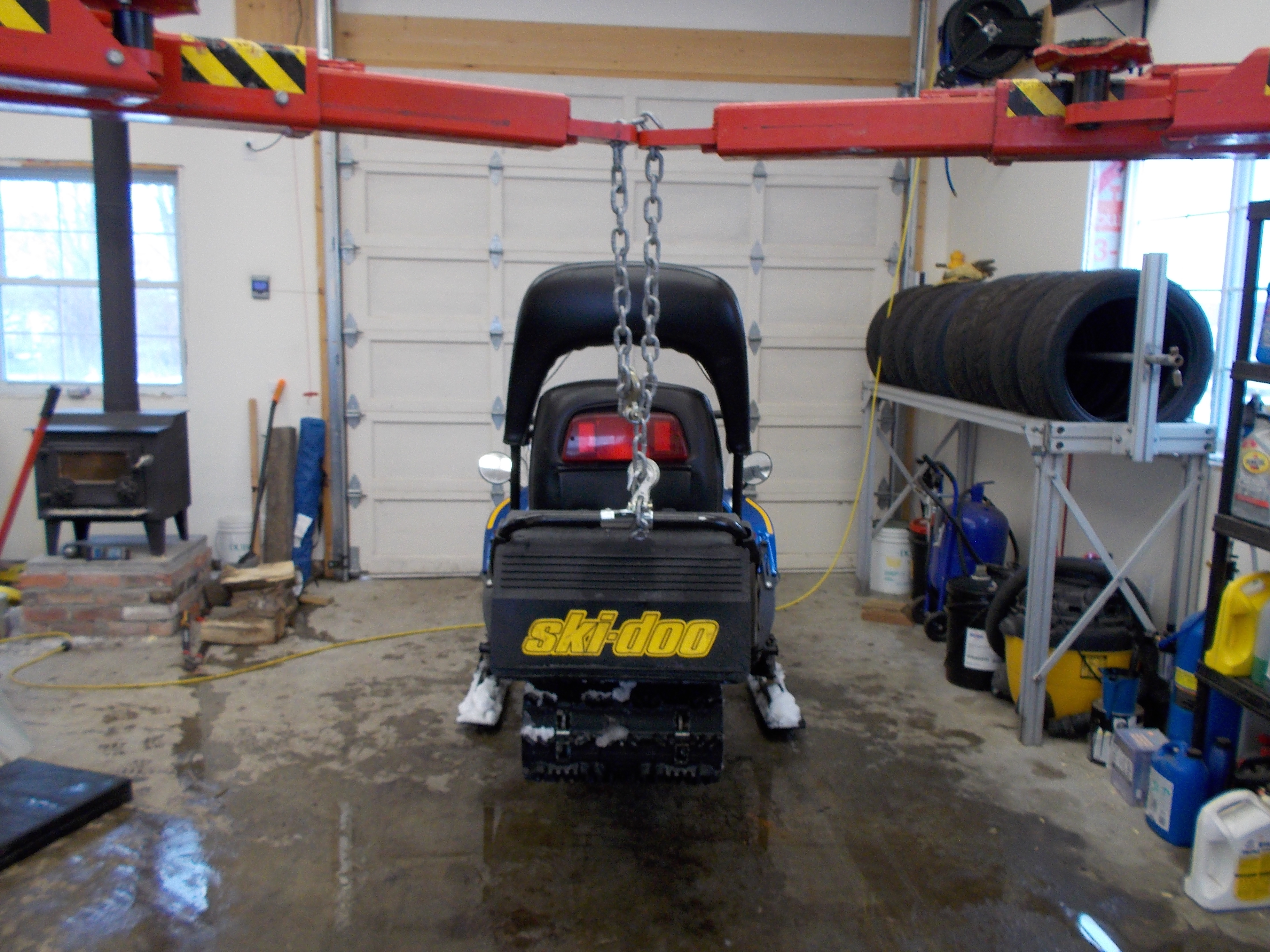
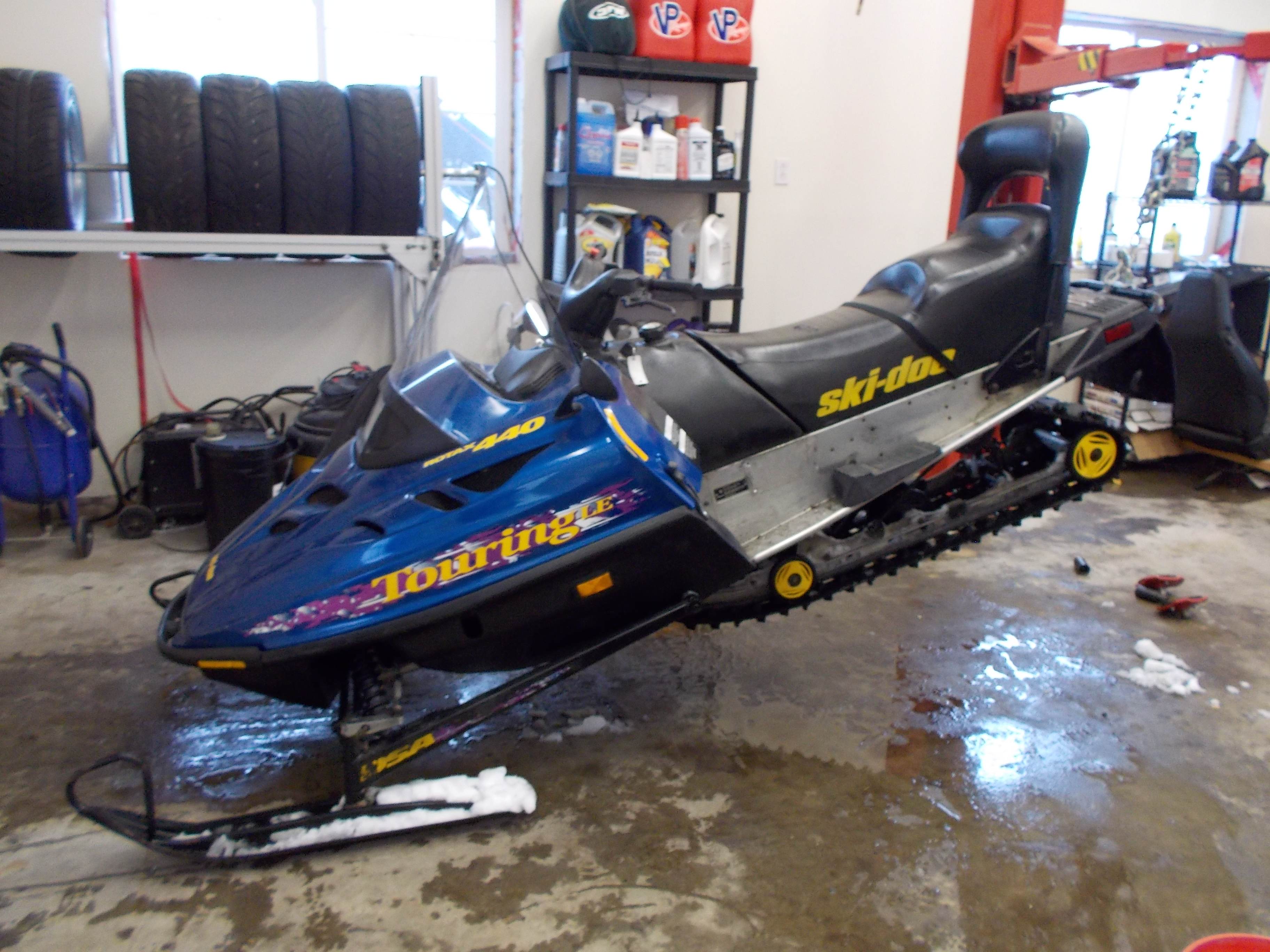
Today I put a fire on in the shop and attended to some of the maintenance tips I gleaned yesterday from a variety of online sources. First was the new belt, which went on easily with the tool I found in the carefully-packed tool case. The old belt’s still in good condition, so I stashed it under the rear seat.
The gear case dip stick had a few filings on its magnet, but the oil looked good, was at the correct level, and I saw no evidence of leaking below.
The main task was to grease the underpinnings, those unmentionable parts only a stern list of must-do’s could make me examine. The manual said to roll the machine onto its side… Uh, I stood on the edge of the running board and pulled on the handle bar, but it didn’t tip, just slammed its left ski down on the shop floor.
Further examination revealed a broken case for the right mirror: I’ll bet I know how that happened. With no desire to do further damage to the rather pristine coachwork on the Touring, I opted to use the system I developed for the 5′ mid-mount mower on my Kubota. The auto lift had no trouble with the weight, and I found three of the (alleged) four fittings under the track. The four fittings on the steering loosened up the my grease gun, and then I let loose with rustproofing oil on the various metal-to-metal moving parts.
The suspension immediately felt less notchy, and we glided fluidly over the local bumps as I put the machine away. Interestingly, the rear bumper now sits at 16″. Before the grease it sat at 17 1/2″.
Over the day I’ve learned that if 1/2 choke doesn’t start the engine, a second or two on the starter with the throttle open will do the job. At least at the freezing point.
There’s a good chance the starting problem is with the operator, not the machine.
UPDATE: 30 March, 2015
The starting problems ended when Cory Sly replaced the float valves in the carburetors (under warranty). From then on the engine started and ran very well. It logged about 300 miles on short runs around the property and a few local trail rides.
There’s stuck and there’s stuck.
February 13, 2011
A few years ago Tom and Kate came up for a mid-February expedition to their beloved cottage, ostensibly to see if the roof was all right after the heavy snowfalls, but really because they were homesick for Scott Island.
We unloaded the snowmobiles near the Isthmus, drove them down the road to the ferry landing, then ducked out onto Clear Lake over a snowmobile trail which avoided the questionable ice near the current. All went well until we hit the deep snow of the Island. On eBay Tom had bought a new drive pulley for his pristine 1970 Skeeter, but he had expressed some worry about the rust on the polished steel where it met the belt. I had assured him it would soon wear smooth with use. What did I know, eh?
The first deep snowdrift left Tom and Kate straddling a smoking, roaring snowmobile which clearly wasn’t going anywhere. A look under the hood showed a lot of fragments of belt, and big holes worn in the sides from the rusty drive pulley. O.K., I guess they don’t polish themselves.
Determined to carry on, we left Bet and Kate with the crippled Skeeter and pressed on with the Alpine. The biggest Skidoo is a brutal machine to control, but its one saving grace is that it can plough through deep snow. It picked its way through the island snowdrifts without difficulty. Trouble only came when we got off the thing and tried to snowshoe down the hill to the cottage. In the deep, wet snow it was a cursory check of the property before exhaustion drove us back to the Alpine.
Out the trail we went to where we had left Bet and Kate. Tom reversed the Skeeter out of the snowdrift, looked ruefully at his frayed drive belt, and gingerly set off in the lead on the return course. Halfway across the Clear Lake stretch, the Skeeter abruptly disappeared into a cloud of gray smoke and came to a halt in front of me. The eyes of Tom and Kate grew wide as they gazed at the water oozing up around their stalled machine. I wasn’t going to stop the Alpine in a pool of slush, so I moved it and Bet to shore before I let off the throttle.
Then we walked back to the Skeeter. Yep, the slush had gotten it all right. The Alpine had had enough power to blast through, but the Skeeter’s wonky pulley had torn up the weakened drive belt when stressed. Now the machine sat up to its running boards in slush. The footing was too questionable to work around, so we retreated to Smiths Falls to recover and plan.
Sunday morning rose clear and very cold. No problem with the footing on the ice this day, so Tom and I headed out with ropes, axes, and an ice spud, not to mention an auger and a ratchet winch. On a whim I threw in a couple of 5” walnut boards I found in the shop, as well.
What followed was a four-hour session of chopping a heavy snowmobile out of six inches of ice. Tom and I emphatically do not recommend this activity.
We discovered that a large snowmobile encased in a block of ice is very heavy, too heavy to move even after we had chopped the ice free around it.
I drilled a hole, stuck the two walnut boards down it, then anchored the come-along to them to stretch the Skeeter enough to pry it forward when we lifted up with the axes and the ice spud. This actually worked, though it was brutally hard work. With two hundred yards to go to shore, we’d be worn out long before we got there.
So I took a hundred-foot 3/4″ yellow tow rope out of the Alpine and tied it to the front of the Skeeter, did a bowline around the trailer hitch on the Alpine, and headed for shore.
There’s quite a bit of spring in nylon rope, so it brought the straining Alpine to a halt with the Skeeter unmoved. Next time I backed up beside the Skeeter and took a running start at the rope. That worked. I heard the loud “SPROING!” even over the roar of the engine, but the ice block and its snowmobile were ten feet closer to shore. Now if we could get it moving again before it froze down…
I tried again, full throttle. Another ten feet. It became a matter of momentum: the Alpine with me on it weighed about nine hundred pounds; the Skeeter with a full load of ice around it weighed anywhere from 1000 pounds to a ton. How can you tell? The rope did not snap and decapitate anybody and Tom kept it from tangling, but it was a long, rough tow as we bungee-corded the Skeeter to safety.
It took a month for all of the ice to melt out of the flooded running gear. Then one sunny day in March I started the derelict up and loaded it onto its trailer.
Tom and Kate got their vintage Evinrude back, but somehow they had lost the urge to cross onto Scott Island with it. Last I heard the Skeeter’s for sale.
 the Walnut Diary