Men who eat quiche can’t back up a trailer.
March 1, 2009
The utility trailer has emerged as the best transportation value in our modern world. Its overhead is negligible: $35. will license it for life. Insurance is unnecessary. It will do all a pickup truck will do, but you don’t have to worry about scratching it, and you can unhook it and leave a partly-completed task behind.
A bit of skill is the main requirement to benefit from this transportation boon. The driver has to be able to back it up, and thus we come to one of the defining tasks of manhood for my generation: backing up a trailer.
Learning the skill was a long and difficult journey for me in my sixteenth year, committed to a summer of mornings hauling firewood into Alan Earl’s basement with a tractor and trailer. The firewood followed a serpentine route down a driveway, between a shed and a brick house, then around a 180 degree turn under a clothes line and up a slight incline to the basement door. I had to back a loaded trailer through this maze, several times per day.
I soon knew every inch of that route, and still rue the day I left a series of bolt-shaped swirls in the gray boards of the shed wall when I edged the tractor too close in an effort to make the turn. No doubt those scratches are still there today.
Later on I learned that it’s much easier to handle a trailer with a vehicle which has a rear-view mirror. All you need do is take a sighting of the corner of the trailer in the mirror, and then if you hold that image still as you back up, the trailer will go straight.
Longer wheelbases are easier, as well, but if you want to observe the true test of a marriage, just watch a couple launching a boat at a ramp without a dock. Logic indicates that if one partner is in the boat at the time of the launch, nobody need get wet. The trick is to have one trained to start and free the boat from the trailer and the other equipped to back the vehicle and its load down the ramp into the water. The problem is that usually the same partner feels uniquely qualified to do both jobs.
The first time Bet tried backing in at Forrester’s Landing, my shouted instructions didn’t seem to help, and she actually ended up sideways on the ramp before leaping from the vehicle in disgust. From that point on my wife has put trailers out of her mind. When I asked for her opinion for this article she paused, thought, and said, “They’re for hauling garbage and moving university students.”
A friend from Ottawa was more forthcoming: “I have a history of poor choices with men, and not one of them could back up a trailer. Maybe it’s that men who eat quiche can’t back up trailers.”
Of course the trailer challenge is specific to my age group. Our son’s generation never had to learn. From hours of play with remote control cars, reverse-steering is hard-wired into their brains. You see, with an RC car the controls steer one way going out and the opposite way on the return trip. The crossover to trailers is a breeze. Charlie was about twelve when he learned how to drive his Grandpa’s Jeep around the farm, and the next day I looked over to see him with a trailer attached, backing the rig straight across an eight-acre field.
One of the most insidious things about trailers is how easily an owner can be persuaded to add another to his fleet.
Last fall when I bought a utility vehicle I gradually realized that I couldn’t take it anywhere because it was too big to fit any trailer I owned. Soon a Kijiji ad put me on to a pair of axles, so I drove to Kingston and picked them up. My neighbour Peter Myers straightened one axle and lengthened both to give the 6′ bed width the UV required, then guided me through the design process to produce quite a wonderful flat-bed trailer. He accepted that I wanted a trailer which was neither too big nor too small, and all it took was a week of work and a lot of steel. I quickly added low wooden sideboards and stakes to go with the magnificent “headache bar” he rigged across the front to provide a positive stop for the front wheels of my UV. Before I got at it with a paint roller, Peter’s creation was a thing of beauty.
Painting steel in late November is strangely difficult, but Tremclad will dry at below-freezing temperatures. It just won’t spray, so the roller was a must. Wiring trailer lights is never fun, but it’s worse when your fingers stick to the pliers, the trailer, and even the bolts.
Notwithstanding the crude paint job, the new trailer has fitted in well with the other eight in the barn. Bet suggests this fondness for trailers must be compensation for my utter inability to back up a farm wagon. There, I’ve admitted it.
Why nobody will take Bet fishing (more than once)
February 6, 2009
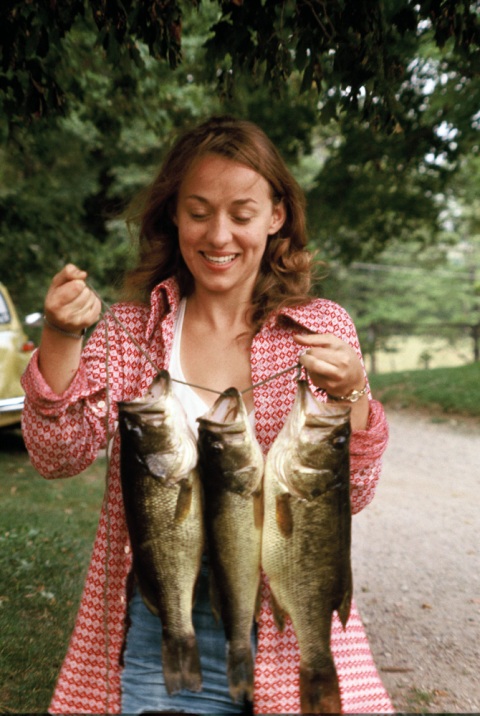
Charlie put up on his website a few old photos he found around the house. My favourite is one of a twenty-one year-old Bet, my bride, proudly holding a stringer of three fat largemouth bass. That was the last time she fished for about twenty-five years.
It wasn’t until my pal Tony was bragging about his ability to hook a bass and he ran into Bet’s barbed wit that the subject came up: “If you know so much about it, why don’t you ever fish?”
“Never mind,” I whispered.
Tony persisted: “How about I set you up with a spinning rod – they’re really simple to use – and take you up onto Mosquito Lake this afternoon for an hour?” Bet showed no real objection, so like an innocent Tony prepared the rod, the boat, and away they went.
I waited. I knew what it would be like when they returned. Yep. There was Bet in the forward seat of the Princecraft as they came in. She was beaming. Tony looked as if someone had stolen his favourite hat and stomped on it. “So how did it go?”
“I got three nice ones,” Bet chirped. “Tony didn’t get any.” Bet was always a ruthless competitor when it came to fishing. I winced.
Any one of the guys would have phrased the report as: “We kept three.” This meant that between us we chose to keep only these three fish. Others, the report implies, were released because they were too small, too large, or were lost. We even learned to call the ones that got away “remote releases” to remove the sting of failure.
Tony groaned, “Does she ever miss a fish?”
“No,” I assured him. “Bet’s a Leo, and I guess that means she has claws like a lion. If a fish even nibbles at a bait on Bet’s line, it’s as good as dead. She never fails to hook a fish.”
Tony and I and the other guys, of course, miss all kinds of bass. It’s a running joke reporting that one or the other of us caught a largemouth on the fifth strike, third worm, or some such. We even credit each other with assists. You get an assist for first missing the fish, and then watching while your partner hooks and lands it.
This sort of sophistry is fun. Putting a positive spin on our ineptitude is a big part of the bonding of fishing partners. But not with Bet. “She was at the front of the boat, right?”
“No, I was in the bow, running the trolling motor, but she still made casts all around me, sometimes even in front of the boat, before I could get my bait into the spots,” Tony complained.
“I gather she didn’t have any trouble switching from bait casting to a spinning rod?” On the dock before departure Tony had made a big deal of teaching Bet how to use a “proper” fishing rod. Now he just glared at me.
“She didn’t leave a square foot of lily pads or a stump for me to fish, and I was in front of her, the whole time!”
“Now do you see why Bet doesn’t fish much?” I asked.
“Yep.”
It was Labour Day, 1974. Over the summer in an old canoe on Opinicon Lake I had recorded data on every bass I caught. My goal was to hit the century mark before summer holidays ended. That morning I had counted up ninety-eight fish. All I needed were two more to reach my goal. We dropped the canoe in at Chaffey’s and worked our way out the shoreline of Opinicon.
Bet soon retired her paddle and worked steadily with her spin-cast rig. The artificial worm on a weedless hook slid easily under the overhanging trees as I methodically positioned the canoe for the best angle. I hardly ever saw an opening to cast. I almost hoped that maybe she would get a line tangle, or even hang up in a tree for a few minutes and give me a chance, but no: every cast was either perfectly placed, or short of the mark and quickly retrieved.
Then in the space of six casts she landed three bass for a total weight of ten pounds. Bet was jubilant at her success. They were very nice fish, and she had handled them well.
But I needed two fish to meet my quota, and she wouldn’t stop casting. What’s more, she ridiculed the one small bass I reeled in. ‘Are you going to keep that poor little thing? Why, it can’t be more than twelve or thirteen inches!’
As I recall my temper frayed sufficiently that I decided to transport my lovely, talented wife and her bass back to the dock before the fish grew stale. Then I took the picture of this beautiful young woman and the fish which should have been mine. That was the last fishing trip.
Bet went on to endure many summers in a leaky boat, my numerous half-completed do-it-yourself projects, and all of my dietary quirks. She raised our son well, has had a fine career and put up with a series of neurotic spaniels.
After thirty-seven years I can’t imagine life without her, but we’re both smart enough not to try fishing together.
Happy Valentine’s Day, Bet.
 the Walnut Diary