What Google AI said about my recent Robertson screwdriver bit purchase
November 18, 2025
I picked up a couple of boxes of screws for a trim project at my local Cassell’s Building Supplies in Crosby, Ontario. I bought a box of 3/4″ #5 screws and another of 1″ #6’s. To turn the screws I bought a yellow Robertson bit and a green one for the #6’s, assuming that one of the screws would work well in the flexible door moulding I was installing.
The yellow bit turned 10 degrees when I fitted it into a #5 screw, and thus had no holding ability for the small screw, which immediately fell off. I have used boxes of #5 on cabinets and hinges, and I realized that something was seriously amiss.
The green bit wouldn’t begin to fit into the #6 screw. On examination, it was almost the size of the red Robertson I found in a pocket.
Determined to stop the northern breeze from entering our kitchen, I took a #6 screw and headed for the auto shop where I found a S1 square bit in a wrench set which is a perfect fit for the #6. It held the screw well and twisted half a box of them into the surrounding trim without event, though the shaft of the S1 required the services of a twist drill rather than an impact driver.
I photographed the product codes on the offending yellow and green bits, but Amazon and hence Google found no use for the numbers. So I asked AI.
What is square screwdriver bit 6 20535 07140 9?
The number sequence 6 20535 07140 9 is a UPC (Universal Product Code) for a specific model of square screwdriver bit set, likely identifying a product from a brand such as VESTTIO or a similar tool manufacturer.
Based on typical product descriptions associated with similar UPCs and standard industry practices, this code likely corresponds to:
- Type: Square head (also known as Robertson drive) screwdriver bits.
- Material: Often made from S2 tool steel for durability.
- Shank: Commonly a 1/4-inch hex shank, compatible with most drills, impact drivers, and power screwdrivers.
- Features: Likely includes a magnetic tip to hold screws securely.
The number “6” at the beginning of the sequence confirms it as a standard 12-digit UPC used for retail tracking. The subsequent numbers identify the manufacturer and the specific item for inventory purposes.

4 sites
- Square Head Screwdriver Bit Set 10PCS SQ2 1/4 Inch Hex Shank 6 …Product details * About this Product. See more. * Top highlights. Brand. VESTTIO. Item length. 6 Inches. Material. S2 Steel. Finis…
Amazon.ca
- Screwdriver Bits Square Recess 6″ | Stay SharpIndustrial quality, made for impact drivers with special tempered S2 spring steel. The reduced, rounded shank improves balance and…
EAB Tool Company
- Square Screwdriver Bits – Grainger Industrial SupplySquare screwdriver bits (also known as Robertson bits) have a four-sided, flat-edged tip that fits into screwheads with a square r…
Grainger


Show all
The bit is yellow in colour, but is too small to hold and turn a #5 Robertson screw, the purpose for which I bought it. I also bought a green Robertson bit, which is far to large to fit a #6 Robertson screw. I eventually found a S1 bit in a tool kit which turned the #6 Robertsons effectively.
The issues you experienced are due to using incorrectly sized bits for the screw gauges (sizes)
. Different Robertson (square) bits are color-coded to match specific screw sizes.
Here is a breakdown of the standard Robertson bit color-coding and sizing system:
| Color Code | Size # | Fits Screw Sizes |
|---|---|---|
| Yellow | #0 | #3, #4 |
| Green | #1 | #5, #6, #7 |
| Red | #2 | #8, #9, #10 |
| Black | #3 | #12, 1/4″ |
Why your bits didn’t work
- Yellow bit: This is a #0 size bit, designed for smaller #3 and #4 screws. It was correctly too small for your #5 screws.
- Green bit: This is a #1 size bit, designed for screw sizes #5, #6, and #7. It should have worked for your #6 screw, but it might have been an off-brand, square-drive bit without the proper Robertson taper, which can cause poor fit.
- S1 bit: The “S1” designation on the bit from your tool kit indicates a Square #1 size. This is the correct size for a #6 screw, which explains why it worked effectively.
For future reference, ensure you match the color code or number designation (S1, S2, etc.) to the appropriate screw size to prevent stripping screws or damaging the bit.



9 sites
- Robertson screw – WikipediaA Robertson screw, also known as a square screw or Scrulox, is a type of screw with a square-shaped socket in the screw head and a…
Wikipedia
- How to choose the right screwdriver bit to fit your screw headFeb 19, 2019 — Choose the bit size that fills the screw head entirely. A bit that is too big or too small will not seat properly, and…
EAB Tool Company
- How to deal with Square Drive vs. Robertson Screws?Oct 3, 2018 — Although the terms “square drive” and “Robertson” are often treated as the same in catalogs, the difference (as I under…
Home Improvement Stack Exchange


Show all
The green bit I purchased recently is too large for #6 screws. In fact, it is almost the size of the red Robertson bit.
The issue you are encountering suggests that the green bit you purchased might be a generic
“square drive” bit rather than a true “Robertson” bit, or it may be an incorrectly sized or mislabeled product.
Here’s why:
True Robertson vs. Generic Square Drive
- True Robertson bits (patented by the inventor, a Canadian) and their corresponding screws feature a slight tapered square socket and bit. This design provides a very secure, wobble-free fit that resists cam-out (slipping out) and can often hold the screw on the tip without needing magnetic properties.
- Generic “square drive” bits and screws have parallel sides in the square recess. These often have a looser, “sloppy” fit, which can lead to the problems you are experiencing.
Sizing Discrepancy
A standard
#1 Green Robertson bit is designed to fit screw sizes #5, #6, and #7. Its typical range is about 0.090–0.091 inches. A
#2 Red bit is larger, for screw sizes #8, #9, and #10, with a range of 0.111–0.1126 inches.
If your green bit is almost the size of a red one, it is physically too large for a #6 screw. The bit from your original tool kit marked “S1” likely refers to a standard #1 square bit, which happened to have a proper fit or the necessary taper for your specific #6 screws.
To ensure a proper fit in the future, it is best to:
- Purchase genuine Robertson bits from reputable hardware suppliers (such as those at Lee Valley Tools) who specify their bits are genuine and tapered.
- Visually test the fit of the bit in the screw head before use to ensure a snug connection.
How to make your own cove siding
August 21, 2011
Over the last year Charlie, Martin and I have put up a fine workshop where the horse stable once stood. Apart from sheetrock taping and interior trim, the only remaining task is the exterior siding. Building inspector Anpalahan Kandasamy told me that the final approval requires permanent siding, so I couldn’t leave the fading gray fabric on the outside for another winter.
The problem was that while I like the trim appearance of vinyl from a distance, up close I hate it. The double joints on long runs ruin a pretty good effect. So I decided to design and build my own horizontal siding.
The tool drawer contained a good set of tongue-and-groove knives for the shaper and a convex cutter designed for raised panels. I went to work on samples. To fit the tooling I would have to plane each board down to just below an inch, then cut the cove on top of the tongue so that the tongue and groove would fit together normally, but with a recess on the top edge of the board to give the traditional appearance. I hoped to be able to blind-nail the interlocked boards to the stud wall.
If this worked the project would give the old Poitras shaper and its power feeder a good workout.
Two years ago when I remarked at how well his fiberglass building dried a stack of wide ash boards he sold me, band-mill owner George Sheffield suggested that I should have my own solar kiln.
Over the winter I had ordered a couple of thousand feet of pine for spring delivery. I decided to follow George’s advice and try kiln drying this stuff in the “plastic palace” to speed the project up. Twenty-five hundred board feet of pine made for impressive piles in the low shed.
Even with large openings in the ends, a greenhouse-type building gets very hot in summer. Lumber apparently likes this as a drying environment. So do wasps. When it came time to take out a trailer-load I discovered that the wasps had colonized the electrical boxes and the rolled-tarp door. They didn’t leave gracefully, either. They like the dry heat.
The first batch of 12” boards I cut up to make siding had been piled outside over the winter, and did not take kindly to ripping on a table saw. The ends had dried a lot and the middle stayed green, so there were huge tensions in most boards. Some actually exploded from the stress during cutting. The 6” siding-candidates came out so crooked I re-piled them in the palace for a couple of months of further drying.
The stuff I cut up this week had gone into the palace in early May, and seemed very nice to work after three months in the “kiln”. The terrific tensions of the outdoor boards just weren’t there.
At the planing stage a new problem cropped up. Normally I run lumber through a trailer-load at a time, let the shavings land on the floor and then shovel them into an old spreader for mechanized unloading elsewhere.
But this dry pine planed off in light, fluffy shavings which plugged the machine. I was forced to hook up the heavy vacuum system I had earlier installed for the sander. That worked nicely until I had finished the third board. Then the planer plugged again, this time because the chip barrel was full. This would take some learning.
I gradually figured out the timing on the barrel and discovered the planer in fact works better with the chip collector installed.
The first batch of siding came out at 5” in width, and I was able to cover the front and half of one side of the 24 X 24 shop. The next batch is almost finished, and I can’t decide whether to try to hit the 5” mark again, or leave these at 5 ½” and reduce waste. This stock was a little wider than the previous lot.
In any case, the 1” cove siding nails onto ¼” strapping quite nicely with galvanized siding nails. Anpalahan insisted upon the strapping to provide an air space so that the siding can adjust to humidity changes and water infiltration. Turns out these little straps enabled me to locate the studs in advance, preventing chaos later.
Making cove siding is nice, mindless work. If you don’t count labour, tools, and the paint yet to come, it’s cheap, too.
https://picasaweb.google.com/106258965296428632652/MakingCoveSiding
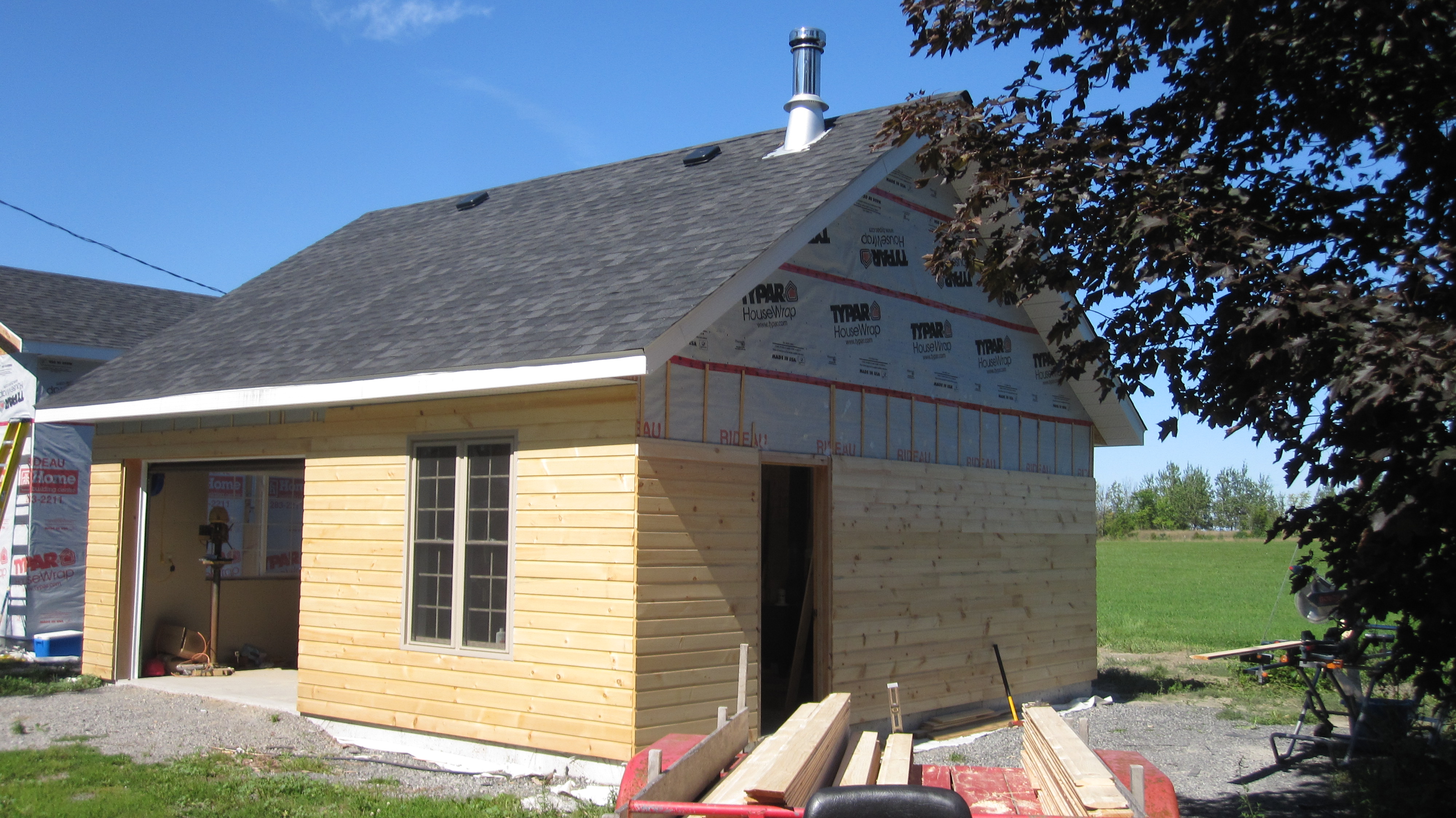
That’s all before the scaffold goes up.
Stone House Reno 5: moving the tools out
June 25, 2009
The end of June
All my life the end of June has been the time to say goodbye, take a rest, and start on a new project. I suppose it’s fitting, then, that today I moved the tools out of the stone house we’ve been renovating since my retirement in the fall of 2004. My shop, refuge, and storehouse for the last thirty-five years has now officially become a dwelling. One floor still needs some sanding and the whole thing needs varnish, but the days of muddy boot tracks to the bathroom have now come to an end.
I’ll miss the time I could put visitors at ease by chiming the house rule as they came in through the door: “No boots in the shower, but they’re optional in bed.”
Bet’s done her best to remain tolerant of my mess for the last few months, but I tend to believe actions more than words, and the two hours of frantic vacuuming upon each arrival at the farm for a weekend sent a clear message: it was time to get on with it.
She even helped me move the tenon cutter out of the living room. It’s a heavy relic from a pre-war factory, and the only way to move it without destroying the floor turned out to be by winching it up to one of the timbers I had installed as a room divider. Once I set it on a heavy plywood dolly with a chain hoist, it was pretty easy to move around. We managed to wiggle it out through the front doors (weeks of work on those doors) and into the bucket of the waiting loader.
Today two saws, a jointer, and my prized Poitras shaper made the trip to the barn. This made me sad. It was like leaving the comfort and security of my childhood home. Funny, the beds, the food, two computers and a television are still there, but it’s the shaper I miss. And I haven’t even had the thing for that long, only about three years. But it’s had a hand in everything good or interesting I have done in this renovation: the flooring, the cabinets, those muntined glass doors Bet insisted upon, the passage and entrance doors, the windows, the baseboards, the stairs, the crown moulding over the doors and windows, even the ceiling and window paneling – it all came off that shaper.
So now I face the grueling task of cleanup. The floor is littered with scraps of walnut from the stair-railing project and a lot of pine shavings from the final door casing in the bathroom which went on this morning.
Oh well, once that’s done I get to drive my floor sander around for a day or two. The old Clark drum sander is far from my favourite tool, but it’s heavy, loud and powerful, so it should stave off nostalgia for a little while until the varnished-floors regime becomes oppressive and I lay out the foundations for a new shop.
For other articles in this series check:
https://rodcroskery.wordpress.com/category/renovating-a-stone-house/
Stone House Reno 4: Making a railing
June 18, 2009
Soggy, but a good day for staircase-building. I’m putting a railing 56″ long along the hall next to the stairs. 1.3″ square plain balusters are fitting into the flooring and up into the rail at 34″. After much thought I decided to cut 1″ dowels into the ends of the balusters, then drill and glue. Surprisingly, the dowel-cutting went very well in the walnut stock: a 1″ diameter plug cutter mounted in the drill press machined the stock secured in the vice so as to cut between the jaws to get the end grain without splitting it. No problem, virtually an instant 5/8″ tenon, so little remained to do but cut the pieces to length and try the same thing on the other end of the 11 pieces. No extras. I missed one measurement by an inch, but caught the goof on the check before sawing. Whew!
To clear the cuts I set up a jig on the band saw to allow only a 5/8″ cut. Then I just sorta circumcised the ends, leaving the dowels exposed.
Then I hit the spreadsheet to calculate the distance between the posts so that I could lay out the floor for drilling. That went well, except that after layout I had a need for 13 posts. Hmmmm. Better not drill yet.
Turns out for each station I had added by 1/2 the post’s width when I should have added by the whole thing. Ready to start drilling 1″ holes in the floor now, but am feeling a bit lazy, so I checked mail instead, and then wrote this.
“So, Rod, how good is the staircase?”
“Depends.”
“On what?”
“Depends upon how good the story about it turns out to be.”
………
Back at it the following day. I had drilled the flooring for the balusters yesterday, using my trusty 6″ dial caliper to scratch arcs on the flooring to intersect a straight line down the middle of the planned railing. This time the count worked out, so I firmed up the marks with a marker pen and transferred them to the railing to run above. Just to be safe I did a rough set of marks with a pencil by laying the railing alongside the floor marks and roughly scribed them across. Then I established the one most likely to be correct and measured the other marks for holes in the railing off it with the caliper. Not surprisingly, these marks corresponded quite well with the rough measurements, but this precaution left me confident throughout the drilling that I hadn’t done the whole thing backwards.
The drill press is much steadier than my arm, but that advantage disappeared as soon as I rounded the top of the railing. Instead I clamped the railing firmly to the bench and had at it with a hand drill and a 1″ Forstener bit. While the hole depth isn’t critical with shouldered tenons, it’s still vital that there be adequate space for the tenon itself and any glue accumulated in the bottom of the hole. Several of the holes needed more drilling to provide adequate clearance. The holes, while not perfectly vertical, seemed to work adequately. None of the posts fell out when I glued them in.
Realizing the risks of gluing above a long run of wood to be stained, I left the balusters upturned in the railing for as long as I dared before moving them to the hall for installation. I still needed to be able to manipulate them a little bit in their sockets before they set hard. With an assistant I nervously flopped the eleven posts and their rail onto the hall floor, grinned hopefully when the whole thing did not fall apart, and then slid the assembly into the glued holes provided for it in the upstairs hall. In it went. No drips, no spills, no fuss.
Huh???
Next up, fabricating a hollow newel post.
For other articles in this series check:
https://rodcroskery.wordpress.com/category/renovating-a-stone-house/
Something interesting about walnut logs
September 25, 2008
This week I have skidded a number of smaller black walnut logs out of the woodlot as I found them during the walnut harvest. They had sat where they fell for two summers after the improvement cut of the winter of 2006-2007. When I unloaded them off the trailer the bark peeled easily and thus the moderate scuffing on one end from dragging behind the loader did not amount to a problem for George Sheffield and his band mill.
The surprise was when we cut the first slabs. Generally a walnut log shows a distressing band of bright white sapwood on the first cut, and it seems to go half-way through the log. Not so with these specimens which had sat for two summers. The sapwood was barely detectable. George speculated that the pigments must blend or else the white pigment fades over time if the logs aren’t sawn immediately.
The logs sawed very easily and produced fine, straight boards and planks. It’s not hard to see why cabinetmakers regard walnut as the king of the cabinet woods. My immediate objective was to get some material from which to build a bannister for the stone house. We cut three 2 1/4″ planks from one log which should fill the bill, though I don’t know if Bet will wait three years for them to dry or if I’ll have to bang out a temporary railing out of pine.
 the Walnut Diary