The rumoured rock barrier at the Marina Road failed to materialize, so we cruised in comfort across the side-roads and beaver ponds which make up the landscape on the stretch between Little Lake and Chaffey’s Locks.
When we came to the bridge over the canal with its planked deck and chain link sides, I regaled the crew with a long and windy account of trying to follow my 15 year-old son across the railway ties while he took advantage of his new, suspended mountain bike. He’d torn across the bridge at full speed while I was reduced to hopping over one tie after another while gazing at the Rideau through the wide gaps below my wheels.
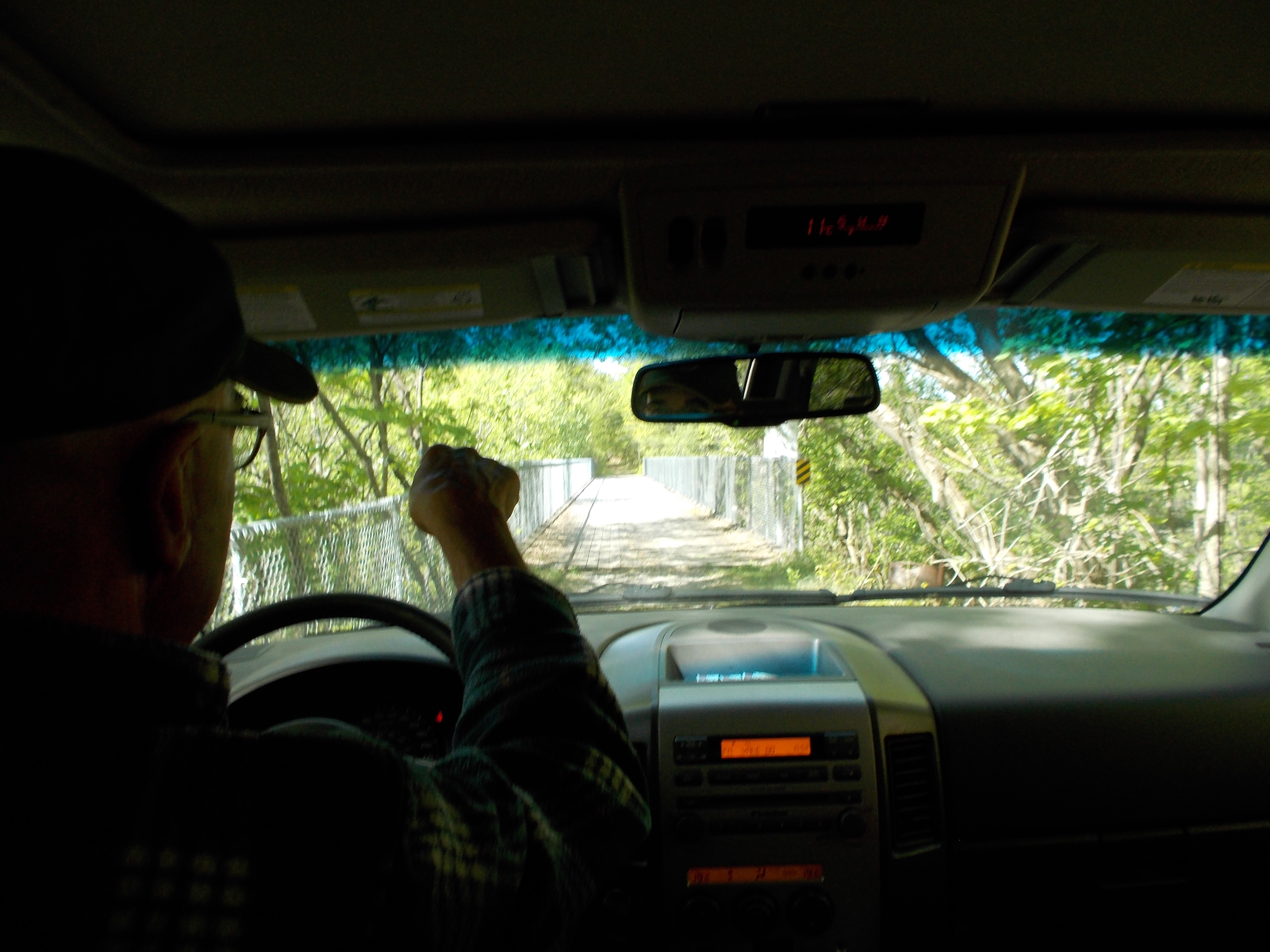

Then it was Doug’s turn to tell us about the livestock culvert through the railway bed and how it had become impossible to maintain due to shifts in the rock and gravel above.
When we came to the gate at the road which leads in to The Two Doctors, a black SUV pulled in quickly behind us while Doug puzzled with the key. The Queen’s Biology Station prof showed Doug how to fit the key, and then asked if he could go ahead because he had a student with a broken ankle a mile and three-quarters down the trail. Away he went.
I had built up the bird watchers’ expectations with wide-eyed accounts of the great blue heron rookery just off this section of the Trail. I should have remembered that dead trees don’t stand indefinitely in a beaver pond. When we finally got to the large marsh which stretched out far below our vehicle, it was treeless, and thus the heron nests had to be somewhere else. Undaunted, Lloyd and Dwayne kept up their search for songbird nesting sites.
This stretch of the railway line runs through very rugged territory, so we saw quite a few isolated lakes, the most impressive Garter Lake (or Carter Lake; Doug’s map wasn’t clear on the first letter). It’s a deep lake a couple of miles long which fills the gap between opposing ridges.

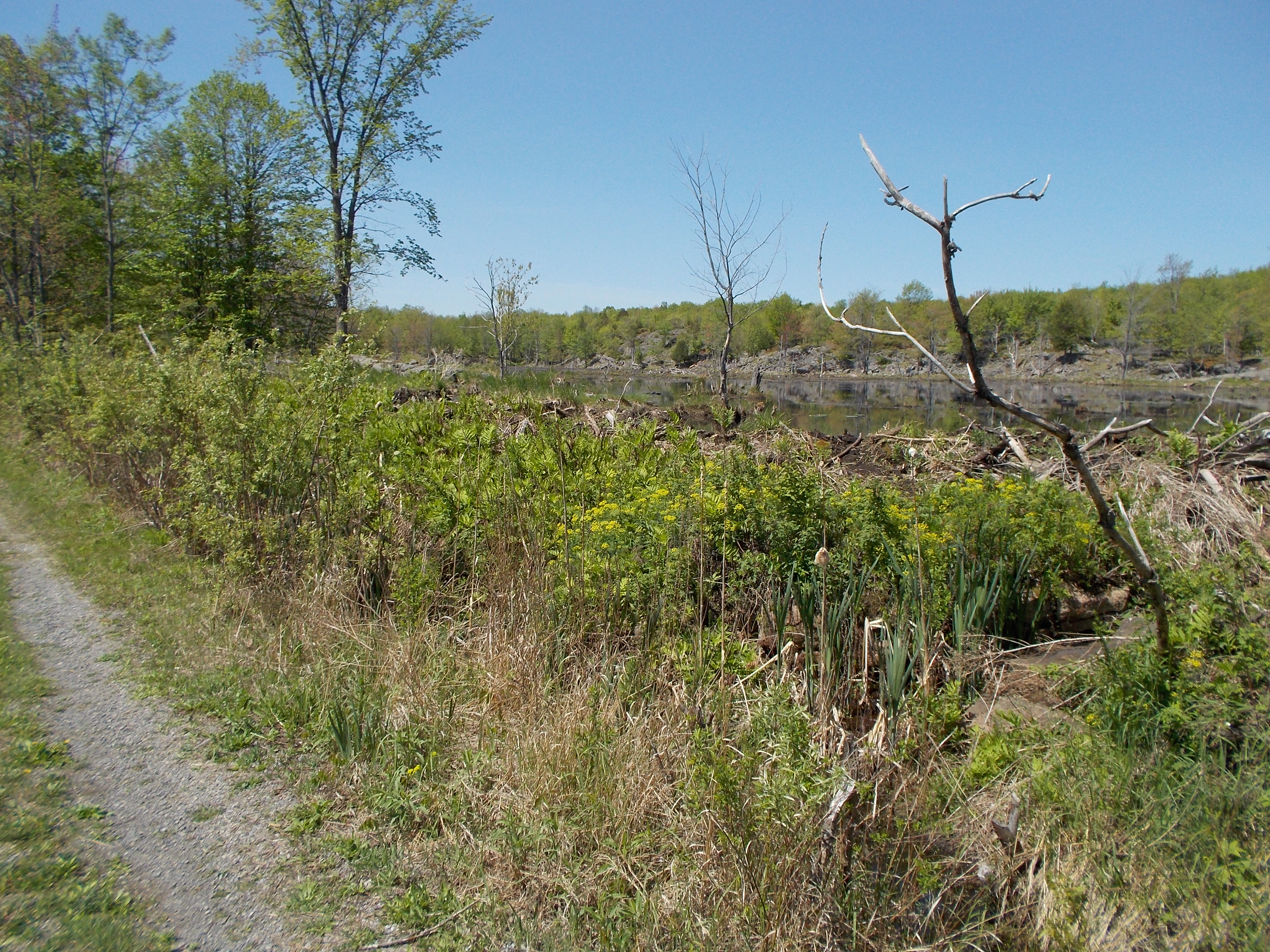
I called a halt at one point to photograph a huge mud beaver dam which maintained a pond at least four feet above the height of the road bed. If it ever broke, the trail would be inundated with silt cascading down to another pond about 30′ below on the other side of the road. Rough country.
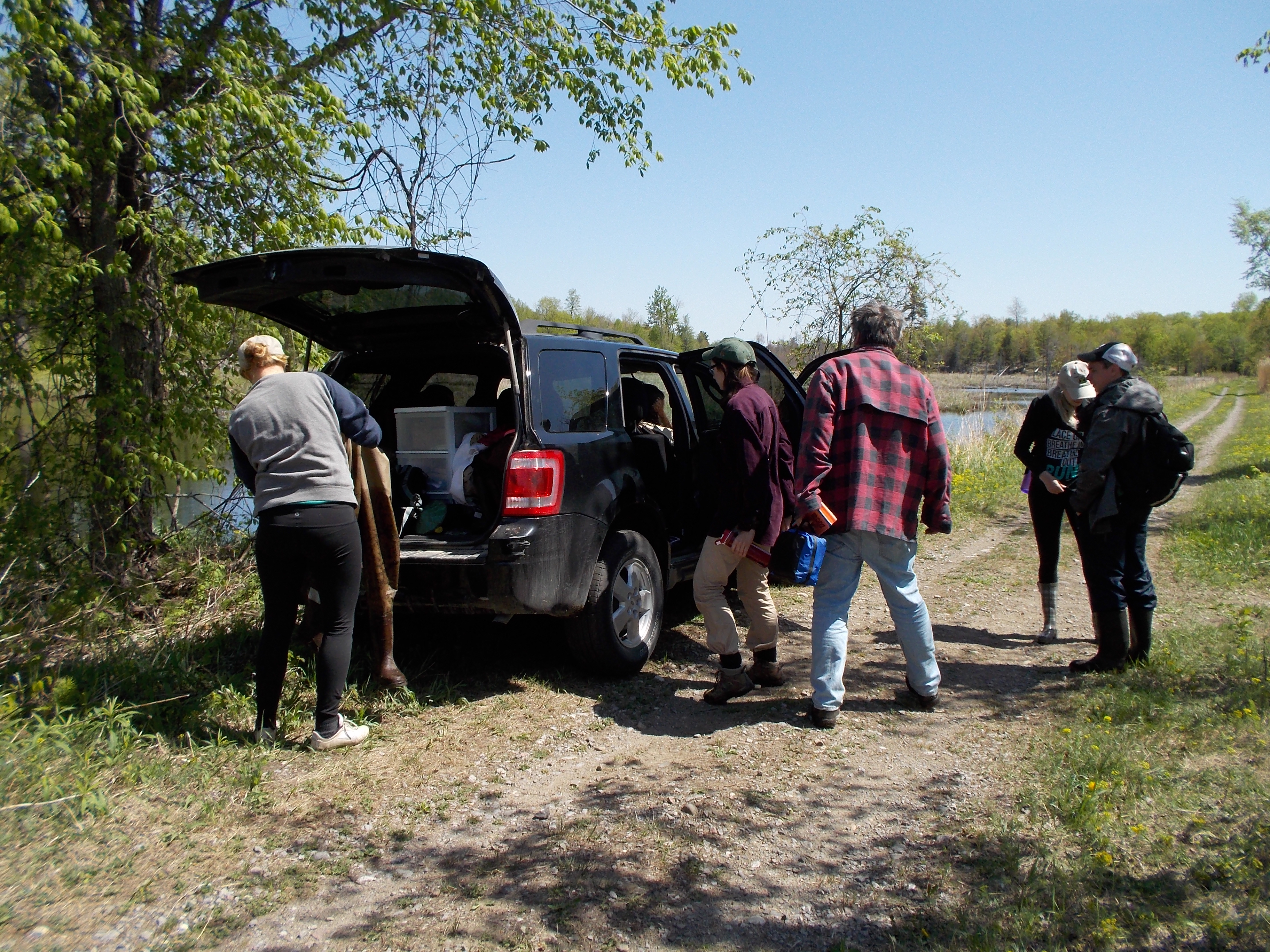
Eventually we came upon the band of Queen’s biology students and the guys helped carry the injured woman out a boggy trail to the prof’s SUV. They loaded her across the rear seat. She had slipped while stepping over a log on her way to the beaver pond to work on the water snake project. The rest of the crew dumped waders and other extra equipment into the back of the car, then cheerfully began the hike back to “QUBS,” their pet name for the Biology Station.
As the landscape began to level out Doug called a sudden halt and asked Lloyd to back up about a hundred feet to a trail marker dangling from a sapling. Then he bailed out and scuttled down the bank to the entrance of what looked like a large cave. “Take a look at this!”

As we assembled at “The Grotto” Doug explained that the builders of the railroad faced a unique drainage problem here. They needed to provide a route for a lot of overflow from a swamp above, so they drilled a tunnel through the granite ridge. The makeshift culvert looked to be about fifty feet to the light at the other end. A placid stream bubbled through the ridge and joined a smaller stream at a conventional concrete culvert under the railway bed.

Soon we came out at another gate a couple of miles short of Perth Road village. We opted to return by road from there while Doug told us about Opinicon Village, though we were unclear about the location of Postal Gate, which apparently guards the trail to the mythical town site.
Time will tell what the impact of the trip will be on bird house placements, DSV containment strategies, or local history tours, but the ride through the Cataraqui trail before the bugs of summer was well worth the effort for its scenic value alone.
There’s a fascination with forbidden spaces which strikes deep to the heart of every owner of an off-road vehicle, so as soon as my neighbour Lloyd Stone bought a used Polaris Ranger, I was eager for an expedition. Actually, there was a bit more to it than that. Lloyd volunteers maintenance services to his section of the Cataraqui Trail, clearing fallen trees and occasionally making a pass or two with his rotary mower. Such work’s not hard for a retired farmer with an embarrassment of tractors and related equipment still on hand.
Lloyd wants me to take over the section which runs past Portland, but I’m still holding out for the Chaffey’s Locks end. My argument throughout the winter remained that we need to make a thorough inspection tour so as to understand the challenges of the western half of the trail before firming up the maintenance schedule.
The list of objectives grew as the landscape turned from snow to mud, to wildflowers. Then it became a matter of recruitment and scheduling.
Doug Good, Chairman of the Cataraqui Trail Management Board, has a key to the gates and his group funds the building of boxes for trail newsletters in my shop, so he became a natural member of the tour group.
Dwayne Struthers is a member of the Leeds County Stewardship Council with a particular expertise in bird habitat, so Lloyd wanted him along to plan the placement of new nesting boxes along the old railway bed. I got to come along because the trip was my idea, and because of my obsession with the invading Dog Strangling Vine (DSV).
So in best bureaucratese, our objectives:
1. to identify what type(s) of bird houses should/could be installed on the different types of terrain along the trail;
2. to determine the extent of DSV infestation along the Trail, and consider remedial measures, including spraying with Arsenal on the shoulders of the trail;
3. to examine lines of accountability and finance to facilitate objective #2 (above) before the seeds take to the air like milkweed fluff in September;
4. to allow Doug to show other participants points of interest and historical significance along the Cataraqui Trail.
Enthusiasm for the use of UTVs for the trip wilted quickly. Lloyd said, “We’ll take my truck,” and that was that. I didn’t quibble because I had recently broken my gas-pedal toe, and was pleased to be a passenger.
Equipment for the safari consisted of Lloyd’s four-door Nissan Titan, an assortment of birdhouses, a few fence posts, a driver for the posts, and three Dewalt cordless drills and a jar of Robertson screws. Lloyd produced one 5/8″ wrench to tighten u-bolts.
Precisely on time we joined the Trail through Lloyd’s private entrance and proceeded to the site of the old Forfar rail terminal where the crew leaped into action to install a bluebird box. Then we crossed Hwy. 15 and encountered the first gate.
Doug managed to unlock the gate, but had to tie the heavy barrier shut with baler twine because the needed sledge hammer or 1″ wrench to adjust the barrier’s alignment with its post had not made the trip.
Off we went to gawk at the surprising beauty of Little Lake and gaze with growing consternation at local DSV infestations.

-More later-
According to Lancet, Roundup is a carcinogen.
March 24, 2015
http://www.thelancet.com/journals/lanonc/article/PIIS1470-2045(15)70134-8/fulltext
Glyphosate is a broad-spectrum herbicide, currently with the highest production volumes of all herbicides. It is used in more than 750 different products for agriculture, forestry, urban, and home applications. Its use has increased sharply with the development of genetically modified glyphosate-resistant crop varieties. Glyphosate has been detected in air during spraying, in water, and in food. There was limited evidence in humans for the carcinogenicity of glyphosate. Case-control studies of occupational exposure in the USA,14 Canada,6 and Sweden7 reported increased risks for non-Hodgkin lymphoma that persisted after adjustment for other pesticides. The AHS cohort did not show a significantly increased risk of non-Hodgkin lymphoma. In male CD-1 mice, glyphosate induced a positive trend in the incidence of a rare tumour, renal tubule carcinoma. A second study reported a positive trend for haemangiosarcoma in male mice.15 Glyphosate increased pancreatic islet-cell adenoma in male rats in two studies. A glyphosate formulation promoted skin tumours in an initiation-promotion study in mice.
Glyphosate has been detected in the blood and urine of agricultural workers, indicating absorption. Soil microbes degrade glyphosate to aminomethylphosphoric acid (AMPA). Blood AMPA detection after poisonings suggests intestinal microbial metabolism in humans. Glyphosate and glyphosate formulations induced DNA and chromosomal damage in mammals, and in human and animal cells in vitro. One study reported increases in blood markers of chromosomal damage (micronuclei) in residents of several communities after spraying of glyphosate formulations.16 Bacterial mutagenesis tests were negative. Glyphosate, glyphosate formulations, and AMPA induced oxidative stress in rodents and in vitro. The Working Group classified glyphosate as “probably carcinogenic to humans” (Group 2A).
Great Lakes Ice Coverage Records
February 20, 2015
For those of you who like to use meta data in formulating your ice-out predictions, here is a bit of climate geography courtesy of Tom Stutzman.
http://www.glerl.noaa.gov/res/glcfs/compare_years/compare_years_o.html
Good fences make good neighbours.
February 1, 2015
I’d thought of using that path across my neighbour’s field as a shortcut to the Cataraqui Trail for snowmobile expeditions, but I hadn’t for fear of leaving a track as an open invitation to trespassers.
On a warm-up round of the farm this morning, though, I ran across the tracks of an intruder made the night before: the snowmobiler had found his way onto my property through a gap in the fence not traveled since the plowing match in 2007.
Had he followed my established tracks I wouldn’t have been annoyed, but the yob took a shortcut through several acres of little trees, trampling them in his quest for a short cut over Young’s Hill. Inevitably he ran up against a closed fence, so he made an awkward U-turn, clipping an 8 year-old pine, then waded through more yellow birch, spruce and walnut on his way back off the property. I hope this guy realizes his mistake and does not return.
If this happens again, I’ll be forced to rebuild the fences we took down for the International Plowing Match in 2007 and haven’t had reason to put back up since. But driving a snowmobile over little trees is uncool.
Have you ever felt like a character in a scifi movie, the unsuspecting schlep who first encounters the mutant plant and then is devoured by it before it goes on to conquer the world?
I felt like that guy this morning when I realized that there was a whole new layer of growth coming up through the huge patch of DSV I had zapped three weeks ago.
Dog strangling vine spreads more rapidly than anything I have seen before. Its rate of growth is hard to believe, and it is relentless. Roundup will kill it, but it’s a lot like creeping charlie, the weed which bedeviled my mother’s gardening days: break it up or cut it off and any bit of root or stem will simply produce another plant.
But DSV also produces pods which rather resemble small green beans. They dry and release milkweed-style seeds on parachutes, and there are millions of these pods on the plants. DSV also climbs with alacrity, wrapping itself around other vines to produce the “dog strangling” effect after which it is named.
On my first attempt to walk through a metre-high mass of this stuff I nearly pulled both hamstrings.
This week I have seen outcroppings of the weed along the Ferry Road near Chaffey’s Locks, the Chaffey’s Locks Road, and Lockwood Lane. On my friend’s building lot it has made it 150 feet in under the forest canopy in one area. On the other side of the road it seems to be progressing unhindered.
If we don’t take immediate measures to control this invader, we can forget about plant diversity and seedling growth in our woodlots. DSV will crowd everything out. We can also forget about walking through forest trails in summer and fall.
By comparison the wild parsnip which lines our roads is a mild irritant. The DSV is a crisis and we need to take immediate steps to fight it back.
Municipal governments must get on the ball. This stuff is vectoring down roadways, quite possibly spread by mowing. Spraying to control the infestation is the logical first step. But it must be done immediately.
In Ogdensburg at the TSC, Roundup and other concentrated herbicides are on the shelf for anyone to buy, but to obtain the same materials in Ontario you must write the pesticides examination every five years. Many tree-huggers, myself included, now hold expired licenses, and our life supplies of Roundup (purchased before our licenses expired) won’t last through a blight on the landscape like this.
The second step would be to facilitate the acquisition of pesticides licenses and renewals: a single exam in Perth in mid-March will do no good for land owners who wish to protect their property this summer. And they’ll need the restricted stuff if they want to do any good. So far in three sessions I have sprayed 6 litres of concentrate (diluted 100 to 1) on one infected building lot, and it will take more to do the job. The diluted stuff in hardware stores available without a license just won’t cut it.
We need to get serious. If a brush fire were blazing at the front of your property, you’d try to put it out, right? DSV will easily have as devastating an effect as a forest fire on your property if it is allowed to spread unchecked.
Once those seed pods dry out and split, the time for action will have passed, and we can forget about walking through the woods.
UPDATE: August 14, 2014
My neighbour dropped a clipping from Tuesday’s Citizen by the house. It’s an interview with Dr. Naomi Cappuccino of the biology department at Carleton University. Her specialty is biological controls of invasive speces. She claims to have located a moth which eats only DSV.
PressDisplay.com – Ottawa Citizen – 12 Aug 2014 – The tale of the moth and nasty plant
Weaponized bitumen?
January 14, 2014
Looks to me as though the Alberta oil patch guys want to ship the bitumen from the tar sands out untreated because they want to send the pollution involved in processing the stuff downstream, as well.
Maybe it’s time for a new meme. How about “weaponized bitumen”? North American business extracts its revenge on China for cheap exports by strangling the country with emissions from its bitumen refineries.
And we thought smallpox blankets and the opium wars were unethical.
Dismantling of Fishery Library ‘Like a Book Burning,’ Say Scientists
December 9, 2013
UPDATE: 8 January, 2014
Gail Shea, Canada’s Minister of Fisheries, has denied the relocation of library materials was anything other than a cost-cutting move, though Huffington Post further rebuts that argument:
http://www.huffingtonpost.ca/2014/01/08/gail-shea-fisheries-libraries-book-burn_n_4562894.html
Columnist Frances Russell weighs in from National Newswatch:
http://www.nationalnewswatch.com/2014/01/08/book-burning-21st-century-style/#.Us2xf_aE4us
This The Tyee article is too important to miss.
“No walnut twig-boring beetles yet,” MNR.
August 6, 2013
For two summers MNR technicians have maintained an insect trap amid the black walnut trees on our property. The task was to locate examples of the walnut twig-boring beetle, a known vector for the thousand cankers disease which is currently devastating black walnut stands in the American South.
I just spoke to the technician. She told me that they soon plan to remove the trap because they haven’t found any of the dreaded critter. There are lots of butternut twig-boring beetles, but no walnut.
Needless to say I liked this news.
Ice out records 1945 to 2012: Little Rideau Lake
March 22, 2013
The record is kept by Lucille Mulville, the matriarch of the family farm at the head of the lake in Westport. It appeared in the March 21, 2013 issue of The Review-Mirror. It’s just too valuable not to distribute online, so here goes.
Rod

Update, 5 April, 2019: The following ice-out dates are for Newboro Lake.
2013 April 16; 2014 April 26; 2015 April 19; 2016 March 31; 2017 April 10
Best wishes,
Rod Croskery
 the Walnut Diary