The Bass Boat
September 8, 2009
When the first bass boats appeared on the Rideau we guys in the cedar strips and Wykes boats didn’t know what to think. They travelled around at ghastly speeds, but didn’t seem to create a hazard for other fishermen except for those who didn’t have their running lights installed. The big surprise was the way they threw very little wake at planning speeds, unlike the cruisers and large runabouts which were the bane of our existence.
The engines seemed excessive and the fuel cost for a day’s fishing didn’t make a lot of sense on small lakes like those around Chaffey’s Locks, but everybody admired the way the electric motors on the front allowed the boats to move around obstacles quietly and with great control.
For control is the whole game when fishing bass in shallow water. Pinpoint accuracy in casting comes only if the boat is in proper position and stays there until the cast is complete. A shadow will ruin an otherwise promising cast. Noise in the water causes the bass to stop biting for several minutes.
Oars are pretty good for moving a boat through weeds and around stumps and over- hanging trees, but the guys with the trolling motors were doing well, too.
Then a fellow from the States hired me to guide him on his 17’ bass boat for a few days in August. Ahah! Now I’d get a chance to see what these things could really do! I leaped at the chance and left my cedar strip tied to the dock. Perhaps I leaped a little too slowly, for on my first attempt to board my client’s boat the bow of the thing swung out from under me and I landed ass-first in the drink. Not a good way to start a day of fishing on a cool August morning.
We left Dorothy’s dock and locked down through onto Opinicon. All was well, though the lock guys ribbed me a bit about my early swim. Word travels fast in Chaffey’s. But then Ken cleared the channel and hit the throttle. 175 horsepower moves a small fiberglass boat fast enough to fold your eyelids back. I discovered that almost immediately. A few seconds later I was frozen. Man, can it get cold in August when you’re wet! Fortunately another few seconds and we had arrived at our destination, Deadlock Bay. The Deadlock is one of the trickiest places to control a boat I knew at the time, and I was determined to give the trolling motor a workout.
My favourite type of fishing at the time was to drag a dead frog over the large clumps of yellow weed which congeal on the surface in the Deadlock. Bass like to lurk underneath them and blast up through at baits dragged over the surface. These strikes are violent, exciting, and persistent: a good fish would keep a client amused for several minutes because the bass seldom connects on its first strike, and when it does get hold of the bait it often spits it out or rips it off the hook. In the dark under the weeds, the bass has no fear, and will strike again and again if the bait is presented properly.
This far-fetched approach to fishing makes for very entertaining sport for guests, and by the end of the day if I told them that a bass would bite at the foot of the oak tree six feet up on shore, most would take a cast or two just to be sure. The downside of fishing the slop, of course, is that the boat can easily become mired in the weeds. My guide boat weighed a few hundred pounds, and at times I couldn’t free it with the oars. I would have to blast out of the goop with the engine, the occasion of not a few bent propellers in the early years.
Fearlessly I glided my client’s bass boat into the weeds. Never having run a trolling motor before, I discovered this one had both 12V and 24V settings. Even on 12V it was pretty strong, and it had a lot of boat to move. If the plate on the side meant anything, the hull and engine weighed 2800 pounds. That’s a lot of boat.
Ken was an amateur tournament angler, so he didn’t need any instruction on casting. The first bass to strike up through the weeds rattled him a bit, though, and he missed the hook-set. “Put it right back in the same spot.”
“Really?”
“Yep. We often catch them on the fifth strike, third frog.”
Ken dropped another dead frog in exactly the same spot, no small achievement from thirty feet away. The bass inhaled it, and this time Ken was ready. “Get him up on top! Otherwise you can’t bring him in!” Ken valiantly yanked the bass up on top of the floating weeds, and then knew enough to skid it across the surface, not giving the fish a chance to nose back into the weeds. He brought a respectable two-pound bass to the boat.
For the rest of the morning we moved around the Deadlock casting at the patches of the yellow goo. Before long I had switched to 24 volts, but the motor resolutely chewed through the weeds.
We fished the week out. Ken caught more fish than he had in a lifetime of tournaments in Louisiana, and I developed a real respect for the bass boat. When it came time to build one, though, I used an old 16’ aluminum hull and a much smaller engine. The important part is the electric motor.
Filed in fish stories
Tags: bass boats, bass fishing, Fishing, frogs, Opinicon, Rideau, The Rideau Canal, trolling motor
Saturday evening on the Farm
July 25, 2009
7:15. Mom’s birthday dinner’s over; Charlie’s back at work on his car; Roz is buried in a book, studying for her big exam; Mom and Bet are washing dishes. I am sleepy after a day of mowing. Solution? Go fishing.
Up I went to the boat at its dock in Newboro to wet a line. A quarter mile out I found some likely pads and caught a bass on my first cast. Oops. Isn’t that supposed to be a jinx?
Then I caught four more in short order, two over three pounds, the others around two. I stopped at five because it was starting to rain a bit and I had run out of the weeds with easy fishing. Of six patches, five had fish.
This was too easy. I let them all go and drove home, chuckling. I’ll keep some fish that I have earned. It was 7:55 when I walked into the house. The kids and Bet were amused by my account of this bravura performance.
It doesn’t get a whole lot better than this, when one can complete a fishing trip in forty minutes, front door and return, and with excellent results. I think we’re going to like it here.
The joy of cooking (and eating) fresh fish
July 19, 2009
Tony’s sister Sharon turned up from British Columbia this week with the fillets of a 20 pound spring salmon caught that day.
When asked to cook a fish from the salmon family, I throw it on a hot grill, baste with unsalted butter while turning frequently, and try to get the skin off the fillet as soon as it comes loose to allow further basting. With this fish I realized the butter wasn’t necessary. Spring salmon’s oil, while plentiful, is sweet and tasty, and the flesh promised to be light and delicious. The problem was that in thickness the fillet ranged from a quarter inch to almost two inches. How could I get it to cook evenly?
I cut it into thick pieces and thin pieces. The thin pieces went to the table as soon as they were ready, and the thick chunks arrived as seconds. Everyone had seconds and bickered over thirds until the meat was gone. It was great.
Tony was a bit apprehensive about taking his sister fishing. Where Sharon lives they normally haul in sturgeon over 100 pounds, and eat salmon from the river several months of the year. How would she take to bass fishing on Newboro Lake?
By all reports Sharon is a match for her big brother’s considerable fishing skills. What’s more, she loved to eat the local product. This came as a surprise, but I guess bass have a distinctive texture and flavour, and are worth seeking out as a meal. I suppose Tony may have picked up a trick or two at the grill over the years, as well.
In this area everybody and his dog knows how to cook bass, but after fifty years of practice I have hit on two methods I’ll pass along, anyway:
The Cast Iron Barbecue Method
Take your best cast-iron frying pan. Dump in a generous pinch of coarse salt. Add enough olive oil to cover the bottom to a depth of 1/8”. Place the pan inside a hot barbecue and allow it to heat until the oil boils from the odd drop of water dripping from wherever.
Cover the bottom of the pan with fillets. Close the lid on the grill until you turn them, using two, good-quality lifters. My wife has an expensive fish spatula which works very well, but I wish she had two. Keep turning the fillets at short intervals until they start to break apart. Immediately transfer them to a platter where they will continue to cook until cool. They will not have browned. If you want brown fillets, use another recipe. These will taste good.
Add a bit more oil and more fillets if you have them, because your guests will likely eat the first bunch from the platter. That’s when they taste best, not after they have dried out on a plate waiting for the broccoli to cook.
Boiled Bass Fillets
Boil a pan of water, with salt added. Drop in fresh or frozen bass fillets. Control the flame enough that the whole thing doesn’t boil over. Remove the fillets when they start to break apart. Serve. Eat like boiled potatoes, dipping each forkful in a bit of butter at the side of your plate. This may not sound elegant, but it tastes great.
Selecting the bass to eat
Smallmouths live in deep water and eat minnows. Shallow water largemouths eat crayfish. I prefer largemouths. You can legally keep a 12” bass, but we generally let them go up to nearly 14”, just because fish of that size make a better fillet. On the other hand we don’t keep any fish over three pounds, as they are more likely to be loaded with pesticides and shouldn’t be eaten by kids or women of childbearing age. More practically, the large bass are much more successful spawners than the younger fish, and it just makes sense to let them go.
If you caught a trophy bass and feel you must eat it
Yes, you can make it delicious. Look up Mme. Jeanne Benoit’s The Canadiana Cookbook and get her instructions for roasting large fish. These involve removing the gill cage and gutting the fish, a major task with a large bass (use side cutters or a hacksaw). Then stuff the cavity with chicken stuffing and sew it up, leaving head, tail and scales in place. Wrap in foil and bake at 450 for ten minutes per inch of thickness. This usually works out to about 35 minutes for a large bass.
The end result tastes a lot like scallops. It’s really good, but you shouldn’t eat large bass that often, and don’t let the kids have any. The last time Bet did this it was a 7 lb. 4 oz bass I caught off the dock at Indian Lake Marina. We took it as our contribution to the Annual Pot-luck Dinner, where everybody in the Marina brings his or her best dish and tempts the other guests to sample it. The fish was gone, every last crumb, before the first ten people had gone through the lineup.
Filed in fish stories, Westport
Tags: cooking bass, cooking fish, simple fish recipes
A man of bullheads, bass, and poetry
March 8, 2009
And as a boy I loved it.
The clear blue sky
Reflected in the shining surface
Of the lakes –
The old stone house,
Resplendent on the hill,
Our home.
It has been my pleasure recently to read Don Warren’s new book, The House on the Hill: Recollections of a Rideau Canal Lockmaster’s son. (Trafford, 2008).
The first section consists of Don’s memories from the twenties up to World War II. The second is a sanitized version of his military experiences, and the volume concludes with a collection of poems he has written over the years.
The Lockmaster’s House at Chaffey’s Locks is very much at the centre of this book. At the end of a long wagon ride from Newboro in his seventh year, Don took one look at the big house on the hill and fell in love with it, ghosts and all. As he gives a lively account of the exploration of his new home, I kept checking back to the photographs he included in the volume. I hadn’t known about the footbridge across the spillway to the rear entrance of the Mill. I wish I could have seen the eels tumbling through the current on their way to the Atlantic.
Don’s accounts of battles with Daisy the Cow and early skirmishes with Opinicon guests with sensitive noses make it evident that the young man will not turn out to be a farmer. The campfire sing-alongs, practical jokes, outhouse mishaps and thefts from his mother’s garden provide a warm and amusing picture of life at the lockstation during the Great Depression.
Then, as now, a lockmaster must be an agent of the government. Don recounts his father having to tell the Chaffey’s fishing guides that they could no longer camp on the property in order to make more space for visitors from the capital. Don carries his father’s shame at this act of “democracy” to this day.
Understandably, some of the best sequences in the memoir concern fishing. Don lists detailed instructions on the construction of a “bob” for fishing bullheads in early spring. He offers a few tales of his guiding experiences, as well. For the talented young fisherman largemouth bass were seldom a problem to catch, but he greatly admired the style and equipment of the wealthy clients who came to fish for them.
Don’s remarkably modest throughout the book, and this no doubt takes away from the military saga, Guys in Gaiters. Like many who have signed the official secrets act, Don explained to me that he preferred to concentrate on the army hi-jinks rather than explain what he was actually doing outside Antwerp during the later stages of the war. “If it seems as though I had a four-year vacation in Europe during the war, I guess that’s a chance I have to take, but I did get shot at four times during that interval.”
Not much detail of the action sneaks into his account, though one paragraph does mention being left behind at Ardenes, Holland as the Allied forces pulled back to avoid a full-on German attack. Don explained, “What happened was that four or five of us were left behind to warn of any enemy attack by tanks. The trouble was that they had to be within 3000 yards for us to intercept their wireless signals. This meant we had to be left far behind the rest of our unit.”
A member of the 3 Canadian Special Service Company, Don trained in signals interception on the Isle of Man. One paragraph mentions Don’s crew’s discovery of a coded German radio message which went out immediately before the firing of every V2 rocket. This insight created quite a stir in intelligence circles because it provided the people of England with an early warning of each V2 attack. This reduced the threat of Hitler’s terror weapon.
But the best part of the book is the poetry. Don presents a great variety of rhymes, ranging from the ribald antics of The Ballad of Peter Milan, to the timeless portrait Woman of War. But Don won’t hold a serious mood for long, so these give way to the driving rhythms and the lively wit of Lesson for Old Age Dodgers:
So pull up those aged pants
Give old ways a different slant
Take a lesson from the youngsters in the crowd
The reader must not miss The Ballad of Senator Bill. It deals humorously with an accusation of indecent exposure at the Narrows Lock. Canoeists are apparently a vengeful lot, and in the ballad Don makes shrewd use of the rumour mill to deal with their tormentor.
The poem Old Age shows the hell of sitting with boxes of multi-coloured pills, blear-eyed and aching, “with conversations centering on the dying and the dead.” Nestled between those of his children, Don Warren’s home couldn’t be further from this drear scene. With a brave little dog watching his every move, a flock of turkeys at his window, swans on the ice below and a bevy of songbirds in his garden, Don traces with coffee cups and all-nighters his progress through the next volume of his memoirs. He’s in his eighty-ninth year.
Donald H. Warren. The House on the Hill: Recollections of a Rideau Canal Lockmaster’s son. Trafford Publishing. 2008. ISBN: 978-1-4251-6019-7
$17.00
Filed in fish stories, Reviews, Westport
Tags: bass fishing, Chaffey's Locks, Don Warren, guiding
Why nobody will take Bet fishing (more than once)
February 6, 2009
Charlie put up on his website a few old photos he found around the house. My favourite is one of a twenty-one year-old Bet, my bride, proudly holding a stringer of three fat largemouth bass. That was the last time she fished for about twenty-five years.
It wasn’t until my pal Tony was bragging about his ability to hook a bass and he ran into Bet’s barbed wit that the subject came up: “If you know so much about it, why don’t you ever fish?”
“Never mind,” I whispered.
Tony persisted: “How about I set you up with a spinning rod – they’re really simple to use – and take you up onto Mosquito Lake this afternoon for an hour?” Bet showed no real objection, so like an innocent Tony prepared the rod, the boat, and away they went.
I waited. I knew what it would be like when they returned. Yep. There was Bet in the forward seat of the Princecraft as they came in. She was beaming. Tony looked as if someone had stolen his favourite hat and stomped on it. “So how did it go?”
“I got three nice ones,” Bet chirped. “Tony didn’t get any.” Bet was always a ruthless competitor when it came to fishing. I winced.
Any one of the guys would have phrased the report as: “We kept three.” This meant that between us we chose to keep only these three fish. Others, the report implies, were released because they were too small, too large, or were lost. We even learned to call the ones that got away “remote releases” to remove the sting of failure.
Tony groaned, “Does she ever miss a fish?”
“No,” I assured him. “Bet’s a Leo, and I guess that means she has claws like a lion. If a fish even nibbles at a bait on Bet’s line, it’s as good as dead. She never fails to hook a fish.”
Tony and I and the other guys, of course, miss all kinds of bass. It’s a running joke reporting that one or the other of us caught a largemouth on the fifth strike, third worm, or some such. We even credit each other with assists. You get an assist for first missing the fish, and then watching while your partner hooks and lands it.
This sort of sophistry is fun. Putting a positive spin on our ineptitude is a big part of the bonding of fishing partners. But not with Bet. “She was at the front of the boat, right?”
“No, I was in the bow, running the trolling motor, but she still made casts all around me, sometimes even in front of the boat, before I could get my bait into the spots,” Tony complained.
“I gather she didn’t have any trouble switching from bait casting to a spinning rod?” On the dock before departure Tony had made a big deal of teaching Bet how to use a “proper” fishing rod. Now he just glared at me.
“She didn’t leave a square foot of lily pads or a stump for me to fish, and I was in front of her, the whole time!”
“Now do you see why Bet doesn’t fish much?” I asked.
“Yep.”
It was Labour Day, 1974. Over the summer in an old canoe on Opinicon Lake I had recorded data on every bass I caught. My goal was to hit the century mark before summer holidays ended. That morning I had counted up ninety-eight fish. All I needed were two more to reach my goal. We dropped the canoe in at Chaffey’s and worked our way out the shoreline of Opinicon.
Bet soon retired her paddle and worked steadily with her spin-cast rig. The artificial worm on a weedless hook slid easily under the overhanging trees as I methodically positioned the canoe for the best angle. I hardly ever saw an opening to cast. I almost hoped that maybe she would get a line tangle, or even hang up in a tree for a few minutes and give me a chance, but no: every cast was either perfectly placed, or short of the mark and quickly retrieved.
Then in the space of six casts she landed three bass for a total weight of ten pounds. Bet was jubilant at her success. They were very nice fish, and she had handled them well.
But I needed two fish to meet my quota, and she wouldn’t stop casting. What’s more, she ridiculed the one small bass I reeled in. ‘Are you going to keep that poor little thing? Why, it can’t be more than twelve or thirteen inches!’
As I recall my temper frayed sufficiently that I decided to transport my lovely, talented wife and her bass back to the dock before the fish grew stale. Then I took the picture of this beautiful young woman and the fish which should have been mine. That was the last fishing trip.
Bet went on to endure many summers in a leaky boat, my numerous half-completed do-it-yourself projects, and all of my dietary quirks. She raised our son well, has had a fine career and put up with a series of neurotic spaniels.
After thirty-seven years I can’t imagine life without her, but we’re both smart enough not to try fishing together.
Happy Valentine’s Day, Bet.
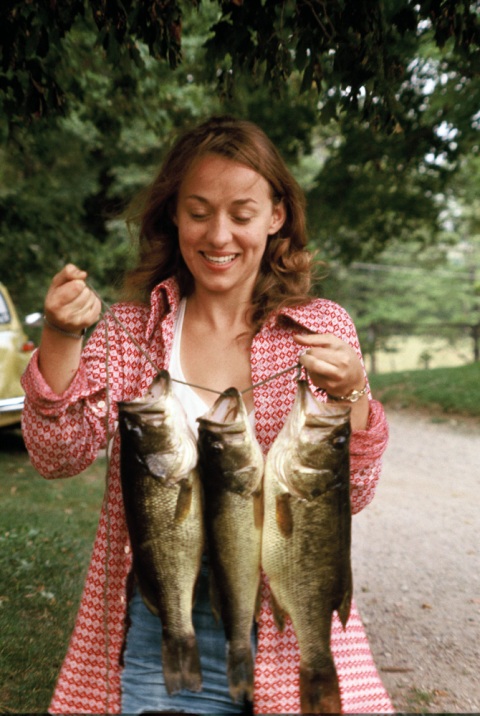
Filed in fish stories
Tags: bass fishing, fishing wives, Opinicon Lake, women fishing
Bass Derby – The way it used to be
January 29, 2009
It was August 5th, 1975. My fishing partner of the day was Dr. Don Mintz, a Queen’s medical student who was at the clinic in Newboro for the summer. Though by 1975 I no longer needed to rent one of his canoes, having inherited one from my uncle, I still liked to launch my fishing trips from Don Warren’s lawn because he had lots of advice on how to fish Opinicon Lake, and he let me pick frogs in his garden if I wanted them.
This day we paddled the three miles up to Deadlock Bay. It turned out to be one of those perfect mid-summer days when the fish simply don’t bite. We explored the beaver dam, then crossed it and made our way up the winding creek to the foot of Hart Lake. A shore leave involved a couple of casts into the upper lake after a climb up the trail, but the prospects of a bass for lunch seemed no better up there than down below, so we headed back out to the large mats of floating yellow algae for which the Deadlock is famous.
They weren’t producing that day, though. We worked down the shoreline with a the gentle breeze, and surely enough, a large bass sheltering beside a flat rock took my artificial worm and surrendered to the net after a vigorous tussle among the weeds and stumps of the bay. It wasn’t until the fish lay panting in the bottom of my canoe that I realized I had a problem on my hands. This fish was big. Trophy big. Bass contest big. How would I preserve the thing for mounting when I was a half hour of hard paddling from the dock?
Like an idiot I paddled up to guide Lennie Pyne, who was trying hard to get fish for his own clients on this slow day. I realized years later what a breach of etiquette this had been, but Lennie took it all in stride. “Keep it alive as long as you can, and be careful not to break or split the fins,” he suggested. “Empty your cooler. It looks as though it will just fit. Fill it with water and any ice you have, and that should keep it until you get to a weigh-in station. It’s a very nice fish, not just because of its size, but because it’s well proportioned and in good condition. You should get it mounted.”
Dr. Mintz had no objection to cutting the expedition short. We hurriedly paddled back to Warren’s launch and showed Don the fish. He looked at the magnificent bass, didn’t notice the tail of a large perch protruding from its gullet, and commented, “It looks a little dry. Maybe we should give it a drink.” He picked up the nozzle of his garden hose and shoved it down the bass’s throat, then turned on the water. As the fish’s abdomen distended he eased the water off. A surprising amount of the torrent stayed in when Don set the fish down on the lawn. “That’s an old guiding trick. Judges will catch lead sinkers every time, though I know of one guy who tried to put a chunk of pig iron into a fish once. There’s not much they can do with water, though, and you have to put the fluids back that the fish has lost since its capture.”
Off we went with our now-heavier bass to Brown’s Store. Chuck Brown was most accommodating. The dripping fish went onto a large piece of craft paper and right onto his polished brass scales. “Five pounds, eight ounces, and 20 ¼” in length. A fine bass.” He wrote the weight on a note, signed it, and suggested we take the fish to Westport to Gary Murphy’s Barber Shop, as he was hosting the only local big bass contest this summer. Chuck didn’t seem to mind the drippings from my fish on his counter. “It wipes off,” he grinned.
‘”Fetch” Murphy remembered me from my time as his pre-teen neighbour on Church Street. The fish weighed five pounds by his scale, but he said it looked pretty dried out and he would accept Chuck’s weight as the official rating. He suggested I freeze the fish and take it to Dawson Girdwood in Perth if I wanted a nice job done on the mounting, so a couple of weeks later I did just that.
Don and Shelley moved to Vancouver soon after our fishing trip and he set up an ear, nose and throat practice. A couple of months passed and out of the blue I received a letter from Miss Claire Donnelly informing me that my entry was “the largest mouth bass caught that summer in the Westport area,” and the $25. cheque enclosed was first prize in the contest.
I had won money in a bass derby!
As I recall the letter went on to name Joe Babcock the winner of the smallmouth contest with a six-pound entry.
Along about February Dawson Girdwood called me to pick up the mounted bass. It cost four times my winnings, but the largemouth still decorates the wall in my study. There have been many bigger fish since, but my first bass over five pounds was a real milestone.
Yarns I have heard while fishing
December 14, 2008
Sometimes the best yarns come from quiet guys. Paul’s a prime example. A polite, fastidious gentleman, well-liked by everyone on the dock, he nevertheless has a good side, I discovered. When fishing, Paul likes to get into the muck. He’s worse than I am, and if it were left to him, we’d have the boat mired in mud every time in our search for largemouth bass in shallow water.
When around civilized society Paul goes out of his way to appear steady and conventional. I guess it’s the training. Paul’s a pilot. Until they bought him a surplus 747, his favourite was an old Boeing 707 which his employer, Pratt and Whitney, bought in Saudi Arabia. “They patched the bullet holes and turned it into a test bed.” The techs placed an improvised mount beneath the cockpit for engines under development so that Paul could give them 3 ½ minutes of negative gravity as part of the test protocol.
“How do you do that?”
“We load twenty laboratory people and their equipment into the plane with the test engine mounted on the front, fly up to thirty thousand feet, point it at the ground and hit the throttle. They do their tests. I pull out and repeat the process until we have the 3 ½ minutes elapsed, and then we land and go for a coffee.”
“So, you fly a vomit comet?”
“I guess you could say that.” He showed me a photo of the 707 with a huge jet engine mounted below the cockpit. At rest the engine only cleared the runway by 3 ½”.
One weekend Paul was a bit grinny, so I could tell he had something to say. He waited until we were well away from the dock and then mentioned that he discovered another 707 in his parking space the other day when he returned from a test flight. He thought no more of it, and headed on in to the coffee room, where he encountered the owner of the plane, a civilian in a leather flying jacket who clearly wanted to talk 707’s. Paul chatted willingly away. The other guy seemed smart and enthusiastic, and was quite taken with Paul’s account of the extra engine on his plane.
After they’d had lunch and parted ways, everybody descended upon Paul at once. “Did you know who that was? John Travolta!”
“He’s an actor, right?” Groans from his colleagues. Paul sometimes seems a little out of it, but I don’t think he misses much.
Taxes on Canadian air space drove them south for their test flights, so for the last few years before Paul’s retirement Pratt and Whitney flew out of an abandoned nuclear missile base in Plattsburg, New York. Paul asked someone about the herd of goats grazing in an open-air compound within the maximum security section of the airport.
“Those critters are worth $1.5 million dollars each. They’re transgenic goats, with a spider gene added, part of a U.S. Defense Department black program. Spider silk is way stronger than Kevlar, so they’re trying to get the goats to produce the fibre in their milk so that they can harvest it and use it for superior body armour for soldiers. The Defense Department is worried a terrorist group will get access to the goats, so they’re farmed under maximum security conditions.”
I had a great laugh about this bit of whimsy, but kept quiet about it until two years later I saw an article in The Ottawa Citizen headed by a photo of a guy in a lab coat with a goat perched on his shoulders, chewing his ear. A Quebec firm had gained possession of the goat technology and were going public with their story to raise interest in their I.P.O.
This article was too good to be true, so I gave copies to my OAC English students and asked them to write a response. As usual, I didn’t quite know what to expect. That’s the fun of teaching English.
I won’t soon forget the rewrite of “The Three Billy-goats Gruff” which a clever young woman named Anna wrote, though. These three transgenic Billy-goats lived in peace in a brick house at the edge of a river until a nasty troll set up shop under the bridge. The confrontation came early when the troll tried to capture one of the young goats and eat him. To his surprise, the troll became entwined in a strong, sticky web which at first restricted his movements, but eventually disoriented him to the point that he fell off the bridge into the river and drowned, all the while subjected to a relentless spray of goat milk from the intended victim and his two brothers.
To this day Anna doesn’t know why I found her story so funny, and she grew up on a farm, too. I guess sending the city kid to the barn to milk the Billy-goat isn’t quite as current as some jokes anymore.
Ten years later, the group trying to develop the spider/goat technology has become Nexia Biotechnologies, and according to their website, biosteel development is still a key part of their asset list though they’ve acquired some pharmaceutical companies and some oil interests, as well.
And to think I’d accused Paul of making the whole thing up.
Filed in Birds and Beasts, fish stories
Tags: fish stories, genetic engineering, transgenic goats
How to cook a splake
November 9, 2008
Martin and Vanya are grad students in the Queen’s Biology Department. They have taken quite an interest in finding alternative sources of food in an urban environment, but since Dr. Bill Barrett suggested that I warn them to check all pigeon’s lung sacs for T.B. spots, they have confined their foraging to squirrels and porcupines they find in our woodlot. The most recent porky was quite a success, according to Martin. From his description it sounds as if it tasted a lot like beaver, a delicacy that I tried with colleagues and 450 Canadian studies students at my school one fall day in 1973. For the record, the large beaver (provided by my grandfather) tasted like finely-grained beef with a hint of liver. This may be more of a tribute to the skills of the ladies in the Chimo cafeteria than to the innate flavour of the critter, but it wasn’t bad, actually.
Martin and Vanya have taken to following Charlie along to the farm on weekends in hope of an invitation to hunt in the woods, or failing that, the offer of a meal of wild game from the family grill.
The first time they showed up I cooked a pile of largemouth bass fillets and dumped them on a cooling tray while they prepared corn in a propane boiler. In my experience if there’s a crowd around the fillets will disappear from the tray at a good rate, and the first sign that the crew is filling up is when a fillet actually makes it to a plate before it is eaten. It took until the third cast iron pan full for this to happen, and it might have been that Martin and Vanya wanted to leave some for the other six people; nevertheless, it does a cook’s heart good to see how a bunch of hungry twenty-somethings can eat.
Their most recent visit came about for the same reason that I had gone fishing the night before: it was simply too nice a fall day to remain inside. I had coaxed a very active splake onto the shore and its fillets were cooling in the fridge as they arrived.
I lit the grill and they required no coaxing. I pontificated away on the tricks of making an inedible fish into a delicacy, but their ears seemed to be blocked by hunger. All they wanted was the food, which they dispatched with haste and relish, did the dishes, looked briefly around the woods for squirrels, then raced to my secret fishing hole, though they claimed they were overdue for work on campus.
The following day brought my largest splake ever, and so I had to circulate a photo or two. Vanya responded with a few photos of his own and the following note:
—————————————–
Hi Rod,
Nice fish. Here are pictures of the one I caught.
After eating the splake at your house, I thought it was impossible that these fish could taste bad. So that evening, I grilled the splake that I caught the night before, and my god it was terrible. Tasted fishy and strong, and smelled equally bad. They’re a pleasure to catch but a chore to eat!
Vanya
—————————————–
Ah ha! He had made the classic rookie mistake: you must never mistake a splake for something good to eat! A splake looks somewhat like a salmon (though it’s a lot prettier), but while an Atlantic’s oil is sweet, a splake’s is almost as rank as that of a lingcod. I still remember the smell in the house that January day when I first tried to fry a ling fillet in an open pan. We had every window of the house wide open, just to get the smoke out. It turned out that the ling’s oil has a very low fuming point, and it smells awful when burning.
Memory of the ling debacle is why I only cook splake outdoors and downwind of the dwelling, if possible. But I’d heard someone — it might have been Lennie Pyne — talking about how ling is quite good if you deep fry it and get rid of the oil. Actually, I think Lennie gave me that ling, but he denies it, so maybe it was someone else in the group ice fishing off Trout Island that day.
Later on after I discovered downrigger fishing I was catching significant numbers of splake during my run of beginner’s luck, and I was unwilling to admit that they were almost inedible. I wondered if Lennie’s principle of broiling the grease out might apply equally as well to splake as ling.
I decided to slice the fish into skinless fillets and try to burn the oil out of them with an open flame. This worked surprisingly well. The whitish oil would rise out of the fillet when heated, and would then burn off when I turned it. You just didn’t want to be downwind.
Butter hides a lot of evil flavours simply by coating the tastebuds on the tongue. It works for August bass, so why shouldn’t it help a splake? I decided to baste the fillets in melted, unsalted butter each time I turned them throughout the cooking process. I singed a few hairs off my hands, but the process worked better than I deserved: it turned out that butter is denser than the splake oil, so as the segments of the fillet open up from cooking, the heavier oil displaces the lighter to the surface, only to be lost to the fire when the fillet is turned.
A splake fillet will sustain a great deal of flame without charring. It is like a salmon that way. Basically you can treat it like steak on a barbecue. Cook it until it breaks in half, then serve it with lots of salt. The fillet will have a great texture and appearance, and will taste like butter and salt – not bad, under the circumstances.
Just don’t be lulled into thinking that these magnificent fillets actually taste good.
Filed in Birds and Beasts, fish stories
Tags: eating wild game, fish stories, Fishing, Newboro Lake, Opinicon, splake, The Rideau
The downside of a lucky streak
July 28, 2008
My friend Tony has suddenly hit a hot streak on splake. Yesterday on Indian Lake he landed three nice ones and one laker in an hour of fishing. Today he sent me a quick note from his Blackberry that he had one more laker in the boat. Then came the following message.
Almost had a heart attack. A 3 foot water snake just slithered past my feet
from the front to the back of the boat and went back behind the tanks. He
must have been in the forward locker.
Now he has to decide: does he get rid of the snake and end his lucky streak, or learn to live with his new mascot and reap the rewards?
Filed in Birds and Beasts, fish stories
Tags: downrigger fishing, Fishing, Indian Lake, Newboro Lake, The Rideau, water snake
The Baitcasting Rod
June 29, 2008
Years ago after wearing out more spincast reels than I could afford to replace in a summer, I took the leap to a Penn Peerless baitcasting reel. The best you could say about this model is that it was durable. The angler’s thumb provided the only override protection, so a year of backlashes followed, with dramatically reduced fishing success.
But I hung in there with the heavy rod and eventually mastered the technique – as long as it was a large bait, tossed downwind, without obstructing tree branches. Then after a month of guiding I bought two modern reels. One, a Diawa Millionaire, was actually a very good, smoothly-casting reel. But I used the Shimano Bantam whenever I could, even though it was a backlash machine. I just liked the thing better. Finally the factory refused to rebuild it any more and I was reduced to casting with the Diawa. Its worn bearings made a plaintive screech throughout each short cast.
Finally my fishing partner Tony had had enough. “Next week I’m going to Fishing Buddies. They’re having a close-out sale, and I’m going to buy you a decent reel. Do you want the large size like that Diawa, or the smaller one like the Shimano?” I chose the smaller size.
Next week Tony arrived with a sparkling new Shimano Calcutta 150. He’d spent the week picking the rig out, and was confident that it would be a good match for my fishing style. Then I saw the bill, gaped, and reached for my cheque book. Before long I took a second mortgage and added a St. Croix 5 ½ foot heavy duty casting rod.
The St. Croix rod was deadly accurate around trees, and the reel provided excellent control, though with enough backlashes to keep it interesting. The new rig instantly tripled my fish output, which put a strain upon the partnership.
Up until now Tony could always lob out long casts with his spinning rig and bring fish to the boat, regardless of my positioning tactics. Now the jibes began about my carpet bombing the area with casts, fishing with the boat perpendicular to the shoreline so that the bow man would catch all of the fish, and of course setting hooks so viciously that on one occasion when the line snapped I had whipped his head and back a little with the rebounding graphite rod before it shattered in the bottom of the boat. Of course everyone heard the tale of the 2 ½ pound bass with which I had clobbered him after a too-enthusiastic hook set. I admit the fish flew quite a long distance through the air that time.
That was when I was young with strong wrists.
Not surprisingly, Tony and I took to fishing together from separate boats, and this had gone on for several years until all of the sudden Tony’s Princecraft was in the shop for some work as opening day approached.
Out we went in my Springbok from the dock at Indian Lake Marina, as usual undecided as to which side of Scott Island to fish. We wandered across Clear Lake, through the Elbow, and out into the middle of Newboro.
I spotted a rocky cliff line which often produces well. Tony said he had never caught a fish there. I explained how it’s usually only good for north winds, but on a calm day like this we might be all right. I quickly put three bass into the live well. No action yet from Tony, except for a few little ones.
As the mist turned to a sprinkle, we moved down to Miller’s Bay, and he gave me precise directions to find some submerged stumps in the middle. No fish. More work along a shoreline produced nothing. Hmm. “They don’t seem to be under the trees except in that one area we fished first.” The rain continued.
“Let’s try just up ahead. ” Tony lobbed a long one out into the middle, latched onto a solid fish, and battled it in that exaggerated way guys do when using spinning rods. Into the well went a very nice largemouth.
Then he suggested we try a small clump of brush further out into the middle of the bay. I moved the boat over to within casting distance, then laid my camo-coloured worm into a clear spot. Strike! I hauled back to set the hook and suddenly the fish ripped the rod from my hands and yanked it overboard. Tony stabbed futilely after the receding line, but he couldn’t reach it.
“We’re in nine feet of water.” Tony could see the depth finder from his seat. I dug into a locker for a dimly-remembered anchor. Out came a ten pound cast iron mushroom, not the ideal dragging hook, but worth a try. Four casts later the deck of the boat was covered with mud and the rod was still gone.
“We’ll have to come back with Sean’s anchor. It has flukes,” Tony offered.
I gave up. “Can you get the mud off this one so I can put it away?” He dipped, and came up with some white line.
“I think I’ve got it.” Then he hauled in line, hand over hand. He grinned, “If you land this fish you’ll really have a story for the paper.” He handed me the muddy rod. With delight I wound up the line. Fortunately the fish had thrown the hook in the same spasm which had yanked the rod overboard. Otherwise the rod would have been in Crosby by now.
I was very, very glad to get that rod back. Now all I have to do is put up with endless suggestions about wrist straps to help me hold onto my equipment.
UPDATE: July 3, 2008. It’s been a long time since I have had that Shimano Calcutta apart for a cleaning. I had forgotten about the brake weights, and was surprised to find that it had only two of the six engaged, and that they were quite worn. When I reassembled the reel I slipped all six out of their snapped-in storage position, but quickly put it back to two of the six weights because casting effort was too high with more weights in operation.
The following day my friend Tom took me fishing and he was becoming frustrated with his brand new Shimano 250, left hand model. Out of curiosity I took it apart and found that he had none of the brake weights operating: he was trying to cast with just the brake adjustment knob turned tight and his thumb. Things improved dramatically when the thing was properly set up.
So if your new bait reel doesn’t work well, check and see if its brake weights are really in operation.
Rod
 the Walnut Diary