The Heroic Winter Assault on Schooner Island
January 4, 2009
The photo shows four people stuffed into snowmobile suits, mitts and helmets, standing along the edge of a frozen lake and leaning on a pair of old snowmobiles. The shot could have been taken anytime, but in fact it is only a couple of years old. It marked the final winter expedition to the cottage on Schooner Island. That’s right. Never again. Both our wives insisted.
But the trip had gone well; it’s just that the weather changed a bit.
Tom and Kate get homesick for their cottage on the Island during the winter, and I can tell by the frequency of emails and phone calls about when the pressure will become unbearable for Tom, and up they will come. Much planning is required: ice reports are filtered through runoff records to determine if the ice is strong enough for a passage across Newboro Lake to the Island.
A few years ago in a fit of optimism I asked a snowmobile collector to locate me a serviceable Ski Doo Alpine, the two track, single ski behemoth which crowned the Bombardier line for many years. From the first time I drove it the thing intimidated me: I could barely pull the starter cord on the monstrous engine. It refused to turn without running into something. Its suspension ignored my considerable weight, and only rode smoothly if I had a full oil drum on the back. But it would float over any depth of snow, and could it ever pull!
Not to be outdone, Tom found a 1970 Evinrude Skeeter, also with reverse, which had been kept in its owner’s living room in Ohio since it was new.
Tom and I decided to run out to the island without wives or luggage to make sure the ice was strong enough to support us. Tom’s machine made a ghastly racket at its maximum speed of 25 miles per hour. The Alpine is actually a lot faster than that, so I had to idle along to let him keep up. Then Tom spun out on the ice. This looked pretty funny, but the third time the machine flipped, tossing Tom clear and rolling until it had divested itself of its windshield. Chastened, Tom made the rest of the trip at a more modest pace.
Back at the SUVs we discovered far too much luggage to load onto the little sled I had brought, so Tom took it and I hitched the 5 X 8 trailer to the Alpine. Down the ramp we went with everything but the kitchen sink in the trailer.
As long as the shore was nearby, our wives’ morale was high. As we pulled out into the open lake, though, and the only reference points became the large bubbles of air just beneath the black, transparent ice, I began to notice a persistent vibration coming from the rear of the Alpine. It didn’t vary with engine revolutions or speed. In fact the shaking continued when we’d stopped. Bet was shivering. This did not bode well, but we were over half-way there, so on we went.
The cold-weather camping was good fun at the cottage, and then the morning dawned to a five-inch drop of slushy snow, with clouds and wind which indicated more on the way. Yikes! The trailer!
The retreat from Schooner Island occurred more quickly than our hosts would have liked, but we had to get off the ice. With the wide track of the trailer I would have to maintain a steady speed until we hit dry land, or we’d be stuck.
We tossed the luggage into the snow-filled trailer, Bet clamped her arms around my waist, and I gingerly urged the rig along the shoreline until we had gained enough momentum to brave the deeper snow.
With a roar the Alpine hit cruising speed, and the next three miles was quite a ride. The open lake alternated between hard portions of frozen snow and liquid puddles of goo. We plunged straight through them. I didn’t dare look back.
Down the lake we went and up the ramp. Newboro had never looked so good. The Alpine shut down with a grateful sigh; I pried Bet’s arms free and staggered off the machine. She still sat there. When I knocked on her helmet, an eye opened through the frosted visor and she gradually became aware that we had arrived.
She pawed at the visor a couple of times with her mitt. I helped her open it and remove her helmet. “I … will … never … do … that … AGAIN!”
I’d sorta expected that, so I checked the load behind. Nope, nothing there but a snowbank which had somehow slid up the ramp and into the parking lot behind us.
Tom couldn’t get over the remarkable turn of speed the Alpine had shown on the trip across the lake. “We were following in your track, but your machine was just a dwindling yellow dot, with a great big snowball forming behind it!”
Perhaps the governor on the huge Rotax engine responded to the weight it was pulling, or maybe the beast just sensed its master’s panic and ran for it, but the Alpine has never gone that fast since, and perhaps it’s just as well.
Ranger Pix
December 27, 2008
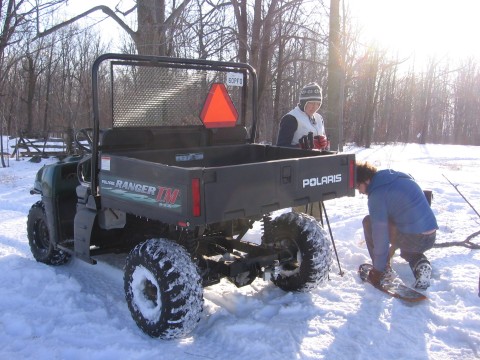
The Ranger TM in Snow
December 19, 2008
Saturday, January 10, 2009: It was about zero F this morning, and the Polaris wouldn’t start. By noon it limped into motion on one cylinder, and eventually the other one cut in after a long warmup. It may be old plugs, but with 130 hours on it, it shouldn’t be. I’ll give it some new ones tomorrow and then try it.
To its credit, it did manage to start without a boost or a battery charge, but this isn’t good enough. I put the battery on the charger for the afternoon and then it lit up quite easily, so it may be a maintenance, rather than a design issue.
YouTube is full of film clips of Polaris Rangers in sand and mud, but I haven’t seen much about the cold weather operation of the machines.
This week during a cold snap the shift cable froze solid, imprisoning the TM in its tent/garage until heat from the idling engine eventually thawed it out. Requests for information from ATV forums didn’t produce anything useful, quite possibly because all of the avatars of contributors have their machines surrounded by sand or mud, not snow.
The 2004 TM is still under factory warranty, so I called the dealer and explained that this intermittent failure of a cable could be a real safety issue for me if I’m out on a frozen lake in mid-winter, so he ordered a replacement cable.
The Subaru 653 twin didn’t start all that well on the cold morning, either, picking up on one cylinder and the choke, and only gradually getting #2 into the act. I bought the machine as a demonstrator last fall with almost 100 hours on the engine (now 130), and I’ll bet it has never had a plug, though, so I’ll hold off on complaints about cold-weather starting until I have fresh spark in it.
This morning I took the TM for a drive to follow the tracks of the coyote who had scurried out of the barn as I approached. I had a pleasant morning wandering around a hundred acres of fields and pine, spruce and walnut seedlings. The coyote is clearly doing her job, foraging for mice almost exclusively around my young seedlings, so I guess her Christmas bonus is assured, and I’ll try to forgive her persistent use of the miscellaneous piles of shavings in my barn as her personal litter box. What’s with that anyway?
Most of the footing was frozen grass under about four inches of powdery snow. As a test I drove the TM at low speed as far as it would go into a field with a gradually thickening pack of snow and ice left over from an earlier storm. With no load in the back the traction failed before it dragged bottom. Fine. I backed up, interested to see whether the thing would get itself out of a situation on the flat, or if with the differential locked it would skid off the the side and compound the problem. I was quite pleased to find that in reverse it follows its track quite faithfully, and seems able to back out of whatever situation I create for it while driving forward — on the level. It would be foolish to expect to back uphill to get unstuck with a 2WD machine.
All in all, the Ranger TM is quite a pleasant machine in cold weather. So far I have only had one morning when it wouldn’t work, and this may be easy to fix.
A month ago the dealer offered me a used cab frame, windshield, cab enclosure and plastic roof, but I declined after considerable thought. A small cab like this would frost up quickly from one or more persons’ breath on a cold morning. There’s no defroster. Further, if I towed the machine to a lake over sanded highways, I’d have to clean the windshield before starting out. That would be rough on the plastic. The doors would have to be removed for safety when traveling on the ice. What’s more, I have a perfectly good 4X4 pickup which is most capable off-road. Why would I create another, inferior copy of it?
The advantage of the Ranger is that I can look up and enjoy the tall trees when driving through my woodlot. In buildings and around obstructions it’s the easy visibility and lack of fragility of the body which give it an advantage over the truck. A cab would reduce these benefits.
So instead of a cab I have opted for a snowmobile suit and helmet with full face shield and a scarf for the chin area under the helmet which freezes instantly without it. Feet don’t seem to get all that cold, but very heavy mitts are a necessity, as well.
My first cold-weather run nearly froze me before I adapted to snowmobile attire. That time I had some carburetor icing or governor issues: at full speed the engine would bog down to medium revs for a while, then speed up again. It continued to fire well throughout the slowdown, though. Surprisingly, the problem has not recurred. Perhaps there was moisture in the crankcase which frosted the carburetor, but once it had cleared the problem resolved itself.
I haven’t started my 1976 Ski Doo Alpine yet this winter, and we have had lots of snow. That says something about the appeal of the Ranger TM.
———————————————————————————————
UPDATE 22 DECEMBER, 2008: Today was so cold my Toyota groaned when starting, but the Polaris lit right up, and the shifter hasn’t whimpered since that one tantrum a week ago. The snow was too deep for the TM, but I had work for it to do, so I cleared a trail back to the woods with my tractor and 5′ snowblower. It was able to bull around enough in the deep snow to turn around at the ends of the road, though more weight in the bed might help. Inexplicably, the left dog on the tailgate release stuck in the on position late this afternoon. (Turns out the right cable had doubled inside the gate, jamming it to the left. No biggie.)
Oh yeah, I forgot to mention that the reason I needed the Ranger was that my faithful old Massey Harris 30 gas tractor wouldn’t start. Those things always go, but it was too cold today or else it was feeling neglected because of all the attention the Ranger gets.
———————————————————————————————–
UPDATE 29 DECEMBER, 2008: Yesterday’s high temperatures and gale-force winds swept the snow away in our area, so I took the Ranger for a tour of the property to check for damage. No doubt because of the improvement cut in the winter of 2006, the woodlot held up well to the onslaught. Traveling on the trails was easy because the snow was all gone from beneath the maple crown. Then I emerged onto the butternut plantation, which is sheltered from the wind on the eastern side of the woodlot. The far side of the field sported a band of green, but the corn snow (crystalized from freeze/thaw cycles) lay a little deeper than I would have liked in the 150 yards separating me from an easy drive back to the house. Do I back up and go around, or try to get through the deep snow?
I hit the snow at about 3/4 throttle, acceleration limited by some ice on the trail. The Subaru engine sounded as though it was working for once, as I kept the revs up and let the locked differential chew its way through about a foot of soft, heavy snow. It seems the way to get through deep snow with the two wheel-drive Ranger is to keep the rev’s up and let it paw away, because as it passed the point where I thought it would lose momentum and stick (necessitating a rescue with my truck), it just kept going at about jogging speed. It carried on through snow that was quite a bit deeper and harder than I expected, and we gratefully reached the grass on the sunny side of the field. What impressed me was the lack of axle-bouncing of the sort I get in my Toyota when spinning in deep snow. The TM’s axle stays in place well while spinning.
Family members accuse me of deliberately trying to get stuck with my toy. But how can you trust a machine if you don’t know its limits?
The Trailer Project
October 29, 2008
Tomorrow’s task is the erection of one of those chintzy little 10 by 10′ portable garages bought mail-order from Winnipeg. The new Polaris Ranger’s demands must be met, or else I’ll gimp around all winter with icy back and bottom, and my tools will rust from dips in the soggy leaf-container on behind.
A more significant problem rests with the Ranger’s outlandish dimensions: it won’t fit any trailer I own, so I can’t even take it back to the dealer should it need service. Not to worry, I’ve been yearning for a new highway trailer for some years now.
I found a good 6X10 utility trailer at a farm implements dealer, but I didn’t like the price. As well, when I inquired at the Ontario License Bureau I learned that: “Only livestock trailers are exempt from provincial sales tax,” regardless of my tree-farm status. I was not about to add another 8% to the already-exorbitant rate. Steel prices are high, eh?
Then I found on Kijiji a set of axles, springs, wheels and tires off a large boat trailer. The owner had replaced the running gear with a heavier set to use for a steel dive boat he owns. The kit looked like an interesting way to start a winter project, so I drove to Kingston and picked up the axles.
I decided to find a welder to make this project happen. Peter Meyers was willing. His loader picked the axles out of my utility trailer and I headed off to the nearest metal yard for some scrap 2″ pipe to extend the axles from 5 to almost 7′.
Through a series of email conversations with pals, I developed the following set of objectives for the trailer:
1. transport the Polaris Ranger;
2. have a versatile bed surface available to transport pieces of machinery, as needed;
3. have a stake trailer available to transport logs and lumber to mill and/or market;
4. have the capacity to transport 1 cubic cord of firewood on the highway, as needed.
The occasional 3-ton capacity and the greater smoothness of towing are why I’m interested in a tandem, rather than using just one of the axles. Yet I want to stay with a smaller-is-better principle in its building, as I see little point in hauling around a lot of extra height, width and weight. Removable sides improve the trailer’s potential versatility, but extract a penalty in convenience; i.e: the drive-on-and-forget ease of a golf cart in a 5X8 box with ramp.
The other conundrum has to do with the trailer’s potential length. A ten-footer would carry the Polaris in better balance than a twelve or fourteen, but a longer bed would work better for lumber and logs. Without a back gate a few feet of overhang wouldn’t be such a big deal, though. My son suggested that his sports car is 13.5 feet long. How could he know that?
The other thing is that the Polaris likely won’t venture away from the farm much. The trailer’s far more likely to haul lumber and machinery for use on the farm.
A system of stakes seems indicated by the wish list above. Regadles s of how it looks, I want a tall stake on the right rear to provide a fulcrum for swinging heavy planks onto and off the trailer. I have found that a similar wooden stake on the lumber trailer is invaluable in making the transfer from trailer to pile. I pull, lift one end, pivot and drop, never lifting more than half of the weight.
Maybe a flat bed with cleats on the sides would work. I could use heavy ratchet tie-downs like what the lumber yards use, substituting chains for the really heavy stuff.
Another priority will be to keep the bed of the trailer as low as is practical, given the nature of the axles and tires. A 21″ height would be a reasonable target. I think a pair of ramps will do for access to this trailer. I’d keep the 5X8 for utility loads such as lawn mowers, golf carts and leaves.
Peter Meyers warned about potential trouble with the Ministry of Transport if we build the trailer too big. I don’t want to get into the annual-inspections routine or have to install brakes. The price list at the metal place woke me up. 1 1/2 by 3″, 1/8″ wall square tubing costs 3.60 per foot. Similar 2″ square tubing costs 3.24 per foot. 2 1/2″ angle iron, 3/16″ wall, costs 2.82 per foot. This tends to shorten a trailer rather quickly. Let’s see: 5 1/2′ by 9 1/2′ will do it…
Notwithstanding my son’s hint that his Porsche is 13 1/2′ long, I think I’ll trim as much “weight” as I can from the trailer at the planning stage.
That’s about it, so far.
UPDATE: November 3, 2008
This evening I discovered that there are no books on the subject of utility trailer construction in the Ontario Library System. The best the research librarian in Smiths Falls could do was a Haynes trailer manual in the collection of the Toronto Public Library, but it’s missing. Maybe I should write a book about this project.
Peter and I settled upon 3 by 1 1/2 square tubing for the frame, and he likes the idea of continuing the frame sides on to form an “A” tongue. That will mean hauling 18′ steel home. This isn’t much of a problem: one of the many trailers at the farm is a tri-axle narrow flat bed 17′ long.
UPDATE: November 8, 2008
At a junk yard I ran across three, three by four inch beams, 17′ long and 1/8″ in wall thickness. I couldn’t resist, so I brought them to Peter for use as the main structual members of the frame. Another foray into the used market proved fruitless, so I bought the remaining material (mainly 1/8X2X2 square tube) at Heaslip’s in Smiths Falls. Or so I thought. When I delivered the steel, Peter had been thinking about the tongue and decided that it needs to mount as a V beneath the bed, rather than an extension of it, so I need to pick up an additional 16′ of 3 X 1 1/2″, 1/8th wall. Oh well, over-runs happen. On the other hand Peter cut and lengthened the axles very neatly, then straightened the bent one to where I couldn’t find any evidence of damage. The guy’s great at straightening steel.
The axles are a bit over 3/16″ steel, so I guess the vendor’s claim that they are rated at 3500 pounds isn’t too crazy even if they are only 1 15/16″ in diameter. The springs are 5 leaf, now moved to beneath the axles to lower the trailer bed.
This may turn into a pretty good trailer.
UPDATE: Nov. 11th, 2008
The basic frame is now complete at 11′ 9″ by 6′. The outer frame is made of 3 X 4″ expanded tube, 1/8″ thick, with stringers on two foot centres of 2 X 2. The “A frame” tongue is on the same level as the top of the bed, made of 1 1/2 X 3 expanded tube, with similar reinforcement underneath to take the weight back to the outer edges of the frame. Peter will next turn the frame over onto the suspension and weld on the large tandem fenders. I think I’ll use 1 1/4″ basswood planks for the floor and bolt the planks to pieces of angle Peter welded on to the front and back cross members for the purpose. That way I won’t have to drill into the main structure to fasten the wood, and the hollow steel should stay dryer without holes in it. The basswood will be strong for ten years and then deteriorate, so I’ll replace the bed at some point before that. Clear basswood’s abundant in the woodlot and surprisingly tough stuff, as long as it isn’t trapped with moisture in a cavity. With the lighter wood I can easily keep the trailer under 1000 pounds.
The 6′ tandem fenders I bought at Princess Auto wouldn’t fit the trailer. The existing frame for the fenders had come with the axles, and it was clear that we needed 5’6″ units to fit the space. An Internet search revealed that a trailer store in Stittsville had two in stock, so I gratefully drove in to pick them up. The new fenders also had a teardrop, a rounded lump of sheet metal to occupy some of the empty space between the tops of the tires and provide reinforcement for the flat surface above it.
I asked Peter to rig up out of scrap some sort of “headache bar” for the front to which I can fasten a simple winch for pulling and holding cargo. He’ll also put stake pockets along the sides and front for tie-downs, or in case I decide to build a low picket fence around the perimeter for hauling firewood. I’ll wait and see what I need as a ramp. I do have a couple of planks with aluminum ends from another trailer, so I’ll try them first.
UPDATE: 19 November, 2008
I’ve scrubbed most of the red paint off my hands, but I’d have to describe outdoor painting in late November as a chancy activity at best. The compressor would barely start because the oil was so cold, and when I poured thinned Tremclad into the sprayer I realized that this was unlikely to work. I sprayed around a couple of corners with diminishing success until I gave up and used a roller. That worked pretty well as soon as I gave up any aspiration to do more than prevent rust. The trailer’s a rough piece of equipment, not a show piece, so it was more important to have the metal protected so that I could use it over the winter than to have a gemlike paint job.
The basswood boards went on after two coats of Cuprinol and I worked the rest of a gallon of paint into them, as well. The trailer is now very red.
Next I’ll wire it, then fasten the boards on. It may take a few days for the paint to dry, though, as it hasn’t gotten above freezing for a while around here.
The overall quality of the construction on the trailer seems to be very high. Peter Myers did a great job on it.
UPDATE: December 6th, 2008
The wiring was an interesting challenge on a cold November day. Because the trailer is over 80″ wide, Ontario regulations require a set of clearance lights at the back. Everyone looks at them and speculates about how long they will last, exposed as they are to banks and loading docks. I put the wires inside a conduit so that I should in the future be able to fish a new harness from front to back without crawling around on the ground. The rest of the wiring went well. Clearance lights went onto the ends of the headache bar.
Then when I connected the rig to the truck, nothing but the left signal light worked.
On a hunch I tested the lights with a 12v battery. Everything worked perfectly. The truck was the villain. I replaced the back pigtail and then all but the right hand signal worked fine. For some reason my Tacoma won’t fire the right-hand signal on the trailer, though all other lights on truck and trailer work perfectly. So far in a year of ownership, this is the only glitch that has defeated me on the truck.
The Ranger loaded onto the trailer without difficulty, and so we then had to devise an efficient method of holding the machine in place. When the dealer loaned me his 6 X 12 utility trailer to bring the Ranger home, he simply winched the machine up against the front rail with a heavy strap and left it. The front tires pulled against the railing provided all of the restraint the rig needed for a highway haul.
With a flatbed I figured I’d better do more, so I winched it against the headache bar with a ratchet strap and then attached two more smaller straps from stake pockets at the sides to the trailer hitch at the back of the Ranger.
This proved less effective than a single, strong attachment point at the front, so I added a commercial-grade strap tightener (the kind you use a separate bar to tighten) and installed 7/8″ basswood sideboards to wooden stakes to enclose the bed. This also lined and strenghtened the fenders.
I’m still using four-foot 2X6 basswood planks with aluminum ends as a ramp. For now I store them in the bed of the truck when hauling.
The system is still evolving, but one strap with a heavy hook runs from the strap-tightener to an appropriate hole in the undercarriage of the Ranger. The front tires tighten up nicely against the headache bar and so far nothing has moved during a couple of tows over moderately bumpy roads.
The tandem trailer works very well, with a smoother ride for the Ranger than I expected. That does not mean that the rig is easy to tow. For my four cylinder pickup the one-ton weight is not a problem, but the sail area on the Ranger is quite considerable, especially with the mesh insert which links the roll bar to the passenger compartment. As I wrote before, the beast towed much better with the mesh removed, but now I have the license and the slow moving vehicle sign mounted up there as well, no doubt robbing even more power through wind resistance. I’ll be o.k. in fourth gear for local jaunts. If I need to go far, I’ll remove the mesh grill and use fifth gear on the highway.
EZ-Go golf cart vs Polaris Ranger TM
October 1, 2008
You may wish to read parts two through eight of this review, also posted on this site.
Our EZ-Go has been an indispensable part of life on the farm now for two years. It replaced a two cycle EZ-Go, a 1989 whose engine simply wore out. Its predecessor was a Yamaha G1 rescued from a wrecking yard and resurrected with regular engine rebuilds.
What I learned from the series of carts is that 2 cycle golf cart engines have a life expectancy measured in hundreds of hours; four cycles run for thousands.
The EZ-Go has worked steadily for the last two weeks on the walnut harvest. Each expedition would involve loading a large plastic tub onto the back compartment of the cart (where the golf bags go), and adding various pails as space provided. Off I’d go, cheerfully picking my way over the familiar bumps on the road back to the walnut plantation.
A good morning’s picking would fill a twenty-gallon tub and a couple of five gallon pails. Then would come a leisurely drive up the hill and back to the house. The cart moved agilely along some rather rudimentary trails in the woodlot, its handiness greatly enhanced by a narrow track, short wheelbase, and rearward weight distribution.
The EZ-Go won’t carry a lot in its “trunk”, but the lift-over height of the back bumper is about fifteen inches. Heavy stuff like rocks or a tub of walnuts can swing in there without much effort on the part of the labourer.
The EZ-Go’s two cylinder, 251 cc Subaru/Robin engine is the smoothest small gas engine I have seen. It provides an ample nine horsepower and runs tirelessly. Maintenance is very easy.
Then we come to the Polaris Ranger TM, a new addition to the farm. It was too big for my 5X8 trailer. This caused some consternation, but the dealer lent me a 6X12 for the delivery. Something that almost broke the deal was the requirement that one remove six screws and a plastic plate in order to check the engine oil! Polaris got rid of this abomination the next year, but it might account for why this brand new 2004 was still on the lot.
Like the EZ-Go, the Ranger has a Subaru/Robin engine, a selling point for me. This one is a big, rumbling V2, shaped like a Harley’s. The 653 cubic centimeters only produce 18 hp, so it’s not working very hard. The other two wheel drive Ranger, the 2X4, digs 40 hp out of a 500cc single, but that model costs a lot more. I read an online review which suggested that the larger engine is detuned in order that the top speed be kept under the 25 mph ceiling for low speed vehicles in the U.S.A.
Anyway, to get to the driving impressions of the new toy: from the first trip across a meadow we all realized that the Polaris is a clear winner in the ride category. The downside of life with the EZ-Go has always been its savagely harsh ride off-road. Do the math: the same back springs go into this 700 pound, gas engined machine as go into a four passenger, electric cart which weighs close to twice that amount.
On the other hand, the Polaris has adjustable back shocks to dial in ride stiffness. In full soft mode for the test drive, the thing floated majestically over the rough fields, even when I used a burst of speed to encourage the neighbour’s cow to return home. There is simply no comparison between the two in the ride department. The Polaris seats three adults side-by-side on its tall bench seat. My elderly mother quibbled a bit about its height because her feet didn’t touch the floor, but insisted that the ride was still comfortable for her while she drove.
As far as cargo hauling is concerned, the EZ-Go handles one large tub of walnuts, with perhaps a five gallon pail or two on the cockpit floor in front of the passenger seat. That’s a lot of nuts, but the Ranger easily holds four tubs and a bunch of pails in its dump box. The liftover height is a killer, though. It’s too high for heavy items. From now on I’ll set tubs of walnuts into the box with the loader or else tow them on a trailer. The golf cart wins hands down in the ease of shuffling aboard a heavy object. Another cargo advantage which goes to the EZ-Go is capacity to handle long objects. I learned last winter that the easiest way to bring a few 16′ boards to the planer is to slide them through the cockpit of the cart from front to back. They balance harmlessly on the dash coping and the rear sweater rack. This trick has proven a real work-saver.
The other thing the EZ-Go is unsurpassed at is sanding an icy driveway. In the fall I fill a few large plastic tubs with salted sand. Under normal circumstances I carry two tubs in the loader of the tractor when sanding is needed, but if it is too icy to walk, getting on and off the tractor safely becomes a problem. I have learned that one tub on the back of the cart is much more manageable than the tractor. Getting on and off the cart is safe because of the handholds provided by the top, and the EZ-Go’s traction is more than adequate for use as a sanding vehicle. The “trunk” is all plastic and I don’t think it has suffered at all from occasional sanding forays.
The Ranger’s plastic dump box isn’t pretty, but it seems well enough designed, apart from the liftover height. Things don’t seem to fall out of it on a rough trail, it dumps easily, and of course it holds a great deal of whatever one sees fit to pile into it.
The Polaris handles the narrow golf cart trails quite well when you consider that it is 16″ wider than the EZ-Go. Two wheel drive isn’t a problem at this time of year, though the differential lock is handy when the drive wheel spins on a rock or stump. Both machines are good in the woods, as long as trails are halfway civilized.
Even with a roof in place, a golf cart is very easy to tow behind a mid-sized vehicle. It feels as if it belongs back there. The Polaris on the borrowed 6X12 trailer nearly stalled my four cylinder pickup truck until I figured out that the mesh grate below the Ranger’s roll bar was sucking power away. I removed the grate at first opportunity, and then it towed well, though the extra weight and the roughness of the larger trailer were obvious.
As far as costs go, a good golf cart can still be found for around $3000, and all it needs is fuel. Overhead is delightfully low on a golf cart. The Ranger costs almost double that, requires $250 for liability insurance or about $450 annually for all perils coverage. The license is a one-time $35 charge.
So why did I buy the Ranger? It handles much heavier loads than a golf cart, the ride is terrific, and it can be used as a miniature truck. When time for spraying comes, the equipment will likely mount on the Ranger. While I still think an old tractor and trailer is the best rig for hauling out firewood, I can see the Ranger taking a larger role as I get too old to climb nimbly onto a tractor seat. Certainly it will come in handy in the future for moving fuel from woodpile to boiler in my shop. The Polaris Ranger TM is a long term investment, but I would probably have stuck with the golf cart if not for the bone-crunching ride over rough terrain.
Update: September 22, 2008
Today I ordered a portable garage to shelter the Ranger from the elements. It’s too much work scraping the frost off that seat in the morning, and it’s better to have the box dry for tools than to have to muck around the accumulated wet leaves to find something. On another level, the Ranger gives every indication of being around the farm for a very long time, so I might as well protect it from the UV. It’s finding its niche nicely, though I do a good deal more walking than I used to when served by a golf cart, most of the trips arising from a reluctance to sit on a cold, wet seat in the morning. The golf cart’s roof really did make a difference.
I almost forgot: the Ranger’s box makes a handy workbench. It’s a good height for that, at least. If I slide scraps of wood into the slots for racks (2003-4 only) they keep boards from sliding backward off the box when I balance a load across the back, though I need a wide, treeless lane when moving long stock to the planer.
Yesterday’s Tractors
June 9, 2008
June is the month of the tractor in Upper Canada. Wherever I look from our perch on Young’s Hill I see the machines methodically changing the colours of the landscape as their owners prepare for another season.
To mechanically-inclined individuals who have not grown up with them, tractors are platypi: strange creatures, interesting, but so unusual that they are hard to relate to.
My friend Tony hates my 1947 Massey Harris 30. He seems to expect it to run like his BMW. Though he handles ten tons of Sea Ray with its six hundred horsepower with ease, Tony had never driven off a hard road surface until I eventually made him take a tour around the farm in my dad’s Jeep.
Tony’s anxiety about the Massey stems partly from the angry growls the starter makes occasionally. The first time it happened he jumped back as if it had bitten him. He never forgave the machine. Perhaps sensing this unease, the Massey does its best to break down as soon as he comes onto the property.
My pal Tom, on the other hand, adores the 1960 Massey Ferguson 35. He regards it as a big step up from his hydraulic lawn tractor in Pennsylvania, and gets as much seat-time running the bush hog as his schedule allows. A wannabe tractor owner, he loves the ride, the sound, the power of the beast. In summer I get a lot of raspberries picked while watching Tom mow around endless rows of walnut seedlings.
I share his fondness for the 35. Other tractors I had looked at were too big. They intimidated me with their size because I had never been around the bigger ones before. The 35 was just right, though.
It replaced a 1951 Ferguson TEA 20 which my dad had bought late in life. I hated that tractor because it terrified me. Running a bush hog with it was such an adrenaline-pumping experience that I couldn’t wait to be rid of the thing. First gear is an indecently fast pace, and in order to keep enough power to run a mower through long grass, I had to rev it pretty high. Galloping over rough ground led to unpleasant surprises every time I discovered where Dad had removed a boulder from the pasture. In long grass I once hit a stump with a front wheel. The sprained wrist took me out of the first month of bass fishing and I never forgave the tractor.
No one had told me that a rotary mower becomes an immense fly wheel connected directly to the driving wheels on a Fergie. I learned that myself the day I fetched up on top of a boulder in the horse pasture. It took an eight-ton hydraulic jack to lift the tractor back off the rock, and I decided then and there that this thing was too dangerous to use for anything except pleasant tours down country lanes with a trailer on back.
As I learned about tractors what amazed me was how much everyone else in the community knew about them. Two of my students had delivered the 35 from Almonte on a float. They gave me an amusing rundown on the strengths and foibles of this very common model. Rob Foster told me that “Some of those old 35’s leak so much they practically change their own oil, but this one’s pretty clean and it starts well, so it should be fine.” Over the phone my teen-aged neighbour Joseph Gordon easily talked me through the installation of a manifold one Friday evening.
Then I discovered the ultimate taboo for the owner of a tractor: I ran out of diesel, on the coldest day of the year, in the driving lane of the road going up Young’s Hill. There I was, snowblower down, engine rapidly cooling, dead on the hill.
I hurried to Portland for more fuel, poured it in, and then discovered why you don’t let these things run out. It wouldn’t go. Peter Myers stopped, took one look and said, “What did you do that for? Fixing that’s a terrible job! You have to work the pump on one side, while loosening each injector on the other side until it goes.”
I further confessed to having let the smoke out of the starter just before he arrived. Starters apparently run on smoke, because once I had let it out, this one wouldn’t work any more. Peter drove over the hill to get his tractor for a tow away from the danger zone. As he attached the chain I asked if it would hurt to try chain-starting the tractor. He told me to put it in top gear, high range, and see how it went.
Peter’s gigantic John Deere had no trouble dragging the suddenly-little Massey Ferguson off the hill and in the driveway. I popped the clutch and it started, so I finished the snow removal, then took off the starter and received an expensive lesson in tractor economics at the rebuilder’s.
When the Massey 30 quits, I add gas, but I don’t touch the diesel tractor until I’m sure the tank is at least half full. Lesson learned.
NOTE: For access to an outstanding knowledge base, check yesterdaystractors.com
Ski Doo Alpine: 2 Ez-Go Golf Cart: 3
March 21, 2008

This morning dawned clear and cold, with a strong wind from the north. If ever there would be a day this year for running on the crust, this would have to be it. As soon as I got to the farm I took the Ez-Go out on the rock-hard snow. Great. A quick tour of the property located a couple of dodgy areas where I fell through but had enough momentum to get out again. It looked as though the cart could see some action today.
The first chore was to deliver gas to the stranded Alpine back in the woods. That done, I backed out on my track to the safer fields, then headed north to visit the maple orchard. The cold forced me back to the house for a helmet with visor, but then I did a one-mile circuit of the farm at a great rate.
Play comes before work, but the next task was to take four 55 gallon drums of accumulated sawdust and wood scraps back to the pile at the edge of the property. These had accumulated over the winter and seriously cramped my style, so I was glad to have the drums empty, even if I found the trip out very cold in each case.
A trip to the gas station for fuel for the cart, and I was ready to play in full snowmobile attire. Charlie had shown up by this time and he snapped the action shot above.
Off to the woodlot.
That looks ominous on the page, and I should have known better. Fifty feet along the first trail and I felt the back tires break through the crust. Then I made my second dumb decision: I decided to push the cart ahead, speed up, and hope the crust got better. Three hundred feet further into the woods (and further from the house) I dropped my visor and jammed the cart through the dead branches of an overhanging tree, but it was for naught. All four wheels dropped into the suddenly-weak snow. Oops!
On the brighter side, I was quite close to the abandoned Alpine, so I gassed it up and the engine caught on the first pull. That refurbished primer makes all of the difference. It warmed up readily, but wouldn’t move. The front ski was frozen to the ground, about two feet below the back of the machine, which was sitting pretty on the crust. I raided a nearby rail fence and jammed, prodded and pried until the front tip came free. I thought I’d try it at that, so I fired up, dropped the Alpine into forward, and eased it out of its mid-winter burrow.
The single ski proved to steer very well on the crust. That was odd. I don’t recall ever driving the thing when it was easy to steer. Anyway, I swung around and picked up the Ez-Go’s track, then eased by it and backed in front. I tied a short length of rope from the towing eye on the cart to the hitch on the Alpine, then fired up and eased ahead.
Mistakes travel in threes, right? The Ez-Go pulled much harder than I expected, but the Alpine has lots of torque and so the driverless cart soon popped up on the crust, tried to overtake the Ski-Doo, then veered into a tree, stopping with a crash. It’s a credit to the cart’s design that it wasn’t damaged (see below)*. The polycarbonate fender bent out of the way and the front tire took the impact. My pal J.P. once told me, “The golf cart is the only motor vehicle ever designed to be driven by drunks.” Perhaps I should add “fools” to his definition.
Once it had shaken off the odd bit of tree bark the cart was fine, so I drove it around the remainder of the trail and back to the house in disgrace, collected Charlie, and returned for the Alpine. Charlie’s a little more cautious than I when it comes to crust, and he made me jump out of the cart as he did a loop close to the Alpine, then booted it out of there.
So I brought the Alpine in from the cold after its prolonged session in the woods. All in all, I guess it was the better vehicle today, though the Ez-Go certainly did its best.
UPDATE: March 22, 2008
Today it was still cold and the crust proved more reliable for the Ez-Go. With it I took a tour of the farm and exposed many pixels on the digital camera. The Alpine stayed where it sat. For a photo shoot the golf cart wins, hands down.
Alpine: 1 Ez-Go: 1
UPDATE: March 24, 2008
The crust is still holding well in the cold weather. After a tour of the southern half of the farm, today the Ez-Go earned its keep moving wood for the renovation project from the barn to the house. Boards too long to ride in the truck can be balanced across the Ez-Go’s dash board and the sweater basket for quick transportation when the trailers are all frozen in.
Once again the golf cart keeps finding uses in all seasons, now that its cold-weather fuel supply problem has settled down.
Today I also used the trailer hitch and a tie-down strap to yank two 18′ boards out of the bottom of a lumber pile. The cart offers good low-end torque in a confined area. I can’t see the Alpine doing this.
The papers today are full of the story of the guy who rigged his electric golf cart with a snowplow and remote controls. He clears his driveway from a standing position in his living room window. I don’t know about that, but the Ez-Go is definitely the sanding vehicle of choice on the farm. Put a plastic tub of sand on the back, fill it, add a shovel and away you go. The advantage over the tractor and loader is that it is much easier to get on and off to move the vehicle. The advantage of the cart over boot leather is that it’s much healthier to skid on the ice than to fall on it.
Alpine: 1 Ez-Go:4
* May 25th, 2008. I spoke too soon about the lack of damage from the impact with the tree. The front axle bent a bit. The left front wheel now tows out, and the suspension sits a bit lower on it than the others. This has caused some binding of the suspension on short turns, and it has reduced the turning circle to the right by a foot or two. Apart from that the cart has still worked normally in the many hours of operation this spring. I guess Alpines handle crashes into trees more readily than do Ez-Go’s.
Alpine: 2 Ez-Go: 4
The unbearable attraction of crusted snow
March 15, 2008
Saturday afternoon the fine weather lured me out on the crust with snowshoes. As I marched along, camera in hand, surrounded by exquisite March beauty, I kept yearning for a good freeze. If this snow were hard I could drive the golf cart in a straight line all the way to Kingston.
Alas, I have a fatal attraction for crust, starting in my early years in Westport with expeditions on mountain and lake, and I’ve never lost the urge. It’s a magical time of year when the whole world turns hard and you can travel anywhere, over lakes, fences, thickets, beaver ponds – it’s all under a heavy layer of crust.
It was a particularly fine March afternoon when Don, Bob, John and I borrowed a ski-tow rope from Ansley Green, tied it behind my old VW Beetle, and went skiing on the Little Rideau.
I was first up because they were my skis and I had had one lesson. Don Goodfellow drove. The Beetle would only do forty-five on the crust, so after a round of the bay I tried to get a bit more speed by cutting side to side behind my tow. I found I could jerk the light car sideways if I came up beside the driver, braced myself and pulled.
The vibration from the rough surface made it feel as though every bone in my feet had come loose and was pinging around inside the boots, but apart from that it was a thrilling ride on the vast, icy surface. I swung to the right, checked on Bob Conroy in the passenger seat, ignored John Wing making faces at me through the narrow back window, then whipped all the way around to Don’s side and gave a massive tug. The rope broke.
I still can’t believe I did this, but I kept my balance in that sideways slide for a very, very long time, until I stopped. After that I didn’t want to ski anymore, and no one else wanted to try it either.
Next weekend John had access to his dad’s favourite toy, a very fine military-surplus Ford Jeep. Again it was a cold March day, but the series of thaws and freezes during the week had reduced the snow pack to an asphalt-hard crust, while smoothing the landscape out just enough that we thought we’d try to explore the Upper Mountain by Jeep. There’s a campground on the site now, but at the time it was just granite and brush, and the Jeep picked its way over the large mounds with little difficulty. There’s no thrill quite like driving on the crust.
Then we hit the frost hole. It was just a small flat area of snow, but John’s Ford dropped through into this big puddle and sank to the axles in a heartbeat. It didn’t stop there, but slowly oozed its way down into the mud until the goo topped the seats. We’d been stuck before, but never anything like this. Now what?
I remembered hearing a local tale about a crew who had laid railway track across a sink hole filled with gravel back in the railroad era. The chief forgot to move their locomotive to harder ground overnight. All that was left in the morning was bent track on both sides of the hole. They never saw their engine again. We needed to do something fast.
I’d remembered seeing Floyd Snider and his bulldozer at the dump as we drove by, and Floyd was the sort who would help us out, so we hiked the half-mile across country to ask him what we should do.
“O.K., Boys, I’ll just finish up this little bit. Then I’ll come over and give you a hand.” Surely enough, Floyd soon left his work and walked the dozer back on our tracks to the stranded Jeep. “You dropped into a frost hole, Boys,” he chuckled heartily. Floyd positioned the dozer and sent John into the muck with the heavy winch cable.
Fortunately the Jeep still had all of its military towing equipment in place. John felt around in the waist-deep mud until he snagged Floyd’s cable onto the nearest hook. The three of us leaned over and with some effort dragged John free.
The dozer stretched the cable a bit, but then the Jeep reluctantly slurped its way free of the massive suction of the mud. It was one sorry looking Ford sitting there in the muddy slush when Floyd reeled up his winch cable, left us two shovels, and returned, singing, to his work.
He had made it clear that we had to clean the mud out of the Jeep’s running gear before we started it. We appreciated the help and the advice, and worked frantically to get the engine compartment clear before everything froze into a block. Then the tough little beast started right up, apparently none the worse for its adventure. Another hour with a hose in Wing’s garage and it was as good as new.
We stayed on the roads for the rest of our explorations that spring.
Dolly, the Belgian Mare
February 27, 2008
If you were to believe the photos on the stairway of my mother’s house you would swear that I could ride a horse before I walked. While this is not an inaccurate impression, it fails to take into account the forty-five year gap in my equestrian exploits after a series of disasters with a mean little pinto stallion named Tony that my dad figured I would somehow grow into.
The bites and bruises eventually became too much, and the homicidal little maniac went to a riding stable where he apparently settled down nicely. By my sixth year I had decided that dogs were more trustworthy, and that was that.
Of course everyone else in my family loves horses. My dad’s Belgians made great moving wallpaper, I’ll grant them that. They were beautiful, placid animals, and if you treated them like large, dull-witted golden retrievers they weren’t hard to get along with at all.
I had come up with a variety of methods of gathering sap from my two dozen buckets when the maple syrup run began each year. The first season there was no snow, so the golf cart did the job quickly and efficiently. The next year I upended the oil drum on the back of a vintage Ski Doo Alpine purchased for the purpose. As long as it sat and idled willingly while I gathered the sap it was fine, but with twenty-five gallons of product on the back it was hard to steer, even though the ride was much improved. When it stalled there was always some question if I would have the strength to restart its huge, high-compression motor.
The year after that the Alpine was in pieces and my tractor and trailer had the sap-gathering job. One morning after a heavy snowfall I needed to go back and look at the buckets and see if the little covers had kept the snow out, or if I would need to dump them before the next run.
The snow was too deep for the tractor, so I put the bridle on an amazed Dolly and led her out of the stable. The next hour was quite an education for me on the thinking patterns of a kindly Belgian mare.
I knew she’d be careful to protect me from harm if I climbed onto her back, so I mounted up off a nearby fence. Dolly didn’t mind, but my pelvis sent out an urgent distress call as soon as I straddled her broad back. I could put my legs over all right, but my hip joints felt as though they were being torn apart. There must be a more comfortable way to do this. Sidesaddle?
As a kid I sat right on the horse’s neck and dug my fingers into the mane to stay on, then kicked like crazy with my feet to direct the horse, but somehow as an adult it didn’t seem right to sit on top of the horse’s shoulders. She might stop for a bite to eat and I’d be down around her ears. I settled in over the saddle area and hoped numbness would come quickly. The ride was nice and warm, though.
Dolly agreed to go for a walk, but when she got about two hundred feet from the barn she stopped, gently turned around, and walked back. Huh? Mom later told me that my dad had trained her to walk that route with the many kids over the years who had come to the farm for a ride.
Now Dolly was my friend, but this wouldn’t do, so the next circuit out I used the bit and my heels to make it clear to her that we’d venture a little further afield this time. A snort and some head-shaking, and Dolly reluctantly plugged back the lane through the deep snow. I noticed that without her partner, Duke, Dolly walked exactly in the middle of whatever lane she faced.
This posed a problem in the woods. I wanted to look into the sap buckets without getting off the horse, so I tried to persuade Dolly to move over closer to the trees. No way. She just wouldn’t do it, for fear of scraping her rider off on a tree, I guess. Whatever I tried by way of backing her up, turning at ninety degrees to the trail, stopping, speeding up – they all ended with Dolly, whatever direction she ended up facing, standing exactly in the middle of the logging road.
Eventually I gave up and headed Dolly back to the stable, but because the snow drifts were very deep I thought I’d cut out into the field to find easier walking for the horse. That’s where we hit the frozen puddles. They happen often in spring. The water drains away from beneath an inch of ice. This day they were covered by snow and invisible to both horse and rider.
Poor Dolly. Every time she cracked the ice the horse thought she was going to die. She didn’t start or buck or balk, she just internalized the panic, but I could feel the shudder slowly run down her neck, along her spine, through her ribs and back to her tail — every time she took a step which cracked ice. And we had a great deal of ice to crack: it was a ten-acre field. It made no difference to her that she had pastured this field every day of her life and had come to no harm, or that the previous dozen crunches underfoot hadn’t actually hurt her. Nope, she was going to drown, she just knew it, and yet she nobly shivered her way across the field to the barn.
She was a glum and tired horse by the time she regained her stall. When I landed on the ground I discovered I could hardly walk for bowleggedness, but my hip joints recovered fairly quickly.
I immediately got to work on the ailing snowmobile. It has always been more than willing to run into trees, and I had had enough of getting out-thought by my vehicle. There was no danger of the Alpine doing that.
More on the 1976 Ski Doo Alpine
February 14, 2008
The Alpine’s been sitting outside, safe from the dust of the barn. There’s been a lot of snow, though, and the blast from my snowblower may have cuffed it a time or two. When I started it yesterday to move it a little higher in the snowbank, it wouldn’t move. Strange, I’d never had it frozen in before.
I kicked enough crusted snow off the foot-trays that I could stand up. The usual shaking motion didn’t work. No movement whatever. No wonder it sat there, emitting smoke and steam around its track.
I had just put the tractor away, so I fired the diesel up and nosed the loader over a three-foot snowbank and up to the front of the Ski Doo. I looped a wrapping chain around the front bar and slotted it into a hook welded to the loader. Up it came. No problem. Few things are as gentle and as powerful as a good hydraulic loader on a tractor. I lifted the Alpine until it lurched ahead a few feet, then set it down carefully and put the tractor away.
It engaged forward gear easily after it was freed from the snow, and away we went into the soft, fluffy stuff, most of which seemed determined to come over the windshield and right into my face. Face shield in place, I concentrated on keeping enough fuel to the cold engine with the primer, and I headed out into an eight-acre field. Turning proved a real challenge, as the Alpine has excellent traction in this snow, but it won’t turn without some driver ingenuity. Finally I had it warm enough that I could jazz the throttle, shifting the weight forward and back enough for it to realize that the front ski was turned all the way to the right. It reluctantly turned a bit each time I blipped the throttle.
Normally I can kick the back end around a corner, but the snow was gobbling up the horsepower, and I had to be careful in the unfamiliar footing, as one earlier cowboy session left me with a badly scratched helmet and two cracked ribs.
Never throw an Alpine into a series of skids on a frozen lake. If the track suddenly catches, it will tip. 38″ away from the stub-point where the track meets the obstruction there is a foot, firmly placed on its tray on the opposite side of the track. The launch off that machine was a sensation I’ll never forget – just a tremendous surge of power under my right foot, and then I was airborne. The Alpine stopped on its side, still idling. My trajectory was a little more radical: the first thing to hit was my visor, which quickly slid down to protect my face. Full marks for the helmet, by the way. The top of the helmet took quite a bit of the impact, but what was left seemed to take an inordinate interest in the left side of my rib cage. This hurt.
Gradually I collected myself and got up. This childish accident had been entirely my own fault. The Alpine was still idling quietly on its side, undamaged. I carefully tipped it up, as I feared I’d never be able to pull that cord again if it stalled.
Gingerly I climbed on and ran the thing a short distance to the marina where my truck and trailer waited. An old friend had just arrived from Montreal as I rammed the Alpine onto and almost through the front panel of the trailer.
Now I know what the expression “Save your breath!” means. I really didn’t want to talk to this guy. It hurt too much. Home I went, having learned the lesson that you never, ever, give an Alpine the opportunity to launch you like a diseased cow on a medieval catapult.
But I digress.
Yesterday’s mission was to recover a 20′ ladder abandoned under the snow after my neighbours had winched down a large elm. I knew the ladder had a rope attached, so I planned a route which would take the machine close to the tree. The turning was the only problem. I rooted the ladder out of the snow, looped the rope over the trailer hitch and blasted away. Straight for the summer deck. More blipping of the throttle and I got it and its load headed downhill. A half-mile later I picked up the reciprocal course and then steering was easy because the earlier track was a bit more than a foot down in the loose snow. All I had to do was use the sides as banking when I wanted to turn.
Pulling a ladder through a foot of snow isn’t much of a challenge for the Alpine, it turns out. Might be different if I had hooked a fence post, but things went well. I left the ladder on top of a pile of lumber I had driven over by accident earlier.
By this point the machine was well warmed up and I was ready for a nap, so I parked it in a slightly less exposed location and headed in for a shower.
Sunday, 17 February:
I thought I had enough gas in the Alpine for a spin around the property. What I hadn’t counted on was having to stop, back and fill around a sharp turn in the woodlot. When I backed up the nose dropped deeply into the snow, and with the nose down it was out of gas. I set off on the short walk back to the house. The snow only seemed about six inches deep on the snowmobile’s track, but with each step my foot would hit a bit of ice about half-way down, then slip a bit to the right, and fall on through. It made for brutally slow walking, even on the broken track. I wisely resisted the temptation to cut across a field and struggled all the way out through a long loop into the field and finally up the hill to the barn.
Exhausted after a half-mile, I stumbled into the shower, ate a meal, and got ready for a nap. Things would have been much different had I been further from shelter.
Next time I’ll take snowshoes and extra fuel, regardless of my travel plans.
 the Walnut Diary