Why are skunks so creepy (another Quora question)?
April 8, 2019
All other wild animals make every choice, every movement, in the context of danger checks from their environment. Skunks are utterly self-involved.
When I have had a chance to watch skunks in daylight, each has had a slightly comical detachment reminiscent of the best Bond villains.
Case in point: Our cat lived outside in a heated kennel with a heated water bowl and her food dish inside the small shelter. Something had been booting her out and eating the kibble at night recently, so I had been pressed into service with the Have-A-Heart live trap to remove the miscreant. I suspected a raccoon.
It was 6:30 on a summer evening when I looked out the long laneway leading to the house. Up the road at a slow, undulating gallop came the fattest skunk I had ever seen. This Falstaffian character had a magnificent coat of black and white, and everything was in motion as he approached. It wasn’t that he was nearsighted and didn’t notice me. He just didn’t care. All he could think about was another meal of that glorious cat kibble. The image sticks in my mind of this beautiful, clean, shiny, happy critter, with its mind fixed on one single idea: food.
Of course as he grew closer I grew more and more uncomfortable. Here I was setting up a Have-A-Heart, but it was I who felt trapped. There was no point in attempting to shoo the critter away. He was too dumb to frighten, and of course he had the nuclear option.
Sorry, Cat. I must retreat.
Subterfuge time. I built my skunk-removal strategy around coping with the fallout from the nuclear blast. Obviously the interception point should not be the front verandah of a tall, Victorian brick house in mid-summer. I considered the prevailing wind and land elevation and eventually set the trap behind a low stone wall, to the north and east of the house. The rest of the plan involved a small wagon to transport the toxic trap and its contents after despatch with a .22 round. A raccoon would climb aboard the wagon and into the trap quite willingly, but Falstaff, here, looked as though the height might be a problem for him.
So a day or so later I did the deed, then lifted the trap onto the wagon, dropped the handle over the trailer hitch on my UTV, and towed the reeking problem a half-mile back to the woods, where I unhitched the wagon and got out of there to let the radiation die down.
A couple of days later after a rain I was able to dump Falstaff’s carcass out of the trap for the vultures, but I still had to leave trap and wagon out in the weather in an open area for the forseeable future. Back at the house the ground under the scene of the assassination was soaked with musk. A month later the area still smelled of skunk, but it was away from the house and life went on.
Karma did in the trap and the wagon, though. A neighbour’s tractor ran over the wagon and crushed the trap while mowing the field. I guess I had left my skunk-removal rig out in the air for a little too long.
That’s why skunks seem creepy. They produce in us feelings of admiration undercut by fear, revulsion, and guilt. And the skunks don’t know or care.
Response to Globe article
April 3, 2019
A Globe and Mail columnist published an article today claiming that Trudeau was getting his Trump on in turfing former cabinet ministers Jody Wilson-Raybourn and Dr. Jane Philpott from the Liberal caucus on Tuesday.
I posted the following response to Andrew MacDougall’s article:
To compare Trudeau’s actions in this case to those of Trump is to use a weak analogy, lazily.
A far more apt comparison can be found in Jean Anouilh’s modern tragedy, Antigone. Set in Ancient Greece following a civil war, King Creon faces a crisis. He vowed that anyone who rose against him would lie unburied on the battlefield, but then his daughter-in-law attempted to bury her two brothers. Three times she is caught by his guards, and three times she refuses to see reason. Finally he has no choice but to execute her by entombment, but his only son insists upon joining her in execution. Creon’s wife kills herself in grief. At the end of the tragedy Creon has done his job and restored order, only to wear an empty crown.
In her hubris Jody Wilson-Raybould fits the role of Antigone quite well. Hers is a correct moral perspective. For her that’s all she needs. The problem is that her moral vision doesn’t take into account the aggregation of other moral visions, also correct, which make up the moral essence. Because Antigone’s too-particular ethical position is destructive to the moral essence, the gods must strike her down. The spectacle of wasted greatness is the tragedy.
Ruby doesn’t do off-road.
March 13, 2019
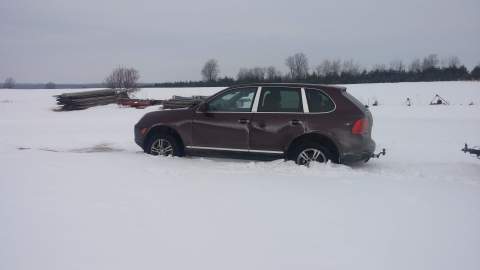
It was a simple task. Put the utility trailer back on the slightly elevated area where it sits in my trailer yard. There was a bit of a snow drift, but so what?
Before I knew it, Ruby was stuck. I disconnected the trailer and realized that there was a fair amount of snow in that drift, and the ground underneath was pretty icy.
Low range and diff lock did no good. I had forgotten all about traction control and how to turn it off. Maybe that is the button on the dash with a three-letter acronym.
Desirable characteristics of an off-road vehicle are flexibility, light weight, simple power train and aggressive tires. Ruby is the antithesis of this, regardless of winter tires, 4WD, differential lock and low range. She still behaves like a lead anvil once belly-hung on hard snow.
Towing requires a second driver because you can’t leave the car in neutral if you want to remove the key, and if you leave the key in the ignition, Ruby may lock you out if you jolt her through the tow rope.
I matched my 35 hp tractor to the Cayenne. With snowblower, cab and loader as well as loaded tires with chains, the TAFE weighs about the same as the Porsche. At 5400 pounds, Ruby is too much dead weight for my little tractors. My wife operated Ruby correctly and the behemoth came out of the snowdrift after several sharp tugs from the tractor through a 30′ tow strap. No, I did not hitch the strap to the tow ball. I looped it over and around the ball holder.
Ruby does fine on the highway, but I don’t want to go off-road with a vehicle I can’t push.
High Drama on Parliament Hill
February 27, 2019
Canadians have just watched four hours of testimony from former Minister of Justice Jody Wilson-Raybould. Her gravitas riveted her audience. We were uplifted through our contact with this heroic figure.
Then after the hubris came the comic relief in the form of the gravediggers from Hamlet, Andrew Scheer and Jagmeet Singh. As soon as he strode onto the stage Sheer blankly called for Prime Minister Justin Trudeau’s resignation. The Conservative leader’s imperfect command of the criminal code of Canada reminded me of the drunken gravedigger’s clumsy but pedantic command of Latin.
The other gravedigger, Jagmeet Singh, seems smarter than Scheer. He at least didn’t make a fool of himself in his first press conference, but he didn’t get much further in opposition than to play a few favourite lines from his campaign, accusing Trudeau of favouring his rich friends.
Then Justin Trudeau strode into his press conference with his new MP in hand and a dozen or so MPs of colour to stand behind him. This was his moment to do a Marc Anthony and reverse the crowd’s direction. He started well in denying Wilson-Raybould’s assumptions, but at the point where he appeared about to communicate with us, he abruptly went back to stale talking points. I was disappointed in him. As a viewer I felt that I could have made a better case for his actions than he did this day. But sometimes Hamlet gave us bathos when we most wanted clarity and action.
Without doubt the star of this afternoon’s play was Jody Wilson-Raybould. She plays the tragic hero Antigone well. She has formed a moral outlook unique to her situation, and has fought with considerable resources against lesser men of power who have continued to assail her. But we must realize that the progress of the tragedy involves Jody’s growing realization that her too-particular moral view, while in and of itself correct, must fail because it does not take into account the other moral imperatives of the world, the moral essence, if you will. Justin’s 9000 jobs trump Jody’s sense of right.
Justin Trudeau is the other tragic figure in this play, cast as antagonist in Jody’s drama because of his wider vision of what is right. Like King Creon, he watches in anguish as Antigone’s willful self destruction wreaks havoc in his kingdom and takes his son and his wife to their deaths along with her. Yet he still must rule.
At this stage of Jody’s descent, neither she nor Justin can comment upon the future, but for the tragedy to reach a satisfactory denouement, she will have to be banished from caucus, and perhaps from Parliament altogether. And no one will grieve more at this spectacle of wasted greatness than Justin Trudeau.
How ethical a government do I want?
February 24, 2019
The last three weeks in Ottawa has been a turmoil of confused and conflicting opinions based upon little evidence. The chronology dates from a Globe and Mail story by veteran reporter Robert Fife that Minister of Justice and Attorney-General Jody Wilson-Raybould was demoted to Veteran’s Affairs following unsuccessful attempts by the Prime Minister’s Office to persuade her to agree to a plea bargaining agreement with SNC-Lavalin to avoid a trial on long-standing charges of corruption in its business dealings in Libya during the regime of Muammar Al Gathafi.
Prime Minister Justin Trudeau has seemed bewildered by Ms Wilson-Raybould’s stances at each stage of the slowly unfolding crisis. Raybould’s not helping much, as she remains largely silent, though shielding behind attorney-client privilege and lawyering up with a retired Supreme Court judge in her corner. For reasons best known to himself, PMO secretary and Trudeau confidant Jerry Butts has resigned his position, astonishing Ottawa.
Michael Wernick has been Clerk of the Privy Council and Secretary of Cabinet for a long time, his career spanning 37 years of service and several governments. The Commons Justice Committee called him to testify about his knowledge of the Wilson-Raybould situation. After 2 1/2 weeks of everyone twisting sideways to avoid saying anything, this career civil servant with nothing to lose decided to respond candidly to questions. Google the testimony. It’s highly entertaining television. His thesis was that there’s nothing wrong with the administration of justice in Canada. SNC-Lavalin lobbied to get the law changed so that they could avoid a trial. The government obliged with a piece of legislation deeply buried in a 580 page budget document. But the law came back from the Senate with a condition that the Attorney General may not take the economic significance of a corporation’s plight into the assessment of its eligibility for the plea deal. He further criticized Fife’s Globe and Mail article, calling it inaccurate and at times defamatory.
He explained that Jody Wilson-Raybould was made fully aware of the potential economic and political impact of a trial on the employer of 9000 Canadians, primarily in Quebec, not to mention the declining stock value’s effect upon the health of the Quebec Public Service Pension Plan, the major stockholder in the corporation. Wernick was utterly unapologetic in claiming that he did have conversations with Wilson-Raybould on the subject because his mandate as cabinet secretary is to make sure that the ministers are aware of all of the points of view so that when they make their decision, they can get it right.
The chief prosecutor decided that SNC-Lavalin did not qualify for the plea bargain, and that the corporation must go to trial on corruption charges. Ms. Wilson-Raybould stood by her underling’s decision, though as Attorney General she technically had the power to direct the Justice Department in the case of significant economic peril to the nation, though not when it is a bribery case. All hell broke loose in Quebec when SNC-Lavalin lawyers discovered that their expensive lobbying efforts of the last two years had failed.
The casualties are piling up from this train wreck. Trudeau’s personal credibility is down sharply because of the uncertainty. Half of Canadians don’t believe that he isn’t hiding something. Members of The Opposition, understanding nothing more than what they read in newspaper columns, appear to be running in circles, barking. Jerry Butts, the lynch-pin of Trudeau’s government, has resigned. Trudeau assured Canadians that if anything inappropriate had happened in Cabinet, Wilson-Raybould would not have accepted another cabinet appointment. The next day she resigned from Veteran’s Affairs. But she still won’t talk, claiming attorney-client privilege. Some have mentioned that she is no longer a licensed attorney, and when she was Minister of Justice her client would have been the Prime Minister. But still she holds her silence.
So it seems to come down to a battle between the ethical heroine (or intransigent narcissist, choose one) and the massive, corporation with its strong ties to Quebecers, the economy, and the army of lobbyists and lawyers who attempt to move governments for their benefit. On another level it pits a single disappointed Aboriginal woman against the massive white male plutocracy.
What is at stake? The crime seems to boil down to a series of bribes to assist the escape of one of Gathafi’s sons from a lynch mob in Syria in order to land a construction contract worth about three times that amount. SNC-Lavalin insists that this all took place a long time ago during a revolution, and the accused have all long-since left the company. The CEO claims his 9000 Canadian employees are being bashed helplessly about like a hockey puck, and he is getting sick of it. The United States and Britain have laws which allow for relatively easy plea bargains to rectify the corporation’s wrongs, but the way things sit a conviction would leave SNC-Lavalin banned from Canadian Government contract bids for a decade. MegaProjects are their stock in trade. They are deeply involved with the Quebec Public Service Pension Plan in the light rail line between Quebec City and Montreal, the only project so far approved by the Trudeau Government’s new investment fund. Trouble is, the stench of corruption from a recent Montreal bridge project still turns up on the opinion pages of the nation.
Wernick says that Wilson-Raybould made the right decision according to the way the law is written. There’s nothing wrong with the administration of justice in Canada, though there is plenty wrong with how politicians, lobbyists, journalists, and members of the public talk about it.
And so it sits. Tomorrow will be another day, with, of course, a new Minister of Justice who comes from Quebec, not British Columbia. I realize I haven’t answered the question in this missive’s title. As a pensioner I guess I lean toward whatever keeps the stock market valuations highest. But who in his right mind would have been buying SNC-Lavalin stock with the corruption rumours circulating? I guess I just don’t know.
Reno 2019: #1. Craftsmanship in the late Victorian era
February 12, 2019
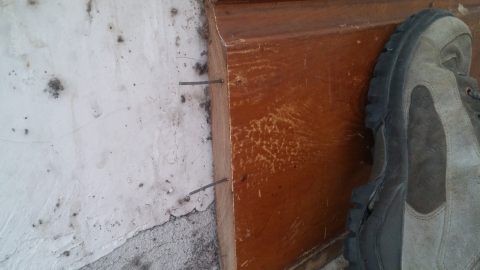
It was a long, wide baseboard in a bedroom of the brick house which hadn’t been disturbed since the house was built in approximately 1898. The wood is chestnut. Virtually all of the wood in the structure of the house is chestnut. The magnificent, sweeping ash staircase is chestnut, though the bannister is cherry. The trim around the towering windows is chestnut. The floor joists and the two layers of 1″ sheeting behind the brick exterior are chestnut. Even the loose floor in the attic is made of clear, straight chestnut boards.
Anyway, I was prying on this baseboard to make way for new wiring. As I worked at it I noticed that the final two feet had been joined to the 12′ board with a very clever butt joint shown in the photo above. Those aren’t the usual horseshoe-type flat nails used elsewhere in the building. These are true square nails, and much smaller than the others. I guess they must have been the finishing nails of the time. These are the only two I have encountered in this building, despite extensive renovations since 1966.
Now look at the photo and determine what the guy did with the nails. He clearly drove each into the wood, persuaded it to turn 90 degrees, and keep going straight. This was no lucky accident: both surfaces of the end grain have been planed for an exact fit. It was only as the joint opened from prying that I realized it was there. The baseboard did not rely on nails into a stud for support at that point.
This craftsman with a pair of nails and a hand plane did what today we would use a biscuit jointer or dowels to accomplish. The same guy fitted the curves of the ogee moulding at the top of the baseboard, not with a coping saw, but with a gouge, a very sharp, scooping wood chisel.
Then there’s the knob-and-tube wiring, installed in the summer of 1939. My job was to pull up tongue-and-groove pine boards to expose the wires from above. When my friend looked at the array of wiring in the cavity under the floor of a bedroom, everything lined up precisely, all of the ceramic insulators exactly the same, every joint done with pride, he exclaimed: “These guys were masons!” Then we set about wrecking their work. Progress.
An unanticipated consequence of the pruning of the trees is more sunlight in the rows of the plantation, an area away from the hay harvesting machinery. Milkweed plants grew rampant last summer. Monarch butterflies emerged and flourished around the property.
Why does the Porsche Cayenne lose so much value so fast?
January 29, 2019
Why buy a car? (another Quora question)
January 17, 2019
A car provides a space where you are effectively autonomous. This power is the result of mobility and anonymity. For the teenager its initial appeal is sudden control over vast distances. The process of conquering the previously inaccessible develops the taste for freedom in the forms of speed and unsupervised time with others, the chance to cut loose.
For my generation the car was the trysting place of young love. Woe betide the swain whose mechanical skills weren’t up to the task of reviving the battery of his car in the gravel pit at the end of a country road with the local clergyman’s daughter in the front seat beside him.
A car is its own economy. It provides mobility, the product, in return for considerable effort to pay its costs. This usually involves using that mobility to go to a variety of places of employment at regular hours, so the car imposes a discipline on the individual which we generally accept as normal in Western society.
Leaving the farm for life at university comes as a wrenching change to the young auto enthusiast. All of the sudden in a high-density environment, a car is a real nuisance and his newly acquired repair skills are in low demand. Parking on campus is prohibitively expensive. Cars are the fashion statements of well-to-do fathers and there is no correlation whatever between the price of the car in front of the residence and the level of satisfaction of the kid in the room above.
Walking provides amazing mobility in the microcosm of a university campus, but a bicycle is even better, if less anonymous. Kamikaze rushes across campus to the lunch room fill the need for speed, and the frequent short stair descents on the route provide adventure. Winter riding enhances these thrills, especially when a blast through a snowbank encounters a fire hydrant.
A car is a much warmer vehicle in winter than a bicycle. It is also much less likely to lose traction on an angled railway crossing under slush, or to spin out on glare ice and slide into a curb.
One’s first new car is a shining, wonderful thing, a sensual delight of smells, sounds, and G-forces. It comes with worry. The owner signs away his freedom in a contract promising to pay a significant amount, each month, for the foreseeable future. The new job imposes even more regularity to the driver’s life, this one with a 35 year contract.
Over the duration of this contract marriage and dogs, houses and kids happen, the trappings of a happy, successful life.
All to pay for that first new car.
 the Walnut Diary