Morels! (updated)
May 5, 2009
May 14th, 2009: They’re still popping up through grass and leaves. A heavy rain and a warm, south wind seems to have encouraged quite a few common morels to make themselves evident. They’re very hard to see in the grass, but Bet and I have been finding them peeking out from under cover. Of course it is tempting to move leaves and grass to find the others, but therein lies madness. Morels only grow where they want.
I read an American newspaper article one guy had on his website. It suggested confining hunting activities to newly-dead elm trees. This produced results for me today. Another point the unidentified author made was that the season continues until three consecutive 80 degree days occur. I don’t know how well that knowledge travels north. He further suggested that the season starts in mid-April in his area and moves north at a rate of 100 miles per week. http://outdoorsportsman.wordpress.com/2008/05/12/how-to-stalk-morels/
Good luck with the hunt. I think it’s at its peak now in the Eastern Ontario area.
May 5th, 2009: They’re starting! This morning I found a few tiny black morels in my favourite spot, and by late afternoon I was able to collect the group in the photo. They’re still quite small, but rain is forecast for the next three days, so they may last until the weekend in Leeds County, Eastern Ontario, Canada.
This is good.
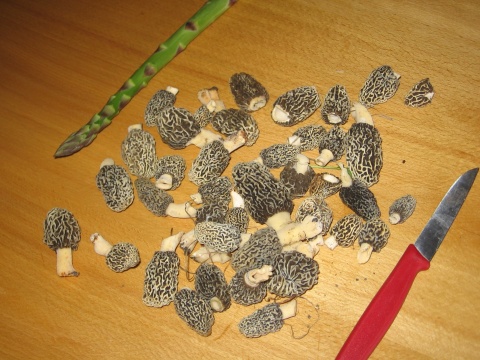
The first pick of the year
The long goodbye
May 3, 2009
She lies and sleeps, utterly still on her bed and we tiptoe around the house so as not to disturb her, even though she is deaf. Our old springer spaniel, Moody Blue, is on her last legs, and it is very hard to say goodbye.
I used to teach new classes a lesson on Robert Frost’s two-line poem, The Old Dog.
The old dog barks backward without getting up.
I can remember when he was a pup.
But in Blue’s case we don’t remember when she was a pup. We adopted her at nearly seven years of age. All of her formative experiences were with another family, her handlers, and various breeders. Blue, you see, was a champion show dog, and raised four litters of pups. If you see a good looking, even-tempered black and white springer in the Ottawa Valley, there’s a good chance it came from Maberly and one of Blue’s litters.
So why was a great dog like this up for adoption, and how did she end up with us? Well, the story has it that she bounced back to the breeder because, when her owners brought home a new kitten, she promptly killed it. When Diane Herns told us this, Bet and I in unison responded, “And?” The odd indiscretion in a hunting dog is only to be expected.
Life with a show dog took some getting used to. She was always quiet, clean, and very obedient, but she hated dogs. That wasn’t much of a problem because we’d had lots of practice handling quirky mutts. The swimming lessons were a challenge, though. Honest, she didn’t know how to swim, and what’s more, she was a very slow learner at ladder-climbing, jumping from docks, and the other skills we had come to expect of a spaniel. What kind of life does a show dog have?
Another thing which threw us at first was strangers’ reactions when they saw Blue. In the evening we often went by golf cart to Chaffey’s Locks for ice cream. Blue heard “SHE”S BEAUTIFUL!” so often that first summer that I think she started to think we’d given her a new name. There she’d stand, outside the Opinicon Store, poised on her mat in the box of the golf cart as she made nice to every potential judge who came her way. Did I mention that Blue was an uncommonly good looking dog?
As she adjusted to life in our home (no worries about her jumping in the pool, anyway) and the boat (major dog-avoidance strategies were indicated), Blue seemed happy to take the new routines in stride. The farm was another matter entirely. A model lives her life hungry, but at the farm Blue proved a true garbage gut, and after a few expensive trips to the vet because of mysterious ailments from things she had eaten, we decided Grandma had to rein in her compost heap, and that pasture romps were not a success.
At the marina one trick at which Blue excelled was the “Stay!” command. Her favourite place to “Stay!” was on the wide ledge behind the stern seat of our boat, WYMBADIITY II. One day a bemused woman came up to me and explained, “I was just admiring that very realistic stuffed animal on the stern of your boat when it suddenly sneezed, woke up, and looked straight at me. It was real!” In fact Blue bore a striking resemblance to that popular toy.
Once when a former student invited our boat to her wedding to use as a prop for photographs, I heard her uncle joke about the young woman’s beauty while we snapped away at the happy couple: “She’s just like a dog: you can’t take a bad picture of a dog.”
This poise in front of a camera was Blue’s true talent, and it endeared her to everyone in the family. She was our son’s model and muse in his early days as a portrait photographer. Even in her declining months, she still groomed up nicely and would work with anyone holding a camera who approached her.
As Charlie brought pals to the house, Blue developed another reputation on Twitter as perhaps the dumbest dog to draw breath this century. Part of this no doubt came from Blue’s vanity: she always made sure she was standing in the right light, and with proper posture. Turns out this meant posing in front of every car entering the driveway. She would just blithely walk into the path of a moving vehicle and expect it to stop and disgorge admiring humans. Then she would receive their adoration in her dim, regal manner. This was her life.
I haven’t mentioned Blue’s warm, loving manner or how fond we have become of her over the last seven years because this is a story of a dog, not of private angst. Blue’s passing will mark the end of an era in our family, and tear a large hole out of our lives, as the passing of a dog always does. It is for this loss alone that we mourn: after a long time of quiet and dignified suffering, the poor dog will at last be without pain.
Keep on textin’ in the free world!
April 15, 2009
My pal Tom arrived a couple of nights ago to open up their family cottage. We immediately joined Charlie and Roz at the Neil Young concert in Kingston. Tom is a big fan. What a great place the K-Rock Centre is!
It had been a long time since the last concert for me. Used to be the air was thick with smoke at a rock concert, and the air bright with BIC lighter flames. Not today. Now the air is clear, and instead of lighters held up as beacons, there are little coloured screens glowing in just about every lap in the building. Honest, it seemed as if everybody had a cell phone or Blackberry out at some point in the concert, texting madly. The guy sitting just in front of me ran off a two line message to someone at an amazing speed, typing accurately with his thumbs on a telephone keyboard. Tom has his Blackberry in a cross-draw holster attached to his braces. No kidding. He sent a number of messages, and then dialed up his wife in Pennsylvania to share Neil’s vocal stylings with her on at least one occasion.
Neil Young did well. It’s not hard to see why he can pack an auditorium with teens, university students, thirty-somethings and retirees. As my son said, “He plays with the energy of a teenager when he’s on the stage.”
With a bit of time to kill before we met the kids, we had drifted down the street to the popular restaurant Chez Piggy. At the table I noticed Tom had a deep cut on his fore-arm, barely healed. I asked how he had hurt himself this time. “That’s nothing. There’s another one.” He rolled up his sleeve, and surely enough, there was an identical cut a couple of inches further up his arm.
Turns out his new truck is a lot longer than the old SUV, and that meant he was standing under the garage door when he tried to pull-start the portable generator. It turned over much more easily than he had expected, and he slammed his forearm into the metal frame of the overhanging door.
He quickly shut off the engine and rushed to make repairs. Turned out the bleeding wasn’t that bad, so a bit later he resumed his work. I interrupted, “And you did the same thing again, right?” Tom nodded. “Where I come from that’s the definition of insanity: to do something that has been proven by experience to hurt you.” After the initial reprimand, of course, I offered the usual sympathy that a veteran do-it-yourselfer can give to a fellow walking wounded.
It’s a good thing I didn’t go too hard on Tom, because whenever he sees me in the next couple of days, I’m in for quite a ribbing. My upper lip has a vertical slash just under my nose, and it’s swollen up and blackened enough that I’m probably recognizable only by scent and hair colour.
I did a stupid thing involving standing in the bucket of the loader and tossing a logging chain over a dangling limb. “Ahah! You say. And you laughed at Tom for cutting himself!”
Yeah, but I’ve never done this before. My boneheaded tricks are unique. I learn from my mistakes. That’s the difference. Anyway, from this one I gained an interesting lesson in physics: the difference between a rope and a logging chain is not only one of weight. Ropes don’t have heavy, hooked ends that turn a slight tug into an avalanche of metal, building up speed for a yoyo vault around the branch and a launch at the face of the victim who twitched the chain. I couldn’t believe a chain would do that. It flowed over that branch, pulled by gravity, and it just kept speeding up until it threw the grab hook at my face. I couldn’t really defend myself – I was still in mid-tug on the other end.
So now I sit with a fat lip. It wouldn’t be the first, and I hope it won’t turn out to be the most colourful. That award was no doubt captured by the work of a splinter of pine 2X4 which caught the side of my skull the time I tried to uninstall a cast iron tub without bothering to look up the crowbar. It provided a spectacular bit of facial art which wouldn’t have been a problem except that I had to attend my retirement dinner with colleagues I hadn’t seen for seven months.
Everyone was cool about the black eye until my friend Leigh Pritchard got up to make her speech. She started off, “I wrote this on my computer last night. As God is my witness, I didn’t know anything about Rod’s mishap with the 2X4.”
The first line of her speech read, “For the last two decades Rod Croskery has been the face of the English Department at Carleton Place High School.” Hoots erupted around the room. Leigh looked a little guilty, maybe even embarrassed, but she’d landed a dandy in front of a tough audience, and I had to give her that.
Oh well, I think a few scars just show that a man has lived dangerously. I totally reject my wife’s assertion that it’s more likely evidence he’s lived dumbly. I’ll have to remember to ask Tom if Neil has a song about a fat lip.
Recession: a self-fulfilling prophecy?
March 30, 2009
With its recent budget the McGuinty government seems to have finally given up on its attempt to recreate the just society of John Robarts and Bill Davis. This budget bows to the masters of Bay Street and tilts the tax system dramatically in favour of the business community. Gone are the steps to end child poverty and provide public day-care. Last week McGuinty even contradicted Finance Minister Dwight Duncan and offered to cancel a scheduled increase to the minimum wage if business needed it.
The Harmonized Sales Tax seems to shift the burden to the consumer. Corporate taxes drop significantly as well. It must be hard to accept that Jim Flaherty, McGuinty’s cordial adversary in Ottawa, might have been right in saying that Ontario was a terrible place to invest, but McGuinty has swallowed his principles and tried again to do the right thing. That was his rationale for the Health Care Tax. He recovered from it primarily because of a weak and fractured opposition. And now he grimly forges ahead in an attempt to slow the hemorrhage in the industrial sector. Apart from Bob Runciman’s tepid criticisms, it seems as though Ontario approves of this necessary action.
So the new Ontario is a land of lowered expectations. A Toronto Star article last week mentioned that the budget even contains a provision to allow retirees to return to work part-time and still accumulate pension credit.
22,000 federally funded child care spaces in the province will dry up because the Harper government has not come through with the funds for the next phase of the program. I guess Flaherty’s rhetoric about shovel-ready programs doesn’t take the needs of kids and young parents into account, even if the 63 million dollars to extend the program would keep 4000 child care workers off the unemployment rolls and provide an essential service to thousands of young families.
The Ontario reaction is interesting: when the Harper government tried to cut cultural funding in Quebec last summer, the move created a province-wide outcry and most likely cost the Conservative Party a majority in the fall election. This led to the free-spending budget of January and a significant dilution of the Conservative brand. On the other hand, when child care spaces evaporate in Ontario, we get one passing reference in a Star Sunday editorial for a similar cutback. What gives?
In Ontario these days it’s all about saving jobs in the auto industry. Nothing else seems worthy of our attention.
Lee Iacocca moved to the bankrupt Chrysler in the early 1980’s and turned the corporation around with the very designs for which he was fired at Ford. The efficient Chrysler mini-van appeared in 1983; it filled a need and restored Chrysler’s fortunes.
So what new model has president Rick Wagoner brought out to rescue GM? Their hopes rest on the 2009 Camaro, a lightning-fast, V8 gas guzzler which can burn its back tires off in an eyeblink. No wonder Obama is yelling for Wagoner’s resignation. Well, Chrysler and Ford have also brought back their pony cars. Considerable engineering effort has gone into each to make the cars faster than the originals were in the early seventies.
I don’t think we need any more two-door, V8 cars on the road, but I watched with interest all last summer how young and middle-aged males stopped to drool over the row of Dodge Challengers arrayed in front of Falls Chrysler.
Does anyone remember gas prices above $1.40/ litre last summer? Is there a perverse satisfaction in running the last cup of gasoline through the carburetor of a pulsating V8 engine?
Obama has made no secret of his interest in GM’s Volt, a mass-market electric vehicle set for introduction in 2010. At least that’s a sensible goal for the auto industry.
In Canada the Department of Transport has no similar interest in a home-grown product, the ZENN electric car built in St. Jerome, Quebec, but sold only in the United States, Europe and Mexico because owners can’t certify the vehicles for street use anywhere but in a couple of communities in British Columbia where municipal governments have found a loophole to allow for their registration.
How many urban planners in the 1960’s could forsee networks of bicycle paths in their cities? Yet the paths happened in response to demand. Neighbourhood vehicles deserve their niche, and we as voters can make the infrastructure changes happen in just the manner we made the bicycle paths appear.
I dread seeing my tax dollars funneled into a company which builds Camaros. A company like Everbrite Solar, on the other hand, might have some potential. Their planned $500 million solar panel factory in Kingston should generate 1200 green-collar jobs in the area and significant research in renewable energy at nearby Queen’s University. If our politicians can get their blinders off and use stimulus funds wisely, Ontario may come out of the recession with a renewed lease on life as Canada’s heartland.
Ten things I have learned from a week of sugar-making
March 22, 2009
1. Young adults are night-owls. Starting work at 7:30 p.m., gathering sap by headlights and boiling all night? That seems normal for these guys. They never seem to tire. Neither do they seem aware of their host’s deep, neurotic need to watch a Senators’ game and find an early bed. What’s more, they seem ever more enthusiastic about the project, constantly planning improvements.
2. Nilex makes an outstanding filter for syrup. Martin brought this scrap of fabric from a bolt of the stuff his father used to concentrate plankton in sea water. It’s a closely-woven nylon fabric which is then pressed between two hot rollers to provide a predictable size of mesh. Used with a dinner-napkin pre-filter, it made my cheesecloth-filtered product look laughable by comparison. Yesterday Martin checked out a competitor’s product at the Kingston Market. The bottles he examined were quite cloudy. The vendor told Martin that they were having trouble getting the sugar sand out of their product with their pressure-filter system, and filtering the syrup is a big problem. I wonder if they have heard of Nilex.
3. Boiling sap over an open fire takes a lot of fuel. I’ve progressed from raiding the woodpile to collecting fallen ironwoods and cutting them into three-foot lengths. They provide a hot fire and reach well back into the arch. If a log extends too far, though, say into the end of the stove pipe, a miserable evening of smoky fire will ensue. Clay makes quite a good emergency mortar to seal up gaping holes in the “firebox”, but it doesn’t make a lot of difference if the pipe is blocked.
4. North winds are unpleasant for sap boiling. I think I see why a sugar shack would be a good investment. It’s no fun at all stoking a fire while the smoke blows back at you.
5. Some sap isn’t very sweet. Martin was astounded when he bottled the second batch. Boiled from a full drum of sap, he decanted six litres of fine, thick syrup. The previous batch produced seven litres, but we had boiled about two and a half drums of sap to get it. The early sap hadn’t tasted sweet at the tree, and I guess it wasn’t.
6. A gas barbecue isn’t much good for boiling syrup. I passed a leisurely afternoon trying to finish a small batch. The heat is all wrong for the job and when I dumped in some milk to purify the syrup, it wasn’t boiling hard enough to congeal the milk properly and I ended up with a very tasty, watery product with a great deal of sediment in the bottom of the bottles. It tasted exquisite on waffles, on the other hand. I insist that thinner syrup tastes better and soaks into pancakes with less waste than the full-strength stuff.
7. A 110,000 btu deep fryer does a great job finishing syrup. Charlie quickly discovered that “the Binford Inferno” in fact has very precise controls. With a sheet-metal wind screen, it has proven a fast and thrifty implement for the finishing of the syrup.
8. A large maple syrup expresso latte is a great deal too much of everything. With all of that tasting, tasting, tasting, my sweet tooth has gotten a real workout. Waffles several times a day aren’t so bad, but I mustn’t try thinning over-strong coffee with maple syrup ever again. It took several hours, two loads of ironwood cut and delivered, and two trailer-loads of planer shavings hauled away to burn off the sugar buzz.
9. The Polaris Ranger has a way of making itself indispensable before anyone notices. It carries the barrel to gather the sap. It hauls the firewood. It makes many trips back to the woodlot to check to see if the sap is running. The headlights are doing far more work than they should. Its relatively light weight and large tires float it over thawing turf into which a tractor would sink. It wades through puddles very well. It’s everywhere, and everyone needs it, most of the time. We learned that it’s important to check if any hoses are attached before zooming off on the next errand.
10. Syrup from the maples on Young’s Hill tastes wonderful. Back when he was persuading me to take on the syrup project, Martin sent me a couple of research documents on the use of black walnut sap for syrup production in Kentucky. In blind taste tests professionals unanimously rated regular table syrup superior to both the maple and walnut syrups produced by the crew. Perhaps Kentucky syrup just doesn’t taste very good. To illustrate my point I gave the boys a sample of some poor-quality maple syrup I found in my mother’s fridge. Their faces dropped. Then the grimmaces started. Descriptors such as “used motor oil” and “aftertaste of licorice” popped up. Nobody took a second taste. Not all syrup tastes good, but the deep red ambrosia Charlie and Martin produce in a pan over an open fire in our yard is a delight to the senses.
When do I take the pan off the fire?
March 16, 2009
UPDATE: 7 June, 2017
I’m pleased to announce that Dr. Anne-Claire Larochette and her husband Dr. Martin Mallet will join us this morning after Anne-Claire’s graduation at Queen’s before they return to their home and careers in New Brunswick.
Last February a CBC reporter interviewed A.C. on the subject of isolation during winter storms:
http://www.cbc.ca/news/canada/new-brunswick/ice-storm-acadian-peninsula-shelter-1.3964010
——————————————————-
Martin and Charlie decided to make syrup this year. They had done the setup in a couple of hurried trips to the farm jammed in between a wedding, exams, a visit to the U.S. Embassy and grad photographs. Sunday afternoon the temperature rose and so they showed up at the farm along with Martin’s fiancee, Anne-Claire, to gather the first sap.
They arrived back from the woods euphoric with a load of sap on the Ranger. “That one little gray tree had both buckets full and overflowing onto the ground, and it’s so small compared to the others!”
With little idea of how to boil the stuff but determined to learn, they ate a quick meal, gave the sap pan a final wash, and made a series of repairs to the ramshackle pile of cement blocks which had served as an arch eight years ago for my last attempt to make syrup. The blocks were frozen into the ground, of course, and accepted attempts to straighten them only reluctantly. Much improvisation and effort went into the leveling of the pan.
Everyone dashed about to locate a promising source of fuel. Charlie and Anne-Claire hauled a load from the woodlot with the Ranger and turned up with the silly grins of a pair of kids who had just discovered the bottom of a mud puddle. Martin dragged in a bunch of broken fence rails on a small trailer. I tore into the bed of an abandoned wagon with my chainsaw, narrowly missing a back tire in my effort to avoid nails and bolts.
Called upon to provide instruction in the art of maple syrup boiling, I think I did reasonably well on the building of the fire, but faltered on the climactic question: “How do I know when it’s time to take the sap off the fire?”
The best I could answer was, “You take it off when you start to feel really nervous about burning the pan.”
Martin took my words of instruction and perhaps gave them more weight than they merited. As the sun went down and he struggled to keep the fire up, I heard him mutter to himself: “The problem with doing it for the first time is that you don’t know when to get nervous.”
“When we went into the woods I was torn between two ways to think of the tapping experience: it was either an idyllic scene with buckets and sap, or one of Charlie, Anne-Claire and me sucking the life out of the forest, draining it.”
I assured him that the maples likely wouldn’t mind a few taps.
Martin’s vigil over the boiling sap was aided by a slick digital thermometer he kept near at hand. He asked at what temperature the sap becomes syrup. Neither Mom nor I could remember the precise figure, so Martin dashed into the house to check on the Internet. He came back a little discouraged. According to Google and Wikipedia, the answer isn’t at all straightforward. About all he could find out is that, “It stays at 212 degrees until all of the water is gone and then it shoots up exponentially until the pan burns.”
Mom showed an uncanny knack of turning up just when it was time to do something with the fire. Her memories of three generations of scattered sugar making efforts came out when prompted: “When my dad set up his arch he piled sod around the stones to seal in the heat.” Charlie couldn’t find any sod soft enough to shovel, so he compromised with a pile of soggy ashes Martin had shoveled out of the fire pit. This primitive mortar worked to seal up the arch and the syrup soon came to a boil. Stone age technology with digital instruments.
A grad student in clinical psychology, Anne-Claire commented, “People were bemused to hear that we were going to make maple syrup ourselves this weekend, but I am no longer surprised by the adventures that Martin gets me into. He is a born scientist, and his whole life is one experiment after another. Whenever I learn another method of making food or growing food or hunting, it makes me feel a little bit more safe. So if there was ever a time where there was no more food in the supermarket, we would still be able to survive and not be dependent upon someone else providing us with food.”
As the evening wore on around the blazing fire, our various points of view emerged on the climactic question of when to take the pan of syrup off the fire.
The psychologist pondered, while peering through the steam, “What if we are past the point of no return and don’t even know it?”
The filmmaker offered, “Let me change the light angle and see if you can see it.”
The biologist pronounced, “The experiment is not complete unless it fails once.”
The teacher yelped: “Take the pan off the fire, now!”
The unfinished syrup has a delightful flavour and the pan is still intact. Not a bad day all around, with many more to come.
Men who eat quiche can’t back up a trailer.
March 1, 2009
The utility trailer has emerged as the best transportation value in our modern world. Its overhead is negligible: $35. will license it for life. Insurance is unnecessary. It will do all a pickup truck will do, but you don’t have to worry about scratching it, and you can unhook it and leave a partly-completed task behind.
A bit of skill is the main requirement to benefit from this transportation boon. The driver has to be able to back it up, and thus we come to one of the defining tasks of manhood for my generation: backing up a trailer.
Learning the skill was a long and difficult journey for me in my sixteenth year, committed to a summer of mornings hauling firewood into Alan Earl’s basement with a tractor and trailer. The firewood followed a serpentine route down a driveway, between a shed and a brick house, then around a 180 degree turn under a clothes line and up a slight incline to the basement door. I had to back a loaded trailer through this maze, several times per day.
I soon knew every inch of that route, and still rue the day I left a series of bolt-shaped swirls in the gray boards of the shed wall when I edged the tractor too close in an effort to make the turn. No doubt those scratches are still there today.
Later on I learned that it’s much easier to handle a trailer with a vehicle which has a rear-view mirror. All you need do is take a sighting of the corner of the trailer in the mirror, and then if you hold that image still as you back up, the trailer will go straight.
Longer wheelbases are easier, as well, but if you want to observe the true test of a marriage, just watch a couple launching a boat at a ramp without a dock. Logic indicates that if one partner is in the boat at the time of the launch, nobody need get wet. The trick is to have one trained to start and free the boat from the trailer and the other equipped to back the vehicle and its load down the ramp into the water. The problem is that usually the same partner feels uniquely qualified to do both jobs.
The first time Bet tried backing in at Forrester’s Landing, my shouted instructions didn’t seem to help, and she actually ended up sideways on the ramp before leaping from the vehicle in disgust. From that point on my wife has put trailers out of her mind. When I asked for her opinion for this article she paused, thought, and said, “They’re for hauling garbage and moving university students.”
A friend from Ottawa was more forthcoming: “I have a history of poor choices with men, and not one of them could back up a trailer. Maybe it’s that men who eat quiche can’t back up trailers.”
Of course the trailer challenge is specific to my age group. Our son’s generation never had to learn. From hours of play with remote control cars, reverse-steering is hard-wired into their brains. You see, with an RC car the controls steer one way going out and the opposite way on the return trip. The crossover to trailers is a breeze. Charlie was about twelve when he learned how to drive his Grandpa’s Jeep around the farm, and the next day I looked over to see him with a trailer attached, backing the rig straight across an eight-acre field.
One of the most insidious things about trailers is how easily an owner can be persuaded to add another to his fleet.
Last fall when I bought a utility vehicle I gradually realized that I couldn’t take it anywhere because it was too big to fit any trailer I owned. Soon a Kijiji ad put me on to a pair of axles, so I drove to Kingston and picked them up. My neighbour Peter Myers straightened one axle and lengthened both to give the 6′ bed width the UV required, then guided me through the design process to produce quite a wonderful flat-bed trailer. He accepted that I wanted a trailer which was neither too big nor too small, and all it took was a week of work and a lot of steel. I quickly added low wooden sideboards and stakes to go with the magnificent “headache bar” he rigged across the front to provide a positive stop for the front wheels of my UV. Before I got at it with a paint roller, Peter’s creation was a thing of beauty.
Painting steel in late November is strangely difficult, but Tremclad will dry at below-freezing temperatures. It just won’t spray, so the roller was a must. Wiring trailer lights is never fun, but it’s worse when your fingers stick to the pliers, the trailer, and even the bolts.
Notwithstanding the crude paint job, the new trailer has fitted in well with the other eight in the barn. Bet suggests this fondness for trailers must be compensation for my utter inability to back up a farm wagon. There, I’ve admitted it.
Rick Mercer Skates The Lake
February 2, 2009
RUMOUR:
I have it on excellent authority that CBC pundit Rick Mercer attended Portland’s annual Skate-the-Lake speed-skating festival on Saturday to do a segment for his show. All I know so far is that Mercer fell a lot and did many takes of the scene before satisfied with it.
Ken Watson posted a photo of Mercer with the Portland waterfront in the background on the Rideau Waterway site.
http://www.rideau-info.com/canal/images/winter/img-rickmercer.html
 the Walnut Diary