The Death of Cursive Writing
March 18, 2014
I have just finished reading an article in the Toronto Star which bemoans the end of elementary school instruction in the fine art of cursive writing.
Personally I welcomed the advent of keyboards because every teacher in my life complained that my handwriting was the worst he/she had ever seen. I even had a prof at Queen’s haul me into his office to read my exam paper to him. He granted the paper an A, which, in comparison to earlier marks on what I considered better performances, made me wonder if the other profs had bothered to read my scribbles at all. The next year take-home exams were the rule at McArthur College, and I cruised through grad school on the strength of my keyboard skills.
During my career as an English teacher and administrator I pioneered the use of computers in the classroom and made a point of having keyboards available for the calligraphy-challenged to write their examinations.
But to return to the subject of the Star article: I would suggest that cursive writing comes naturally to boys raised in Canada. Try to print your name in the snow sometime.
Bathos at the Olympics
February 23, 2014
Twenty years from now I wonder if anyone in Canada will talk about where he or she was during the gold medal hockey game at Sochi.
The experience was radically different during the 2010 medal game. The maple syrup crew had assembled in our living room, and we still remember our breathless anticipation leading up to Sydney Crosby’s climactic goal. We almost let the sap pan burn dry when the U.S. team tied it up and they went to overtime.
https://plus.google.com/photos/106258965296428632652/albums/5983655953647816593?banner=pwa
The days aren’t getting longer quickly enough!
December 28, 2013
I’ve been waiting anxiously for December 21st so that the days would get longer, but yesterday my wife called me on it when I allegedly said, “Wow! It’s 4:20 and it’s not dark yet!” for the third straight day.
So I asked Google and found a blog devoted to sunsets. Astro Bob explained that it takes about ten days for the sunsets to come later after the winter solstice. Something about elliptical shapes and straight lines. Interesting, though.
http://astrobob.areavoices.com/tag/sunset/
Anyway, there’s hope. By Valentine’s Day sunset will be at 5:34, an hour later than it was yesterday afternoon.
Here’s a chart:
Not another Friday 13th!
December 13, 2013
The second Friday in September this year was really bad, and I have memories of quite a few unfortunate Friday 13ths with which to compare it. So this time I vowed to be especially careful and to avoid all contact with machinery until the day was over or I had accumulated three catastrophes from other sources.
Bad things travel in threes for me on Friday 13th.
So I cowered inside on a beautiful day and waited. Not much was happening. Took the dog for a run in the woods and we came back chilled, but intact. Then I noticed the truck tracks in the driveway. Gas delivery. No problem.
My mother asked me to check the calculations of her propane bill. O.K., disaster #1 for the day. Propane has gone from 57 cents per litre to 75.9 in the year since I installed the furnace.
Speaking of furnaces, Bet checked the oil level in ours and quickly called the fuel company. Apparently they had forgotten about us, and the tank was below 25%. Disaster #2.
An online payment froze up when I pressed “Send” on Paypal. Disaster #3. O.K., I’m set now.
But then I received an email receipt for the payment. Oops… back to waiting for #3 and watching sitcoms. In bed.
Got up to go the the washroom and somehow, I don’t know how, managed to drop my cell phone into the W.C. I immediately rescued the little LG and dried it off while it cycled through its on/off routine. Then it uttered a sad little bleep and died. None of our efforts to revive it produced any reaction. It had shorted out.
That’s my only phone. We don’t have a land line. So now I have to find a replacement for it. That’s about standard for me on Friday the 13th.
Seat cushions for cold weather
December 11, 2013
My grandfather and even my dad used to talk about the importance of the right seat cushion for horse-drawn implements. The favourite for hot weather use (pressed tin or cast iron seats) was a loon skin. Apparently loon plumage prevented scalding. I don’t remember what the prescribed insulation for winter piles-prevention was, though it was strictly forbidden to sit on anything hard and cold. For example you’ll never see a Leeds County rural resident sit down on the ground until at least June.
Now that I think of it, the wealthy had buffalo robes and raccoon coats, and the embroidered wool seat upholstery on buggies and cutters had more wool underneath as padding.
As a student I used my grandfather’s raccoon coat for winter attire. I remember a couple of bike rides across Kingston shielded by the full-length coat. Wonderful wind protection. On one occasion I got out onto Lake Ontario on glare ice and rode to Wolfe Island, then turned right and fetched up in Amherstview, where I asked my uncle for a ride back to Morris Hall. Tailwind. It was kinda hairy riding across Collins Bay, but I was young and immortal.
Other ramblings about cold weather seat cushions (perhaps our most basic technology) are welcome.
Ice Reports begin today.
November 28, 2013
If you look to the right you’ll find a page entitled “A New Ice Report…” I’ll try to keep it updated throughout the season.
Friday the 13th
September 13, 2013
At this point it’s almost ten a.m., and I have retreated to my bed to hide for the remainder of the day. Any reasonable man would do the same. Terrible things happen to me on Friday the 13th and they usually travel in threes.
First, I should have suspected something was up when a wasp dropped from the plastic roof of my shed onto my shirt collar at 4:00 a.m. and stung me while I was walking the dog.
This morning a guy came for a second look at a piece of machinery I have advertised. His father approved; the mechanism worked perfectly. It should have been a sale, but just before he had left to come to our appointment someone had offered him (free of charge) another machine which would also move his sawdust and he felt he should look at that one first. He’d get back to me. Fine, no problem. Needless to say, he soon called back to tell me that he had chosen the free one.
So I decided I should oil the mechanism on the manure spreader. Its apron is a pair of chains driven by cogged wheels which roll above and below the wooden bed of the trailer. Cross pieces join the chains and enable the mechanism to unload its cargo. To oil the chain I planned to extract a couple of litres of used engine oil from the collector in the garage, an 18 gallon tank on wheels with a large funnel on top which wheels under a car on a hoist for oil changes. It also boasts a connection and a series of valves to allow the use of an air compressor to force the oil out of the tank and presumably into a waiting container.
Twice I have performed this function involving adding air to the tank while directing the resulting stream of oil into a five-gallon pail via a siphon hose which otherwise sits draped over the edge of the funnel. Today I discovered how big a mess ten gallons of old oil hooked to an air compressor can make in a garage if anything goes wrong.
I blamed myself and cleaned the mess up as well as I could.
The third disaster occurred when I returned to the spreader, started the tractor and the PTO, and carefully dripped oil from a gallon container onto the chains, taking great care to avoid the dangerous turning shafts. The track broke.
A cotter pin holding a cogged idler on the right front corner had failed, allowing the gear to slide off, causing the chain to …. I shut the tractor off before things got worse, leaving me with a bent bolt to repair and a complex apron mechanism to readjust.
This should not have happened.
Then I thought of the date. Damn! Friday the 13th.
So instead of fixing the mechanism I retreated to my computer, hoping against hope that the third disaster of the day wouldn’t involve something indispensable like my laptop. (I’d been too sleepy at 4:00 a.m. to attach any significance to a random wasp sting, so I cowered around all morning until I realized that this Friday the 13th had probably completed its mischief for the day.)
How to blackmail a mulberry tree
July 4, 2013
It was just a little shrub growing at the side of the garden, a bit in the way but not too bad. All summer I had avoided it, then one day the mower reached out and flattened it. Oops. Oh well, there are lots of mulberries, both red and white, growing wild at the farm.
But it popped back up, looking horrid. So I backed over it to put it out of its misery. Further mangled, it doggedly resisted the diesel mower’s three spinning blades and rose tentatively from the sod again. I left it for a forthcoming session with the hand-held brush cutter, but then forgot the thing.
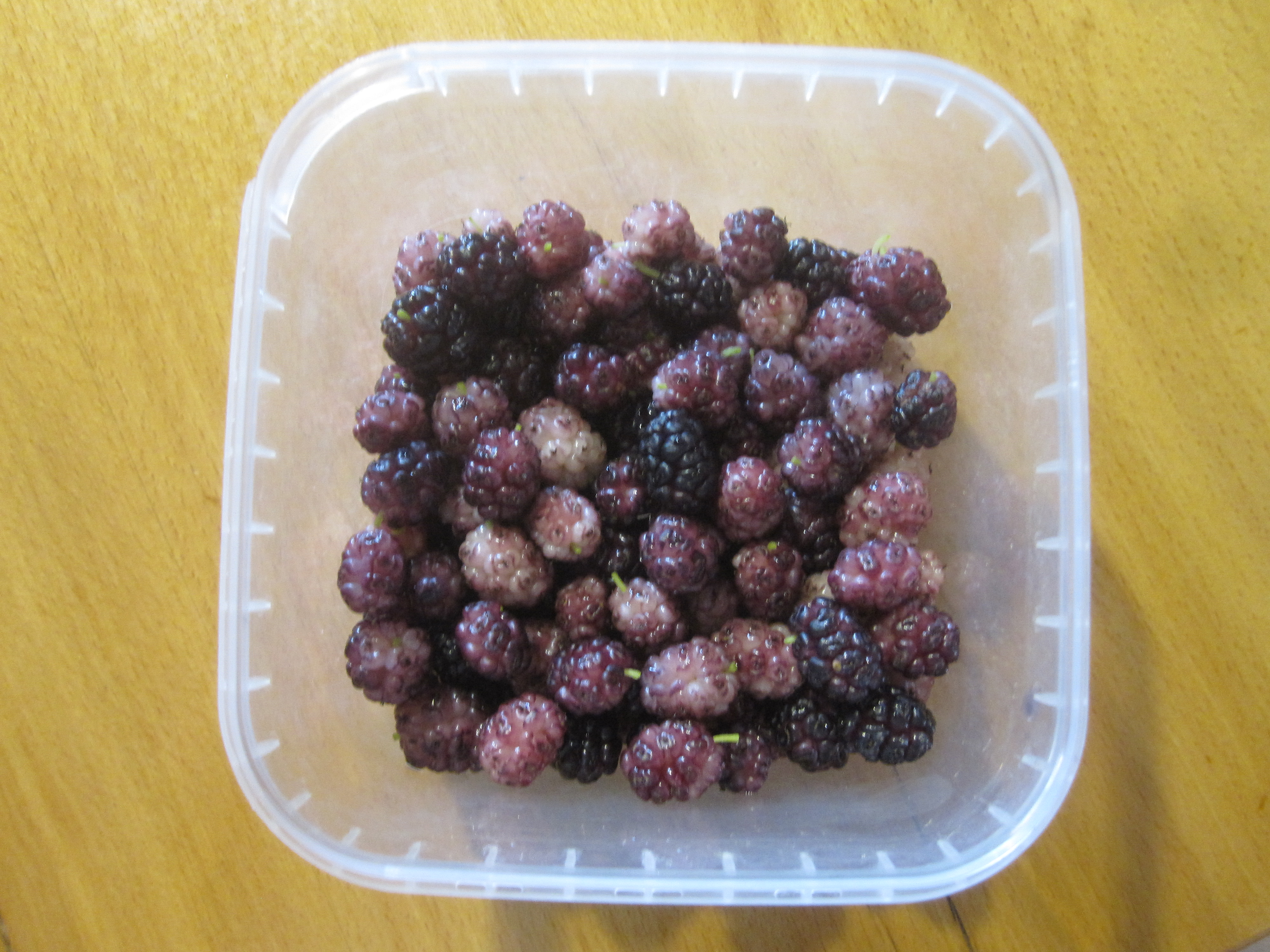
A year later it surprised me with a handful of extremely sweet mulberries which were a pale mauve colour.
I’d never seen mulberries of that mauve colour, ripe or unripe.
There’d been a large white mulberry near the house until I cut it up and burned it as firewood. It blocked my mother’s view of the road and it confused me because there was no way to tell visually if the abundant fruit was green, ripe, or spoiled: all were a pale greenish white. Of course the more common red mulberries are white when formed, progressing to bright red and then to shiny black when ready to eat. Simple. Birds, dogs, raccoons and humans love them.
This year the little tree in the upper garden is loaded with berries ranging from white to black, but the pale mauve fruit are already sweet enough to eat, and actually taste better than the fully ripe deep purple ones. The tree seems to be going all-out to prevent another visit from the mower.
Perhaps stress motivates a fruit tree.
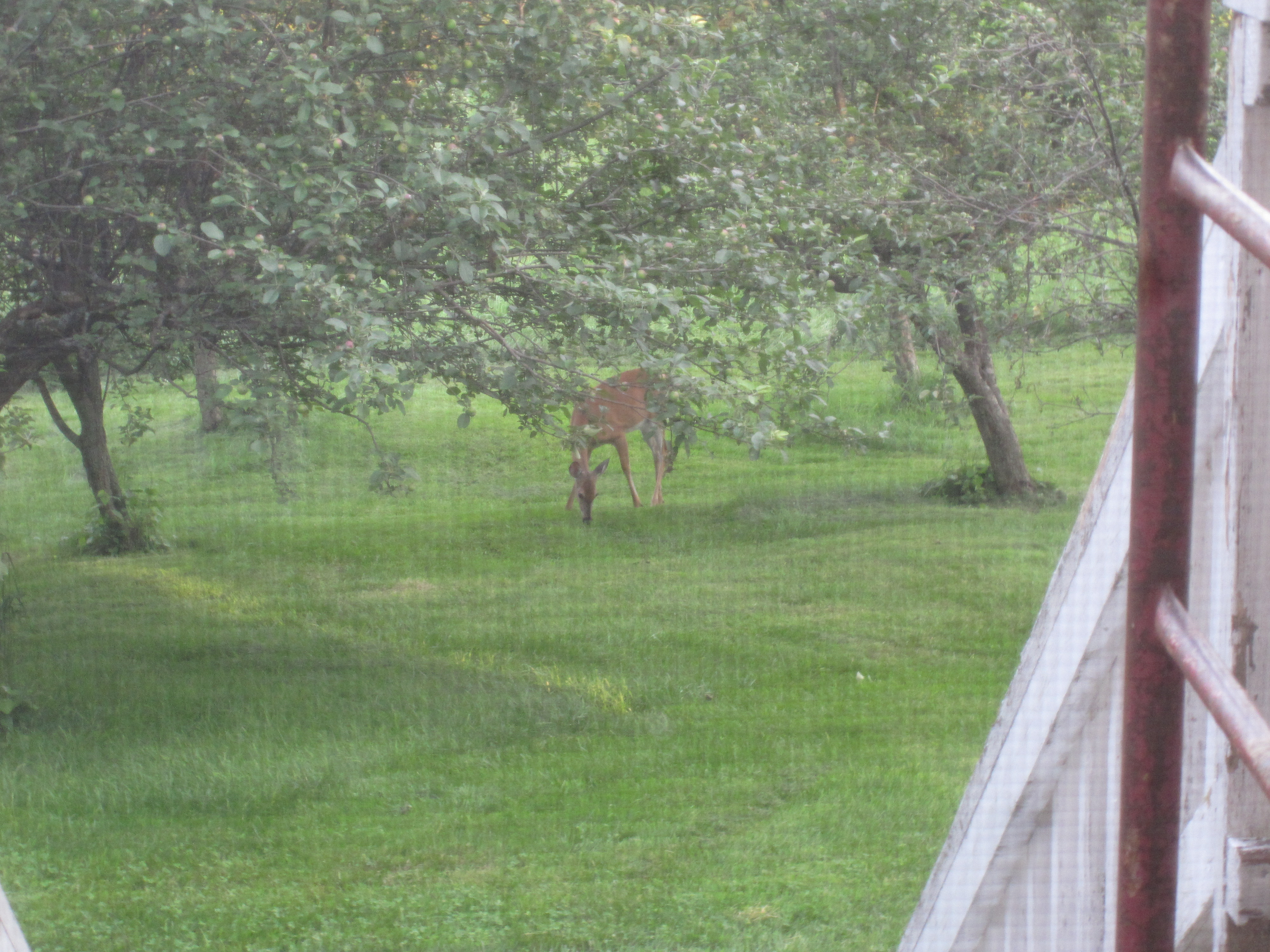
With Emily-the-Wolf absent, this yearling fawn has decided she likes our orchard for twice-daily feeding sessions. She let Bet take a few shots yesterday.

Dr. Derek Dunfield on TEDx Queen’s
April 30, 2013
Derek Dunfield grew up in Portland. He and our son became acquainted when Charlie (an English major) was offered a room on the astrophysicists floor in Morris Hall residence at Queen’s.
After Derek completed his Phd. he announced to Charlie that he was going to take some time to make maple syrup at the farm, and so he did. He represented the physics team. Martin Mallet led the biology team. Martin and Derek had radically different approaches to the theory and practice of boiling sap: Derek insisted that it didn’t matter if the pan stopped boiling when cold sap was added. Martin fancied the art of adding sap so gradually that the boil continued uninterrupted.
And so on it went up to and including theories on the formation of sugar sand. They never did solve that one, though Derek sent me an article published in the 1950’s which suggested that copper and zinc operate as catalysts to inhibit sand formation. From that I inferred that the recent rash of sugar sand in maple syrup likely stems from current regulations requiring the use of stainless steel boilers.
Both teams made fine maple syrup.
That summer Derek also came along to help pour the floor of the workshop we built on the property in 2010. He proved a game, if lightly-skilled, practitioner of the masonry arts. We appreciated his input, though.
This evening Charlie sent along a link to the TEDx Queen’s lecture. It was good to see and hear Derek again.
Sap run, finally, I hope.
March 25, 2013
40 litres of partially-boiled sap had sat for two weeks since the last run, and the grad students in the Queen’s Biology Department were eager to visit the bush Saturday as part of their celebration of Roz’s completion of her Phd. Trouble was, a wicked north wind chilled the woods so that only the buckets on the south side of sheltered trees would actually run.
So I lugged the two, 25 litre covered pails from the shop to the shack, then heaved them up onto the counter. Which promptly collapsed under the weight. Oops. One pail punctured. Poured the sap into the pan. No real harm done. Turns out lag bolts, however sturdy they may look from the outside, must be longer than 1″ if they are to hold 1/4″ steel angle irons to pine 2X4’s. Four longer screws solved the problem and the large oak boards, freshly planed for the occasion, became a bottling counter once again.
With a limited quantity of fluid in the pan I had to time the finishing boil quite carefully, or I’d run dry and face the ignominy of adding tap water to my hard-earned maple syrup. But the fire added cheer to the sugar shack, and soon everyone was gathered round, quaffing mugs of Canada tea and shooting portraits of each other through the steam. Visitors make Canada tea by sneaking over to the tap on the pan for a bit of vigorously boiling sap drained over a tea bag. The sugar content of the sap was a little high today — Roz renamed it “diabetea” — so Charlie dusted off a chrome kettle from behind the stove in the shop and boiled some water to dilute the sugar. This worked.
An expedition to the bush produced much activity and many pictures, but only a little sap. Nonetheless, we had a good afternoon and the crew headed off to Elbow Lake for a dinner party. The pan survived to boil another day.
Sunday’s run was again hampered by the north wind, though it looks as though things will get serious today and through the rest of this week. Now, if I could only find my BRIX meter to test the sugar content of the syrup….
Photographer Robert Ewart was along:
http://www.flickr.com/photos/rewart/sets/72157633074672159/
 the Walnut Diary