The Geezer’s Gaze
September 10, 2014
For three days this past week I have subjected my sun-damaged face to a chemical peel with a new, jaw-droppingly expensive product called Picato. Then yesterday I emerged into the light of day.
All went well until my wife and I entered Costco in Kingston. Most people I had met to that point had basically ignored me or met my eyes and passed on. But several men of about my age stared. Right at me, eye contact and all, trying to figure out what was wrong with my face. The jarring disparity between their behaviour and that of other people I encountered left me wondering: were they staring because they were identifying with my plight or glorying in my apparent illness? Maybe they were also worried about their faces and bodies deteriorating. Or maybe they just don’t give a damn any more, and stare if they want to stare.
This was my first encounter with what feminists used to call the male gaze. It wasn’t pretty. I’d have to agree with their accusations of entitlement and objectivization. My few square inches of reddened skin really didn’t deserve to be viewed as an ugly bit of landscape, but that’s how I felt after these brief encounters.
In sharp contrast to the geezer gaze was that of younger women. They had no reaction beyond polite eye contact. At first I thought they were remarkably controlled and kind, but as I think about it, maybe they didn’t see beyond the gray hair and beard. Maybe I have moved into that age group where I am now invisible to pre-menopausal women.
What if the fellow geezers were actually the kind ones? At least they acknowledged my existence.
Anyway, I have discovered a new narcotic: Grey’s Anatomy, Seasons 1-3. Those episodes were better than codeine at making time pass in a smooth, mildly pleasurable manner. The shows are of consistent quality, just clever enough to hold one’s attention, occupy 42 minutes, and provide the kind of emotional “ups” Huxley raved about in his drug-addled Brave New World.
Grey’s is available for download in almost unlimited quantities as well, so after surviving two trans-continental flights on it, I went on a 3-day Grey’s holiday in bed away from light, without glasses, while the Picata chewed away at the sun spots. Grey’s Anatomy, streamed online without commercials, is Huxley’s Soma.
Sockeye fishing on the Fraser River
August 25, 2014
 Sockeye fishing is well worth doing, though the learning curve is steep.
The sport is conducted on sandbars and from anchored boats when the fish run up the river in enormous numbers. Sockeye are fine fighting fish, prone to using the fast current for leverage, and bursting into unpredictable leaps when they see shore approaching.
Of course the water is too murky to see anything, so one must cast on the assumption that the river is full of the things. Sometimes it is; most times it isn’t, so fishermen tend to herd into areas where others are catching fish.
After a placid morning with a single sockeye, my beginner’s luck fish, we got wind of a hotspot and crowded onto a sandbar eroded by what seemed a powerful current. Chad worked hard to beach the 20′ jet boat and keep it from dragging the 60 pound anchor and chain right back into the river.
But the fish were there, and fishermen on all sides of us were hauling them in. Jim and Molly fished from the boat while Jamie and I preferred the coarse gravel of the bar. We started getting hits, and some came to the boat, to be netted, bled, and put on a stringer to keep them fresh in the cold water.
All afternoon we made long casts across fast, shallow water with a 4 oz sinker to anchor the hook, followed by a little, floating plastic egg.
Chad taught us to bounce the sinker down the current, with 12′ of mono leader behind it before the hook, feeling for anything that isn’t rock. Strike instantly.
The fish get hooked around the mouth, and so they call it flossing, or bottom bouncing. Fights are impressive.
The strenuous part of the fishing, though, is cranking in the heavy sinker back against the strong current. It’s like landing a fish each time you retrieve.
I grilled two fillets for supper. Words fail to describe the eating quality of this fish.
UPDATE: 26 August, 2014
Day two of sockeye fishing began quickly with a series of hits which had Curtis, our guide of the day, sprinting up and down the sandbar with a large net to land fish. We kept him busy.
I asked him to rig my favourite bait-casting reel, an old Shimano Calcutta, in lieu of the spinning reel he provided. Things improved dramatically after that, though an occasional backlash would send the 4 ounce sinker and accompanying tackle halfway up the nearest mountain.
But I averaged two good fish per backlash, and I didn’t complain when he missed a particularly fine sockeye at the net. It just became another of my many remote releases.
The problem with the spinning reel was that everything was out of whack. My body just wasn’t designed to crank that thing. Tony told me it was because I was turning the handle with my right hand and making my left do all of the strength work. He may be right, but my skeleton had nothing good to say about the series of spinning reels which passed through my hands Monday.
I had managed the odd backlash with the spinning reel, too.
This morning the more experienced fishermen made good use of the wave of fish passing the bar and we filled our limits quickly. Then we lazed in the sun while the inexperienced member of our party struggled to find a sockeye, any sockeye, so that we could finish up and go chinook fishing.
Chinooks were scarce today, so we came in early to sort out the fish packaging for one group in our party. Before we could find our beds, Tony, Sean, Sharon and I cleaned, packaged and froze twenty-three pristine sockeye salmon which ranged from five to nine pounds. They are beautiful fish.
An innocent at large in the land of milk and honey
August 23, 2014
Tony and Sean Izatt and I arrived at Sharon’s farm in Yarrow in the middle of the night. We devoted the morning and early afternoon to settling in, shopping for lunch materials for the upcoming four days of guided fishing on the Fraser River, and an unsuccessful search on the black market for an early-season sockeye.
By afternoon when members of the group dropped off for naps, I found a flat pan and wandered across the road to the neighbour’s to inquire about the “Organic Blueberries – You pick” sign on the driveway of a trim mixed-farming operation on 10 acres. From the looks of things they raise a few cattle, sheep, grapes, blueberries, and a principal crop of squab, my hostess told me. Honest, there’s a ready market for large quantities of baby pigeons, year-round.
The owner Jacob directed me to a corner of a 2 1/4-acre field of blueberries and set me to work, muttering that he didn’t think I would pick many.
This was my first encounter with a domesticated blueberry bush, though as a little kid I had earned my first cash by selling wild blueberries to passing cottagers.
The berries hung in plump bunches on the shrubs and I dug in with a will. Catching the clumps of berries proved trickier than I expected. First of all, two hands would be much better than one. The flat pan soon found itself nestled in the grass below the bush, and I gently dropped berries into it. Many were overripe and squished when I touched them. These, of course, were eaten. What could I do? Delicious flavour. Oh yeah, the dish. Seems it was easier to squish them and then eat them by the handful than bend to drop them into the pan below.
I blamed my bifocals and considered removing them, but the berries were actually accumulating quite well in the pan by the third bush and I had well exceeded what I could eat over the next week. Besides, I only had four dollars in my pocket and the stated price for pick-your-own was $1 per pound.
But then our hostess Sharon Izatt showed up to add $2. to the kitty and even pick a few berries. Before long a cat came along to supervise and Sharon was lost in that wordless communication that some people have with felines. Damned thing was trying to roll in my berry dish, but Sharon was in heaven.
At length my human supervisor called a halt to the harvest and we walked up to the owner’s deck to pay. Mrs. Jake looked at the pan, smiled, and said “$2.00.”
Sharon whispered, “$4.00.”
I handed over four loonies and grinned at Jake. He quipped: “From the looks of his face and tongue, he’s eaten about a pound, so they’re not far off.” I gaped. He continued: “How you tell that blueberries are really organic is that they turn your tongue and teeth blue. If your tongue doesn’t turn blue when you eat blueberries, they’ve been sprayed. They’re not organic.”
Then I wandered off into a conversation with Jake’s guest from Illinois about bass fishing in BC until Sharon had finished her neighbourly chat. Away we went with our haul of fruit for a picnic up in the Fraser River Canyon tomorrow.
After supper I tried to catch the sunset and discovered Rider, Sharon’s rough collie, is as skilled a photo-bomber as I have met.
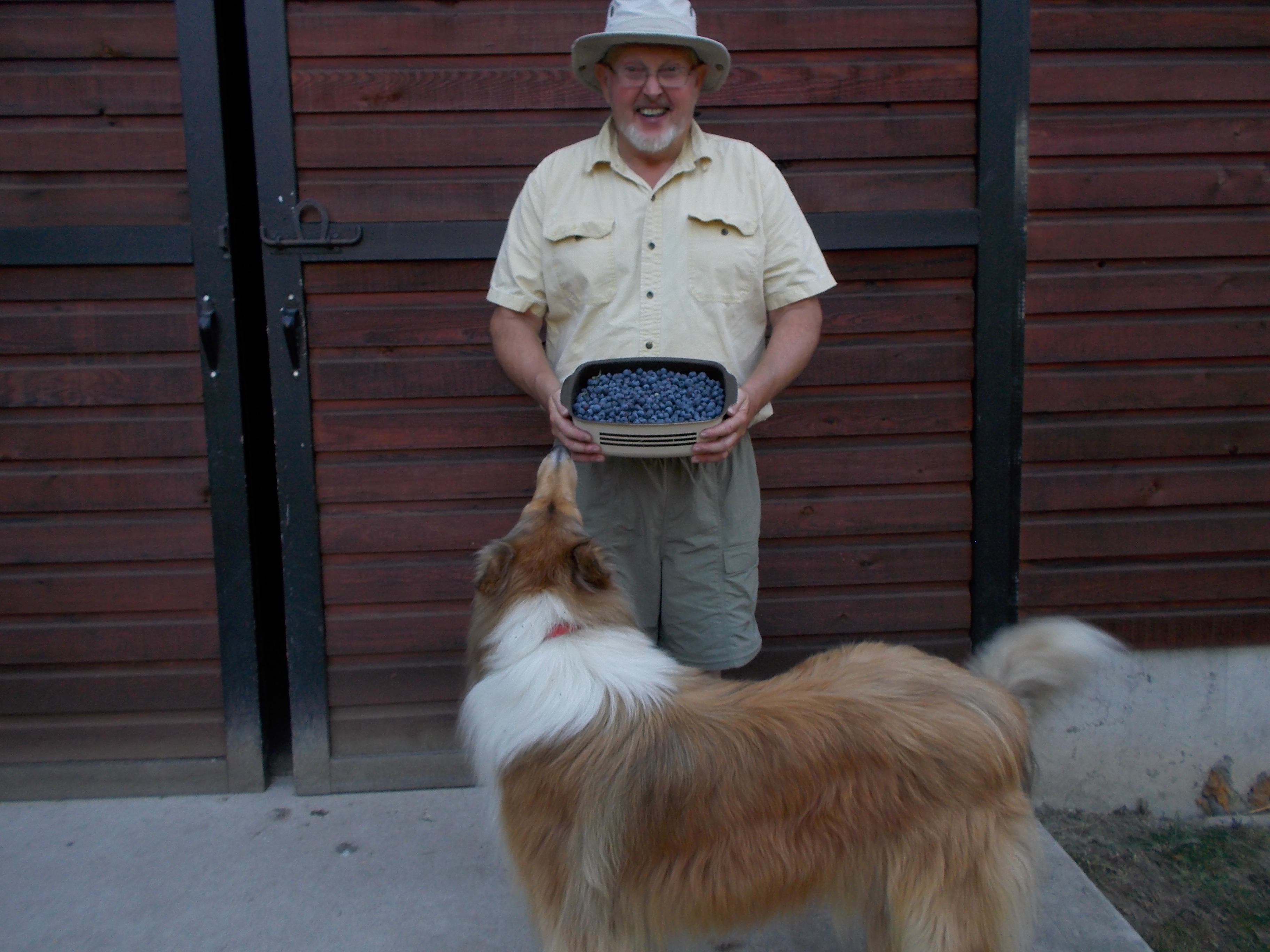
Rider inspects the day’s crop of blueberries.
Harperspeak dictionary, latest revision: Elite
August 21, 2014
So the Conservatives plan to sweep to power by rousing ordinary Canadians against the “Elite” who want to take over the Government of Canada.
They’d better get the new talking points out to the trolls haunting newspaper comments sections. They’re still running Justin Trudeau down as a part-time supply teacher with no background and no experience and no ideas, in over his head.
Now at the stroke of Harper’s pen Justin is “Elite.”
Harper’s had good luck with Harperspeak before. Stephen Lewis’s “Corporate Welfare Bums” became “Job Creators” in Harper’s new language.
Members of Her Majesty’s Loyal Opposition became “traitors” and “losers” when they formed a coalition.
“Canadians (didn’t) care about…” a variety of things including flouting the rules of Parliament, misappropriation of funds by government representatives, multi-million dollar ad campaigns for non-existent jobs, and I guess the systematic torture of prisoners in Afghanistan.
Remember “You’re not supporting our troops”? It was a popular heckling line in the House of Commons until it grew so threadbare that not even Fantino would try to wheel it out after stories in the “elite media” revealing the extent that veteran’s affairs has slid off the table of this government.
So expect to see lots of footage of the elite Trudeau and his elite wife in the elite classic Mercedes convertible he inherited.
It’ll be interesting to see how this one backfires.
———————————————-
First reaction to the new edict was a tweet by Gerald Butts, Trudeau’s main advisor: “My dad mined coal for 40 years in Cape Breton. He’d be proud the prime minister thinks his son’s an ‘elite.'”
Have you ever felt like a character in a scifi movie, the unsuspecting schlep who first encounters the mutant plant and then is devoured by it before it goes on to conquer the world?
I felt like that guy this morning when I realized that there was a whole new layer of growth coming up through the huge patch of DSV I had zapped three weeks ago.
Dog strangling vine spreads more rapidly than anything I have seen before. Its rate of growth is hard to believe, and it is relentless. Roundup will kill it, but it’s a lot like creeping charlie, the weed which bedeviled my mother’s gardening days: break it up or cut it off and any bit of root or stem will simply produce another plant.
But DSV also produces pods which rather resemble small green beans. They dry and release milkweed-style seeds on parachutes, and there are millions of these pods on the plants. DSV also climbs with alacrity, wrapping itself around other vines to produce the “dog strangling” effect after which it is named.
On my first attempt to walk through a metre-high mass of this stuff I nearly pulled both hamstrings.
This week I have seen outcroppings of the weed along the Ferry Road near Chaffey’s Locks, the Chaffey’s Locks Road, and Lockwood Lane. On my friend’s building lot it has made it 150 feet in under the forest canopy in one area. On the other side of the road it seems to be progressing unhindered.
If we don’t take immediate measures to control this invader, we can forget about plant diversity and seedling growth in our woodlots. DSV will crowd everything out. We can also forget about walking through forest trails in summer and fall.
By comparison the wild parsnip which lines our roads is a mild irritant. The DSV is a crisis and we need to take immediate steps to fight it back.
Municipal governments must get on the ball. This stuff is vectoring down roadways, quite possibly spread by mowing. Spraying to control the infestation is the logical first step. But it must be done immediately.
In Ogdensburg at the TSC, Roundup and other concentrated herbicides are on the shelf for anyone to buy, but to obtain the same materials in Ontario you must write the pesticides examination every five years. Many tree-huggers, myself included, now hold expired licenses, and our life supplies of Roundup (purchased before our licenses expired) won’t last through a blight on the landscape like this.
The second step would be to facilitate the acquisition of pesticides licenses and renewals: a single exam in Perth in mid-March will do no good for land owners who wish to protect their property this summer. And they’ll need the restricted stuff if they want to do any good. So far in three sessions I have sprayed 6 litres of concentrate (diluted 100 to 1) on one infected building lot, and it will take more to do the job. The diluted stuff in hardware stores available without a license just won’t cut it.
We need to get serious. If a brush fire were blazing at the front of your property, you’d try to put it out, right? DSV will easily have as devastating an effect as a forest fire on your property if it is allowed to spread unchecked.
Once those seed pods dry out and split, the time for action will have passed, and we can forget about walking through the woods.
UPDATE: August 14, 2014
My neighbour dropped a clipping from Tuesday’s Citizen by the house. It’s an interview with Dr. Naomi Cappuccino of the biology department at Carleton University. Her specialty is biological controls of invasive speces. She claims to have located a moth which eats only DSV.
PressDisplay.com – Ottawa Citizen – 12 Aug 2014 – The tale of the moth and nasty plant
Review: MFG 15 gallon spot sprayer from Princess Auto
August 10, 2014
I bought this rig to mount in the back of my Polaris Ranger because backpack sprayers were becoming a lot of work. In the first year it did a reasonable job around 8000 little trees, though I needed a driver for the Ranger.
As time went on the sprayer’s role changed to defender of the farm against invasive plant species, and in this role it served pretty well. A couple of tanks of Roundup mix per year did the job until wild parsnip moved in. I went at the parsnip with a vengeance and the sprayer continued to do its job with occasional repairs to the 12v outlet. I had to switch to a heavier plug because extended running would melt the little plugs.
Then came the current scourge of DSV (dog strangling vine) on a friend’s building lot, an intimidating mass of tangled vines stretching back into the forest. The pump delivered its load, but I melted a high-quality plug from sustained running.
I realized we need a longer hose to deal with this infestation as I don’t like disassembling the Ranger after every spraying session to ensure there are no seed pods hidden in its body.
The $129. sprayer has delivered yoeman service over five years with the only problems the power supply and an occasional hose connection coming loose. I wish it had a 50′ hose as an option.
Update 10 August, 2014:
This morning I grafted 50′ of beverage tubing to the hose and tackled the DSV anew. The load of 1% Roundup 3 weeks ago made it easier to move around in the infested area, but there was still more to do.
With the property owner handling the Ranger and the hose, I was able to venture deep into the jungle and kill stuff all of the way out while Les withdrew the hose and coiled it in the back of the Ranger in preparation for the next sortie. We sprayed two, 15 gallon loads in an intensive session where, among other obstacles, I had to belay down a ten foot embankment into a loose pile of logs hidden under vines.
Mosquitoes and deer flies had no use for me today. Roundup’s a good insect repellent, though I wouldn’t recommend it.
Kubota BX2350 first impressions
August 3, 2014
Tony’s new BX was in the way in my shop so I backed it out this morning, wiggled the bucket, and looked for something for it to do while it worked the grease into the forward/reverse foot pedal. I’d found the fitting under the floorboards after a look at the manual.
Before long the bucket found itself digging into a small topsoil pile, just to see how it carried stuff around. It filled nicely. I particularly liked the way I could see what I was doing throughout the process, even to the point of tipping the loaded bucket back enough I could peek inside. For someone who grew up on blind loader operation, this was a real treat.
Let’s see: where can I put a bucket full of choice topsoil? The BX took itself out the driveway in the general direction of two flower beds 500 feet away. With the speed this thing moves, is there any need for a dump trailer?
How about if I cover those rocks on the raised embankment so that I can climb up there with the mower? The BX moved in neatly, carefully avoiding the loose-stone flower bed enclosure and an irrigation tap peeking up through the sod. I dumped a useful amount of topsoil exactly where I’d planned, then zipped back up the lane for another, and another. Then I smoothed the black fill over the stones, leaving lumps. What if I took that stone out? It’s pretty big. Worth a try. The little 48″ bucket scratched away at the stone for a while, and then rolled it over. The boulder was too big for me to lift, but I could roll it easily into the bucket. The BX was game, picking it up without hesitation, so I hauled it 600′ to my stone dump and took another bucket of topsoil back to the site.
The topsoil worked into place well, using the bucket as a trowel. Then it came time to pack the surface on the steep slope. Up we went. When a front wheel came off the ground, the differential lock kept things moving, under control.
The BX stalled a couple of times when descending the steep slope* (see update). There seems to be a safety interlock which shuts things down temporarily if the tractor tips too far. I soon learned how to approach the slope so as not to disturb the interlock.
All too soon the little job was done and the topsoil pile showed signs of imminent depletion. The mid mount mower had been a passenger throughout this project, and interfered only when I tried to find a way between another stone wall and a dogwood bush. It was too wide to let me in. The high, flat elevation of the mower in travel mode is a considerable improvement over my B7510, which seems to want to drag its front casters around, no matter how I adjust it.
Wherever this remarkable little tractor goes, there’ll be dump trucks full of fill and topsoil not far behind. The BX2350 and its loader are a highly addictive combination.
Update: 21 August, 2014
*I should mention that my friend’s wife found one little glitch in the BX’s setup. Whenever she pressed the forward pedal the machine would cut out. Seems she’s not all that heavy, and the spring under the seat to control the operator presence sensor was a double layer of spring steel. On Tractorbynet I found a discussion about this and the solution: remove two, 12mm studs, take off the top spring, retighten. Worked fine, once we found a socket set which would break free the studs without twisting them off.
That minor modification completed, all was well with the BX.
The generic bush hog (updated, with retraction)
August 1, 2014
This review is the product of seven years of mowing 25 acres of tree seedlings on our property. After wearing out a Walco 60″ rotary mower inherited from my dad (replacing one set of blades and three gearboxes), I bought a new 60″ Rhino to run on my 35 hp TAFE tractor but discovered that many of the rows in the new plantings were too narrow for the 5′ 6″ tractor to travel. So I bought a 1980 Bolens G174 with a track of 38″, 4WD, suitcase weights, a 17 hp diesel, and a separate overrunning clutch to cope with the the Braber’s flywheel effect. A 48″ Braber rotary mower mounted neatly onto the 1200 lb tractor and I gained easy access to the shrinking rows between the trees.
The Braber 48 likely had about 200 hours on it when last summer I demolished the gearbox by bellying onto a rock. The bottom of the gearbox casting sheared right off. Braber replaced it under warranty, but I had to do the mechanical work myself. Regardless of lubricant choice the new gearbox is too noisy and damages my hearing, even with earmuffs. I can’t see going deaf to that racket for another ten years, so I’ll probably buy a better mower soon.
But accidents happen, and maybe the replacement was a lemon. My real beef with this mower has to do with its gear ratios. The Bolens G174 has 3 pto speeds, and I chose the middle gear which provided 750 rpm at the shaft. This worked well. But then I bought a much newer Kubota B7510HST with a 540 pto. This produces a lousy cut in long grass with this mower. The 5′ Rhino’s cut is vastly superior.
So I looked at some parts manuals. There are two 40-45 hp gearboxes available, a 1:1.4 ratio, which this one is, and a 1:1.9 ratio* which would likely work well on my Kubota. (Big mea culpa here: the replacement gearbox is a 1:1.9 model.)*
So if you have a small tractor with a 3 speed PTO, select the middle gear and this model will do you well. If you have a more modern tractor and want to do a lot of mowing, find a mower with the 1:1.9 ratio or get a 60″ machine. The tip speed just isn’t there for a fine cut unless you turn the shaft more quickly than 540 rpm.
This morning I shattered a blade on another rock and was pleased to find that TSC USA stocks them. Tuesday with any luck I’ll slip across the border to Ogdensburg and get the parts I need.
Update, Sunday, 3 August, 2014:
A lull in the action prompted me to head off for Ogdensburg and pick up the 3″ X 18″ blades they had in stock. There was a set of 3 1/2″ X 18″, but the box didn’t look that wide. I opened it up. Two 3″ X 1/2″ X 18″ looked back at me. What’s a little typo on a box between friends, eh?
As the surviving original blade measured about 17″ and the replacement was 18″ at the same point, I had bought the blades on the assumption that I would have to cut an inch off them. The saw was all set up before I examined the dead one more carefully. Though the metal was dark and smooth, it didn’t look as though I had been at it with an angle grinder, and I had done a lot of sharpening on those blades over the years. Seems the rock strike had broken one blade in two; the other had lost an inch off its end in a very precise split, as well as bending all out of shape.
I had bought the correct blades after all. They fastened right on with the bolt kit on the shelf beside the blades.
I found the Ogdensburg TSC quite an impressive store with a smart, helpful guy on the service desk.
The much-maligned Brader 48″ rotary mower may again see service> If the blades work well I may just replace the noisy gearbox with a 1:1.9 model. (See above).
UPDATE: August 5, 2014
The rotary mower had to be readjusted to allow for the larger offset of the new blades. I raised the chassis of the cutter an inch and adjusted the rear wheel and chains at the front until it cut properly, if producing a somewhat taller cut than before with the old blades.
As soon as the paint wore off the blades, the cut improved immensely over the old blades. It wasn’t just sharpness. The old blades, I am convinced, had been banged out on a forge by a blacksmith who had no concept of how the things were supposed to work. The sharp part of the blade was on the high side of the twisted blade, not the lower side. Instead of sucking the hay up to the blades, the old blades blew it down after cutting it.
So now the mower cuts much better than before. It is also quieter and more agile in conjunction with the tractor in its taller stance: the rear wheel pivots much more easily.
I feel I may have mistreated TSC in my review of their 4′ rotary mower in that I ascribed failings to their model which may well have been the result of bungled blade construction by a competitor. In the review I rated the generic machine a 3/5 when 4/5 would have been more appropriate. The TSC blades and bolts were fine, at least before their first encounter with a rock.
UPDATE: 28 January, 2015
In retrospect, I realize that the problem with the blades is that they are made of soft steel. An impact with a rock will bend the blades up. Repeated impacts will result in the reverse-shape I have referred to above.
The conclusion from this, I guess, is that the Brader machine with its low-carbon blades is a decent grass-cutter, but if the machine sees rough use around rocks, the owner should be prepared to replace the blades with a new set. At $58. per pair at TSC (USA), the price is not exorbitant.
I should also remark that the replacement gearbox on the Brader has gradually grown less noisy, though it’s far from quiet. One tip for anyone replacing the gearbox on this model: bolt it on with the nuts up, rather than down. Then if one or more nuts come loose on the unit, the change will be immediately obvious to the operator, and with a little luck can be tightened up immediately with a wrench, instead of requiring the disassembly of the machine to re-tighten the bolts.
People who stare at screens (updated)
July 24, 2014
“Does anyone plan to stare at their phones some place exciting this weekend?”
This comment which I read on an online comic strip this morning could only have been written in our current era. The telephone has morphed into a device which has immobilized much of our brains and corrupted our language. In particular it has savaged the rules of English grammar, invalidating the specific references created by proper use of pronouns. But if one can broadcast every narcissistic impulse to the entire cyber-universe as soon as it occurs, why bother to distinguish between the one and the many, between her and their?
I blame the daycare generation for the increasing reliance upon “their” as a grammatical crutch. In a universe of interchangeable people, why value one particular friend beyond the convenience of shared toys? Why bother to keep track of who is who when “they” is easier?
Conversations with graduate students over the last few years have increasingly become punctuated by Google quotes. In fact it wasn’t at all uncommon for the four or five people in the room to have MacBooks, iPhones or Galaxies open while they chatted. Mind you the conversations delved far more deeply into topics than they used to, and this alpha male’s recourse to B.S. when the facts ran out has been dramatically reduced by fact-checking family members. But a good memory for details seems no longer to be required. If I can’t remember an actor’s name, for example, all I need do is look up the cast list from a remembered movie or T.V. series to get the information.
Perhaps the ultimate manifestations of the dominance of the smart phone came during a visit to our son in Vancouver this spring. He had located an Italian restaurant online and led Bet and me off, Pied-Piper-style, while he brandished his Galaxy in front of him. We walked for a long time, but each complaint received an “Only a couple of blocks more!” response until eventually we arrived.
As we sat down Charlie blasted off a quick text message. An answering beep informed us that Roz had left work and was already on a city bus, converging upon our new location. She skilfully planned a route through the maze of Vancouver streets on her phone, and twenty minutes later she casually strolled up to our patio table, Galaxy still in hand.
A day later when we hiked up the side of a mountain and I ran out of wind halfway up, Roz whipped out her phone, called up a picture of the summit, and playfully suggested I photograph it to prove to Bet and Charlie that we had made it to the top. So it’s little wonder Parks Canada has introduced Internet service on their properties. Today’s citizens see no reason to cut themselves off from the Internet while they enjoy their lives.
While today’s denizens of the western world may appear to stare blankly at phones and laptops for long periods of time, they don’t get lost much, have continual access to good information, and get to enjoy live videos of grandkids, if they have any. What’s more, I have built and installed four flights of stairs for friends’ homes this summer and they all fitted perfectly, thanks to a $13.00 spreadsheet I downloaded to my MacBook Air.
One of my favourite screen-starers, Dr. Martin Mallet, did this interview recently:
 the Walnut Diary