Men who eat quiche can’t back up a trailer.
March 1, 2009
The utility trailer has emerged as the best transportation value in our modern world. Its overhead is negligible: $35. will license it for life. Insurance is unnecessary. It will do all a pickup truck will do, but you don’t have to worry about scratching it, and you can unhook it and leave a partly-completed task behind.
A bit of skill is the main requirement to benefit from this transportation boon. The driver has to be able to back it up, and thus we come to one of the defining tasks of manhood for my generation: backing up a trailer.
Learning the skill was a long and difficult journey for me in my sixteenth year, committed to a summer of mornings hauling firewood into Alan Earl’s basement with a tractor and trailer. The firewood followed a serpentine route down a driveway, between a shed and a brick house, then around a 180 degree turn under a clothes line and up a slight incline to the basement door. I had to back a loaded trailer through this maze, several times per day.
I soon knew every inch of that route, and still rue the day I left a series of bolt-shaped swirls in the gray boards of the shed wall when I edged the tractor too close in an effort to make the turn. No doubt those scratches are still there today.
Later on I learned that it’s much easier to handle a trailer with a vehicle which has a rear-view mirror. All you need do is take a sighting of the corner of the trailer in the mirror, and then if you hold that image still as you back up, the trailer will go straight.
Longer wheelbases are easier, as well, but if you want to observe the true test of a marriage, just watch a couple launching a boat at a ramp without a dock. Logic indicates that if one partner is in the boat at the time of the launch, nobody need get wet. The trick is to have one trained to start and free the boat from the trailer and the other equipped to back the vehicle and its load down the ramp into the water. The problem is that usually the same partner feels uniquely qualified to do both jobs.
The first time Bet tried backing in at Forrester’s Landing, my shouted instructions didn’t seem to help, and she actually ended up sideways on the ramp before leaping from the vehicle in disgust. From that point on my wife has put trailers out of her mind. When I asked for her opinion for this article she paused, thought, and said, “They’re for hauling garbage and moving university students.”
A friend from Ottawa was more forthcoming: “I have a history of poor choices with men, and not one of them could back up a trailer. Maybe it’s that men who eat quiche can’t back up trailers.”
Of course the trailer challenge is specific to my age group. Our son’s generation never had to learn. From hours of play with remote control cars, reverse-steering is hard-wired into their brains. You see, with an RC car the controls steer one way going out and the opposite way on the return trip. The crossover to trailers is a breeze. Charlie was about twelve when he learned how to drive his Grandpa’s Jeep around the farm, and the next day I looked over to see him with a trailer attached, backing the rig straight across an eight-acre field.
One of the most insidious things about trailers is how easily an owner can be persuaded to add another to his fleet.
Last fall when I bought a utility vehicle I gradually realized that I couldn’t take it anywhere because it was too big to fit any trailer I owned. Soon a Kijiji ad put me on to a pair of axles, so I drove to Kingston and picked them up. My neighbour Peter Myers straightened one axle and lengthened both to give the 6′ bed width the UV required, then guided me through the design process to produce quite a wonderful flat-bed trailer. He accepted that I wanted a trailer which was neither too big nor too small, and all it took was a week of work and a lot of steel. I quickly added low wooden sideboards and stakes to go with the magnificent “headache bar” he rigged across the front to provide a positive stop for the front wheels of my UV. Before I got at it with a paint roller, Peter’s creation was a thing of beauty.
Painting steel in late November is strangely difficult, but Tremclad will dry at below-freezing temperatures. It just won’t spray, so the roller was a must. Wiring trailer lights is never fun, but it’s worse when your fingers stick to the pliers, the trailer, and even the bolts.
Notwithstanding the crude paint job, the new trailer has fitted in well with the other eight in the barn. Bet suggests this fondness for trailers must be compensation for my utter inability to back up a farm wagon. There, I’ve admitted it.
You don’t own it.
February 23, 2009
This week I flipped back to The Day the Earth Stood Still and the only memorable line of movie dialogue from a pretty dismal year. American secretary of state Kathy Bates asks the alien, Keanu Reeves: “Why have you come to our planet?”
His terse response: “You don’t own it.”
This line jars the viewer because to a great extent our culture still draws its attitude toward the environment from the first three chapters of Genesis. The Lord created man and placed him on earth and gave him dominion over the earth and its creatures. This assumption causes grave harm when it becomes the freedom to destroy and pollute without cost, but for those who recognize the duty of care which comes with such “ownership”, it is a call to do what we can to restore the health of the small patches of the planet we call our own.
Gary Nielsen, MNR Climate Change Project Co-ordinator, spoke at the annual woodlot conference in Kemptville this week. “Earth ice cover is currently at its lowest point in 100,000 years. Climate change is real. It is serious, the biggest challenge humanity has ever faced. We have seen significant change already, and it is accelerating. The people who will bear the brunt of its effects are in school right now.
“Charles Keeling was a graduate student in the early 1950’s when he showed that while carbon dioxide levels in water vary widely depending upon where the sample is taken, CO2 levels in air are consistent. What happens in China or India happens immediately to us in North America. We’re all in this together.
“Trees take in CO2 and give off oxygen in an annual cycle. The Keeling curve traced the cycle and year over year, atmospheric carbon dioxide has been increasing on an exponential curve since the Industrial Revolution increased the population capacity of the planet.
“In our solar system Venus suffers from a runaway greenhouse effect. Mars has no atmosphere and is glaciated. Earth is the Goldilocks planet, neither too hot nor too cold. This is a precarious balance. The best thinking today holds that the tipping point comes if temperatures increase another 2 degrees Celsius. Above that point positive feedback develops: tundra stripped of ice will attract much more solar heat and accelerate the process as the frost melts.
“So far world temperatures are up .7 degrees globally, and 1.3 degrees in Ontario.
“We can’t control climate change, but we can restore forests. Trees sequester carbon dioxide. A sustainable landscape is the goal. The United Nations has begun the Billion Trees Program, and Ontario has made the single largest commitment: 50 million trees in the ground by 2020.
“One of the major instruments to resist climate change which lies within our control in Ontario is afforestation, that is, returning land to the forest. Creating a healthy, diverse and sustainable environment will create the resiliency needed to face the coming challenges.”
A major problem with the forests of Eastern Ontario is the fragmentation of the tree cover. Stewardship councils, conservation authorities and the MNR are working actively to reconnect the scattered woodlots by retiring farmland to provide the kind of density and wildlife corridors needed by many species.
The trees will be planted by contractors at a charge of 15 cents per seedling. Landowners in Leeds and Grenville who have at least 5 acres of open land available for tree planting can contact the following agencies for assistance:
Rick Knapton: Cataraqui Region Conservation Authority – 389-3651
Martin Streit: Leeds County Stewardship Council – 342-8526
Jack Henry: Grenville Land Stewardship Council – 342-8528
Eastern Ontario is a priority in the planning. A major project was completed last year in the Toledo area.
According to the Kyoto Protocol, trees planted after December 31, 1989 will count for carbon sequestration projects. The current thinking holds that 1 hectare will produce about 4.5 tonnes of offsets each year, worth about $89/ha/year gross. Obviously with tradeable units of 10,000 tonnes each, there will be administrative costs, but tree planting does show some actual income potential for the land, as well as the tax advantages of returning acreage to the forest.
So what the 50 Million Trees Program offers is the chance for landowners to do their bit to fight climate change with the help of cheap trees, free planting, and reduced property taxes.
Gary Nielsen concluded his address to the landowners with a few key points. “We don’t know how people will behave in the next 100 years. Will the economic forces or the environmental forces carry the day? Fighting climate change is like slowing down the Queen Elizabeth II. It doesn’t stop on a dime.”
Another interesting development emerged at the Kemptville Woodlot Conference in an address by Robert Lyng, Director of the Ontario Power Generation Biomass Initiative. Lyng spent a lot of time with graphs and I tend to be skeptical of such presentations, but the bottom line for OPG seems to be that they plan to burn wood pellets in their coal boilers for hydro generation as soon as the law requires them to do so. To me this looks like a potential shot in the arm for the pulpwood industry.
UPDATE: February 17, 2010 Robert Lyng came back for an update at this year’s Kemptville Woodlot Conference. He detailed plans to burn wood and plant fibre pellets at four coal-fired generating stations, two on the shore of Lake Superior, one in the Lake St. Clair area, and one on Lake Erie. He identified areas of crown land as the source of the wood fibre for the initial stage of the project. I may have spoken too soon when I suggested this has potential to boost the pulpwood industry. Distances are too great. There’s nothing set up for Eastern Ontario.
Another presenter who runs a large sawmill in Eastern Ontario explained that it is the market for low grade wood fibre which makes or breaks a sawmill operation. The depressed pulpwood market leaves all sawmills on the edge of survival. Even worse, American companies desperate for cash are dumping surplus wood products in Toronto. In some cases lumber is available for sale in Toronto for less than Eastern Ontario landowners are currently getting for standing timber.
The Mysterious Case of the Runaway Bronco
February 15, 2009
I dread Friday the 13th. I have done so ever since April, 1971, when on a Shakespeare exam at Queen’s I faced a compulsory 45 mark question on three plays I hadn’t read. Then I reeled into a Canadian history exam and had forgotten pretty well everything by the fifth hour of the six-hour ordeal.
It’s not that I’m overly superstitious. No, my fear of Friday the 13th comes as the result of a lifelong series of catastrophes on that day, many of which have had a built-in ironic component which makes my head spin. The mysterious case of the runaway Bronco is a good example:
————————————————————————-
I was in the shower, a bit late for the drive to school, when I heard a loud crash. Bet shouted, “Rod, somebody’s hit your truck!”
I stumbled outside. There was my poor 4Runner, huddled against the curb, one back wheel driven up onto the lawn. The left side had been creased and scratched and the mirror was nowhere to be found.
Just past my truck a Ford Bronco had wrapped itself around the hydro pole which grows at the edge of our driveway. Coolant gushed from the radiator and perfumed the air around the wreck. I checked the cab. No driver. What’s more, the interior of the truck was tidy, locked up, and with no keys in the ignition.
A Smiths Falls Police cruiser arrived. The officers looked as bewildered as I about the absent driver.
About this time a little guy strolled up the road from Quattrocchi’s vegetable warehouse, a block further down the hill. “I’d just got in with a load a’ potatoes from New Brunswick when I saw those poles and wires-a-dancing, so I left my truck to come up and see what’s happened.”
Constable Jim Ecker asked, “Sir, did you see the accident? Did you see anyone running away from the vehicle?”
“No, all I saw’s the wires, but they were really jumping around there for a bit.”
The stranger walked over to the wrecked SUV. “Say, now, that’s a 1986 Ford Bronco. I had one a’ them. Thing kept jumpin’outa park whenever I left ‘er parked on a hill. Finally it got away on me out front o’ my sister’s house and it rolled into a swamp and we never did find it again. Brand new tires on’er, too. I missed those tires.”
Constable Alison Smith piped up: “Sir, are you suggesting that this vehicle might have been parked up the street, and that it jumped out of park and rolled down the hill until it hit this pole?”
The man looked at the wrecked Bronco, looked up the street, considered the slopes, the distances, the angle of deflection off my Toyota, and nodded his head in the affirmative. “Yep.”
Constable Ecker ran the plate and discovered that the Bronco was registered to the pastor of his church. He called and interrupted the clergyman’s breakfast. He promised to come right over, and soon parked his Crown Victoria behind my stricken 4Runner.
“I lent the Bronco to my daughter to use while her husband is out of town. They live in an apartment up the hill,” gesturing up Church Street towards the town hall.
“What’s her name and phone number, Reverend?” Smith asked.
“Would you mind not calling her? She worked the night shift and is probably just getting to sleep now. Why don’t I call my insurance company and the tow-truck and we let her sleep?”
The officers decided that this would be all right, so a genial and very knowledgeable tow truck owner soon arrived and separated the Bronco from its splintered adversary.
It fell to me to notify my insurance company of the accident. The local answering machine referred me to another in Kingston, into which I dictated my message.
“Dear Sir, Madam, or machine: This morning at approximately 7:30 a ten year-old Bronco got away from its owner and ran down the street, plunged through an intersection, sideswiped my 4Runner and killed itself on the hydro pole in my driveway.”
I left my contact numbers and soon a smart and very competent woman called to guide me through procedures. The repairs were soon done to my satisfaction, the rental Ford went back, and I thought I had heard the last of the matter.
Then, three months later, a letter arrived from the insurance company:
“Dear Mr. Croskery re: Animal Collision, April 13, 1997. We hope that you have found the repairs to your vehicle satisfactory…”
Animal collision??? This left me in a quandary. The nice lady on the phone couldn’t possibly have mistaken a 1986 Bronco for a horse. So was she joking? I couldn’t tell, and worse, I didn’t know how to respond. Do I clear up her “misconception” and make myself the butt of the joke, or do I let it go? Torn by indecision, I finally wimped out and said that everything was fine. Maybe that gave her the best laugh of all.
When I told the guys at the Marina about this, my Newfoundland friend Les said that he had the same thing happen when he hit a moose with his Blazer. About three months later a letter came, this one about a “collision with a flying object.”
“Well, that moose was a’flyin after I ran into ‘er, but maybe they’d used up all the animal collisions in Ontario and gave us what was left over.”
Why nobody will take Bet fishing (more than once)
February 6, 2009
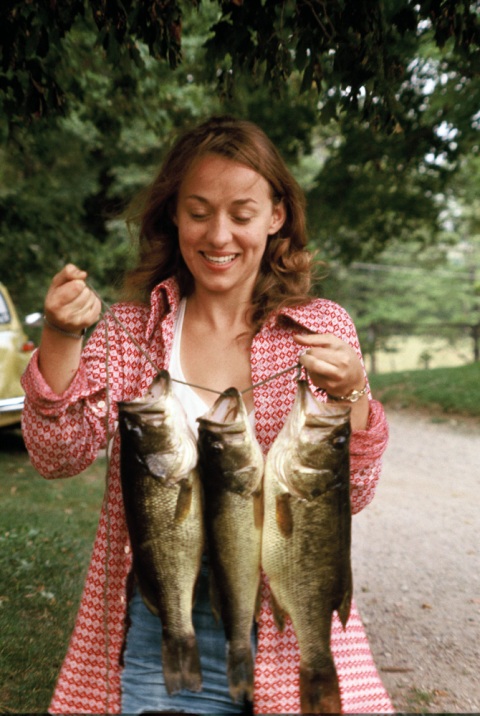
Charlie put up on his website a few old photos he found around the house. My favourite is one of a twenty-one year-old Bet, my bride, proudly holding a stringer of three fat largemouth bass. That was the last time she fished for about twenty-five years.
It wasn’t until my pal Tony was bragging about his ability to hook a bass and he ran into Bet’s barbed wit that the subject came up: “If you know so much about it, why don’t you ever fish?”
“Never mind,” I whispered.
Tony persisted: “How about I set you up with a spinning rod – they’re really simple to use – and take you up onto Mosquito Lake this afternoon for an hour?” Bet showed no real objection, so like an innocent Tony prepared the rod, the boat, and away they went.
I waited. I knew what it would be like when they returned. Yep. There was Bet in the forward seat of the Princecraft as they came in. She was beaming. Tony looked as if someone had stolen his favourite hat and stomped on it. “So how did it go?”
“I got three nice ones,” Bet chirped. “Tony didn’t get any.” Bet was always a ruthless competitor when it came to fishing. I winced.
Any one of the guys would have phrased the report as: “We kept three.” This meant that between us we chose to keep only these three fish. Others, the report implies, were released because they were too small, too large, or were lost. We even learned to call the ones that got away “remote releases” to remove the sting of failure.
Tony groaned, “Does she ever miss a fish?”
“No,” I assured him. “Bet’s a Leo, and I guess that means she has claws like a lion. If a fish even nibbles at a bait on Bet’s line, it’s as good as dead. She never fails to hook a fish.”
Tony and I and the other guys, of course, miss all kinds of bass. It’s a running joke reporting that one or the other of us caught a largemouth on the fifth strike, third worm, or some such. We even credit each other with assists. You get an assist for first missing the fish, and then watching while your partner hooks and lands it.
This sort of sophistry is fun. Putting a positive spin on our ineptitude is a big part of the bonding of fishing partners. But not with Bet. “She was at the front of the boat, right?”
“No, I was in the bow, running the trolling motor, but she still made casts all around me, sometimes even in front of the boat, before I could get my bait into the spots,” Tony complained.
“I gather she didn’t have any trouble switching from bait casting to a spinning rod?” On the dock before departure Tony had made a big deal of teaching Bet how to use a “proper” fishing rod. Now he just glared at me.
“She didn’t leave a square foot of lily pads or a stump for me to fish, and I was in front of her, the whole time!”
“Now do you see why Bet doesn’t fish much?” I asked.
“Yep.”
It was Labour Day, 1974. Over the summer in an old canoe on Opinicon Lake I had recorded data on every bass I caught. My goal was to hit the century mark before summer holidays ended. That morning I had counted up ninety-eight fish. All I needed were two more to reach my goal. We dropped the canoe in at Chaffey’s and worked our way out the shoreline of Opinicon.
Bet soon retired her paddle and worked steadily with her spin-cast rig. The artificial worm on a weedless hook slid easily under the overhanging trees as I methodically positioned the canoe for the best angle. I hardly ever saw an opening to cast. I almost hoped that maybe she would get a line tangle, or even hang up in a tree for a few minutes and give me a chance, but no: every cast was either perfectly placed, or short of the mark and quickly retrieved.
Then in the space of six casts she landed three bass for a total weight of ten pounds. Bet was jubilant at her success. They were very nice fish, and she had handled them well.
But I needed two fish to meet my quota, and she wouldn’t stop casting. What’s more, she ridiculed the one small bass I reeled in. ‘Are you going to keep that poor little thing? Why, it can’t be more than twelve or thirteen inches!’
As I recall my temper frayed sufficiently that I decided to transport my lovely, talented wife and her bass back to the dock before the fish grew stale. Then I took the picture of this beautiful young woman and the fish which should have been mine. That was the last fishing trip.
Bet went on to endure many summers in a leaky boat, my numerous half-completed do-it-yourself projects, and all of my dietary quirks. She raised our son well, has had a fine career and put up with a series of neurotic spaniels.
After thirty-seven years I can’t imagine life without her, but we’re both smart enough not to try fishing together.
Happy Valentine’s Day, Bet.
Rick Mercer Skates The Lake
February 2, 2009
RUMOUR:
I have it on excellent authority that CBC pundit Rick Mercer attended Portland’s annual Skate-the-Lake speed-skating festival on Saturday to do a segment for his show. All I know so far is that Mercer fell a lot and did many takes of the scene before satisfied with it.
Ken Watson posted a photo of Mercer with the Portland waterfront in the background on the Rideau Waterway site.
http://www.rideau-info.com/canal/images/winter/img-rickmercer.html
Harper takes a page from Obama’s notebook
January 27, 2009
I wrote this as a parody of Obama’s inauguration address and thought I might use it as a column in The Review Mirror. My wife said it was too creepy, so I wrote something else. Then I read the text of Harper’s throne speech. His Obama-write-alike was a bit shorter and a lot less candid.
We are here to mark the continuation of our journey to a majority. This is fitting because it in this city, in the office of the Governor General of Canada, that we took the step to prevent the death of this government. It was here that an oil man from Alberta and a Quebec T.V. host gathered to prorogue parliament and avoid the destiny to which my career seemed doomed.
It was a risky thing, asking the Governor General to prorogue the house. There was no guarantee that she would go along with my request. More than once she asked me if I was crazy, but after a long while she agreed and I found a way to avoid the prospect of defeat.
We had to put it all on the line – our political lives, our fortunes, and our integrity – for our government’s right to do the job that fully 22% of Canadians chose us to do. To govern this country with the set of ideals that continue to light the world. That lower taxes are best. That our lives, liberty and happiness come from laws which protect us from people who are not like us. And that a Conservative government, by and for conservatives, can endure. It was these ideals that led us to close down the House until we had time for our propaganda to work, producing documents and leaks which were imperfect, but over time, with the help of polls, could be made to work.
We are here today not simply to pay tribute to the Finance Minister for his work this fall, but to pick up his work again. The trials we face are very different now, and much more severe than expected. Only a handful of times in our history has a generation been confronted with challenges so vast. An economy that is faltering. A coalition prepared to overthrow the government. A war we have no prospect of ending responsibly, a continent turning away from its love for Alberta oil.
And yet while our problems may be new, what is required to overcome them is not. What is required is the same procedural and propaganda tricks which worked to defeat our opponents two times before. What is also required is a new policy, not just in our nation, but in our own lives, to spend, spend, spend like a Liberal, and in so doing to buy as many votes as sixty-four billion dollars can purchase before voters again go to the polls.
That is the reason I called the election in the fall of 2008. I did so in the belief that the time for a majority was slipping out of reach, that the time of the interests of the few would give way to the interests of the many before we could bring it about.
And so I broke my own law. I believed that we can only face the future if we control the vast numbers in Canada who do not believe as we do. Then and only then can we bring back a Canada where oil is king and the lights shine bright only west of Thunder Bay.
This is what I believed, but Mme. Jean, you have made this belief real. You proved once more that a man and his vision for this country can change it. And as I prepare for this session of parliament, I know that I will not be traveling alone. Guy Giorno, Patrick Muttart , Darrell Reid and Jasmine Igneski are with me. Kory Teneyckeare’s propaganda machine grinds merrily along even as I speak, and Don Cherry can be counted upon to pour out his heart each Saturday night on CBC.
Theirs are the voices I will carry with me every day in the PMO. Theirs are the strategies I will be thinking of when I deliver the changes you elected me to make.
When affordable health care fades from the memory of Canadians, I’ll think back to the massive deficit of this budget and how it gave me the justification to sell off health care to the private sector.
When we extend the Canadian Mission to Afghanistan for another five years to protect the Auto Pact, I’ll think of my visits to the troops for photo ops, and how they gave me the boost to win two successive minority governments.
These are the stories that will comfort me in the days ahead. They are different stories, told by men and women whose journeys may seem separate, yet you showed me time and again that no matter where we come from or what party we vote for, we are a common people of soaring hopes and fearful dreams and quiet greed, who ask only for what was promised us as Canadians: cheap fuel, good hockey, and a lottery win to let us retire.
I recognize that the coalition is an enormous challenge which must be solved quickly. If we can survive as a government for the next week, we should be fine.
But we should never forget that we are the heirs of that first band of patriots, Ronald Reagan, David Frumm, Mike Harris, George W. Bush, who refused to give up when liberalism seemed unstoppable, and who somehow believed that they could make the world just like it was, before Trudeau.
For the Common Sense Revolution did not end when Mike retired. It was never something to be won only on an electoral battleground or fulfilled only in our budget documents. It was not simply a struggle to break free from the evil Liberal empire and declare a Tory Canada. The Common Sense Revolution was — and remains – an ongoing struggle for the minds and hearts of the voters to live up to our founding creed of small government, lower taxes, and no same-sex marriages.
Let’s build this government that is responsible to its founders: Imperial Oil, Suncor Energy, Matco Investments, The Royal Bank of Canada, CTV, The National Post and the Canada West Foundation. Let’s all of us do our part to rebuild the status of Alberta Oil and the National Post as the foundation of this country.
Let’s all of us do our part to rebuild this country. Let’s make this deficit not the end of Tory frugality, but rather a brief interval in which we buy enough votes to ensure a majority in two years. Join me in this effort, and let’s seek a better world with a balanced budget and lower taxes in two years’ time. Thank you.
Public-Private Partnerships and the PMO
January 26, 2009
A few weeks ago Dr. Al Drummond of Perth drew attention to the problem local hospital staff had in finding a bed for a patient who was a suicide risk. The chronic shortage of acute care facilities for mental health patients impacts daily upon emergency room staff.
January 26, reporter Mohammed Adam of the Ottawa Citizen ran a front-page story “Audit on Royal Ottawa sought” in which he described the case of the private consortium-built Brampton Civic Hospital. “Conceived as a 716-bed hospital, (it) opened with 479 beds in October, 2007. Two months later public protests over medical deficiencies and shortages of beds and staff forced the Ontario government to appoint a supervisor to run the hospital.” Adam goes on to quote the Ontario auditor general’s report which showed that the hospital had an initial cost overrun of $194 million. Because of the higher interest rate charged by the consortium, over the life of the lease it will have cost taxpayers an additional $200 million more than if the project had been financed by government.
The justification for the audit call in the case of the Royal Ottawa, another P3 consortium contract, is that while in its two years of operation it has had “serious problems, including building quality and equipment failures,” its management has remained extremely secretive. “Hospitals are not bound by provincial freedom-of-information laws…and the Royal Ottawa has been particularly reluctant to disclose information on its project and the only way to get it is through the auditor general,” said a spokesperson for The Ontario Health Coalition in the article.
The P3 program is a legacy of the Harris government. Its dealings are conducted well away from the public eye, and the history of cost overruns puts one in mind of the carpetbaggers who plundered the American south after the Civil War. In Mike Harris’s home town, the North Bay hospital was budgeted at $551 million. It cost $1 billion. Sarnia’s figures were $140 million and $320 million. The Royal Ottawa’s budget was $100 million and the final figure was $146 million.
These figures remain numbers on a page until it is your relative or your patient who can’t find a hospital bed.
So what does this have to do with the return of parliament after the Christmas recess? I’m worried. The idea of Stephen Harper and Jim Flaherty with $64 million in their pockets scares me even more than Mike Harris’s giddy cut-fast-cut-deep-don’t-flinch mantra which he and his staff (including Flaherty and Guy Giorno) chanted as they lay waste to the public sector of Ontario.
Political pressure for stimulus spending in this budget leaves Harper in the enviable position of having a huge sum of money with which to buy votes. With his hyper-partisan attitude, I can’t imagine him seeing beyond that initial thought.
Today’s Citizen shows two examples of the complexity of government spending: Harper has ordered 1,300 non-combat trucks for the military, a contract with the U.S. company Navistar worth $274 million. But the trucks will be built in Texas, and 500 workers at Navistar’s Chatham plant have received layoff notices, with another 200 expected in the spring (David Pugliese “Make sure defence projects create jobs here, Tories told”). So far Harper’s spending to upgrade Canadian military equipment has not generated the promised benefits for Canada’s defence and aero-space firms. Peter McKay wants to buy $3.1 billion worth of Italian search and rescue aircraft which will be built in the U.S.A. Alenia has made no real commitment to create Canadian jobs in return for the deal.
According to Pugliese, the worry is that the Harper government doesn’t take enough care to look after Canadian jobs in these deals.
Spending money calls for wisdom and integrity. Do you remember Pierre Trudeau taking $100,000 for harbour improvements away from Westport because of a fight with MP Tom Cossitt, and then bestowing the same money, unasked, upon Perth? Can you imagine John Baird doing better? Remember the mess he made of the light rail portfolio in Ottawa just to give pal Larry O’Brien a boost in the polls?
Through the hype of the budget this week, we should bear in mind who, apart from Stephen Harper, really calls the shots in Canada at this time. The PMO is run by Guy Giorno who was Mike Harris’s right hand man. The massive program cuts of the Harris era were his idea. His deputy Patrick Muttart, an ardent neo-conservative, tries to remain invisible, but has been implicated by Maclean’s magazine in the In and Out scandal. Darrel Reid campaigned against divorce, abortion and same-sex relationships as head of Focus on the Family Canada. Then he became chief of staff for Rona Ambrose on the way to his current position as deputy director of policy and research in Harper’s office. “Jasmine Igneski is an adviser on economic affairs, environment and energy security. Kory Teneycke, the director of communications, is advising on how to sell the budget – and its whopping fiscal shortfall – to the media and, through them, to Canadians” (Les Whittington, Toronto Star).
If the PMO manages to turn the stimulus money into votes – and it’s hard to imagine them doing anything else with it – I wonder how they will get the Canadian finances back out of the deficit? My guess is that, if this cabal is still in power, they will push Harper to sell the health care system to the highest bidder.
I think of this and then I think of Obama’s call last week for the interests of the few to give way to the interests of the many, and I want to weep.
 the Walnut Diary